
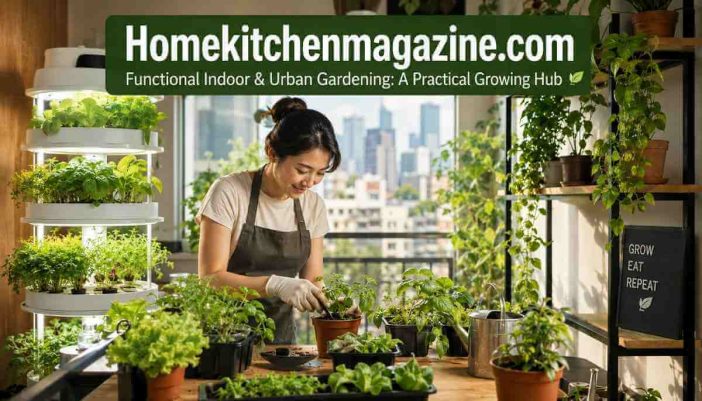
A productive small-space garden begins with constraints, not plant lists. Available light, root depth, drainage, maintenance time, food safety, and the amount a household will actually harvest determine whether an indoor or urban garden becomes useful—or becomes another system that is difficult to maintain.
A pot of basil on a kitchen windowsill can look like the simplest form of gardening.
Then the stems stretch toward the glass. The lower leaves yellow. Water collects in the saucer. A few leaves are harvested, but the plant never produces enough to become part of regular cooking.
The problem is not necessarily a lack of gardening ability.
The plant may have been placed in a location that could not supply enough light. The pot may have lacked drainage or root volume. The household may have chosen basil when chives, parsley, microgreens, or a rotating crop would have matched the space more reliably.
Small gardens make every mismatch visible.
There is less soil to buffer watering mistakes, less room for roots, fewer alternative planting locations, and little value in maintaining crops that the household does not use.
This hub treats indoor and urban gardening as a functional home system. Its purpose is to help readers match plants, containers, light, water, growing media, maintenance, and harvest expectations to the space they actually have.
What Functional Indoor and Urban Gardening Means
Functional gardening is not defined by whether a plant is grown indoors, on a balcony, beside a window, or in a compact courtyard.
It is defined by whether the growing system serves a clear household purpose.
That purpose may include:
- producing herbs used in weekly meals;
- growing small amounts of leafy greens;
- starting seedlings for later outdoor planting;
- creating a safe food-growing area where existing urban soil is unsuitable;
- using a balcony, patio, fire-safe landing, or rooftop area responsibly;
- growing plants within physical-access limitations;
- learning how food crops respond to light, water, and nutrients;
- maintaining useful greenery without excessive equipment or waste.
A plant may also provide enjoyment, visual interest, or a stronger connection to seasonal routines. Those benefits are valid.
However, this category does not classify a project as functional merely because it looks attractive in photographs.
A useful garden should answer four questions:
- What is being grown?
- Why is it being grown?
- What does the crop require?
- Can the household maintain and use the result?
Start With the Space, Not the Plant
Many gardening failures begin when a plant is selected first and the growing conditions are considered afterward.
The more reliable sequence is:
- observe the space;
- measure the usable area;
- estimate available light;
- identify water and drainage limitations;
- define the desired harvest;
- choose a plant that fits those conditions.
Indoor light is especially easy to overestimate.
A room may appear bright to a person while providing inadequate light for compact, productive plant growth. University of Minnesota Extension advises matching plants to the actual light environment and notes that insufficient light can produce pale, elongated, weak growth. Supplemental lighting can compensate when natural light is inadequate, but the distance, duration, spectrum, and plant type still matter.
Before purchasing seeds, containers, or a growing system, document:
- window direction;
- hours of unobstructed direct sun;
- shadows from neighboring buildings, roof overhangs, or trees;
- seasonal changes in light;
- distance from the window;
- available electrical outlets;
- nearby heat or air-conditioning vents;
- floor and counter surfaces that could be damaged by water;
- access to a sink;
- room for plant growth and harvesting;
- pet and child access;
- building, lease, balcony, or fire-safety restrictions.
A small garden becomes easier to manage when its limitations are identified before they become plant problems.
The Six Systems Behind a Productive Small-Space Garden
Indoor and urban gardens depend on six connected systems.
1. Light
Light determines what the plant can produce.
Leafy crops and herbs generally need more light for dense, harvestable growth than many foliage houseplants need merely to survive. Fruiting plants such as tomatoes and peppers usually demand stronger light, more space, and a longer growing period than compact leafy crops.
Most culinary herbs perform best in substantial direct light. University of Minnesota Extension notes that many herbs require at least six hours of direct sunlight for strong growth and that inadequate indoor light can produce thin, spindly plants.
A bright window may be sufficient for some herbs during part of the year. In other homes, a grow light is necessary.
When selecting supplemental lighting, compare:
- the type of plant;
- the area the fixture can cover;
- light intensity at plant height;
- recommended distance from leaves;
- timer compatibility;
- heat output;
- electrical consumption;
- water exposure risk;
- whether the light can be raised as plants grow.
Do not evaluate a grow light by wattage alone. Wattage describes electrical use, not the full quantity or distribution of plant-usable light.
Fixture specifications should include a meaningful coverage area and light-output information. The recommended mounting distance should come from the fixture manufacturer and should be adjusted if plants show stretching, bleaching, scorching, or uneven growth.
2. Root Space and Growing Medium
The visible plant is supported by a root system that requires water, nutrients, oxygen, and physical space.
Containers that are too small dry rapidly, restrict root development, and may make larger plants unstable. Containers that are too large for the plant and conditions can remain wet for long periods.
For most container growing, use a medium intended for containers rather than dense outdoor garden soil. Container mixes are designed to balance moisture retention with drainage and air space.
Every soil-based food-growing container should provide a safe drainage path.
Penn State Extension identifies drainage as one of the central requirements for productive container vegetables because waterlogged growing media limits oxygen around roots.
Before planting, check:
- mature root depth;
- container volume;
- number and size of drainage holes;
- saucer capacity;
- material durability;
- food-growing suitability;
- total wet weight;
- whether the container can be moved safely;
- whether water can drain without damaging the building.
Repurposed containers should not have previously stored chemicals, fuels, cleaning products, or other unsafe materials.
For edible crops, decorative value should never take priority over material safety, drainage, and cleanability.
3. Water and Drainage
Small containers can move from adequately moist to severely dry more quickly than garden beds. They can also become waterlogged when drainage is poor or saucers remain full.
The correct watering frequency depends on:
- crop type;
- container size;
- growing medium;
- root development;
- indoor temperature;
- light level;
- airflow;
- season;
- plant growth stage.
A fixed weekly schedule is less useful than checking the growing medium and observing the plant.
Watering should be treated as a complete process:
- check moisture below the surface;
- water thoroughly when appropriate;
- allow excess water to drain;
- empty standing water when it could keep roots saturated;
- inspect nearby surfaces for leakage;
- adjust frequency as light and plant size change.
University of Minnesota Extension warns that trays holding water can create prolonged saturation and recommends emptying them regularly rather than allowing container roots to remain waterlogged.
Indoors, drainage water also becomes a home-maintenance issue. Repeated spills can damage wood, laminate, drywall, cabinetry, windowsills, and flooring.
Place containers on stable, waterproof surfaces and make the drainage path visible enough to inspect.
4. Nutrients and Plant Growth
Container plants have access only to the nutrients held within a limited volume of growing medium or nutrient solution.
That does not mean more fertilizer is always better.
Overfertilization can contribute to:
- salt accumulation;
- damaged roots;
- excessive weak growth;
- leaf injury;
- nutrient imbalance;
- runoff;
- unnecessary cost.
Use fertilizers labeled for the crop and growing method. Follow the product directions rather than increasing concentration in an attempt to accelerate growth.
For hydroponic or semi-hydroponic systems, use nutrients designed for that system. Garden fertilizer, household food scraps, homemade liquid mixtures, and unverified “natural” additives may not provide the correct nutrient balance and may create odor, microbial growth, clogged pumps, or unstable water chemistry.
Nutrient management should be matched to:
- crop stage;
- growing medium;
- water quality;
- container volume;
- irrigation method;
- manufacturer instructions;
- visible plant response.
A deficiency should not be diagnosed from one symptom alone. Light stress, root damage, overwatering, temperature, pests, and nutrient problems can produce similar visual signs.
5. Airflow, Temperature, and Humidity
Plants do not grow independently of the room around them.
Indoor growing adds moisture through irrigation and plant transpiration. Closely spaced foliage can also reduce air movement around leaves and growing media.
Poor airflow and persistently damp conditions can contribute to plant disease, algae, fungus gnats, odors, and moisture problems on nearby surfaces.
The U.S. Environmental Protection Agency emphasizes moisture control as a central part of preventing indoor mold growth. An indoor garden should therefore be managed as a potential moisture source, particularly near walls, windows, cabinets, and other areas prone to condensation.
Practical controls include:
- spacing plants so leaves are not continuously compressed together;
- removing dead foliage promptly;
- avoiding standing water;
- cleaning spills;
- monitoring condensation;
- preventing leaves from remaining pressed against cold glass;
- maintaining appropriate room ventilation;
- using a small circulation fan only when needed and positioned safely;
- inspecting walls and furniture behind shelving.
A garden that produces herbs while causing mold, damaged finishes, or persistent pest problems is not functioning well.
6. Harvest and Use
A plant is not productive merely because it remains alive.
For an edible garden, success should be evaluated by usable output.
Record:
- how often the crop is harvested;
- how much is harvested;
- how it is used;
- whether the flavor and quality meet expectations;
- how much is discarded;
- how quickly the plant regrows;
- how much time and equipment the crop requires.
Some crops provide repeated small harvests. Others are harvested once and replanted.
A household that uses a handful of chives several times a week may receive more value from one reliable chive pot than from a demanding indoor tomato plant that produces a few fruits after months of maintenance.
The best crop is not always the crop with the largest possible yield.
It is the crop that produces a useful harvest within the available system.
Choose the Right Growing Format
Different spaces require different growing methods.
| Growing format | Best use | Main advantage | Main limitation |
|---|---|---|---|
| Windowsill containers | Herbs and small leafy plants near strong natural light | Simple setup with minimal equipment | Light and root space may be limited |
| Countertop grow system | Herbs, lettuce, or compact greens | Controlled light and convenient placement | Electricity, accessory, and replacement-part costs |
| Freestanding shelf with grow lights | Multiple trays or succession planting | Expandable and easier to organize | Requires floor space, safe wiring, and moisture control |
| Balcony containers | Herbs, vegetables, compact fruits, and flowers | Access to stronger outdoor light | Wind, heat, weight, drainage, and building restrictions |
| Vertical garden | Leafy greens, herbs, and compact plants | Uses wall height instead of floor area | Uneven light and irrigation can complicate maintenance |
| Microgreen trays | Rapid, small edible harvests | Short crop cycle and shallow root requirement | Sanitation, seed quality, mold, and repeated replanting |
| Hydroponic system | Leafy greens and selected herbs | Controlled root-zone nutrition and clean indoor placement | Pump, light, nutrient, cleaning, and power dependence |
| Raised urban container | Food crops where ground soil is unsuitable | Cleaner growing medium and accessible root zone | Weight, material cost, and possible recontamination |
For readers considering wall-mounted or stacked growing, our vertical garden guide provides a starting point. It should be updated before being positioned as a primary child page, particularly where it makes broad claims about heat reduction and air quality without measuring the actual installation.
The Functional Garden Fit Test
Use this framework before building or purchasing a garden system.
Score each factor from 0 to 2.
| Decision factor | 0 points | 1 point | 2 points |
|---|---|---|---|
| Light | Available light is unknown or clearly inadequate | Supplemental lighting may solve the gap | Light conditions match the chosen crop |
| Root space | Container size is selected mainly by appearance | The crop may fit with careful management | Mature root and plant size have been planned |
| Water and drainage | Leaks, standing water, or inaccessible drainage are likely | Drainage is possible but inconvenient | Watering and drainage can be managed safely |
| Maintenance time | Daily checks are unrealistic | Care is possible with simplification | The household can maintain the system consistently |
| Harvest use | The crop is rarely eaten or used | Some harvest will be useful | The crop is used regularly and can replace purchases |
| Safety and sanitation | Material, pest, soil, pet, or electrical concerns remain | One concern still requires verification | Materials, location, sanitation, and access have been checked |
How to interpret the result
10–12 points: Strong fit
The crop and system match the space, maintenance routine, and intended use. Begin with a modest planting and track results before expanding.
6–9 points: Conditional fit
The garden may work, but one or more constraints need to be corrected. Reduce the number of plants, choose a less demanding crop, improve drainage, or add appropriate lighting.
0–5 points: Redesign before planting
The current plan is likely to produce poor growth, unnecessary equipment purchases, water damage, or an unused harvest.
This score evaluates compatibility, not gardening enthusiasm.
Match the Crop to the Household
Plant selection should begin with how the harvest will be used.
For frequent cooking
Consider crops harvested in small amounts:
- chives;
- parsley;
- basil under sufficient light;
- mint in its own container;
- thyme;
- oregano;
- cilantro as a succession crop.
Our current guide to indoor herb garden ideas introduces several possible layouts. Before it becomes a major supporting article, it should be revised to separate viable indoor methods from outdoor structures and to add measurable light, container, and harvest guidance.
For fast crop cycles
Microgreens can fit shallow systems and short production schedules, but they require clean seed, clean trays, appropriate moisture, airflow, and careful harvesting.
The existing article on growing and using microgreens should be rewritten before promotion. Its nutrition claims need more careful context, and the article should distinguish nutrient concentration by weight from the small portion sizes in which microgreens are typically consumed.
For limited natural light
A crop that tolerates lower light may survive, but edible productivity can remain limited.
Options include:
- adding an appropriately sized grow light;
- growing short-cycle greens;
- reducing the growing area;
- starting seedlings under controlled light;
- choosing non-edible foliage plants for that location instead of promising a food harvest.
Low natural light should be treated as a design constraint, not overcome through plant-list optimism.
For balconies and patios
Select crops after assessing:
- hours of sun;
- wind exposure;
- reflected heat;
- container weight;
- watering access;
- drainage;
- railing safety;
- falling-object risk;
- lease or association rules;
- fire and emergency access.
Large wet containers can be significantly heavier than empty pots. Rooftops and balconies should not be loaded based on guesswork. Where structural capacity is uncertain, obtain building-specific guidance.
For people with limited mobility
Prioritize:
- stable raised containers;
- accessible watering;
- lightweight tools;
- clear pathways;
- reachable harvesting height;
- containers that do not require frequent relocation;
- low-maintenance crops;
- irrigation systems that can be inspected easily.
Accessibility is part of function, not a secondary feature.
Indoor Plants Are Not a Substitute for Air-Quality Control
Plants can make a room more enjoyable and may support personal well-being, routine, and connection with nature.
They should not be marketed as replacements for ventilation, source control, moisture management, or mechanical air cleaning.
A peer-reviewed analysis of potted-plant studies found that VOC removal measured in small laboratory chambers does not translate into meaningful passive air cleaning in typical buildings. The analysis estimated that an impractically high density of plants would be required to compete with normal building air exchange.
This matters because Home Kitchen Magazine currently features an older article claiming that selected houseplants can remove indoor pollutants, reduce allergens, and serve as natural air purifiers. Those claims are broader than the available real-home evidence supports.
That article should be:
- removed from the “Popular Guides” section immediately;
- substantially rewritten around realistic plant benefits and care requirements;
- stripped of unsupported medical, allergy, and air-purification claims;
- reviewed for pet toxicity;
- redirected if a new evidence-based page replaces it.
Readers concerned about indoor air quality should address pollutant sources, ventilation, moisture, filtration, and professional assessment where appropriate.
Soil Safety Matters in Urban Food Gardens
Urban soil may have a history that is not visible from the surface.
Potential concerns include:
- deteriorated lead-based exterior paint;
- historic vehicle emissions;
- industrial activity;
- demolition debris;
- treated materials;
- pesticide residues;
- contaminated fill;
- runoff from roads or neighboring properties.
The EPA recommends testing soil used for food crops and using raised beds or containers with clean soil where lead levels are elevated. It also advises locating food gardens away from buildings, roads, and driveways where contamination may be more likely.
USDA food-safety guidance similarly recommends evaluating soil contamination, using commercially packaged soil for food crops when appropriate, choosing non-toxic materials, keeping animals away from growing areas, and cleaning tools and produce-handling containers.
Before growing food in existing urban ground:
- investigate the site’s history;
- contact a local Cooperative Extension office about testing;
- test the intended growing area;
- evaluate lead and other locally relevant contaminants;
- avoid using unidentified fill;
- use clean containers or properly constructed raised beds when needed;
- cover exposed soil to reduce splash and tracking;
- wash hands, tools, and harvested produce;
- keep gardening soil from being tracked indoors.
Raised beds reduce contact with questionable ground soil only when they are designed, filled, and maintained appropriately. They should not be presented as a permanent guarantee against contamination.
Sanitation Is Part of Edible Indoor Gardening
Edible crops are handled repeatedly during sowing, watering, pruning, and harvesting.
Keep the system clean by:
- starting with clean containers and tools;
- using potable water;
- buying seed from a traceable supplier;
- removing diseased or decaying material;
- cleaning trays between crop cycles;
- washing hands before harvesting;
- keeping pets away from edible growing surfaces;
- using food-safe harvest containers;
- washing produce appropriately before eating;
- preventing soil and nutrient solution from contacting food-preparation surfaces.
Microgreens and other densely planted crops deserve particular attention because moisture, warmth, organic material, and close spacing can favor microbial and fungal growth.
A crop showing unusual odor, extensive mold, slime, or decay should not be treated as safe merely because it was grown at home.
Control Pests Without Creating a New Indoor Exposure
Indoor plants can develop:
- fungus gnats;
- aphids;
- mites;
- whiteflies;
- scale insects;
- mealybugs;
- plant diseases.
Begin with identification.
Pesticides should not be applied based only on the presence of a flying insect or leaf damage. Different pests require different controls, and some symptoms are caused by watering, light, or nutrient problems rather than insects.
Use lower-exposure measures first when appropriate:
- isolate new or infested plants;
- remove heavily damaged material;
- clean fallen leaves;
- adjust overwatering;
- improve airflow;
- wash suitable plants;
- use traps for monitoring;
- inspect leaf undersides;
- use a product only when the pest and plant appear on the label.
EPA guidance emphasizes following pesticide labels, using only recommended amounts, increasing ventilation, and using non-chemical methods where possible. Using a pesticide in a manner inconsistent with its label is illegal.
Never assume that a product labeled “natural” is harmless to children, pets, edible crops, aquatic life, or indoor air.
Evaluate Hydroponic Systems as Appliances
A countertop hydroponic garden is both a growing system and an electrical appliance.
It may include:
- LED lighting;
- a water reservoir;
- a circulation pump;
- timers;
- sensors;
- proprietary nutrient products;
- plastic grow baskets;
- replacement pods;
- model-specific accessories.
Before buying, evaluate:
- actual growing area;
- mature plant height;
- light adjustability;
- reservoir access;
- cleaning difficulty;
- pump noise;
- replacement-pump availability;
- nutrient cost;
- proprietary seed or pod requirements;
- standby and lighting electricity;
- leak containment;
- warranty;
- expected service life.
A system should not be called sustainable merely because it grows herbs indoors.
Its value depends on how long it lasts, whether replacement parts remain available, how much of the harvest is used, and whether the household can maintain it without repeatedly replacing proprietary components.
Hydroponics can be appropriate where soil is undesirable or where a controlled indoor crop is useful. It is not automatically simpler than a well-designed container garden.
Track the Garden as a Working System
A simple growing log creates information that product reviews and generic plant lists cannot provide.
Record:
| Item | What to track |
|---|---|
| Crop | Variety and supplier |
| Planting date | Seed, cutting, transplant, or purchased plant |
| Light | Window exposure or fixture schedule |
| Water | Frequency and approximate amount |
| Nutrients | Product, dilution, and application date |
| Problems | Pests, disease, stretching, yellowing, or root issues |
| Harvest | Date and approximate weight or volume |
| Use | Meal, preservation, gift, or waste |
| Operating cost | Seeds, growing media, nutrients, replacement parts, and electricity |
| Decision | Continue, change variety, reduce scale, or stop |
The purpose is not to turn a home garden into a commercial operation.
It is to determine which crops deserve continued space and maintenance.
Common Small-Space Gardening Mistakes
Buying plants before measuring light
The plant is then blamed for failing in a location that never matched its needs.
Choosing containers by appearance alone
A decorative pot may lack drainage, root volume, stability, or a safe material for edible crops.
Growing too many species at once
Each crop introduces different watering, light, nutrient, support, and harvest requirements.
Expanding before completing one crop cycle
A system that looks successful for two weeks may later develop pests, nutrient problems, or an impractical cleaning burden.
Treating every yellow leaf as a nutrient deficiency
Yellowing may result from water stress, inadequate light, root damage, age, pests, or temperature.
Assuming indoor growing eliminates pests
Pests can arrive on purchased plants, growing media, produce, clothing, or open windows.
Expecting grocery-store replacement from a tiny system
A windowsill garden may improve freshness and convenience without supplying the full household demand for herbs or vegetables.
Relying on plants to clean indoor air
Plants should be grown for realistic benefits, not as substitutes for ventilation or filtration.
Using unknown urban soil for food crops
The absence of visible contamination does not confirm that the soil is appropriate for food production.
Recommended Reading Path
Start with herbs used in everyday cooking
Read our guide to indoor herb garden ideas, then compare each suggested method with your available light, drainage, and harvest needs.
The overlapping DIY indoor herb garden for the kitchen should not remain a separate article in its current form. The two pages target nearly identical intent and should be consolidated into one stronger, evidence-based guide.
Start with fast, small harvests
Use the existing microgreens guide only after its nutritional claims, food-safety procedures, seed guidance, and sanitation steps have been revised.
Start with vertical growing
Review the vertical garden planning guide for layout ideas, then verify wall loading, drainage, light distribution, irrigation access, and material suitability for the proposed installation.
Start with non-edible indoor plants
Our guide to indoor plants for apartments can support plant selection for restricted spaces, but it should be updated to prioritize light, mature size, pet safety, watering, and maintenance rather than appearance alone.
How This Hub Connects With Other Home Kitchen Magazine Categories
Functional indoor and urban gardening overlaps with several household systems, but the editorial jobs should remain distinct.
The Sustainable & Efficient Living Hub should cover water use, resource efficiency, material lifecycles, household waste, and measurable environmental performance. This gardening hub may link there when evaluating irrigation, equipment electricity, compost, or growing-system waste.
The Kitchen Systems, Appliances & Efficiency Hub should cover countertop growing appliances, safe electrical placement, outlet capacity, kitchen workflow, cleaning, and equipment lifecycle where an indoor garden functions as an appliance.
The Home Safety, Maintenance & Prevention Hub should address water damage, mold, electrical warning signs, structural concerns, pest hazards, and building-condition problems.
This hub remains responsible for:
- crop selection;
- light planning;
- root-zone design;
- growing media;
- irrigation;
- plant nutrition;
- edible harvest;
- small-space garden sanitation;
- urban soil considerations;
- gardening-system maintenance.
Clear boundaries prevent the site from publishing several weak versions of the same topic.
What This Hub Does Not Cover
To protect topical clarity, this category should not prioritize:
- large-scale farming;
- broad ornamental landscaping;
- lawn care;
- hobby-only flower lists without practical household function;
- generic garden inspiration galleries;
- unverified medicinal-plant claims;
- treating homegrown herbs as medical therapies;
- cannabis cultivation;
- hallucinogenic or controlled plants;
- pesticide recommendations that ignore label restrictions;
- homemade fertilizer recipes without safety and nutrient context;
- claims that plants replace air purification or ventilation;
- invasive-plant recommendations without regional warnings;
- universal planting calendars that ignore climate;
- crop-yield promises;
- product roundups without original testing;
- “zero-cost” or “zero-waste” gardening claims.
Outdoor planting dates, invasive-species rules, pesticide labels, water restrictions, lease rules, balcony policies, and urban soil guidance vary by location. Articles covering those subjects should be geographically specific and reviewed against current official information.
Our Editorial Standard for Gardening Content
Every child article connected to this hub should answer:
- What usable function does the garden provide?
- Which light conditions does the crop require?
- What root space and container design are appropriate?
- How will water enter and safely leave the system?
- What maintenance is required each day, week, and crop cycle?
- What pests, sanitation, pet, child, or soil concerns apply?
- What harvest can reasonably be expected?
- How will the reader determine whether the system is worth continuing?
Crop recommendations should identify:
- botanical and common names where useful;
- mature plant size;
- light requirements;
- container requirements;
- watering characteristics;
- harvest method;
- known toxicity to pets where relevant;
- regional outdoor limitations;
- evidence source;
- realistic uncertainty.
No article should invent a gardener’s personal experience, imply guaranteed savings, or turn a laboratory finding into a household health promise.
Grow What the Space Can Support
A useful small-space garden is rarely the one with the most plants.
It is the one in which each component has a clear job.
The light supports the crop. The container supports the roots. The drainage protects the plant and the home. The maintenance fits the household schedule. The harvest enters meals or serves another intentional purpose.
Indoor and urban gardening becomes functional when the system can answer three questions with evidence:
Is it growing well?
Is it safe and manageable?
Is the result being used?
When the answer to one of those questions is no, the solution may not be more fertilizer, more equipment, or another plant.
It may be a smaller garden designed more carefully.
Explore More in This Category
- How Far Should Grow Lights Be From Indoor Plants?
- How Long Should Grow Lights Be On for Indoor Plants?
- How Much Electricity Does a Grow Light Use? Real Monthly Cost
- How to Grow Microgreens Indoors Without Soil: A Clean Setup
- Low-Maintenance Backyard Landscaping Ideas: 10 Amazing Secrets
- Organic Fertilizer for Vegetables: 7 Jaw-Dropping Benefits
- DIY Wooden Planter Box Tutorial: 5 Shockingly Easy Steps
- DIY Raised Garden Bed Plans: 7 Stunning Hacks for Lush Growth
- Best Indoor Plants for Air Purification: 7 Powerful Cleaners
- Composting Tips for Beginners: 7 Powerful Secrets to Success
- Water-Efficient Garden Design: 10 Brilliant Ideas to Transform Your Yard Into a Sustainable Oasis
- Sustainable Gardening Ideas: 7 Powerful Tips For Success
- DIY Indoor Herb Garden for Kitchen: 7 Amazing Benefits You’ll Love
- Microgreens Benefits: 7 Amazing Reasons to Try Today
- Best Indoor Plants for Kitchen: 15 Stunning Picks You’ll Love
- Best Indoor Plants for Apartments: 10 Stunning Picks You’ll Love
- 15 Best Indoor Plants for Low Light That Thrive in Any Room
- Best Plants for a Raised Garden Bed: Grow a Thriving Garden with These Top Picks
- Indoor Herb Garden Ideas That Will Transform Your Cooking Life
- Pesticide Control Program: Protect Your Health and Environment Today
- Types of Ferns: Discover Their Beauty and Benefits
- Maximizing Crop Yields with Coconut Pulp Fertilizer: A Farmer’s Guide
- Coconut Pulp Fertilizer for Beginners: Easy Tips to Get Started
- The Future of Sustainable Farming: Coconut Pulp and Other Organic Fertilizers
- The Impact of Coconut Pulp Fertilizer on Soil Microorganisms and Ecosystems
- How Coconut Pulp Fertilizer Helps Combat Soil Erosion and Degradation
- Organic Fertilizer Alternatives: Comparing Coconut Pulp to Other Natural Sources
- How to Source and Prepare Coconut Pulp for Garden Use
- Coconut Pulp Mulching: How to Use Coconut Waste Beyond Fertilizer
- Coconut Pulp as a Soil Conditioner: Improving Texture and Aeration