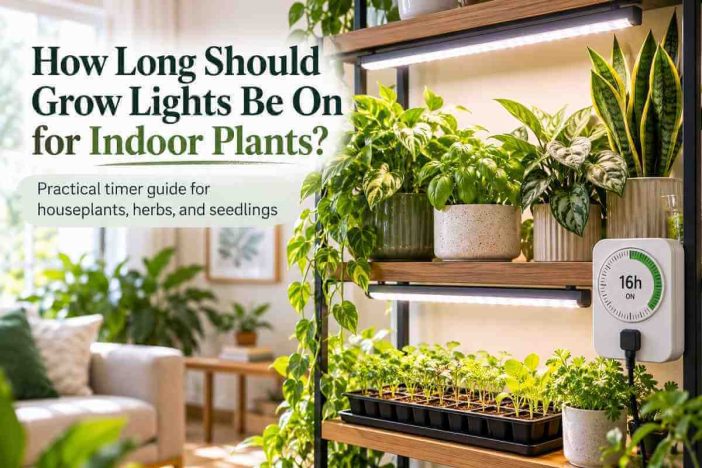
A grow light on a timer creates an odd little sunrise.
At 7:00 a.m., the shelf brightens instantly. A pothos that spent the night in darkness is suddenly under white LEDs. Basil leaves catch the light below it. By evening, the lamp may have been running longer than almost any other appliance in the room.
That makes one question inevitable:
How long should it actually stay on?
The tempting answer is a single number—12 hours, 14 hours, perhaps 16.
The better answer starts with a distinction that prevents many indoor-lighting mistakes:
Your plant needs an appropriate total amount of light across the day. Your grow light is only one source contributing to it.
A plant beside a bright window and the same plant on a dark interior shelf should not automatically receive identical artificial-light schedules.
At the same time, six hours beside a dim winter window is not automatically equivalent to six hours beneath a properly positioned grow light.
That is why a useful timer schedule starts with the plant and the room, not simply the timer.
Quick answer: For many foliage houseplants, start with 12–14 total hours of light per day. University of Minnesota Extension recommends 16–18 hours for seedlings, 12–14 hours for hydroponic lettuce and herbs, 12–14 hours for foliage houseplants, and 14–16 hours for flowering houseplants. Keep a daily dark period, count meaningful natural light as part of the overall setup, and adjust only after checking light intensity and plant response.
Grow-Light Hours by Plant Type
The simplest starting schedule is based on what you are actually growing.
| Growing situation | Practical starting total light period |
|---|---|
| Seedlings | 16–18 hours/day |
| Hydroponic lettuce and herbs | 12–14 hours/day |
| Foliage houseplants | 12–14 hours/day |
| Flowering houseplants | 14–16 hours/day |
These ranges come from University of Minnesota Extension, which also recommends using a timer when supplemental light is needed.
They are starting ranges, not universal prescriptions.
Light duration is only one part of the system. Fixture intensity, distance from the leaves, natural daylight, species, growth stage, and flowering response can change what actually works.
Iowa State University Extension similarly recommends about 12–14 hours per day in general, while noting that home-gardener supplemental-light schedules can range from about 10 hours to no more than 16 hours.
Total Light Hours Are Not Always Grow-Light Hours
This is the most important distinction in the guide.
Suppose a foliage plant has a target starting range of around 12–14 total light hours.
If it sits on a dark shelf with essentially no useful daylight, most or all of that light period must come from the grow light.
But place the same plant close to a bright window and the equation changes.
Natural daylight contributes.
That does not mean you should simply count every hour between sunrise and sunset and subtract it from 14.
Window light can change dramatically with:
- window direction,
- season,
- cloud cover,
- curtains or blinds,
- exterior buildings and trees,
- window coatings,
- and the distance between the plant and the glass.
A room can look bright to you while providing surprisingly little useful light at leaf level.
So think in terms of meaningful light, not merely daylight on a clock.
Example: a foliage plant on a dark shelf
There is little useful window light.
A reasonable first timer setting might be:
7:00 a.m. → 9:00 p.m. = 14 hours
Then observe the plant.
Example: a foliage plant beside a useful window
Suppose the plant receives its strongest natural light between roughly 9:00 a.m. and 3:00 p.m.
You could use the grow light to extend the useful day, perhaps running it before and after the strongest window period rather than duplicating a full fourteen-hour artificial schedule.
That is a trial schedule—not a claim that one hour of window light equals one hour from your fixture.
If you want more precision, the solution is to measure light rather than keep adding hours.
Why 14 Hours Is a Useful Trial Setting
Fourteen hours sits near the middle of several research-backed home-growing ranges.
Iowa State Extension’s practical trial-and-error method recommends installing a grow-light fixture according to its instructions and initially running it for 14 hours per day, then observing plant growth and adjusting the setup.
That is a useful philosophy.
Do not keep changing the timer every two days.
Start with a defensible schedule, hold the other variables reasonably steady, then watch what happens.
The question is not:
Did the plant look different this afternoon?
The question is:
Is new growth consistently telling me that the current lighting system is working?
This Set → Observe → Adjust → Verify loop is far more useful than continually changing hours, distance, watering, and fertilizer at the same time.
A Practical Timer Schedule for Common Indoor Setups
The clock time itself is flexible.
Plants do not require your grow light to turn on at precisely 7:00 a.m. The important variables are the duration, regularity, total light environment, and necessary dark period.
Here are useful starting schedules when artificial lighting supplies most of the usable light.
Foliage houseplants
Examples include pothos, philodendron, monstera, snake plant, ZZ plant, and rubber plant.
Starting total: 12–14 hours.
Example timer:
7:00 a.m. → 9:00 p.m.
If your collection consists mostly of foliage plants in an apartment, our guide to the best indoor plants for apartments can help separate naturally lower-light choices from plants that are likely to demand a brighter setup.
Indoor herbs
For hydroponic lettuce and culinary herbs, University of Minnesota Extension gives a 12–14-hour total-light starting range.
Example:
7:00 a.m. → 9:00 p.m.
But duration alone cannot rescue weak intensity.
Basil under a tiny lamp several feet away may still stretch or stall despite fourteen hours of runtime.
If herbs are your main crop, use our broader guide to growing herbs indoors for the potting, watering, pruning, and harvesting decisions that the lighting schedule has to support.
Seedlings
Seedlings commonly need a longer light period.
Starting total: 16–18 hours.
Example:
6:00 a.m. → 10:00 p.m. = 16 hours
That still leaves eight hours without the grow light.
Keep the fixture height appropriate as seedlings grow; increasing hours is not a substitute for keeping sufficient usable light near the young canopy.
Flowering houseplants
A general starting range is:
14–16 hours.
But this group requires an important warning.
Some flowering plants respond strongly to the length of the dark period. Poinsettias, Thanksgiving and Christmas cacti, for example, are short-day plants and require sufficiently long nights to initiate flowering.
For those plants, extending artificial light into the evening can interfere with the response you are trying to encourage.
Plants Need a Dark Period Too
Leaving a grow light on 24 hours a day is usually a poor default.
University of Maryland Extension notes that most indoor plants require a period of darkness and recommends no more than 16 total hours of illumination per day, particularly when natural and artificial light are combined.
The dark period becomes especially important with photoperiod-sensitive plants.
Plant flowering responses are often governed not simply by the length of the “day,” but by the duration of uninterrupted darkness.
This means room lighting can matter too.
A poinsettia placed under a carefully programmed grow light but exposed to bright household lighting late every night may not experience the darkness regime you intended.
For ordinary foliage plants, you do not need to turn your home into a laboratory.
Just avoid treating continuous illumination as a shortcut to faster growth.
More Hours Cannot Fix Every Lighting Problem
This is where many timer guides stop too early.
If a plant looks light-starved, it is tempting to add two more hours.
Sometimes that helps.
Sometimes it solves the wrong variable.
Light intensity at leaf level changes as you move the fixture.
University of Minnesota Extension gives useful starting distances of roughly:
- 4–6 inches for seedlings
- 6–12 inches for hydroponic lettuce and herbs
- 12–24 inches for foliage houseplants
- 6–12 inches for flowering houseplants
Those distances still depend on the actual fixture.
A small LED bar and a high-output panel cannot be treated as interchangeable just because both are LEDs.
Change duration when
Consider changing the timer when:
- the fixture is correctly positioned,
- the plant type is known,
- the current schedule is genuinely too short or long,
- seasonal natural light has changed,
- or a photoperiod-sensitive plant requires a different day/night pattern.
Change intensity or distance first when
Look at fixture placement instead when:
- stems stretch strongly toward the light,
- new growth is persistently weak or unusually elongated,
- one side of the canopy grows while another stalls,
- the center looks healthy but outer plants stretch,
- or leaves directly beneath the lamp bleach or scorch.
More hours cannot fix poor coverage.
Use the Plant as a Diagnostic Tool
A timer is measurable.
The plant is evidence.
University of Minnesota Extension identifies pale or yellowing foliage, long thin stems, increased distance between leaf nodes, leaf drop, and poor flowering among possible consequences of insufficient light. Excessive light can contribute to scorched or bleached foliage.
The useful question is not simply “Does this plant look bad?”
Use patterns.
| What you observe | Check first | Why |
|---|---|---|
| Long, thin, leaning growth | intensity and fixture distance | More hours may not fix a weak source |
| Healthy growth but schedule varies daily | timer consistency | Remove an unnecessary variable |
| Bleached leaves closest to lamp | excessive intensity/distance | Shorter runtime alone may not solve a hotspot |
| Plant thrives beside window in summer but stalls in winter | seasonal window light | Supplemental hours may need to change |
| Poinsettia or Christmas cactus refuses to rebloom | uninterrupted darkness | Evening light can affect photoperiod response |
| Plant looks healthy and new growth is normal | change nothing | A working schedule does not need constant optimization |
That last row matters.
Indoor gardeners often create problems by trying to optimize a system that is already functioning.
The Window-Light Adjustment Framework
Instead of guessing whether your grow light should run four, eight, twelve, or sixteen hours, use this framework.
Step 1: Set the plant’s starting range
Start with the plant category.
For a foliage houseplant, that might be 12–14 total light hours.
Step 2: Identify the window’s useful period
Do not count the entire day.
Observe when useful light actually reaches the plant.
A pot six feet from a window may experience a very different light environment from one sitting directly beside it.
Step 3: Use the grow light to fill the weak part of the day
The fixture can:
- extend morning light,
- extend evening light,
- supplement a dim daytime window,
- or provide nearly the entire light period in a windowless location.
Step 4: Preserve darkness
Do not automatically stretch the schedule later simply because the timer allows it.
Step 5: Hold the schedule long enough to observe new growth
Then change one major variable at a time.
That makes the plant’s response interpretable.
Intensity × Duration Explains Why Hours Alone Mislead
Horticultural lighting uses a concept called Daily Light Integral, or DLI.
DLI describes the amount of photosynthetically useful light delivered across a full day.
Iowa State gives the relationship:
DLI = PPFD × hours × 0.0036
PPFD measures how much photosynthetically useful light reaches a surface such as the leaf canopy at a particular moment.
You do not need to calculate DLI for every pothos in your living room.
The concept is useful because it explains a common mistake:
a dim light used longer and a strong light used for the same number of hours do not give a plant the same amount of usable light.
Likewise, extending a weak fixture from twelve hours to sixteen does not guarantee that it has become suitable for a high-light plant.
Duration and intensity work together.
How Window Light Changes With the Seasons
A timer setting that works in June may not be the right setting in December.
Day length changes.
The sun angle changes.
Nearby trees may lose leaves or develop a dense canopy.
A neighboring building may shade a window differently.
Curtains may remain closed longer during hot weather.
This is one reason low-light plants can seem perfectly content for months and then gradually stretch or stall.
If your plant already sits in a dim location, our guide to the best indoor plants for low light can help you decide whether changing the plant is more sensible than adding a more aggressive lighting system.
Revisit timer settings seasonally, but do not change them merely because the calendar changed.
Change them because the actual light environment changed.
Grow-Light Runtime Also Changes Electricity Use
Every additional hour on the timer adds electrical consumption.
If a 60-watt fixture runs two extra hours each day:
60 W ÷ 1,000 × 2 hours × 30 days = 3.6 kWh per month
That does not mean you should shorten the photoperiod merely to save 3.6 kWh.
It means duration has both a horticultural and operating-cost consequence.
If you want to calculate the effect before changing your timer, our grow-light electricity cost guide converts actual wattage, daily hours, and your electricity tariff into monthly kWh and cost.
A useful indoor-growing system supplies enough light for the crop without paying for hours the plants do not need.
What About Microgreens?
Microgreens have a short production cycle, so consistent lighting becomes part of a repeatable harvest system rather than long-term houseplant care.
The exact schedule depends on crop, fixture intensity, and whether useful daylight contributes.
Avoid copying a houseplant timer blindly.
First establish germination correctly, then use repeatable lighting after the tray is uncovered and watch for stretching, leaning, uneven canopy development, or excessive moisture around weak growth.
Our soil-free microgreens setup explains how light interacts with watering, airflow, seed density, and the growing mat instead of treating the lamp as an isolated variable.
A Five-Minute Timer Setup Checklist
Before deciding your grow light needs “more hours,” check these in order:
- Identify what you are growing.
- Choose a research-backed starting duration.
- Check the fixture manufacturer’s placement guidance.
- Position the light for useful canopy coverage.
- Account for meaningful window light.
- Preserve a daily dark period.
- Set a repeatable timer.
- Observe new growth rather than one old leaf.
- Change one variable at a time.
- Recheck the setup when seasons, plant height, or room conditions change.
This sequence prevents the timer from becoming a universal fix for problems caused by distance, intensity, coverage, or plant selection.
Frequently Asked Questions
Can I leave a grow light on 24 hours a day?
For most ordinary indoor plants, that is not a good default. Most plants benefit from a daily dark period, and University of Maryland Extension recommends no more than 16 total hours of illumination for most plants. Photoperiod-sensitive species can be particularly affected when their required uninterrupted darkness is shortened.
Does sunlight through a window count toward grow-light hours?
Yes, meaningful natural light contributes to the plant’s overall daily light environment. However, do not assume one hour of weak window light equals one hour under a suitable grow light. Window intensity varies greatly with direction, season, weather, glazing, shading, and distance from the glass.
Is eight hours of grow light enough for indoor plants?
It can be when a plant also receives substantial useful natural light, but eight artificial-light hours alone may be insufficient for many setups. Start from the plant’s total-light needs and evaluate fixture intensity and natural daylight rather than choosing eight hours simply because your timer offers an eight-hour preset.
Should grow lights be on during the day or at night?
Either can work if the schedule is consistent and preserves the required dark period, but daytime operation often integrates more naturally with window light and household routines. For photoperiod-sensitive flowering plants, protecting uninterrupted darkness is more important than choosing a universally “best” clock time.
Set the Timer, Then Stop Chasing the Timer
The practical answer to how long should grow lights be on for indoor plants begins around 12–14 total light hours for many foliage houseplants, but the timer is only one control in the system.
Seedlings may need longer days. Flowering plants have different requirements. Natural window light can reduce the amount of artificial supplementation required. A badly positioned lamp may need to move rather than stay on longer.
Start with a defensible schedule.
Preserve darkness.
Observe the plant.
Then change one variable for a reason you can explain.
That is more reliable than searching for one perfect number of hours and expecting it to solve every shelf, season, plant, and grow light.