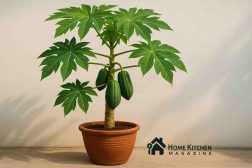
The frustrating part is how healthy the plant can look.
A potted papaya may rise above the railing, push out broad green leaves and begin opening flowers along the trunk. From several feet away, everything appears to be working.
Then the flowers fall.
Another group opens. Those fall too.
Weeks pass, yet the small swelling you expected below a flower never develops into a papaya.
At that point, it is tempting to reach for fertilizer, change the watering schedule, or move the container. But papaya has an unusual reproductive system, and the first useful clue is often hanging directly on the plant.
Look at the flowers before changing anything else.
Why a Papaya Tree Can Flower but Still Produce No Fruit
A papaya that does not fruit can be failing at several different stages.
The plant might:
- not yet be reproductively mature;
- be producing primarily male flowers;
- be female but have no compatible pollen source;
- be a hermaphrodite temporarily producing poorly functional flowers;
- be losing flowers to heat, cold, drought, shade, or moisture stress;
- begin setting fruit and then abort it;
- or be growing in a container that has become too restrictive.
Those problems can look similar from across the patio.
They require different fixes.
The most efficient diagnosis therefore follows this order:
flower stage → flower type → pollination → environment → water → roots → nutrition
Not fertilizer first.
Start With the Symptom, Not the Suspected Cause
Use this table before making changes.
| What you see | First thing to investigate |
|---|---|
| No flowers yet | maturity, warmth, sunlight and general growth |
| Many flowers on long hanging branched stalks | male plant |
| Large flowers close to trunk but no fruit swelling | female plant without adequate pollination |
| Hermaphrodite-type flowers but seasonal gaps in fruit set | heat, drought or environmental stress |
| Flowers repeatedly drop | temperature, moisture, light and plant stress |
| Tiny fruit begins but drops | water stress, extreme conditions or root stress |
| Vigorous top growth but cramped container | root restriction and water instability |
The point is not to diagnose from one symptom alone.
It is to identify where the fruiting process stops.
1. Make Sure the Plant Is Actually Ready to Fruit
If your papaya has not begun flowering, you do not yet have a fruit-set problem.
You have a flowering problem or a plant that is not mature enough.
Papaya can develop quickly in a warm tropical environment, but container plants in cooler climates may grow more slowly. Low temperatures, insufficient sunlight, recent transplant stress, or root problems can delay flowering even when the plant remains green.
Before troubleshooting pollination, ask:
- Has the plant produced mature flowers?
- Is it actively growing?
- Does it receive strong direct sun?
- Has growth stalled after moving indoors or after repotting?
If the plant is still in its vegetative stage, changing pollination will accomplish nothing.
For complete planting, soil, watering and container setup, start with our guide to growing papaya in a pot before diagnosing fruit set.
2. Check Whether Your Papaya Is Male
This should be one of the first inspections on a flowering papaya.
Papaya commonly occurs as male, female, or hermaphrodite plants.
Male flowers are typically smaller and tubular and are produced in clusters on noticeably long, branched flower stalks extending away from the trunk.
A normal male plant primarily produces pollen rather than a useful fruit crop.
So if your papaya has:
- long dangling flower stalks,
- many small flowers clustered together,
- and no obvious swollen ovary at the base,
you may simply have a male plant.
That is a biological limitation, not a fertilizer deficiency.
Rare exceptions can occur, so “male equals absolutely impossible to fruit” is too rigid. But a plant consistently producing typical male inflorescences should not be treated as a reliable fruiting plant.
Do not diagnose plant sex from the leaves
Plant height, leaf size, trunk thickness and how “healthy” the papaya looks do not reliably tell you whether it is male, female or hermaphrodite.
Wait for flowers and examine them.
That prevents months of correcting a watering or fertilizer problem that never existed.
3. A Female Papaya May Need a Pollen Source
Female papaya flowers look very different from male clusters.
They are generally:
- larger;
- positioned close to the trunk;
- more rounded at the base;
- and equipped with a functional stigma and ovary but no functional stamens.
That means a female plant generally requires pollen from a compatible male or hermaphrodite papaya before normal fruit set can occur.
This creates a classic small-space problem.
A homeowner may grow one beautiful female papaya in one container, see healthy flowers and assume fruit should follow automatically.
There may simply be no pollen available.
The critical distinction
If the flowers are female and they repeatedly open and disappear without the ovary developing, check pollination before increasing fertilizer.
If another compatible papaya is flowering nearby, insects or wind may transfer pollen naturally.
If no pollen source exists, you have identified a structural limitation in the setup.
Where practical, hand transfer of pollen from an appropriate male or hermaphrodite flower can also be used. Use a clean, soft brush and transfer visible pollen gently to the stigma of a freshly open female flower.
Do not treat hand pollination as a cure for every non-fruiting papaya, though.
It cannot fix a male-only plant, weak light, cold conditions, saturated roots, or severe drought stress.
4. A Hermaphrodite Papaya Can Still Skip Fruit
Hermaphrodite papaya plants are attractive to home growers because their flowers contain functional male and female structures and are usually capable of self-pollination.
But “self-pollinating” does not mean “guaranteed fruit every time.”
University of Hawaiʻi CTAHR notes that hermaphrodite papaya can produce different flower expressions depending on environmental conditions and time of year. Hot, dry weather can suppress functional ovary development and produce female-sterile flowers.
The plant may therefore look capable of flowering while temporarily failing to set normal fruit.
This matters because the wrong response is often:
“It stopped fruiting, so it must need more fertilizer.”
If a previously productive hermaphrodite papaya suddenly develops a gap in fruit set during stressful weather, first look at:
- heat;
- moisture consistency;
- recent drought;
- flower form;
- and whether the problem is temporary.
A seasonal fruiting gap does not automatically mean the plant has permanently “changed sex.”
The Papaya Flower Test
Before checking soil chemistry, stand beside the plant and classify several fresh flowers.
Male pattern
Look for many narrow flowers carried away from the trunk on long branched stalks.
Likely implication: the plant is functioning predominantly as a pollen producer.
Female pattern
Look for larger, fuller flowers close to the trunk, with an obvious rounded base.
Likely implication: the plant can produce fruit, but pollen availability matters.
Hermaphrodite pattern
Look for flowers that also sit relatively close to the trunk but appear more elongated than the round female flower and contain both reproductive structures.
Likely implication: self-pollination is usually possible, so persistent failure pushes the diagnosis toward environmental or plant-health factors.
Inspect several flowers rather than one damaged bloom.
That small observation often eliminates half the troubleshooting possibilities immediately.
5. Check Sunlight and Temperature Before Fertilizer
Papaya is not a low-light fruit crop.
UF/IFAS recommends at least six hours of sun, with warm conditions strongly favoring growth and fruiting.
Temperature matters too.
Papaya grows and fruits best in warm conditions. Cool temperatures slow root growth and can interfere with flowering, while very high temperatures can also contribute to flower drop and reduced fruit set.
For a potted plant, this creates several seasonal traps:
- a balcony that receives strong summer sun but little winter sun;
- a plant moved indoors where the room looks bright to human eyes but is dim for papaya;
- cold nights beside glass doors;
- a dark covered patio;
- or an extremely hot reflected location against masonry.
A plant can remain alive in those conditions without having enough energy or environmental stability to produce a reliable fruit crop.
Do not confuse survival with fruiting conditions
A papaya can maintain leaves under conditions that are inadequate for strong fruit production.
That is why “the plant looks green” is not enough.
If there are flowers but no fruit, ask whether the plant receives fruit-crop-level light, not merely enough light to survive.
6. Water Stress Can Stop Fruit Set
Papaya creates another apparent contradiction:
It dislikes both severe drying and saturated roots.
UF/IFAS notes that papaya prefers frequent, even watering and may drop leaves, flowers and fruit when moisture conditions become unfavorable.
Containers amplify this problem.
A pot may:
- dry quickly on a hot windy afternoon;
- stay wet for days after heavy rain;
- develop dry zones around a dense root ball;
- or drain poorly because its holes are blocked.
This can create a repeated cycle:
dry → flood → dry → flood
The leaves may recover after every watering, but reproductive growth can be less forgiving.
Check moisture patterns rather than following a rigid calendar
Do not assume “water every three days” is correct.
Instead check:
- how quickly the container dries;
- whether drainage holes are open;
- whether water actually penetrates the root ball;
- whether the pot sits in collected drainage water;
- and whether recent flower drop followed unusually dry or wet conditions.
Consistent moisture is more useful than alternating extremes.
7. The Container May Have Become the Limiting Factor
The papaya that fit comfortably in a pot six months ago may no longer fit it physiologically.
NC State Extension notes a general container-growing principle that is highly relevant here: restricted root growth can reduce plant growth, and flowering and fruiting can also decline in containers that are too small.
That does not mean every non-fruiting papaya should immediately be repotted.
Papaya roots dislike unnecessary disturbance.
Instead look for several signs together:
- roots emerging heavily from drainage holes;
- water running through almost immediately;
- the pot drying much faster than it used to;
- growth slowing despite warm weather;
- a large top-heavy plant in a relatively small container;
- or a dense root mass occupying most of the available medium.
The parent guide currently uses 40–50 cm diameter and depth as a minimum container starting point for potted papaya.
But a rapidly growing fruiting plant may eventually outgrow its original setup.
Pot size affects water behavior too
Root restriction does not operate alone.
A crowded pot may have very little moisture-buffering capacity. The root system can shift from wet to dry rapidly, making fruit-set conditions less stable even if the gardener is watering frequently.
So when evaluating an undersized container, think in terms of both:
root volume + moisture stability
Do Not “Fix” Fruit Set With Heavy Fertilizer First
Fertilizer is easy to add, which makes it an attractive first response.
But it is a poor first diagnostic tool.
Extra nutrients cannot convert a male plant into a normal fruit-bearing female plant.
They cannot pollinate an isolated female flower.
They cannot provide six hours of sun.
They cannot warm a cold root zone.
And they cannot restore oxygen to waterlogged roots.
Papaya does benefit from appropriate nutrition, but nutrient management should come after the structural causes have been checked.
If the plant is growing actively, foliage looks reasonably healthy, and the problem is specifically failure to set fruit, examine flower biology and environmental conditions before changing the feeding program.
Use the Fruit-Set Triage Method
Instead of trying five remedies at once, use this sequence.
Stage 1: Is it flowering?
No: investigate maturity, sunlight, temperature, roots and general plant vigor.
Yes: move to Stage 2.
Stage 2: What type of flowers are present?
Long clusters of small flowers: likely male.
Large rounded flowers close to trunk: likely female; investigate pollen availability.
Bisexual-looking flowers close to trunk: move to Stage 3.
Stage 3: Do small fruits begin to form?
No: investigate flower function, pollination, temperature and light.
Yes, then they drop: investigate water stress, weather extremes, root conditions and overall plant stress.
Stage 4: Is the problem seasonal?
If the same plant has fruited before but suddenly develops a gap, environmental stress is more plausible than assuming the plant has permanently become non-fruiting.
Stage 5: Change one variable
Do not simultaneously repot, fertilize heavily, change watering and move the plant.
Correct the strongest suspected constraint first.
Then observe subsequent flowers.
That gives you evidence instead of another guess.
When Flower Drop Points to the Environment
Flower drop deserves a slightly different diagnosis from a plant that produces the wrong flower type.
Check recent conditions.
Was there:
- an unusually hot spell?
- a period of cold nights?
- several days of dry potting mix?
- prolonged heavy rain?
- a move from outdoors to indoors?
- a sudden loss of direct sunlight?
UF/IFAS notes that drought, temperature extremes and other environmental stresses can reduce papaya production and contribute to flower and fruit drop.
If those events line up with the beginning of the problem, stabilize the environment before reaching for new products.
When Tiny Papayas Form but Fall Off
The appearance of a tiny developing fruit tells you something valuable:
The plant progressed further through the reproductive process than a flower that never began swelling.
That makes plant sex alone a less complete explanation.
Recheck:
- moisture consistency;
- root-zone drainage;
- heat or cold stress;
- container restriction;
- and general plant vigor.
Do not expect every flower to become mature fruit. Some loss is normal.
The diagnostic concern is a repeated pattern in which nearly every developing fruit aborts.
If leaves are also distorted, severely mottled, declining rapidly or showing unusual ringspot-type symptoms, broaden the investigation to pests or disease rather than treating the problem as simple pollination failure.
Should You Replace a Non-Fruiting Papaya?
Sometimes, yes—but only after identifying why.
Replacement makes the most sense when:
- the plant consistently produces male flowers and fruit is the goal;
- the plant has severe recurring health problems;
- its size has become unrealistic for the container or space;
- or environmental conditions cannot provide enough light and warmth for dependable fruiting.
Replacement makes less sense when a healthy female plant simply needs a compatible pollen source.
Likewise, a previously productive hermaphrodite plant experiencing a temporary hot, dry period may only need better environmental stability.
Diagnose first.
Remove second.
What If the Container Is the Real Problem?
If your plant has clearly outgrown its setup, do not automatically jump from a small pot into the largest container you can find.
The objective is sufficient root volume, drainage and stability—not maximum soil volume at any cost.
The broader setup, including initial pot dimensions and drainage, is covered in our complete potted papaya guide.
If limited space makes a mature papaya impractical, a smaller tropical project such as growing pineapple at home may fit the location more comfortably.
Container gardening works best when the crop and the available space are matched from the beginning.
A Better Way to Think About Non-Fruiting Papaya
A non-fruiting papaya is not one problem.
It is several possible failures that happen to produce the same visible outcome.
That is why diagnosis should move in a fixed order:
Is it flowering?
Then:
What kind of flower is it producing?
Then:
Can pollination occur?
Only after those questions should you investigate sunlight, temperature, water, root space and nutrition.
This order avoids wasting months trying to fertilize a male plant or trying to hand-pollinate a papaya that is dropping flowers because its roots alternate between drought and saturation.
Frequently Asked Questions
Can a male papaya tree produce fruit?
Typical male papaya plants usually do not produce a normal fruit crop because their flowers function primarily as pollen producers. Rare exceptions and changes in flower expression can occur, so the rule is not absolute. For dependable home fruit production, however, a consistently male plant should not be treated as a reliable fruiting tree.
Does one papaya tree need another tree for fruit?
It depends on flower type. A female papaya generally needs compatible pollen from a male or hermaphrodite plant. Hermaphrodite papaya flowers normally contain functional male and female structures and are usually self-pollinating. Identifying the flowers is therefore more useful than assuming every single papaya can fruit alone.
Can hand pollination help a papaya that flowers but does not fruit?
It can help when you have confirmed a female flower and have access to viable pollen from a compatible male or hermaphrodite flower. It will not solve poor light, severe temperature stress, waterlogged roots, an immature plant, or a plant producing only typical male flowers.
Can a pot that is too small stop a papaya from fruiting?
Root restriction can reduce plant growth as well as flowering and fruiting in container-grown plants. A cramped papaya may also dry out unusually quickly, creating additional moisture stress. Check root density, drainage, pot stability and drying rate before deciding that fertilizer or pollination is the primary problem.
Diagnose the Flowers Before Changing the Whole Setup
When a papaya tree is not fruiting, begin where the fruit should begin: at the flower.
A male plant, an unpollinated female and a stressed hermaphrodite may all look like “a papaya with no fruit,” but they require completely different responses.
Identify the flower type. Check whether fruit begins to swell. Then work outward through sunlight, temperature, watering and root space.
For small-space growers building more than one edible crop, our guide to urban farming methods explains how container crops, hydroponics and other compact growing systems can fit together without treating every plant as the same kind of project.
The goal is not to force a papaya to fruit.
It is to identify the constraint that is preventing a fruit-capable plant from doing so.