At first, the change is almost too small to notice.
Water that once disappeared immediately begins circling the drain. A shallow pool remains after the dishes are finished. Then one evening, the sink is still holding water several minutes later.
The natural reaction is to reach for a bottle of drain cleaner or assume that one large object has blocked the pipe.
Kitchen drains rarely become slow that simply.
Most restrictions develop in layers. Grease adheres to the pipe wall, fine food particles collect against it, and the usable opening becomes narrower over time. In other cases, the visible symptom begins farther downstream—in a branch drain, vent, disposal, or septic system.
The useful question is therefore not only, “What can I pour into the drain?”
It is:
What does the drainage pattern reveal about the location and seriousness of the restriction?
The Short Answer: Why Is My Kitchen Sink Draining Slowly?
A kitchen sink drains slowly when water meets resistance somewhere in the drainage path. Common causes include debris near the strainer, buildup inside the P-trap, accumulated fats and food in the branch drain, or a restricted garbage disposal. Gurgling or several slow fixtures may indicate a venting, main-line, sewer, or septic-system problem.
This article focuses on diagnosis before treatment.
That distinction matters because a method that helps a shallow debris clog may do nothing for a sagging pipe, blocked vent, or restriction beyond the kitchen branch.
For a broader understanding of how supply lines, traps, vents, and drainage pipes work together, begin with our guide to how a kitchen plumbing system works.
Start With the Drainage Pattern, Not the Product Shelf
Before disassembling anything, conduct a simple observation.
Empty the sink, remove loose debris from the strainer, and let the faucet run at a moderate rate for approximately 30 seconds. Watch how the water behaves.
The timing of the slowdown may help narrow the location of the problem.
Water Slows Immediately
If water begins pooling almost as soon as the faucet starts, the restriction is often close to the drain opening, garbage disposal outlet, or P-trap.
The pipe has little remaining capacity, so even a modest flow overwhelms it.
Water Drains Normally, Then Slows After a Minute
This pattern often points to a restriction farther along the branch drain.
The section of pipe nearest the sink temporarily stores the incoming water. Once that available volume fills, water begins backing up into the sink.
The delay does not reveal the exact distance, but it suggests that the first part of the drainage path may still be relatively open.
One Bowl Is Slow but the Other Is Not
In a double-bowl sink, this may indicate a restriction in the affected bowl’s connecting arm, strainer assembly, or garbage disposal.
If both bowls back up together, the obstruction is more likely beyond the point where their drain lines join.
The Sink Gurgles as It Drains
Gurgling occurs when air moves through water or is pulled through a restricted drainage path.
A partial clog can cause it, but persistent gurgling may also justify evaluating the drainage vent or a deeper restriction.
The sound alone does not prove that the roof vent is blocked. It should be interpreted together with the other symptoms.
Other Fixtures Are Slow Too
When the kitchen sink, a nearby bathroom fixture, floor drain, or laundry drain slows at the same time, stop treating the problem as a sink-only clog.
The shared branch, building drain, sewer lateral, or septic system may be involved.
Seven Common Causes of a Slow Kitchen Sink
1. Debris Trapped at the Strainer or Drain Opening
The shallowest restriction is also one of the easiest to overlook.
Fibrous vegetable fragments, produce labels, rice, coffee grounds, and small pieces of food can lodge around the basket strainer, stopper mechanism, or crossbars inside the drain.
This cause is more likely when:
- The slowdown appeared suddenly.
- Water pools immediately.
- Visible material surrounds the drain opening.
- Removing debris from the strainer noticeably improves flow.
A sink strainer is not merely a convenience. It is the first control point that keeps solids out of a drainage system primarily designed to transport wastewater.
Clear only material that is safely accessible.
Never reach into a garbage disposal, even when it appears to be switched off.
2. Buildup Inside the P-Trap
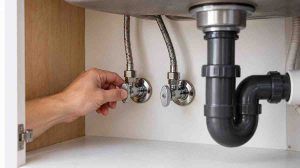
The curved pipe beneath the sink is known as the P-trap.
It retains a small amount of water that creates a barrier against sewer gases. Its curved shape also makes it a natural collection point for dense debris and grease-coated particles.
A restricted P-trap may produce:
- Slow drainage
- Standing water
- Persistent odor
- Gurgling
- Occasional leakage at the joints
However, odor does not automatically mean the P-trap is clogged.
A leaking connection, dry trap, dirty garbage disposal, deteriorated seal, or deeper drainage problem can produce a similar complaint.
If the trap is accessible and no hazardous drain chemical has been used, a competent homeowner may choose to inspect it with a bucket placed underneath.
Anyone uncertain about the connections—or dealing with corroded metal plumbing—should leave removal to a plumber.
A minor inspection can become a leak if a fragile joint does not reseal correctly.
3. Fats, Oils, and Grease Narrowing the Branch Drain
Grease buildup is rarely caused by one large event.
Warm fat enters the drain as a liquid, cools farther along the pipe, adheres to the interior surface, and begins trapping food particles.
The resulting restriction gradually grows inward.
Municipal wastewater agencies consistently warn that fats, oils, and grease, commonly called FOG, can accumulate in household and public sewer lines.
Hot water and detergent may move grease beyond the visible drain, but they do not remove it from the plumbing system. The grease can cool and collect farther downstream.
Grease buildup is more likely when the sink:
- Became slower gradually rather than overnight
- Improves briefly after hot water but slows again
- Handles frequent cooking cleanup
- Receives food waste through a garbage disposal
- Develops recurring clogs after temporary treatment
The City of Riverside Public Works Department advises keeping fats, oils, grease, and food debris out of sinks and garbage disposals.
A garbage disposal may reduce the size of food scraps, but it does not make grease safe for the drain.
4. A Restricted Garbage Disposal
A garbage disposal can still make noise and rotate while its grinding chamber or outlet remains partially restricted.
Food fibers, starches, grease, and unsuitable scraps may reduce the rate at which water leaves the unit.
The disposal becomes a stronger suspect when:
- The disposal side of a double sink drains more slowly.
- Water rises when the disposal runs.
- The slowdown began after a large food-cleanup event.
- The unit produces an unfamiliar sound.
- Water drains better when the disposal is not being used.
Turn the disposal off and disconnect its electrical power before any close inspection.
Never place a hand inside the grinding chamber, even when the wall switch is off. The switch may not provide complete protection against unexpected activation.
If the disposal hums, leaks, repeatedly trips its reset, or fails to clear after manufacturer-approved troubleshooting, professional service or replacement may be more appropriate than repeated unclogging.
Our kitchen appliance lifespan guide explains why age, corrosion, maintenance history, and recurring failure matter more than age alone.
5. A Partial Obstruction Farther Down the Branch Line
The P-trap may be clean while the kitchen sink remains slow.
In this situation, the restriction may be inside the horizontal branch piping behind the wall.
Years of grease and fine solids can reduce the internal diameter of this pipe without completely blocking it.
One useful clue is delayed backup.
The sink initially accepts water at a normal rate. After the faucet runs for a short period, water begins accumulating.
The delay may represent the amount of open pipe available between the sink and the more distant restriction.
A hand-operated drain auger may reach some branch-line obstructions, but technique matters.
Excessive force can:
- Damage fittings
- Become trapped inside the pipe
- Push debris deeper
- Create a small temporary channel without clearing the entire restriction
Restoring a narrow passage is not the same as cleaning the drainage path.
If the sink becomes slow again within a short period, the underlying buildup may still be present.
6. Venting, Pipe Slope, or Aging-Pipe Problems
A drainage system depends on more than an open pipe.
It also requires appropriate venting and a layout that allows wastewater to move as intended.
A blocked or poorly configured vent may contribute to slow flow and gurgling. An improperly sloped line, sagging pipe section, internal corrosion, or mineral scale in older plumbing can also reduce drainage capacity.
These problems are less suitable for trial-and-error treatment because the restriction may be structural rather than something that can be dissolved or pushed away.
Warning signs may include:
- Repeated gurgling after the drain has been cleared
- Recurring slow drainage
- Older galvanized or cast-iron piping
- Drainage that has always been slow
- Evidence of previous plumbing modifications
- A pipe that visibly sags beneath the sink
- Frequent clogs in the same location
Recurring symptoms after mechanical clearing are an important clue.
The clog may be the consequence—not the root cause.
7. A Main Drain, Sewer Lateral, or Septic-System Problem
One slow kitchen sink does not usually establish that the main sewer line has failed.
Concern increases when:
- Several fixtures drain slowly.
- A low-level drain backs up.
- Wastewater returns through another fixture.
- Gurgling occurs in multiple parts of the house.
- Sewage odors accompany the slowdown.
- Drainage problems worsen after heavy household water use.
For homes with onsite wastewater treatment, the U.S. Environmental Protection Agency identifies slow sinks, showers, and tubs, plumbing backups, and widespread gurgling as possible warning signs of septic-system malfunction.
Standing water, sewage odors, or unusually wet ground near the drainfield add urgency.
Homeowners can review the EPA’s guidance on resolving septic system malfunctions.
A sewage backup is not a routine DIY clog.
Avoid contact with wastewater and contact an appropriate plumbing, septic, or local utility professional.
The Sink Drain Location Test
Instead of guessing from one symptom, combine several observations.
| What You Observe | More Likely Location | Sensible Next Move |
|---|---|---|
| Water slows immediately and visible debris is present | Strainer or drain opening | Remove accessible debris and retest |
| One bowl is slow while the other works | Bowl arm, strainer, or disposal | Isolate the affected side |
| Both bowls back up together | Shared trap or branch line | Inspect the common downstream path |
| Flow starts normally and then backs up | Farther branch-line restriction | Consider mechanical clearing or a plumber |
| Gurgling accompanies recurring slow drainage | Partial clog or venting issue | Clear the drain and investigate if it returns |
| Several fixtures are slow | Shared drain, sewer lateral, or septic system | Stop sink-only treatments and escalate |
| Moisture appears beneath the cabinet | Joint, trap, disposal, or supply leak | Stop testing and locate the leak |
This framework does not replace an onsite plumbing inspection.
Its purpose is to narrow the likely problem so that the next action matches the available evidence.
Safe Steps Homeowners Can Try First
Step 1: Remove Accessible Debris
Clear the basket strainer and any material that can be removed without reaching into a garbage disposal.
Retest the sink using moderate water flow.
If drainage immediately returns to normal and remains consistent, the obstruction may have been limited to the drain opening.
Step 2: Check the Garbage Disposal Safely
If a disposal is installed, follow the manufacturer’s troubleshooting instructions.
Disconnect its power before performing any close inspection.
A disposal that hums, leaks, smells electrically hot, or repeatedly trips needs more than a drain-cleaning experiment.
Step 3: Use a Sink Plunger Only Under Safe Conditions
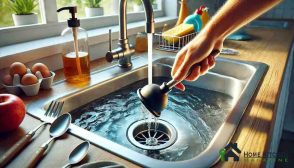
A flat-bottom sink plunger may help dislodge a shallow obstruction.
In a double-bowl sink, seal the second drain so that pressure is directed into the affected drainage path.
Do not plunge a sink containing chemical drain cleaner. Splashback can cause serious chemical exposure.
Do not continue applying force if plumbing joints begin leaking beneath the sink.
Step 4: Inspect the Accessible Trap if Appropriate
Only proceed if:
- The piping is in sound condition.
- The trap is accessible.
- No caustic drain cleaner is present.
- You understand how the connections fit together.
- A bucket is positioned beneath the trap.
Document the connection arrangement before removing anything.
Stop if the fittings are corroded, damaged, or resist reasonable hand-tool pressure.
Step 5: Escalate Based on the Pattern
If the P-trap is clear but the sink remains slow, the restriction may be inside the wall or farther downstream.
At this stage, proper augering, branch-line inspection, or professional diagnosis becomes more useful than repeating household remedies.
What Not to Do With a Slow Kitchen Drain
Do Not Send Grease Away With Hot Water
Hot water can move softened grease out of sight without removing it from the plumbing system.
Once the water cools, grease may adhere farther along the branch drain or sewer line.
Wastewater authorities generally recommend:
- Cooling cooking grease
- Placing it in a suitable container
- Wiping greasy cookware before washing
- Scraping food into the trash
- Using a sink strainer for remaining solids
Prevention matters because a reopened drainage channel is not necessarily a clean pipe.
Do Not Assume Baking Soda and Vinegar Can Clear Every Clog
The visible fizz produced by baking soda and vinegar is an acid-base reaction.
It is not proof that a dense grease deposit or distant obstruction has been removed.
The mixture may help loosen light surface residue or reduce some odors, but it should not delay mechanical diagnosis when drainage remains slow.
Do Not Mix Drain-Cleaning Products
Chemical drain cleaners may contain strongly corrosive ingredients.
Never mix household cleaning chemicals.
Different products can react unpredictably, generate heat, splash corrosive material, or release dangerous gases.
Always follow the product label exactly.
If a chemical drain cleaner has already been used, inform the plumber before any work begins.
Do not plunge the sink or open the P-trap while corrosive liquid may still be present.
Do Not Keep Forcing a Recurring Clog Open
Repeatedly creating a narrow passage through the same buildup may restore flow temporarily while leaving most of the restriction inside the pipe.
A drain that becomes slow again within days or weeks deserves a broader assessment of:
- Branch-line condition
- Plumbing venting
- Pipe slope
- Disposal performance
- Waste habits
- Sewer or septic conditions
Recurring blockage is evidence—not merely an inconvenience.
When the Slow Drain Is Also a Water-Damage Risk
A slow drain and a plumbing leak are different problems, but one can expose the other.
Standing water increases the time that sink strainers, disposal flanges, slip joints, and trap connections remain under load.
Aggressive plunging can also expose an already weakened seal.
Stop testing and inspect beneath the cabinet if you notice:
- Droplets forming at a slip joint
- Swelling or discoloration in the cabinet base
- Dampness around the garbage disposal
- A persistent musty odor
- Water appearing only when the sink is deeply filled
- Moisture along the wall behind the drain connection
- Staining that returns after being wiped dry
Our guide to preventing leaks around sinks, dishwashers, and supply lines explains how small plumbing failures can become cabinet, flooring, and structural damage.
A slow drain should never be treated so aggressively that a manageable restriction becomes a leaking connection.
When to Call a Plumber
Professional diagnosis is justified when:
- More than one fixture is draining slowly.
- Wastewater backs up into another sink, tub, shower, or floor drain.
- The sink repeatedly slows after being cleared.
- The garbage disposal leaks, hums, or repeatedly trips.
- The P-trap is clear but the flow remains restricted.
- Piping is corroded, damaged, sagging, or inaccessible.
- Sewage odor accompanies a backup.
- A septic system shows additional warning signs.
- Chemical drain cleaner is standing inside the sink.
- Water is leaking into the cabinet or wall.
- The problem returns shortly after mechanical clearing.
A plumber may use an appropriately sized auger, inspect the branch line, evaluate venting, or recommend a camera inspection when symptoms suggest a recurring or structural problem.
The objective should not be merely to make water disappear during the service visit.
It should be to identify why the restriction formed and whether it is likely to return.
How to Keep the Kitchen Sink Draining Reliably
Drain prevention is mostly waste control.
Use these habits consistently:
- Install a basket strainer and empty it into the trash.
- Scrape plates before rinsing.
- Cool and contain cooking fats, oils, and grease.
- Wipe greasy cookware before washing.
- Avoid sending coffee grounds down the drain.
- Keep fibrous peels and stringy vegetables out of the disposal.
- Avoid sending large quantities of rice, pasta, or other expandable starches into the sink.
- Use the garbage disposal only for materials permitted by its manufacturer.
- Run adequate water when operating the disposal.
- Investigate recurring gurgling, odor, or slow flow instead of normalizing it.
Homes with septic systems require additional care.
The EPA’s SepticSmart sink guidance advises homeowners to keep grease, cooking oil, coffee grounds, harsh chemicals, and excessive garbage-disposal solids out of the drainage system.
Prevention will not correct a pipe that is already damaged or improperly configured. It does, however, reduce the material available to create future restrictions.
Frequently Asked Questions
Why Is My Kitchen Sink Still Slow After I Cleaned the P-Trap?
The restriction may be inside the branch drain behind the wall, at the garbage disposal outlet, or farther downstream. Delayed backup after the water runs for a short period strengthens the possibility of a more distant obstruction. Recurring gurgling may also justify checking venting and pipe configuration.
Can Boiling Water Fix a Grease-Clogged Kitchen Sink?
Boiling water may soften grease and move it farther along without removing it from the plumbing system. It can also create burn or material risks. A persistent grease restriction is better addressed through appropriate mechanical cleaning and improved waste-control habits than repeated boiling-water treatments.
Does a Gurgling Kitchen Sink Mean the Vent Is Blocked?
Not necessarily. Gurgling can occur when air passes through water around a partial drain restriction. Vent trouble is one possibility, particularly when the sound persists after the drain is cleared, but gurgling alone cannot identify the exact cause or location.
Can a Slow Kitchen Sink Indicate a Septic Problem?
Yes, but an isolated slow sink is not enough to establish septic failure. Multiple slow fixtures, widespread gurgling, plumbing backups, sewage odors, or unusual wet areas near the drainfield are more concerning and justify professional evaluation.
Let the Drainage Pattern Guide the Repair
A kitchen sink draining slowly is not a diagnosis by itself.
It is a symptom created somewhere along a connected path—from the strainer and P-trap to the branch drain, venting, building drain, sewer lateral, or septic system.
Begin with the pattern.
Determine whether the slowdown is:
- Immediate or delayed
- Isolated or shared
- Silent or accompanied by gurgling
- Temporary or recurring
- Limited to one bowl or affecting both
- Connected to disposal use
- Accompanied by leakage or odor
That short observation often tells you more than the label on a drain-cleaning product.
More importantly, it leads toward a repair that addresses the cause instead of briefly hiding it.