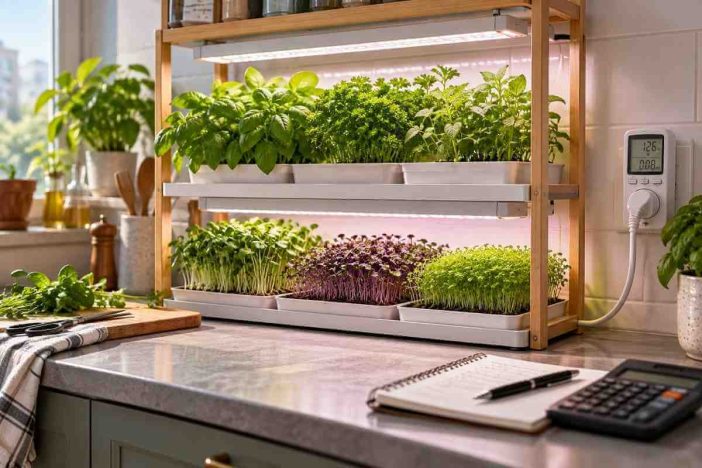
A shelf of basil can look almost weightless at night.
Leaves sit quietly under a thin strip of white LEDs. There is no compressor humming, no heating element glowing red, no obvious sign that much energy is being used. Yet the lamp may stay on through breakfast, lunch, dinner, and several hours beyond.
That long runtime is what changes the calculation.
A 40-watt grow light is a small electrical load while it is running. Leave it on for fourteen hours every day, however, and those hours accumulate into kilowatt-hours that eventually appear on the utility bill.
The useful news is that the cost is unusually easy to predict.
Quick answer: calculate grow-light electricity use with this formula:
Monthly kWh = actual watts ÷ 1,000 × hours per day × days used
Then:
Monthly energy cost = monthly kWh × your electricity price per kWh
For example, a 100-watt grow light operating 14 hours per day for 30 days uses about 42 kWh. What that costs depends almost entirely on your local electricity rate.
What Actually Determines Grow Light Electricity Use?
Four numbers determine most home grow-light electricity calculations:
- Actual electrical input in watts
- Number of fixtures
- Hours the lights run each day
- Your electricity price per kilowatt-hour
Plant type matters indirectly because it helps determine an appropriate lighting schedule.
A houseplant shelf receiving useful window light may need less supplemental runtime than seedlings being grown almost entirely under LEDs.
That distinction is why simply asking whether a grow light is “cheap to run” rarely produces a meaningful answer.
Start With Actual Watts, Not the Number in the Product Name
The first number to find is input power.
Look at the fixture label, power adapter, specification sheet, or a plug-in energy meter.
Do not automatically assume a product called something like “1000W Grow Light” actually draws 1,000 watts from the outlet. Product names, model numbers, replacement-equivalent claims, diode ratings, and actual wall power are not necessarily the same thing.
For cost calculations, the number that matters is what the fixture actually consumes.
If one light draws 35 watts and another draws 80 watts, those are the numbers that belong in the electricity formula.
Dimmable lights require another check
A dimmer marked 50% does not automatically prove that measured electrical consumption is exactly 50% of maximum input.
For a rough estimate, the manufacturer’s documented power at that setting may be sufficient.
For an accurate household calculation, a plug-in power meter is better because it measures what the system is actually drawing from the outlet.
This matters even more when several light bars share one driver or controller.
How to Calculate Grow Light Electricity Cost
Take a 60-watt LED grow light running for 14 hours per day.
First convert watts to kilowatts:
60 ÷ 1,000 = 0.06 kW
Then calculate daily energy:
0.06 × 14 = 0.84 kWh per day
Over 30 days:
0.84 × 30 = 25.2 kWh per month
If electricity costs $0.18 per kWh:
25.2 × $0.18 = $4.54 per month
The formula scales cleanly.
Two identical fixtures double the lighting consumption. Cutting the photoperiod from fourteen hours to twelve reduces the operating time by about 14%. A higher utility rate changes cost but not energy consumption.
Use the calculator below with your own numbers rather than relying on somebody else’s tariff.
Use actual input watts and your own electricity rate whenever possible.
Daily electricity use: 0.84 kWh
Monthly electricity use: 25.20 kWh
Estimated monthly energy cost: $4.62
Annualized cost at the same schedule: $55.40
Energy-charge estimate only. Fixed charges, taxes, tiered pricing, time-of-use tariffs, and other equipment can change your actual bill.
Grow Light Cost Examples for the US and UK
Electricity rates vary substantially by location, tariff, and time of use, so your own bill should always take priority.
For reference, the U.S. Energy Information Administration reported an average U.S. residential electricity price of about 18.31 cents per kWh in July 2026.
For Great Britain, Ofgem’s average Direct Debit electricity unit rate for 1 October–31 December 2026 is 26.32 pence per kWh.
Using those rates only as October 2026 reference examples, and assuming 14 hours per day for 30 days:
| Actual light draw | Monthly energy | US example | UK example |
|---|---|---|---|
| 20 W | 8.4 kWh | $1.54 | £2.21 |
| 40 W | 16.8 kWh | $3.08 | £4.42 |
| 60 W | 25.2 kWh | $4.61 | £6.63 |
| 100 W | 42 kWh | $7.69 | £11.05 |
| 150 W | 63 kWh | $11.54 | £16.58 |
| 200 W | 84 kWh | $15.38 | £22.11 |
These figures estimate the energy charge attributable to the light.
They should not automatically include a household standing charge or fixed service fee that you would pay even if the grow light were unplugged.
They also do not include fans, pumps, heat mats, humidifiers, dehumidifiers, or other equipment.
A 100-Watt Grow Light Is Not Automatically “Expensive”
The phrase 100 watts sounds very different depending on runtime.
A 100-watt fixture used for two hours consumes:
0.2 kWh
The same fixture running for fourteen hours consumes:
1.4 kWh
Run it every day for a month and it reaches 42 kWh.
This is why comparing indoor-gardening equipment by wattage alone can be misleading.
The product’s power draw tells you the rate at which electricity is being consumed. The timer determines how long that rate continues.
Both belong in the decision.
Do Not Choose the Photoperiod Only to Save Money
Turning lights off sooner obviously reduces energy consumption.
That does not mean the shortest possible schedule is the cheapest sensible schedule.
If the plants no longer receive enough light, the electricity bill may fall while the growing system stops doing its job.
University of Minnesota Extension gives useful starting ranges for total daily light:
| Growing situation | Typical total light period |
|---|---|
| Seedlings | 16–18 hours/day |
| Hydroponic lettuce and herbs | 12–14 hours/day |
| Foliage houseplants | 12–14 hours/day |
| Flowering houseplants | 14–16 hours/day |
These are starting points rather than universal prescriptions because natural daylight, fixture intensity, plant species, and growth stage also matter.
If you are primarily growing culinary plants, HomeKitchenMagazine’s guide to growing herbs indoors explains the broader potting, watering, and care decisions that lighting has to support.
Duration and Intensity Are Two Different Variables
A common indoor-gardening mistake is treating hours as a substitute for adequate light intensity.
A weak lamp left on for sixteen hours does not automatically produce the same growing conditions as a suitable fixture running for fewer hours.
Plants respond to the quantity of photosynthetically useful light they receive over time.
One useful concept is Daily Light Integral (DLI).
Iowa State University Extension describes DLI as the amount of photosynthetically useful light delivered over an area during a 24-hour period and gives the calculation:
DLI = PPFD × hours × 0.0036
You do not need to become a lighting engineer to use that idea.
The practical lesson is simply:
your electricity meter measures watts and hours, while your plants care about how much useful light actually reaches the canopy.
A fixture that spills much of its light onto the wall, floor, or empty shelf may consume electricity faithfully while producing little benefit where it matters.
The Cost-per-Useful-Shelf Framework
This is a better way to compare grow-light setups than simply asking which fixture has the lowest wattage.
1. Calculate monthly energy
Use:
watts × hours × days ÷ 1,000
This tells you how much energy the fixture consumes.
2. Calculate the monthly energy cost
Multiply that result by your local rate per kWh.
Now the operating expense is visible.
3. Check the usable illuminated area
Ask how much of the plant canopy actually receives appropriate light.
A 25-watt lamp illuminating one healthy herb pot may be more useful than a 15-watt clip light trying unsuccessfully to cover an entire shelf.
4. Verify the plants, not the marketing claim
Watch new growth.
Persistent stretching, pale growth, strongly directional leaning, or weak seedlings can indicate that the useful light reaching the plant is inadequate.
Conversely, bleaching or stress immediately beneath the fixture can indicate excessive intensity or unsuitable placement.
The cheapest light is therefore not necessarily the fixture with the lowest monthly electricity cost.
It is the setup that supplies enough usable light without paying for substantial output that never reaches the plants.
What an Extra Two Hours Actually Costs
Timer changes are easier to evaluate once you convert them to kWh.
For a 100-watt grow light, adding two hours per day adds:
100 ÷ 1,000 × 2 × 30 = 6 kWh per month
At the July 2026 U.S. reference rate used earlier, that is about $1.10 per month.
At the current Ofgem reference rate, it is about £1.58 per month.
That does not mean every plant needs those additional two hours.
It means you can make the decision with real numbers instead of assuming that a small schedule adjustment will dramatically change the bill.
Small Indoor Gardens Often Need Less Power Than Grow-Tent Examples Suggest
Search results for grow-light electricity costs frequently use 300-, 400-, 600-, or even 1,000-watt fixtures because many publishers are writing for grow rooms or large controlled environments.
That can make household indoor gardening look far more energy-intensive than it needs to be.
A windowsill herb supplement, a single microgreens tray, or a few foliage plants may use much smaller fixtures.
For example, the system in our soil-free indoor microgreens guide only needs light matched to a shallow tray—not a fixture designed for a large enclosed grow space.
Start with the illuminated area you actually need.
Then size the light.
Do not start with the biggest fixture you can afford and search for plants to place beneath it afterward.
Six Ways to Reduce Grow-Light Electricity Waste
1. Use a timer
A timer prevents accidental overrun and gives plants a consistent schedule.
Iowa State recommends timers for supplemental lighting and notes that most home-gardener setups should still preserve a period of darkness.
Two forgotten hours every night may look trivial, but they recur thirty times each month.
2. Match the fixture to the shelf
Oversizing a light increases both purchase cost and potential electrical consumption.
Measure the actual growing footprint before buying.
A narrow shelf usually benefits more from even coverage than from a large high-powered fixture designed for a much bigger canopy.
3. Position the light correctly
Moving a suitable fixture closer to the canopy—within its manufacturer’s safe recommended range—can improve the amount of light reaching leaves without increasing electrical draw.
That is different from blindly lowering a powerful lamp.
Always follow fixture guidance and watch for heat or leaf stress.
4. Use natural daylight when it genuinely contributes
A bright window can reduce the amount of artificial supplementation needed.
But visible room brightness is not the same as useful plant light.
Season, orientation, window glazing, nearby buildings, and distance from the glass all change the result.
Our eco-friendly indoor gardening guide explains why natural light should be treated as part of the growing system rather than merely a decorative advantage.
5. Use dimming as a measured adjustment
Dimming can reduce power consumption, but only when plants are still receiving enough useful light.
Do not dim solely because the fixture feels bright to human eyes.
If possible, compare plant response, PPFD information supplied by the manufacturer, or measured canopy light before and after the adjustment.
6. Consider time-of-use electricity rates
Some households pay different prices at different times of day.
If your utility offers cheaper off-peak electricity, a programmable timer may let you shift part of the photoperiod into a cheaper period without changing the total hours of light.
Do this only when the resulting schedule still provides a consistent light-dark cycle and does not create practical problems in the room.
Why “LED Uses Less Electricity” Needs Context
LED grow lights are widely used because modern fixtures can produce substantial plant-usable light without the heat and power profile of older high-intensity lighting.
But LED alone does not tell you whether a fixture is economical for your specific shelf.
A poorly sized 150-watt fixture can still waste more energy than a well-matched 50-watt setup if most of its output misses the canopy.
Likewise, replacing a working light solely to save a very small amount of electricity may take years to recover the purchase cost.
Compare:
- actual wall watts,
- usable coverage,
- expected daily runtime,
- purchase price,
- plant requirements,
- and how long you expect to use the system.
That produces a better decision than choosing the lowest advertised wattage.
When a Plug-In Power Meter Is Worth Using
Manual calculations are usually sufficient when the fixture has a trustworthy input-power specification and runs at full output.
A power meter becomes more useful when:
- the grow light is dimmable,
- several bars share a driver,
- you suspect the real draw differs from the product listing,
- smart controls consume standby power,
- or you want to measure an entire growing shelf.
Run the system as you normally would and record cumulative kWh over several days.
That captures the real schedule instead of relying entirely on specifications.
It is particularly useful before adding a second or third shelf because you can multiply a measured system rather than a theoretical one.
Do Not Ignore the Rest of the Indoor-Growing System
Grow lights may be the main continuous electrical load in a simple plant shelf, but some setups add other equipment.
Hydroponic pumps, circulating fans, heating mats, humidifiers, and dehumidifiers each have their own wattage and schedule.
Calculate them separately.
A 10-watt pump operating twenty-four hours per day does not belong in the same line of arithmetic as a 60-watt light operating fourteen hours.
Calculate each device:
watts ÷ 1,000 × its own hours × days
Then add the monthly kWh totals.
Readers considering a water-based setup can use our beginner hydroponics guide to decide whether that additional equipment is actually necessary for the crop they want to grow.
Electrical Safety Around Plants and Water
Indoor gardening puts water and powered equipment unusually close together.
Keep plugs, timers, power strips, adapters, and connections away from watering areas and locations where runoff can reach them. Do not overload cords or power strips, and do not use a damaged cord simply because the fixture still turns on.
The U.S. Consumer Product Safety Commission warns that improperly designed or used extension cords can present electrical-shock and fire hazards, while the Electrical Safety Foundation International advises against overloading extension cords or allowing them to contact water.
Follow the electrical ratings and installation instructions supplied with your fixture and timer. If an indoor garden requires permanent extension cords, overloaded outlets, or improvised wiring, the solution is an electrical setup problem rather than a gardening hack.
Grow-Light Electricity Checklist
Before buying or expanding a lighted indoor garden, verify these seven items:
- Actual input watts are known.
- The fixture covers the real plant footprint.
- The timer matches the crop’s lighting needs.
- Your calculation uses your own electricity rate when available.
- Natural daylight is counted where it genuinely contributes.
- The plant is receiving useful light rather than light spilling onto empty surfaces.
- Electrical connections remain dry, correctly rated, and safely installed.
If all seven are known, the running cost should no longer be a surprise.
Frequently Asked Questions
Do grow lights use a lot of electricity?
Not necessarily. Electricity use depends on actual wattage and runtime. A small 40-watt light running 14 hours daily uses about 16.8 kWh in 30 days, while a 200-watt fixture on the same schedule uses 84 kWh. Compare the fixture with the growing area it actually serves.
How much does a 100-watt grow light cost per month?
At 14 hours per day for 30 days, a 100-watt fixture uses about 42 kWh. Multiply 42 by your electricity price per kWh. At 18.31 cents/kWh the energy portion is about $7.69 per month; your own tariff may be substantially higher or lower.
Does setting a grow light to 50% cut electricity use in half?
Do not assume so from the dimmer position alone. Driver design and fixture controls differ. Manufacturer power data can provide an estimate, but a plug-in power meter is the simplest way to verify actual wall consumption at a particular dimmer setting.
Should grow lights stay on 24 hours a day?
For most home-growing situations, no. Plants generally require a normal dark period, and university extension guidance typically recommends defined photoperiods rather than continuous light. Seedlings, herbs, foliage plants, and flowering plants also have different starting ranges.
Make the Bill Predictable Before Adding Another Shelf
Learning how much electricity a grow light uses does not require guessing whether LEDs are expensive.
Find actual watts. Multiply by real hours. Convert the result to kilowatt-hours. Apply your own electricity rate.
Then ask the more useful question: what are those purchased watts doing for the plants?
A small light that evenly serves a productive herb shelf can be an efficient household growing tool. A powerful fixture lighting walls, empty space, or plants that already receive sufficient daylight is simply paid electricity going somewhere you do not need it.
If you are building an indoor plant collection rather than an edible-growing shelf, our guide to the best indoor plants for apartments can help determine which plants actually need supplemental lighting before you add another fixture.