A clogged kitchen sink should not be treated with random drain-clearing methods until you know what the drainage pattern is telling you.
A sink that contains completely standing water, drains slowly, backs up into the second bowl, gurgles, or stops draining only when the garbage disposal runs can point to different locations in the drainage system.
Before using a plunger, opening the P-trap, or inserting a drain snake, identify the pattern first.
Quick Answer: What Should You Check First?
Use this sequence:
| What the sink is doing | First area to investigate |
|---|---|
| Water does not drain at all | Drain opening, garbage disposal if present, P-trap, or downstream blockage |
| Water drains but very slowly | Partial restriction rather than a complete clog |
| One bowl backs up into the other | Shared drain path, disposal, trap, or downstream restriction |
| Drain gurgles while water leaves | Possible restriction or drainage/venting issue |
| Disposal runs but water remains | Disposal outlet, connected trap, or downstream drain |
| P-trap is clear but sink still will not drain | Blockage may be farther into the branch drain |
| Several fixtures are draining poorly | Problem may extend beyond the kitchen sink |
If the sink still drains but only slowly, use Why Does My Kitchen Sink Drain So Slowly?. That page is intended for partial-flow diagnosis rather than a fully blocked sink.
Before You Try to Clear the Clog
First check three things.
1. Is There a Garbage Disposal?
If the sink has a disposal, determine whether the problem occurs on the disposal side and whether the unit operates normally.
Do not put your hand into the disposal chamber.
A disposal problem and a downstream drain clog can produce similar symptoms, so confirm which one you are dealing with before opening plumbing connections.
2. Is the Clog Accessible Near the Drain?
Remove visible food debris from the strainer or drain opening if it can be reached safely.
Do not push accessible debris farther into the drain.
3. Is the Problem Local to the Kitchen Sink?
Check whether nearby fixtures drain normally.
If multiple fixtures are backing up or draining poorly, the restriction may be farther downstream than the kitchen sink trap.
Diagnostic rule: identify the drainage pattern → locate the likely restriction → use the least invasive appropriate method first → escalate only if the clog remains.
Do Not Start With Random Drain Remedies
Two commonly recommended kitchen-drain remedies deserve some context before you use them.
Boiling Water Is Not a Universal Clog Fix
Hot water may help rinse loosened grease or residue after drainage has been restored, but it should not be presented as the primary solution for a completely blocked kitchen sink.
A solid obstruction, compacted food waste, a blocked P-trap, or a clog farther into the branch drain usually requires the blockage to be displaced or physically removed.
If you plan to use very hot water, also consider the sink, disposal, fittings, and piping materials involved and follow any manufacturer guidance that applies to the installation.
Baking Soda and Vinegar Create Fizz, Not a Guaranteed Clog Remover
Baking soda and vinegar react visibly because they produce carbon dioxide gas.
That reaction can look powerful, but fizzing does not prove that grease, compacted food, or another blockage has been dissolved.
For a completely blocked kitchen sink, do not spend repeated cycles adding baking soda and vinegar while standing water remains.
Move instead to a method that matches the likely clog location.
Be Careful With Chemical Drain Openers
Commercial drain cleaners may contain highly corrosive acidic or alkaline ingredients.
If you have already poured a chemical drain opener into a blocked sink, do not immediately begin plunging, opening the P-trap, or inserting tools without considering the possibility of chemical splash or exposure.
Follow the product label exactly.
Never mix different drain-cleaning chemicals or combine them with other household cleaners.
When corrosive drain cleaner remains trapped in standing water or plumbing that you intend to open manually, professional service may be the safer next step.
How to Unclog a Kitchen Sink: Use the Least Invasive Method First
Once you have ruled out an obvious disposal problem and removed any debris you can safely reach from the drain opening, escalate gradually.
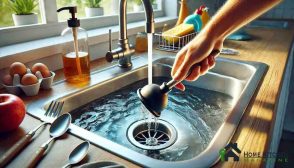
Step 1: Try a Sink Plunger
A plunger can help move a blockage located relatively close to the fixture.
Before plunging:
- remove as much standing water as necessary to work safely, while leaving enough water to cover the plunger cup;
- use a flat-bottom sink plunger;
- create a tight seal over the drain;
- if you have a double-bowl sink, seal the second drain with a stopper or wet cloth;
- do not put your hand into a garbage disposal opening.
Pump the plunger with controlled up-and-down strokes, then lift it and check whether the sink begins draining.
Repeat several times if you see improvement.
If nothing changes, move to the next diagnostic point rather than plunging indefinitely.
Do not plunge a sink that contains corrosive drain cleaner unless the product instructions specifically allow it. Splashing contaminated water can create a chemical-exposure hazard.
Step 2: Check the P-Trap
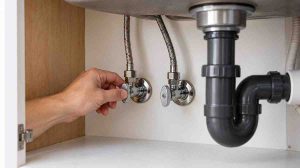
If plunging does not restore flow, the blockage may be in the curved P-trap beneath the sink.
Only open the trap if you are comfortable working with the connections and there is no hazardous chemical cleaner sitting in the drain.
Place a bucket underneath before loosening anything.
Then:
- remove the trap carefully;
- empty the trapped water into the bucket;
- inspect the trap for food, grease, or other obstruction;
- clean it mechanically;
- inspect the washers and connections before reassembly;
- reinstall the trap in the same orientation;
- run water and check every connection for leaks.
If the P-trap contains the blockage, drainage should return once the trap is cleaned and correctly reassembled.
If the trap is clear but the sink still will not drain, the restriction is probably farther downstream.
Step 3: Use a Hand Auger for a Deeper Local Clog
A hand auger, commonly called a drain snake, is the next logical step when the trap is clear but the branch drain remains blocked.
With the P-trap removed, the auger can usually be introduced into the drain line leading into the wall.
Advance it gradually.
When you meet resistance:
- rotate the cable according to the tool instructions;
- work gently rather than forcing it;
- withdraw debris when possible;
- repeat until the cable can travel farther through the line.
Then reassemble the plumbing and test the sink.
Do not use excessive force. Resistance may come from a pipe fitting rather than the clog itself.
Step 4: Know When the Clog Is Beyond a Simple Sink Repair
Stop escalating DIY methods when:
- the P-trap is clear but the line remains completely blocked;
- the auger cannot pass the obstruction;
- the clog repeatedly returns;
- several nearby fixtures are draining poorly;
- wastewater backs up into another fixture;
- opening the plumbing would expose chemical drain cleaner;
- the drain piping is corroded, damaged, or difficult to disassemble safely.
At that point, the problem may be farther into the kitchen branch drain or another part of the drainage system.
For that narrower scenario, continue with How to Unclog a Kitchen Sink Drain Pipe, which should focus specifically on a clog beyond the sink opening and P-trap rather than repeating basic sink-clearing methods.
Frequently Asked Questions
What is the first thing to try when a kitchen sink is completely clogged?
First determine whether the blockage is at the drain opening, garbage disposal, P-trap, or farther into the drain line.
After removing any safely accessible debris and ruling out a disposal problem, a sink plunger is usually a reasonable first mechanical method. If that does not work, inspect the P-trap before assuming the clog is deeper in the pipe.
Will baking soda and vinegar unclog a kitchen sink?
Baking soda and vinegar create a visible chemical reaction, but the fizz does not guarantee that a grease plug, compacted food, or another substantial blockage will be removed.
For a completely blocked sink, mechanical methods such as plunging, cleaning the P-trap, or using an appropriate hand auger are generally more directly targeted at the obstruction.
Should I pour boiling water down a clogged kitchen sink?
Very hot water may help rinse some loosened residue, but it should not be treated as a universal solution for a fully blocked sink.
A physical blockage often needs to be displaced or removed. Consider the piping, disposal, fittings, and manufacturer instructions before introducing extremely hot water.
When should I stop trying to unclog the sink myself?
Consider professional help when:
- the P-trap is clear but the drain remains completely blocked;
- a hand auger cannot pass the obstruction;
- the clog repeatedly returns;
- multiple fixtures are draining poorly or backing up;
- drain piping is damaged or badly corroded;
- corrosive drain cleaner is trapped in standing water;
- wastewater is backing up from farther downstream.
These symptoms suggest the problem may extend beyond a simple sink-level clog.
How to Reduce Future Kitchen Sink Clogs
The most effective clog prevention happens before material enters the drain.
Use these habits:
- scrape food scraps into the trash or compost before washing dishes;
- keep cooking oil, fats, and grease out of the sink;
- wipe greasy cookware before washing it;
- use a sink strainer to catch food particles;
- avoid treating the garbage disposal as a substitute for removing food waste;
- pay attention when drainage begins slowing instead of waiting for complete blockage.
Grease is particularly problematic because it can accumulate inside drainage piping over time and contribute to restrictions and backups.
If your sink is still draining but becoming progressively slower, troubleshoot it before complete blockage develops with Why Does My Kitchen Sink Drain So Slowly?.
Clear the Clog Based on Where It Is
The best way to unclog a kitchen sink drain is not to cycle through every home remedy.
Follow the drainage system logically:
check the drain opening and disposal → plunge the sink → inspect the P-trap → investigate the branch drain if the trap is clear.
Each step tells you something about where the obstruction is located.
If plunging restores flow, there is usually no reason to disassemble the trap.
If the P-trap contains the blockage, there is usually no reason to snake farther into the wall.
And if the P-trap is completely clear but the sink remains blocked, the problem has moved beyond basic sink-level troubleshooting.
At that point, continue with How to Unclog a Kitchen Sink Drain Pipe for diagnosis of a restriction farther into the branch drain.
The goal is simple:
use the least invasive method that reaches the actual clog, then stop once normal drainage is restored.