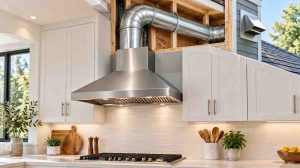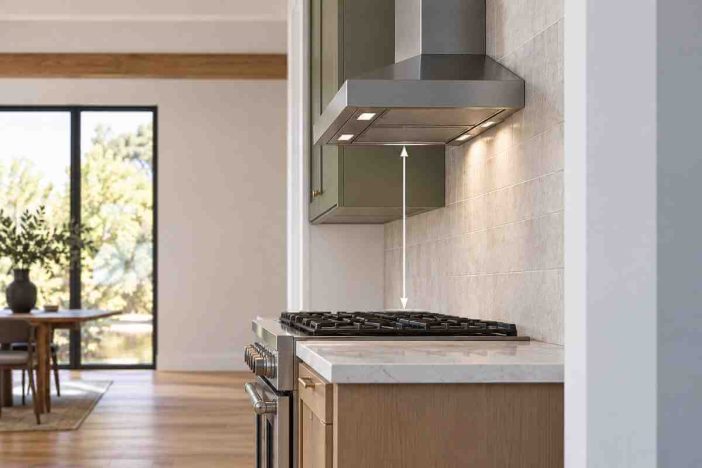
A pencil line across a newly tiled backsplash can quietly decide whether a range hood works as intended for the next decade.
Move that line several inches upward and the hood may look cleaner against tall cabinets, but the cooking plume has farther to travel before it reaches the canopy. Move it downward and capture may improve, yet heat clearance, cookware access, sightlines, or the appliance manufacturer’s limits can become a problem.
This is why asking, “How high should a range hood be above the stove?” sounds simpler than the real decision.
There is no single mounting height that applies to every hood, every cooktop, and every kitchen.
The correct height is a compatibility range.
And that range should be established before cabinetry, backsplash, ductwork, and decorative trim make it expensive to change.
Quick Answer: There Is No Universal Range Hood Height Above a Stove
The safest planning sequence is:
- identify the exact range hood;
- find its permitted minimum and maximum mounting height;
- review the cooking appliance’s installation instructions for overhead-clearance requirements;
- check any applicable local requirements;
- confirm that the selected height works with the hood’s width, depth, duct route, chimney, and ceiling height.
Do not choose a height from a generic internet chart if the hood manufacturer specifies something different.
The Home Ventilating Institute notes that installation instructions among its member products commonly fall within roughly 20 to 30 inches above the cooking surface, but HVI specifically directs homeowners to the exact manufacturer’s instructions.
That distinction matters because individual products can sit outside another brand’s “typical” recommendation.
The objective is therefore not:
find one magic distance.
It is:
find the permitted overlap for your exact installation.
If you are still choosing blower capacity, resolve that separately with our range hood CFM sizing guide. Mounting height and airflow influence each other, but one should not be used to compensate blindly for the other.
Why Published Range Hood Height Charts Disagree
Search long enough and you will encounter several apparently authoritative numbers.
One manufacturer may publish a general recommendation around 24 to 30 inches.
Another may distinguish gas from electric cooking.
A third may permit a particular model to sit higher.
UK guidance may be expressed in centimetres and can differ again.
That does not necessarily mean one source is wrong.
It often means they are discussing different products.
For example, published consumer guidance currently includes examples such as:
| Source type | Published example | Important limitation |
|---|---|---|
| HVI guidance | Member instructions average roughly 20–30 in. | Use the exact product instructions |
| Some Broan-NuTone guidance | Often approximately 24–30 in. | Individual models can differ |
| KitchenAid consumer guidance | Gas, electric and induction receive different typical ranges | Exact model instructions govern |
| Bosch UK consumer guidance | Metric guidance is provided for certain electric/induction installations | Exact hood instructions still govern |
These are useful orientation points.
They are not interchangeable installation specifications.
A 30-inch number taken from one manufacturer’s article cannot automatically be applied to another manufacturer’s hood.
That is the first principle of range hood mounting height.
The Three-Constraint Mounting Height Test
Instead of memorizing one distance, make the installation pass three constraints.
Constraint 1: The range hood
Start with the installation manual for the exact model.
Look for:
- minimum distance from the cooking surface;
- maximum recommended distance;
- different limits for gas or electric cooking, if specified;
- installation type;
- ceiling or chimney limitations;
- special conditions for high-output cooking equipment.
A minimum height usually protects the hood from inappropriate heat exposure and preserves working space.
A maximum height usually protects capture performance.
Both boundaries matter.
Constraint 2: The cooking appliance
Next, inspect the range or cooktop documentation.
Do not assume that the hood is the only product imposing clearance requirements.
Cooking-appliance instructions can include requirements for:
- material above the cooking surface;
- cabinets;
- combustible construction;
- microwave/hood combinations;
- specific ventilation products;
- professional-style burners or broilers.
When two listed appliances are being installed together, the installation has to satisfy the instructions that apply to both.
Constraint 3: The building
Finally, check the requirements enforced for the project.
Model codes contain provisions involving domestic cooking equipment, exhaust equipment, combustible clearances, ducts, and specialized cooking appliances. Local jurisdictions may adopt, amend, or replace those provisions.
This is an important distinction:
a code clearance to combustible material is not automatically the same thing as a range hood manufacturer’s mounting-height specification.
Do not pull a number from one code paragraph and assume it is a universal hood height.
If the project involves gas equipment, unusual construction, a professional-style range, an open-top broiler, or uncertain clearances, professional or local-code review is more reliable than interpretation by internet chart.
Use the Highest Minimum and the Lowest Maximum
Once you have the applicable documents, look for overlap.
Imagine a hypothetical installation where:
- Hood A permits mounting from 24 to 30 inches.
- The cooking appliance creates no stricter hood-specific minimum than 24 inches.
- No project-specific requirement increases that minimum.
The usable hood range remains 24 to 30 inches.
Now imagine that another requirement applicable to the installation establishes a 30-inch minimum.
The practical overlap becomes much narrower.
And if one component requires a minimum height that exceeds the other component’s permitted maximum?
That is not a reason to improvise.
It may mean the appliance combination or layout is incompatible.
Changing the hood, changing the cooking appliance, or redesigning the enclosure can be safer and cheaper than forcing two incompatible specifications together.
This is the central decision framework:
highest applicable minimum ≤ planned height ≤ lowest applicable maximum.
If that inequality cannot be satisfied, stop the installation plan and investigate why.
What Happens When a Range Hood Is Mounted Too High?
Smoke does not rise in a perfectly vertical pencil line.
Heat from cooking creates a plume that rises and expands.
Grease aerosols, steam, smoke, particles, and odors move with that plume while room air currents can push it sideways.
The farther the plume travels before reaching the hood, the larger the capture problem can become.
That is especially relevant to front burners.
Lawrence Berkeley National Laboratory research into residential range-hood capture has shown that mounting configuration, airflow, burner location, and hood geometry all affect capture efficiency. In tested configurations, changing mounting height changed capture performance even when other variables were held relatively stable.
The exact percentages from one laboratory configuration should not be treated as universal household performance numbers.
The principle is more important:
distance is part of capture geometry.
A hood mounted beyond its intended range may allow more of the plume to escape around the front or sides before suction can capture it.
More CFM is not an automatic cure
A common reaction to poor capture is to buy a larger blower.
That can be the wrong diagnosis.
Poor capture can also result from:
- excessive mounting height;
- a shallow canopy;
- insufficient width;
- front-burner cooking;
- cross-drafts;
- island exposure;
- restrictive ductwork.
Increasing airflow can sometimes help.
But it can also increase noise, duct requirements, operating energy, and pressure effects.
Before moving toward a much larger blower, use the range hood CFM sizing guide to determine whether the existing problem is really airflow or geometry.
And when higher CFM moves the project toward substantial exhaust rates, our range hood makeup-air guide explains why replacement air and building pressure can become a second design problem.
Why Mounting the Hood Lower Is Not Always Better
If high mounting can reduce capture, it may seem logical to move the hood as low as possible.
That is also an oversimplification.
A hood that is too low can create different problems.
Heat exposure
Cooking appliances produce significant heat.
Gas burners add open flames, while high-output cooking can expose nearby surfaces to sustained thermal stress.
The hood manufacturer establishes minimum clearance partly because the appliance is designed and tested around particular installation conditions.
Ignoring that minimum can expose components, finishes, filters, lights, electronics, or surrounding materials to conditions outside the intended installation.
Restricted working space
A low canopy can interfere with:
- large stockpots;
- tall cookware;
- lifting lids;
- wok cooking;
- sightlines;
- comfortable access to rear burners.
A range hood is not performing well if the household repeatedly bumps into it or avoids using parts of the cooktop because the enclosure feels intrusive.
Installation conflicts
A lower hood changes:
- chimney length;
- cabinet dimensions;
- backsplash area;
- duct entry point;
- electrical location;
- decorative enclosure proportions.
Moving a hood several inches after cabinetry has been fabricated can trigger far more work than the movement itself suggests.
The goal is therefore not “lowest possible.”
It is the correct permitted height with adequate capture and usable cooking space.
Range Hood Height Above a Gas Stove
Gas is the searcher’s most common reason for questioning mounting clearance.
That makes sense.
A visible flame makes heat and clearance concerns more obvious.
Many consumer guides publish gas-hood distances somewhere around the mid-20-inch to 30-inch range, but this should remain orientation rather than installation instruction.
The exact decision should consider:
- the range hood manual;
- the gas range or cooktop instructions;
- burner output;
- hood style;
- hood depth and width;
- any requirements that apply locally.
Professional-style cooking equipment deserves particular attention because its heat output and manufacturer ventilation requirements may differ substantially from a conventional residential range.
Do not reduce clearance merely because a lower hood might improve capture.
And do not raise the hood beyond its permitted range simply to create a more open visual appearance.
Range Hood Height Above an Electric Stove
Electric resistance cooking eliminates an open gas flame but does not eliminate the need for correct hood placement.
Some manufacturers permit their hoods to be mounted lower over electric cooking equipment than over gas equipment.
That can improve proximity to the cooking plume.
But again, the published range for another brand is not your product specification.
Cooking itself can still release particles, grease aerosols, smoke, steam, and odors.
The U.S. Environmental Protection Agency recommends using a range hood while cooking and venting outdoors where possible because cooking can increase indoor particulate matter.
Fuel type changes part of the ventilation problem.
It does not remove the capture problem.
Range Hood Height Above an Induction Cooktop
Induction complicates generic advice because there is no open flame and relatively little waste heat from the cooking surface itself.
That can permit lower installation distances for some products.
But induction does not make the hood optional whenever the cooking activity produces steam, grease aerosols, smoke, or particles.
Frying bacon on induction still produces cooking emissions.
Searing meat still produces a plume.
Boiling several pots still releases moisture.
The correct distance is therefore still based on the hood and cooktop documentation rather than a blanket rule that “induction hoods should always be mounted lower.”
UK readers may encounter the same question as cooker hood height above hob.
The terminology changes; the verification logic does not.
Measure From the Correct Reference Point
Several installation errors begin with a tape measure placed at the wrong point.
The relevant distance is usually measured from the cooking surface to the bottom of the hood, but the exact manual determines the reference points.
Do not automatically measure from:
- the countertop;
- the floor;
- the cabinet bottom;
- the backsplash;
- the ceiling.
A freestanding range, built-in cooktop, and gas appliance with elevated grates do not always present identical geometry.
If the manufacturer’s diagram defines a particular reference surface, use that definition.
For planning purposes, mark both the cooking-surface elevation and proposed hood-bottom elevation on the wall before cabinets or tile are finalized.
A full-size cardboard or painter’s-tape outline of the hood can reveal ergonomic problems that are difficult to see on a plan.
Ceiling Height Can Quietly Make a Hood Incompatible
A wall-mounted chimney hood has two vertical relationships to satisfy.
Below the hood:
cooking surface → hood bottom
Above the hood:
hood bottom → ceiling
The first is governed by mounting clearance.
The second has to accommodate the hood body, decorative chimney, duct connection, mounting hardware, and model-specific adjustment range.
A simple planning calculation helps:
available height above hood bottom = ceiling height − cooking-surface height − planned mounting clearance
For example, suppose:
- ceiling = 96 inches;
- cooking surface = 36 inches above the floor;
- planned hood clearance = 30 inches.
The available zone from the bottom of the hood to the ceiling is:
96 − 36 − 30 = 30 inches.
That does not prove that the hood fits.
It simply gives you the dimension that the hood body and chimney system have to work within.
Now compare that dimension with the manufacturer’s product drawing.
This calculation is particularly useful with:
- 8-foot ceilings;
- unusually high ceilings;
- sloped ceilings;
- custom enclosures;
- chimney extensions;
- island hoods.
A beautiful hood can be the wrong hood if its chimney cannot physically achieve the required cooking-surface clearance.
The duct path must work as well. Our range hood duct-size guide explains why outlet position, first elbow, diameter, route length, and ceiling framing should be resolved before cabinetry closes the route.
Hood Depth Changes the Meaning of Mounting Height
Imagine two hoods mounted at exactly 30 inches.
One extends deeply over the front burners.
The other is shallow and terminates well behind them.
They do not have identical capture geometry.
Height, width, and depth work together.
This is why increasing mounting height for aesthetic reasons is especially risky when the hood is already shallow.
As the plume rises, it expands.
A deeper or wider canopy can provide more capture area, while a shallow hood gives the plume less room for error.
This does not justify inventing your own dimensional formula.
It does mean that a mounting-height decision should never be made from elevation drawings alone.
Look at the installation from the side as well as from the front.
Island Hoods Need More Than a Height Number
An island hood does not have a wall behind the cooktop to help contain the rising plume.
It is also exposed to room air movement from more directions.
That makes capture geometry especially important.
When evaluating an island installation, verify together:
- manufacturer mounting height;
- canopy width;
- canopy depth;
- cooktop position;
- usable airflow;
- ceiling mounting system;
- duct route;
- cross-drafts.
A hood mounted at a permitted height can still underperform if the canopy is too small for an exposed island cooking plume.
This is one reason our CFM guide treats island installations differently from wall-mounted hoods.
Do Not Raise the Hood Just to Improve Sightlines
A taller cook may prefer an elevated hood.
A designer may want a larger visual gap above a dramatic backsplash.
A cabinet layout may look more symmetrical with the hood moved upward.
Those are real design considerations.
They should not override the appliance’s permitted range.
If the preferred visual height exceeds the product’s maximum, better options include:
- selecting a hood designed for a higher mounting position;
- increasing canopy depth or width where the chosen manufacturer recommends it;
- redesigning the enclosure;
- choosing a different hood style.
Some manufacturers publish product-specific adjustments for installations above their normal design range.
Only use those adjustments when the manufacturer explicitly provides them for the product or product family.
Do not invent a rule such as “add 100 CFM for every few inches” and apply it universally.
Replacing an Existing Hood? Do Not Copy the Old Height Automatically
An existing installation is evidence of what was built.
It is not proof that the installation was correct.
When replacing an old hood, verify the new model from the beginning.
The old hood may have been:
- mounted above its preferred range;
- installed before the current cooktop;
- paired with later cabinetry;
- connected to unsuitable ductwork;
- designed around different clearances;
- selected before the kitchen’s cooking habits changed.
Measure the old installation, but do not inherit it blindly.
A useful replacement check is:
| Existing condition | Verify before reuse |
|---|---|
| Old hood height | Is it inside the new hood’s allowed range? |
| Existing duct | Does it match the new hood’s required size and route? |
| Cabinet opening | Can the new hood be positioned correctly? |
| Chimney | Can it reach the ceiling at the required height? |
| Cooktop | Are its current overhead requirements satisfied? |
| Electrical | Does the new appliance have the required supply and location? |
An old installation can save considerable work when it is compatible.
When it is not, discovering the mismatch before purchase is far less disruptive than discovering it after delivery.
The Pre-Purchase Range Hood Height Record
Before ordering the hood, record these values in one place:
- Exact hood manufacturer and model
- Hood manual obtained
- Minimum hood mounting height recorded
- Maximum hood mounting height recorded
- Exact range or cooktop model identified
- Cooking-appliance clearance instructions reviewed
- Cooking-surface height measured
- Ceiling height measured
- Planned hood-bottom height marked on the wall
- Available vertical space above hood calculated
- Hood body and chimney dimensions checked
- Hood width checked against the cooking surface
- Hood depth checked against front-burner position
- Exhaust outlet and duct route confirmed
- Applicable local requirements reviewed
- Final permitted mounting range has a valid overlap
If the final three or four items remain unresolved, delaying the purchase is usually easier than redesigning the kitchen around an incompatible hood.
A Five-Minute Mock-Up Can Prevent an Expensive Mistake
Before the hood arrives, use painter’s tape or cardboard to mark its proposed lower edge and approximate canopy outline.
Then stand at the range.
Check whether you can:
- see the front and rear burners comfortably;
- place and remove a tall stockpot;
- lift lids without striking the hood;
- reach the controls;
- use the front burners without leaning into the enclosure;
- open nearby cabinet doors;
- maintain the mounting range specified for the product.
This mock-up does not replace installation instructions.
It solves a different problem.
Specifications tell you whether the hood can be installed there.
The mock-up helps reveal whether the kitchen will actually be comfortable to use once it is.
What to Check When an Existing Hood Captures Poorly
If smoke routinely escapes even though the hood operates, do not immediately move it.
Poor performance can originate from several places.
Check:
- whether the hood is inside its permitted mounting-height range;
- whether grease filters are clean;
- whether the canopy adequately reaches the active burners;
- whether the duct matches the hood’s requirements;
- whether dampers and exterior termination are unobstructed;
- whether the blower is being used at an appropriate speed;
- whether room cross-drafts are disturbing the plume.
EPA also recommends using back burners when practical because emissions generated there are generally easier for an overhead hood to capture.
Routine filter and airflow checks belong in the same preventive system as other kitchen-appliance maintenance. Our year-round kitchen appliance maintenance checklist provides a practical schedule for keeping these supporting systems visible instead of waiting for performance to decline.
Trust and Verification
Range-hood mounting height is an installation parameter, not merely a design preference.
For a real project, verify the decision in this order:
1. Exact range hood documentation
Use the current installation manual for the exact model.
A general manufacturer article is useful for shopping.
The product manual governs the product.
2. Exact cooking-appliance documentation
Review the range or cooktop installation instructions, particularly when using gas, professional-style equipment, broilers, microwave combinations, or unusual overhead construction.
3. Locally applicable requirements
Building, mechanical, fuel-gas, and electrical requirements vary by jurisdiction.
Model-code numbers found online do not prove what your city, state, province, or country currently enforces.
4. Professional review where the combination is unclear
Professional review is particularly useful when:
- manufacturer requirements appear to conflict;
- the hood sits outside a normal installation;
- gas or high-output equipment is involved;
- cabinetry or combustible construction is close to the cooking zone;
- structural changes or new exterior ducting are required;
- a high-CFM hood introduces pressure or makeup-air questions.
This article is planning guidance, not a substitute for the installation documents or rules that apply to a specific building.
FAQ
Can a range hood be 36 inches above a stove?
It can be if the exact hood permits that mounting height and the rest of the installation remains compliant. Some products allow heights approaching 36 inches; others specify lower maximums. Mounting above the approved range may reduce capture, so do not use 36 inches as a universal design target.
How high should a range hood be above a gas stove?
Many consumer guides publish gas clearances somewhere around 24 to 30 inches, but that range is not universal. Check the exact hood and gas-appliance instructions and any applicable local requirements. Professional-style ranges and unusual cooking equipment may require different ventilation or clearance planning.
How high should a range hood be above an induction cooktop?
Some hood manufacturers allow a lower installation over induction than over gas because there is no open flame, but product requirements vary. Cooking still produces steam, particles, grease aerosols, and smoke, so capture geometry remains important even when the cooktop itself is induction.
Is it better to mount a range hood too high or too low?
Neither. A hood mounted too high can lose capture effectiveness, while one mounted too low can create heat, clearance, usability, or installation problems. The correct position is within the range permitted by the exact hood while satisfying the cooking appliance and project requirements.
The Right Height Is an Overlap, Not a Magic Number
A range hood height above a stove should not be chosen because 24, 30, or 36 inches appears repeatedly on the internet.
Those numbers can be useful clues.
They are not your installation.
The stronger process is to identify the exact hood, identify the exact cooking appliance, determine the applicable minimums and maximums, and find the range where those requirements overlap.
Then evaluate what happens around that number:
capture area, hood depth, burner position, chimney length, duct routing, cabinetry, ceiling height, and usability.
That prevents two opposite mistakes—mounting the hood high enough to look elegant but too high to capture well, or moving it so low for better capture that the installation no longer works safely or comfortably.
Mounting height is therefore one part of a larger ventilation system.
That systems-based approach is also the foundation of our Kitchen Systems, Appliances & Efficiency Hub, where airflow, ducting, appliance reliability, plumbing, electrical capacity, and maintenance are treated as connected parts of a kitchen rather than isolated specifications.