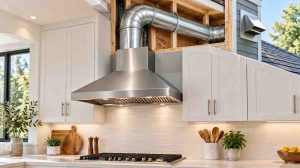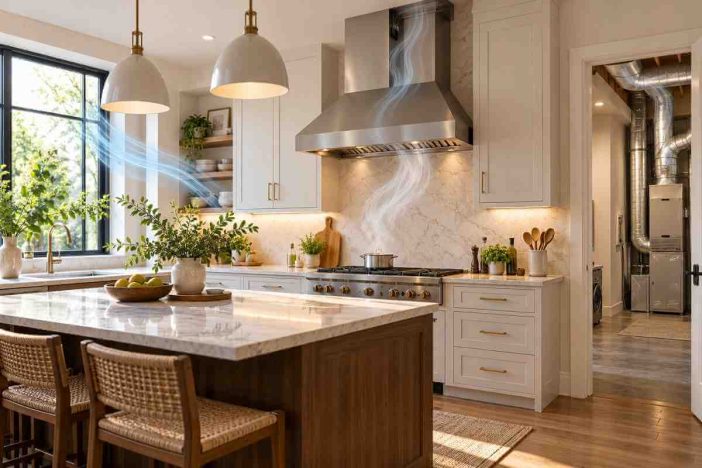
A kitchen remodel can reach the point where almost every visible decision has been made.
The range is selected.
Cabinets are measured.
The hood has an impressive airflow rating.
A contractor has mapped a route through the wall or ceiling.
Then one question appears late in the project:
Where will all the air exhausted by that range hood come from?
It sounds simple until you imagine a 600-CFM hood operating in a closed house.
That fan is not creating air. It is moving indoor air outdoors.
Every cubic foot leaving the building has to be replaced somehow. Replacement air may enter deliberately through a designed makeup-air system—or unpredictably through cracks, door gaps, fireplaces, chimneys, attached garages, wall cavities, and other leakage paths.
In some homes, that is primarily a comfort and performance problem.
In others, depressurization can interfere with naturally drafting combustion appliances and potentially pull combustion products back toward the living space.
That is why range hood makeup air should be evaluated before a powerful hood becomes an installed appliance.
The familiar 400 CFM number is an important planning checkpoint.
It is not the entire decision.
Quick Answer: Does a Range Hood Need Makeup Air?
A range hood may require dedicated makeup air when its exhaust capacity is high enough to affect building pressure or when the locally adopted building or mechanical code requires it.
Under the 2024 International Residential Code, Section M1503.6, the model-code makeup-air provision applies when an exhaust system capable of more than 400 CFM is present and qualifying gas-, liquid-, or solid-fuel-burning appliances that are neither direct-vent nor mechanically drafted are located within the dwelling’s air barrier. The code calls for mechanically or passively supplied makeup air at approximately the exhaust-air rate under those conditions.
That does not mean:
Every range hood rated 401 CFM automatically requires exactly the same makeup-air system everywhere.
Local jurisdictions can adopt different code editions, modify provisions, or impose different requirements. Even where a specific code trigger does not apply, pressure and combustion-safety concerns can still justify professional evaluation.
The practical sequence is:
size the hood → verify the duct → identify combustion appliances → check local code → assess pressure risk → design makeup air if required or appropriate.
If you have not determined the hood capacity yet, begin with our range hood CFM sizing guide.
What Is Range Hood Makeup Air?
Makeup air is replacement air intentionally brought into a building to compensate for air removed by an exhaust system.
Imagine a range hood exhausting 600 cubic feet of indoor air every minute.
Unless replacement air enters at roughly the same time, the pressure inside the building can fall relative to outdoors.
The house will then attempt to replace that missing air through whatever paths are available.
Those paths may include ordinary building leakage, but they can also include places where reverse airflow is undesirable.
A dedicated makeup-air system gives that replacement air a planned route.
Depending on the project, that may involve:
- an outdoor-air duct;
- an automatic or passive damper;
- a powered supply fan;
- integration with HVAC ductwork;
- filtration;
- heating or cooling of incoming air;
- controls that operate with the range hood.
The correct configuration depends on the home, climate, exhaust capacity, adopted code, and mechanical design.
Why Exhausting Air Changes House Pressure
A house is not completely sealed, but modern homes can be much tighter than older buildings.
When an exhaust fan runs, indoor air is removed.
If replacement air cannot enter easily enough, indoor pressure becomes lower than outdoor pressure.
Air then moves toward the lower-pressure space.
That principle is not unique to range hoods.
Bathroom fans, clothes dryers, fireplaces, and other equipment can contribute to pressure differences as well.
A high-capacity kitchen hood can simply become one of the strongest exhaust devices in the house.
The U.S. Environmental Protection Agency warns that high-airflow range hoods can contribute to combustion appliance backdrafting when more air is exhausted than brought into the home. EPA specifically identifies natural-draft equipment such as some gas water heaters and furnaces as a concern.
So the relevant question is not merely:
“Is my hood powerful?”
It is:
“What happens to the rest of the house when this hood operates?”
Rule 1: Treat 400 CFM as a Planning Checkpoint, Not a Universal Law
The number 400 CFM appears repeatedly in discussions about range hood makeup air because it is used in major model-code provisions.
But context matters.
The 2024 IRC M1503.6 trigger includes more than the hood’s airflow rating.
The provision refers to homes containing certain fuel-burning appliances within the dwelling’s air barrier that are neither direct-vent nor mechanically drafted.
This distinction changes the decision.
Consider two houses.
House A
- 600-CFM range hood
- atmospheric-draft gas water heater inside the air barrier
- relatively tight building envelope
House B
- 600-CFM range hood
- all-electric appliances
- no naturally drafting combustion equipment inside the home
Those two houses do not present exactly the same combustion-backdraft scenario under the IRC language.
Yet that does not automatically mean House B can ignore pressure, comfort, energy, manufacturer requirements, or local mechanical code.
That is why “over 400 CFM = install this kit” is too simplistic.
Rule 2: Identify Combustion Appliances Before Choosing a High-CFM Hood
Before purchasing a high-output range hood, make an inventory of equipment that burns fuel.
Potential examples include:
- gas furnaces;
- gas water heaters;
- boilers;
- fireplaces;
- wood-burning appliances;
- other fuel-burning equipment.
The important distinction is how those appliances obtain combustion air and how they exhaust combustion products.
A direct-vent or sealed-combustion appliance behaves differently from an appliance that relies on indoor pressure conditions and natural draft.
The concern is particularly important with atmospherically vented equipment.
Pacific Northwest National Laboratory’s Building America Solution Center notes that an overly powerful kitchen exhaust fan can backdraft atmospherically vented combustion appliances. It also cautions that backdrafting can potentially occur below the 400-CFM model-code trigger under some conditions.
That means the code threshold should not be mistaken for a law of physics.
A 390-CFM hood does not make depressurization impossible.
A 410-CFM hood does not guarantee a dangerous condition.
The building has to be evaluated as a system.
Rule 3: Do Not Size the Hood Before Checking What the House Can Support
Buying the biggest blower available can create unnecessary complexity.
Home Ventilating Institute guidance for conventional wall-mounted residential hoods begins around 100 CFM per linear foot of cooking surface, while island installations use a higher starting rate of approximately 150 CFM per linear foot. HVI also recommends following appliance-manufacturer requirements for professional-style cooking equipment.
That means a 30-inch wall-mounted residential range does not automatically need an enormous 1,200-CFM hood simply because that number looks impressive.
Higher exhaust capacity can mean:
- larger ductwork;
- more noise;
- greater air removal;
- greater pressure effects;
- potential makeup-air requirements;
- more difficult climate control;
- more complicated installation.
First determine how much ventilation the cooking setup actually needs.
Then determine whether the building can support it.
Our range hood CFM sizing guide covers that first decision in detail.
Rule 4: The Exhaust Duct and Makeup-Air System Are Two Different Paths
A common planning mistake is treating makeup air as part of the exhaust duct.
They serve opposite functions.
The range hood exhaust duct removes contaminated kitchen air.
The makeup-air path brings replacement outdoor air into the building.
You still need to design the exhaust route correctly.
An undersized, overly restrictive, or badly routed duct can reduce actual hood performance even if the makeup-air system is excellent.
Before planning replacement air, verify:
- the hood’s specified exhaust diameter;
- permitted duct configuration;
- route length;
- elbows and transitions;
- exterior termination;
- backdraft control.
Our range hood duct size guide explains how to verify those items before cabinetry or finishes make the route difficult to change.
Then evaluate the second airflow path:
Where will replacement air enter?
The two systems have to work together without turning the kitchen into a short circuit where outdoor air enters immediately beside the exhaust and disappears before mixing usefully with the room.
Rule 5: Local Code Determines the Legal Requirement
The International Residential Code is a model code.
A jurisdiction may adopt:
- the current edition;
- an older edition;
- an amended edition;
- another residential or mechanical code framework;
- local amendments.
This matters because makeup-air wording can differ.
For example, some jurisdictions have amended the model provision so that required makeup air is based on the amount above 400 CFM rather than approximately matching the entire exhaust rate, while others change exceptions or thresholds. Official local amendments provide concrete examples of these differences.
Therefore, do not design the system from an online statement such as:
“My hood is 600 CFM, so I need exactly X CFM of makeup air.”
Instead verify:
Which code edition and amendment has authority over this project?
That question should be answered before equipment is ordered when possible.
Broan-NuTone similarly advises installers and homeowners to check the local jurisdiction because makeup-air requirements and amendments can vary.
Rule 6: Makeup Air Has to Arrive Somewhere Useful
Bringing outdoor air into a house is not enough.
Its location matters.
Under 2024 IRC M1503.6.1, where required kitchen exhaust makeup air is ducted from outdoors, it is directed into the kitchen, into communicating rooms, or into communicating duct systems as specified by the provision.
The practical design question is broader:
Where can replacement air enter without creating another problem?
Poor placement can create:
- cold drafts in winter;
- hot or humid air near occupants;
- uncomfortable kitchen temperatures;
- interference with hood capture;
- short-circuit airflow from intake directly to exhaust;
- unwanted moisture loads;
- pressure imbalance in adjacent rooms.
A large outdoor-air opening placed carelessly beside the cooktop can theoretically satisfy an airflow concept while making the kitchen less comfortable and potentially disturbing the rising cooking plume.
The design must consider both air quantity and air behavior.
Rule 7: Cold, Hot and Humid Climates Change the Makeup-Air Problem
Outdoor air is not free conditioned air.
In a cold climate, a high-capacity makeup-air system can introduce a substantial amount of cold air.
In a hot-humid climate, it can introduce:
- heat;
- humidity;
- additional cooling load;
- potential condensation concerns.
That is why some systems use tempered makeup air rather than simply opening a large outdoor duct.
Tempering may involve heating, cooling, mixing, or integrating replacement air with an HVAC system depending on the project.
This does not mean every residential range hood requires a complicated dedicated air handler.
It means that the larger the airflow, the less reasonable it becomes to ignore what that outdoor air will do once it enters the house.
Passive Makeup Air vs. Mechanical Makeup Air
There are two broad concepts.
Passive makeup air
A passive system allows outdoor air to enter because the exhaust fan creates a pressure difference.
Its components can include an outdoor-air duct and damper.
The advantage is simplicity.
The limitation is that actual airflow depends on:
- pressure difference;
- opening size;
- duct resistance;
- damper characteristics;
- building tightness;
- wind and weather conditions.
PNNL notes that the IRC allows both mechanical and natural/passive approaches under applicable provisions, but also discusses practical limitations of passive dampers in some installations.
Mechanical makeup air
A mechanical system actively supplies outdoor air, usually with a fan coordinated with the exhaust hood.
That offers greater control but adds:
- electrical equipment;
- controls;
- installation cost;
- noise potential;
- maintenance;
- possible filtration or conditioning requirements.
The appropriate system should be selected from actual project conditions rather than from CFM alone.
What About Opening a Window?
Opening a window certainly allows outdoor air to enter.
That can reduce depressurization while it is open.
But it is not automatically a substitute for a code-required automatic makeup-air system.
A homeowner may forget to open it.
Weather may make opening it impractical.
A window does not provide controlled, verified airflow.
Its location may also create cross-drafts that reduce range-hood capture.
EPA does recommend opening windows or doors when appropriate as one strategy for bringing fresh air indoors when effective outdoor-vented kitchen exhaust is unavailable or as supplemental ventilation, but that general indoor-air-quality advice should not be confused with satisfying a project-specific makeup-air requirement.
A Seven-Question Range Hood Makeup Air Decision Test
Before buying a high-CFM hood, answer these seven questions.
1. What is the actual hood capacity?
Do not rely only on marketing language.
Identify the exact model and certified airflow information where available.
HVI maintains a certified products directory for residential ventilation equipment, including range hoods.
2. Does the cooking setup actually need that capacity?
Check:
- cooktop width;
- wall versus island location;
- cooking intensity;
- canopy coverage;
- manufacturer requirements.
Do not solve a capture problem by automatically buying a much larger blower.
3. What exhaust duct does the hood require?
Confirm the exact duct diameter, material, route, elbows and termination before purchase.
4. What fuel-burning appliances exist inside the air barrier?
Identify whether any are naturally drafting rather than direct-vent or mechanically drafted.
5. Which code has the jurisdiction adopted?
Do not stop at “IRC 400 CFM.”
Verify the actual edition and amendments enforced locally.
6. What happens to building pressure when the hood operates?
This question becomes especially important in tighter homes, homes with naturally drafting combustion appliances, and installations combining multiple exhaust devices.
7. If makeup air is required, how will it be supplied and conditioned?
Determine:
- passive or powered supply;
- damper/control strategy;
- intake location;
- supply location;
- filtration;
- heating/cooling implications;
- commissioning or testing requirements.
If several of these questions remain unanswered, the project is not ready for final hood selection.
Range Hood Makeup Air Pre-Purchase Record
Complete this before buying or approving a high-capacity range hood. The purpose is to reveal which ventilation decisions are still unresolved.
1. Range hood
2. Exhaust duct
3. Combustion appliances
4. Code
5. Building pressure
6. Makeup-air strategy
7. Comfort and climate
Final decision
Four Real-World Scenarios
Understanding the difference between projects is easier than memorizing one rule.
Scenario 1: 300-CFM wall hood
A conventional wall-mounted hood is rated around 300 CFM.
No other unusual exhaust systems are involved.
The home contains an atmospheric gas water heater.
The hood is below the familiar 400-CFM IRC threshold, but that does not make pressure irrelevant.
If the house is unusually tight or other exhaust devices operate simultaneously, a combustion-safety professional may still have reason to evaluate depressurization.
The correct conclusion is not:
“Under 400 CFM means impossible to backdraft.”
It is:
“The model-code trigger and physical building behavior are not the same thing.”
Scenario 2: 450-CFM island hood
A 36-inch island installation can reasonably push airflow planning above 400 CFM because island capture generally requires more airflow than an equivalent wall configuration.
Now the project enters a range where makeup-air review should happen before purchase.
Questions include:
- what fuel-burning appliances are inside the air barrier?
- what code is locally adopted?
- how tight is the home?
- where can replacement air enter?
- will the incoming air create comfort problems?
The extra 150 CFM above a 300-CFM wall example changes more than the fan specification.
It can change the building-system decision.
Scenario 3: 600-CFM hood in an all-electric home
Suppose the house contains no fuel-burning appliances inside the dwelling.
Under the conditional language of 2024 IRC M1503.6, the specific combustion-appliance trigger described by that section is absent.
That still does not establish that the project needs no further thought.
The jurisdiction may have amended its requirements.
The hood manufacturer may impose requirements.
A tight house can still experience noticeable depressurization, drafts, door-pressure effects and comfort penalties.
And exhausting 600 CFM still means replacement air has to come from somewhere.
Scenario 4: 1,200-CFM professional-style hood
At this level, treating the hood like a simple kitchen appliance becomes increasingly unrealistic.
The project may involve:
- large exhaust ductwork;
- substantial replacement-air flow;
- heating or cooling of outdoor air;
- dedicated controls;
- combustion-safety considerations;
- noise management;
- coordination with HVAC design;
- inspection and commissioning.
A large blower should therefore be selected because the cooking equipment and capture design justify it—not simply because more CFM sounds safer.
Can an HRV or ERV Provide the Makeup Air?
A heat-recovery ventilator or energy-recovery ventilator brings outdoor air into a building while exhausting indoor air, but that does not automatically mean an existing HRV or ERV can replace a dedicated makeup-air system for a high-CFM range hood.
The airflow rates can be very different.
A whole-house ventilation system may operate at a modest continuous rate, while a large range hood can exhaust several hundred cubic feet per minute intermittently.
The equipment capacity, controls, balancing strategy and locally adopted requirements must therefore be checked.
HVI recognizes HRVs and ERVs as part of whole-house mechanical ventilation strategies, but a specific range-hood makeup-air application still has to be designed for the required airflow and project conditions.
Does an Induction Range Eliminate Makeup-Air Concerns?
Induction removes combustion at the cooktop.
That is important.
But it does not mean the range hood stops exhausting air.
Cooking can still generate:
- particulate matter;
- grease aerosols;
- steam;
- smoke;
- odors.
EPA recommends using kitchen ventilation during cooking and prefers exhausting the hood outdoors where possible.
An all-electric house may change the combustion-backdraft analysis significantly, but a 600-CFM exhaust fan still removes approximately 600 cubic feet of indoor air per minute under its rated test conditions.
So separate the questions:
Do I need good kitchen exhaust?
and:
Does my building require or benefit from dedicated replacement air?
They are related, but not identical.
Do Not Oversize the Hood Just to Compensate for Bad Capture
This is one of the most expensive mistakes in range hood planning.
Smoke escapes from the front burners.
The proposed solution becomes:
Buy a much larger fan.
But poor capture can originate from:
- shallow hood depth;
- excessive mounting height;
- insufficient canopy width;
- island exposure;
- cross-drafts;
- poor burner-to-canopy geometry.
Increasing CFM can sometimes improve capture.
It can also create:
- more noise;
- larger duct requirements;
- more replacement-air demand;
- greater pressure effects.
The better sequence is to improve capture geometry first, then select enough airflow to support it.
That is why CFM sizing, duct planning and makeup-air planning belong in the same ventilation cluster rather than being treated as unrelated purchases.
Eight Common Makeup-Air Planning Mistakes
Assuming every hood over 400 CFM follows one identical rule
Model-code language, adopted code and local amendments can differ.
Waiting until after the hood is installed
A makeup-air requirement can affect walls, ducts, electrical work, HVAC design and budget.
Checking the stove but ignoring the water heater or furnace
The relevant combustion appliance may be in a basement, utility closet or another room.
Assuming all gas appliances are equally vulnerable
Direct-vent and mechanically drafted appliances differ from naturally drafting equipment.
Treating an open window as a permanent engineered solution
A manually opened window is not equivalent to an automatically controlled system when a code or project requires one.
Installing an outdoor-air duct without considering climate
Unconditioned replacement air can create drafts, heating loads, cooling loads and humidity problems.
Buying a huge blower to fix bad hood geometry
Capture and CFM are not interchangeable.
Ignoring the exhaust duct
Makeup air cannot compensate for an undersized or restrictive exhaust path.
What Should Be Verified Before the Cabinets Are Final?
Before the hood, soffit, ceiling or cabinetry makes changes expensive, confirm:
| Decision | Verify Before Construction |
|---|---|
| Hood | Exact model and airflow rating |
| Capture | Width, depth, mounting height and cooking pattern |
| Exhaust | Required duct diameter and permitted route |
| Duct path | Length, elbows, transitions and outdoor termination |
| Combustion | Fuel-burning appliances and venting type |
| Code | Locally adopted residential/mechanical requirements |
| Makeup air | Required or recommended capacity |
| Intake | Safe and practical outdoor-air location |
| Distribution | Where replacement air enters the building |
| Comfort | Heating, cooling and humidity consequences |
| Controls | How supply air operates with the hood |
| Verification | Inspection, pressure or combustion-safety testing where appropriate |
This is the point where a range hood stops being merely an appliance specification and becomes part of the building’s air system.
When Should You Call an HVAC or Building Professional?
Professional review becomes particularly valuable when:
- the hood is above roughly 400 CFM;
- the house contains atmospheric-draft combustion appliances;
- the house is very airtight;
- the hood is 600, 900 or 1,200 CFM;
- several large exhaust devices can operate together;
- the jurisdiction requires engineered or mechanically controlled makeup air;
- incoming outdoor air needs heating or cooling;
- the HVAC system will distribute makeup air;
- there is uncertainty about combustion safety;
- the project involves substantial remodeling.
EPA recommends professional help when range hood selection or installation could create combustion-backdraft concerns.
That is a reasonable boundary.
Backdrafting, flue performance and whole-house pressure are not good areas for trial-and-error DIY modification.
FAQ
Does every range hood over 400 CFM require makeup air?
No universal statement applies everywhere. The 2024 IRC model provision uses more than the hood rating: M1503.6 applies under specified conditions involving certain fuel-burning appliances inside the dwelling’s air barrier. Local jurisdictions may adopt or amend this differently, so verify the code actually enforced for the project.
Is makeup air required for a 400-CFM range hood?
The 2024 IRC wording refers to systems capable of exhausting in excess of 400 CFM, but local requirements can differ. Building pressure and combustion safety also cannot be determined from the rating alone.
Does a 600-CFM range hood need makeup air?
It deserves makeup-air review. Whether dedicated makeup air is legally required depends on the code and project conditions, but a 600-CFM exhaust rate is high enough that replacement air, pressure effects and combustion appliances should not be ignored.
Does an electric or induction range need makeup air?
The cooking fuel alone does not decide this. Makeup air relates to the amount of air exhausted from the building and to the building’s pressure, combustion appliances and applicable code. An all-electric home changes the combustion-backdraft analysis but does not stop the hood from removing indoor air.
Can I just crack a window while the hood runs?
A window can provide replacement air while open, but it is not automatically equivalent to a code-compliant automatic makeup-air system. It also provides uncontrolled airflow and may create drafts that interfere with capture.
What size makeup-air duct do I need?
There is no reliable universal duct-size answer based only on hood CFM. Required airflow, duct length, fittings, pressure drop, damper characteristics, supply method and local requirements all affect sizing. Use the makeup-air equipment manufacturer’s design data and professional calculations where appropriate.
Should makeup air be heated?
In cold climates, large volumes of unheated outdoor air can create discomfort and heating penalties, so tempering may be appropriate or required by the system design. Hot-humid climates create different cooling and moisture concerns. Project conditions determine the solution.
Can makeup air blow directly at the range?
That is generally a poor design assumption without airflow analysis. Strong cross-drafts around the cooking surface can interfere with the hood’s ability to capture the rising plume. Replacement-air placement should support the room without undermining source capture.
The Better Question Comes Before the Hood Is Purchased
The worst time to discover a makeup-air problem is after the range hood, cabinets, ductwork and finishes are already installed.
By then, the project may have committed to a blower that the house cannot support easily.
A better planning sequence is:
determine cooking needs → size the hood → verify capture geometry → design the exhaust duct → identify combustion appliances → check adopted code → evaluate pressure → design makeup air if required.
That sequence turns range hood makeup air from an expensive surprise into a predictable part of ventilation planning.
It also avoids the most common mistake surrounding the 400 CFM rule:
treating one number as though it describes every home.
It does not.
The hood, exhaust duct, combustion equipment, building envelope, climate and local code all participate in the decision.
That systems-based approach is the same principle behind our Kitchen Systems, Appliances & Efficiency Hub: reliable kitchens come from coordinating the systems hidden around the appliances—not simply choosing the largest specification on the box.