
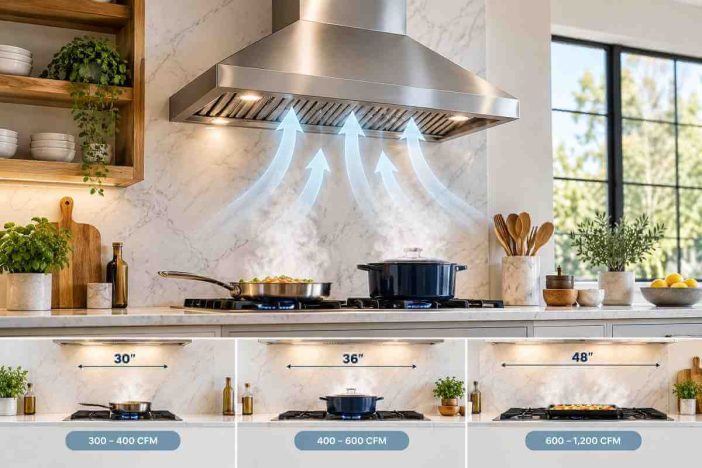
Choosing a range hood by CFM alone can leave a kitchen with plenty of fan power but disappointing real-world ventilation. The right size depends on the cooking surface, hood position, capture area, duct path, noise, and what happens to the rest of the house when that air is exhausted.
A range hood can look powerful on a specification sheet and still let the plume from a front burner roll past its edge. Another hood with a more modest airflow rating may perform surprisingly well because its canopy reaches farther over the cooking surface, its duct run is short, and the person using it is willing to turn it on.
That is why the useful question is not simply, “How many CFM should I buy?”
It is:
How much effective ventilation does this cooking setup need, and can the entire system actually deliver it?
CFM—cubic feet per minute—is still an important starting point. But it is only one part of the system.
The Short Answer: Start With Hood Width and Location
For conventional residential range hoods, the Home Ventilating Institute (HVI) recommends 100 CFM per linear foot of cooking surface for a wall-mounted range and 150 CFM per linear foot for an island installation. HVI also advises following the appliance manufacturer’s requirements for professional-style cooktops.
That gives the following useful starting points:
| Cooking surface | Wall-mounted hood | Island hood |
|---|---|---|
| 30 inches | 250 CFM | about 375 CFM |
| 36 inches | 300 CFM | about 450 CFM |
| 48 inches | 400 CFM | about 600 CFM |
For readers comparing UK or European specifications, 1 CFM is approximately 1.7 m³/h. That makes 300 CFM roughly 510 m³/h and 400 CFM roughly 680 m³/h.
These numbers are sizing guidance, not a promise of installed performance and not a universal building-code requirement.
A 300-CFM hood connected to an unfavorable duct system may not move the same amount of air once installed. More importantly, airflow does not tell you how much of the rising cooking plume the hood actually captures.
That distinction is fundamental to the system-based approach in the Kitchen Systems, Appliances & Efficiency hub: appliance specifications matter, but the components around the appliance determine whether those specifications translate into useful performance.
Why the CFM Number on the Box Is Only the Starting Point
CFM measures airflow volume. It does not directly measure how effectively the hood intercepts smoke, moisture, grease aerosols, and other material rising from the cooking surface.
Researchers at Lawrence Berkeley National Laboratory describe capture efficiency as the fraction of contaminants generated during cooking that are captured and exhausted by the hood. Their research specifically notes that airflow alone does not tell us how much cooking pollution reaches the exhaust.
Think of two umbrellas in the rain.
One is small but held directly over you. The other is much larger but shifted sideways. Size alone does not determine how dry you stay.
Range hoods behave in a similar way.
A hood’s real-world capture is affected by:
- how far the canopy projects over the cooktop;
- whether cooking occurs on front or rear burners;
- mounting height;
- hood geometry;
- airflow;
- cross-drafts in the room;
- and the resistance imposed by the exhaust path.
Berkeley Lab testing has also found that capture efficiency can be substantially poorer for emissions generated on front burners than on rear burners.
This is why buying the highest CFM number within a budget is not a reliable ventilation strategy.
A Five-Factor Framework for Sizing a Range Hood
Before comparing models, evaluate the installation in this order.
1. Cooking-surface width
Start with the physical width of the range or cooktop.
For standard residential equipment, HVI’s wall-mounted recommendation produces the familiar starting points of 250 CFM for 30 inches, 300 CFM for 36 inches, and 400 CFM for 48 inches.
The hood should also adequately cover the cooking area. A powerful blower cannot fully compensate for a canopy that allows the cooking plume to escape around its edges.
2. Hood location
A wall behind the range helps contain and direct the rising plume. An island does not have that assistance.
HVI therefore recommends a higher airflow rate for island installations: 150 CFM per linear foot rather than 100 CFM per linear foot for a wall installation.
This is one reason a 36-inch wall hood and a 36-inch island hood should not automatically be specified with the same blower.
3. Cooking pattern
Consider what happens on the cooktop rather than simply whether the appliance is labelled gas, electric, or induction.
Frequent frying, searing, wok cooking, griddling, or other high-emission cooking creates a more demanding capture problem than gently simmering a pot.
Also consider where that cooking occurs.
If large pans routinely occupy the front burners, hood depth and capture geometry become particularly important. EPA guidance recommends using back burners when possible because they generally allow the hood to capture cooking particles more effectively.
For professional-style or unusually high-output equipment, use the cooktop and hood manufacturers’ installation requirements rather than substituting a generic online formula. HVI gives the same advice for professional-style cooktops.
4. Exhaust path
The blower does not discharge into an empty laboratory.
It has to push air through the installed system.
Long duct runs, multiple elbows, transitions, unsuitable duct dimensions, restrictive exterior caps, and other resistance can reduce the airflow the installed system actually delivers.
This means two kitchens using the same hood can have different results.
Before buying, check the hood manufacturer’s installation manual for:
- required duct diameter;
- allowed duct type;
- maximum or equivalent duct length;
- permitted transitions;
- clearance requirements;
- exterior termination requirements;
- and mounting height.
Do not design the duct around whatever space remains after cabinets are installed. The airflow path is part of the appliance system.
5. Whether people will actually use it
A hood that technically performs well at its highest setting but is intolerably loud at that speed has a practical problem.
HVI-certified products can include both airflow and sound ratings, with sound commonly expressed in sones.
Compare noise at the speeds you expect to use regularly, not just maximum CFM.
A quieter medium setting that is switched on every time someone cooks may provide more real household value than an extreme boost mode that everyone avoids.
Range Hood Sizing Is Really a Capture Problem
This changes how you should read a product specification sheet.
Suppose Hood A is rated at 600 CFM but has a shallow canopy mounted high above the cooktop.
Hood B is rated at 400 CFM but extends farther over the burners and connects to a short, correctly sized exterior duct.
The specification sheet alone cannot establish which one will capture your cooking plume more effectively.
This is why capture efficiency matters.
Airflow describes how much air the blower moves. Capture efficiency describes how much material released at the cooking surface actually enters the exhaust system rather than escaping into the room. Berkeley Lab has developed testing specifically around this distinction.
When certified capture-efficiency information is available for a model, it adds useful context to the CFM number. When it is not available, hood geometry, coverage, mounting instructions, and verified airflow become even more important.
Wall Hoods and Island Hoods Should Not Be Sized the Same Way
An island range is exposed on every side.
There is no backsplash or wall immediately behind the burners to help contain the thermal plume. Air movement through an open-plan kitchen can also interfere with capture.
That is why HVI’s sizing guidance increases from 100 CFM per linear foot against a wall to 150 CFM per linear foot for an island.
For a 36-inch cooking surface, that means approximately:
- 300 CFM as the wall-mounted starting point;
- 450 CFM as the island starting point.
But the second number has an important consequence: once ventilation capacity climbs above roughly 400 CFM, makeup-air and pressure issues deserve attention rather than being treated as an afterthought.
Gas, Electric, and Induction Change the Source—Not the Need for Capture
Kitchen ventilation is sometimes discussed as though only gas cooking needs a range hood.
That is too simplistic.
The cooking process itself can generate particulate matter, especially during frying, grilling, sautéing, high-temperature cooking, or accidental burning. EPA therefore recommends using a range hood while cooking and, where possible, exhausting it outdoors.
Gas cooking adds combustion-related considerations, but switching to an electric or induction cooktop does not make grease, steam, smoke, or cooking-generated particles disappear.
The practical distinction is therefore:
fuel type affects what the ventilation system must manage, while cooking activity affects how much source capture is needed.
For induction and conventional electric cooking, do not arbitrarily slash CFM simply because there is no gas flame. Size the hood around cooking width, hood location, capture geometry, cooking intensity, and the manufacturer’s requirements.
The 400-CFM Question: When the Hood Starts Affecting the House
A high-capacity hood does not merely remove cooking air.
It removes house air.
That air has to be replaced.
If exhaust greatly exceeds incoming air, the home can become negatively pressurized. In some houses, that can interfere with naturally drafting combustion appliances.
EPA specifically cautions that high-airflow range hoods can contribute to combustion-appliance backdrafting and recommends professional help where range-hood selection or installation could create that concern.
The 2024 International Residential Code provides an important example. Section M1503.6 requires makeup air for an exhaust system capable of more than 400 CFM when qualifying gas-, liquid-, or solid-fuel appliances that are neither direct-vent nor mechanically drafted are located within the dwelling’s air barrier.
That does not mean:
“Every 401-CFM range hood everywhere requires makeup air.”
Local jurisdictions adopt and amend codes differently, and the IRC provision itself contains specific conditions.
Instead, treat 400 CFM as a planning checkpoint.
Before buying a 450-, 600-, 900-, or 1,200-CFM hood, ask:
- Which residential and mechanical codes are actually adopted where I live?
- Are there naturally drafting fuel-burning appliances inside the home’s air barrier?
- Does the hood manufacturer specify a makeup-air solution?
- Could the proposed system create undesirable pressure effects?
- Does a contractor, HVAC professional, or local building official need to review the design?
If the hood is part of a larger renovation, this is also the point to coordinate ventilation with kitchen electrical load planning rather than treating each appliance and system as a separate last-minute decision.
Ducted and Recirculating Hoods Are Not Equivalent
A ducted hood moves captured kitchen air to the outdoors.
A recirculating hood passes air through filters and sends it back into the room.
That distinction matters when reading CFM ratings.
HVI states that nonducted recirculating hoods do not provide actual ventilation and recommends equipment that exhausts directly outdoors for optimum kitchen air quality.
EPA similarly recommends an outdoor-vented range hood when possible.
A recirculating system may still have a practical role when exterior ducting cannot reasonably be installed. Grease filtration and activated-carbon filtration can help with specific contaminants and odors, depending on the system and filter condition.
But its airflow rating should not be interpreted as though 300 CFM of indoor air is being removed from the home. The air is being processed and returned.
That deserves its own buying decision rather than being buried inside a CFM calculation.
How to Compare Two Range Hoods Without Being Misled by One Big Number
Imagine you are choosing between two 36-inch wall hoods.
One advertises 900 CFM prominently.
The other advertises 450 CFM and provides clearer information about certified performance, sound, duct requirements, filters, mounting height, and installation.
The first number may look more impressive. It does not automatically make the first hood the better system.
Use this comparison framework instead:
| Check | Why it matters |
|---|---|
| Verified airflow rating | Helps distinguish measured performance from marketing claims |
| Hood width and depth | Determines how effectively the canopy covers the cooking source |
| Mounting-height range | Changes the relationship between the hood and rising plume |
| Duct diameter | Affects whether the exhaust path can support the intended flow |
| Duct-route limitations | Long or restrictive paths can compromise installed performance |
| Sound rating | Determines whether occupants are likely to use useful fan speeds |
| Filter access | Poor access makes routine maintenance less likely |
| Exterior venting | Determines whether captured air actually leaves the building |
| Makeup-air implications | Becomes increasingly important with high exhaust rates |
| Serviceability | Matters long after the purchase decision |
HVI notes that certified performance ratings can help buyers assess airflow claims.
The maintenance side should not be ignored either. Grease-loaded filters and neglected components can turn a well-designed hood into a poorly performing one. HomeKitchenMagazine’s year-round kitchen appliance maintenance checklist places range-hood care inside the same preventive system used for other major appliances.
And because repairability and maintenance access affect long-term ownership, the decision also fits into the broader framework in Kitchen Appliance Lifespan: What Really Lasts and Why.
Three Real-World Sizing Scenarios
The following examples are planning scenarios, not substitutes for manufacturer instructions or local code review.
Scenario 1: 30-inch wall range in a conventional kitchen
The cooking surface is 30 inches wide and sits against a wall.
HVI’s recommended starting point is:
2.5 feet × 100 CFM = 250 CFM.
For normal residential cooking, a properly designed 250-CFM-class system may therefore be more rational than automatically buying a 600-CFM hood.
Before making the decision, confirm canopy coverage, duct requirements, mounting height, cooking pattern, and noise.
Scenario 2: 36-inch wall cooktop with frequent high-emission cooking
The baseline HVI recommendation is approximately 300 CFM.
But suppose the household frequently sears meat, stir-fries, or uses large pans on the front burners.
The decision should not simply become “double the CFM.”
Instead, investigate:
- canopy depth;
- hood width;
- capture over the front burners;
- usable fan speeds;
- duct restrictions;
- and whether the manufacturer specifies additional airflow.
This is a case where geometry can be as important as buying a larger motor.
Scenario 3: 36-inch island cooktop
HVI’s recommended island rate gives approximately:
3 feet × 150 CFM = 450 CFM.
Now the decision crosses an important planning boundary.
Because the proposed exhaust capacity exceeds 400 CFM, the designer should check whether applicable local code, the home’s combustion appliances, and pressure conditions create makeup-air requirements or other design considerations.
The extra 150 CFM is therefore not just a bigger fan.
It may alter the project.
Seven Range Hood Sizing Mistakes That Create Weak Ventilation
Buying the highest CFM you can afford
More airflow can help, but it can also increase noise, duct demands, energy use, and pressure-management requirements.
Buy enough system performance, not the largest motor.
Ignoring hood depth
A hood that barely reaches the front burners may struggle to intercept the plume even when its blower is powerful.
Treating rated CFM as installed CFM
The exhaust duct and fittings are part of the airflow system. Read the installation requirements before cabinetry closes off your options.
Using a room-volume formula as the entire sizing method
Kitchen exhaust is primarily a source-capture problem. Clearing the room after contaminants escape is not the same as intercepting them at the cooktop.
Mounting the hood wherever it looks best
Mounting height affects capture. HVI advises using the manufacturer’s specified installation height; its review of member instructions found a typical range around 20 to 30 inches, but the exact product instructions govern.
Comparing ducted and recirculating CFM as though they mean the same thing
One exhausts air from the building. The other returns filtered air to the room.
The number may use the same unit, but the ventilation outcome is different.
Ignoring sound
A hood that household members refuse to turn on is an underperforming system regardless of its laboratory airflow.
The Pre-Purchase Range Hood Verification Checklist
Before paying for the hood—or allowing cabinet and duct decisions to become difficult to change—verify the following.
This checklist is deliberately longer than a simple CFM calculator because a range hood is not merely a fan attached to a cabinet. It is part of the building’s air system.
Once the Hood Is Installed, How You Use It Still Matters
Sizing does not end the ventilation problem.
EPA recommends turning the range hood on whenever cooking, using back burners when possible, and allowing the hood to continue operating for 10 to 20 minutes after cooking.
That advice illustrates an often-overlooked point: performance depends on both equipment and behavior.
The most sophisticated hood cannot capture a cooking plume when it is switched off.
Likewise, routine filter cleaning matters. HVI notes that grease-filter cleaning frequency depends on use and gives approximately monthly cleaning as a general reference for aluminum mesh grease filters. Always follow the specific manufacturer’s instructions for the installed model.
FAQ
Is 300 CFM enough for a 30-inch range hood?
For a conventional 30-inch wall-mounted range, HVI recommends about 250 CFM, so 300 CFM can fall within a reasonable planning range. Actual suitability still depends on hood geometry, cooking intensity, duct design, mounting height, and the appliance manufacturer’s instructions.
Is 400 CFM enough for a gas range?
There is no universal answer based only on fuel type. Hood width, cooktop output, cooking behavior, canopy design, ductwork, and manufacturer requirements all matter. HVI specifically recommends following manufacturer guidance for professional-style cooktops rather than relying on one generic CFM number.
Do induction cooktops still need a range hood?
Induction eliminates combustion at the burner, but cooking itself can still generate particles, grease aerosols, steam, smoke, and odors. EPA recommends using kitchen ventilation during cooking and prefers outdoor exhaust where feasible, so induction does not eliminate the value of source capture.
Is a higher-CFM range hood always better?
No. Higher airflow may improve capture under some conditions, but CFM alone does not measure capture efficiency. Hood geometry, burner position, mounting, duct resistance, noise, and pressure effects also matter. A correctly designed lower-CFM installation can therefore be preferable to a poorly designed high-CFM one.
A Better Range Hood Decision Starts Before the Blower
If you are asking how many CFM a range hood needs, start with the cooking-surface width and hood location—but do not stop at the resulting number.
A 30-inch wall installation may begin around 250 CFM. A 36-inch wall setup may begin around 300 CFM. The same 36-inch cooktop on an island moves the starting point toward 450 CFM.
After that, evaluate what determines whether the airflow will actually work: capture coverage, mounting, duct design, sound, cooking pattern, maintenance, and pressure balance.
That approach avoids both common extremes: buying too little ventilation and buying an enormous blower to compensate for a poorly designed system.
The range hood should not merely move a large number of cubic feet per minute.
It should capture the cooking plume, move it through a workable exhaust path, and do so without creating a new problem elsewhere in the home.