A refrigerator does not need a miniature solar panel attached to it to run on solar energy.
In most grid-connected homes, the more practical system is much simpler:
solar panels generate electricity → an inverter supplies usable household AC power → ordinary kitchen appliances use that electricity
That distinction matters because the phrase solar powered kitchen appliances can create the impression that homeowners need to buy special solar refrigerators, microwaves, dishwashers, or cooking appliances.
Usually, they do not.
A standard electric kitchen appliance can be supplied by a properly designed home solar system when the electrical system, inverter capacity, available solar generation, and—where applicable—battery storage can support the load.
The real planning question is therefore not:
“Which kitchen appliances have solar panels?”
It is:
“Can the home’s solar and electrical system supply the kitchen loads we want to run, and for how long?”
Quick Answer: Can Kitchen Appliances Run on Solar Power?
Yes. Many ordinary electric kitchen appliances can operate as part of a residential solar-electric system.
However, the answer depends on more than the appliance’s wattage.
You need to consider:
- the appliance’s running power;
- short-duration peak or startup demand where applicable;
- how long the appliance operates;
- whether several kitchen loads may run at the same time;
- solar-array production;
- inverter capacity;
- grid connection;
- and battery power and usable energy if backup operation is expected.
A refrigerator, for example, uses electricity over many hours but does not draw its rated maximum power continuously.
An electric kettle may draw much more power while operating but only for a few minutes.
An electric oven or induction range can create a much larger sustained load and may influence both solar-system sizing and the home’s electrical infrastructure.
This is why watts alone are not enough.
For solar planning, you need to distinguish:
Power (kW) — how much electricity an appliance demands at a particular moment.
Energy (kWh) — how much electricity the appliance uses over time.
What “Solar-Powered Kitchen Appliance” Actually Means
There are three different systems that are often grouped under the same phrase.
Grid-Connected Solar Home
This is the most common residential arrangement.
Solar photovoltaic panels generate DC electricity. An inverter converts that electricity into AC power used by typical household appliances.
The refrigerator, dishwasher, microwave, coffee maker, or induction appliance can therefore remain an ordinary household product.
The home energy system is solar-powered; the appliance itself does not need to be a special solar model.
Solar Plus Battery Storage
A battery can store energy and make it available later, including after solar production falls.
That can be useful when households want to shift solar energy into evening appliance use or provide backup power.
But battery capacity must be evaluated in both power and energy terms.
A battery may have enough stored energy for an appliance yet still be unable to supply a load whose instantaneous power demand exceeds the battery or inverter rating.
Dedicated Off-Grid or Portable Solar Equipment
Cabins, RVs, outdoor kitchens, remote properties, and emergency systems may use appliances designed specifically around lower-voltage DC systems or portable power stations.
Those systems are different from a conventional grid-connected residential kitchen and should be evaluated separately.
The important takeaway is:
Do not buy an appliance merely because it is marketed as “solar compatible.” First determine how the home’s solar, inverter, battery, electrical circuit, and appliance load actually fit together.
What Solar Can—and Cannot—Change in a Kitchen
1. Solar Can Offset Kitchen Electricity, but Savings Are Household-Specific
A solar-electric system can reduce the amount of electricity a home purchases from the grid, including electricity used by kitchen appliances.
But there is no credible universal figure such as:
“A solar-powered kitchen saves $X per year.”
The financial result depends on:
- how much electricity the household uses;
- how much electricity the solar system actually produces;
- when that electricity is produced;
- when kitchen appliances operate;
- local electricity prices;
- compensation for electricity exported to the grid;
- system purchase or financing cost;
- battery cost, if storage is included;
- and available incentives.
This also means that a high-wattage appliance is not automatically the appliance with the highest annual energy cost.
A kettle may draw substantial power for only a few minutes.
A refrigerator draws much less at any one moment but operates intermittently throughout the day and night.
For useful planning, separate:
Power demand (kW) — whether the system can run the appliance at that moment.
Energy consumption (kWh) — how much electricity the appliance uses over time.
Estimate the Kitchen Load Before Estimating Savings
Start with actual appliance energy use whenever possible.
Record:
- refrigerator consumption;
- dishwasher cycles;
- microwave use;
- electric cooking;
- coffee makers and kettles;
- ventilation equipment;
- and other frequently used electrical loads.
Then compare that consumption with expected solar production.
For a grid-connected system, a qualified solar professional can estimate expected generation for the site rather than relying on a generic number of kilowatt-hours per day.
Solar savings should be calculated from the complete household system—not by assigning an arbitrary percentage of whole-home solar savings to the kitchen.
2. Solar Changes the Electricity Source, Not the Appliance Efficiency
Running a refrigerator from solar electricity does not make the refrigerator itself more efficient.
Its energy demand remains determined by factors such as:
- appliance design;
- size;
- temperature settings;
- ambient conditions;
- usage;
- maintenance;
- and efficiency rating.
The same principle applies to dishwashers, microwaves, and electric cooking appliances.
This creates two separate opportunities:
Use a more efficient appliance to reduce the amount of electricity required.
Use solar generation to supply some of that electricity from an on-site renewable source.
Combining those two strategies can reduce the amount of generation capacity needed to serve the same household tasks.
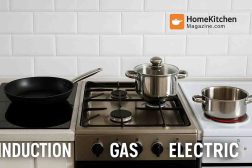
For cooking, see Induction vs Gas vs Electric Stove: Which Is Best? for the differences between cooking technologies themselves.
What About Environmental Impact?
Solar PV does not create fuel-combustion emissions while generating electricity at the home.
However, that does not make the complete system impact-free.
Panels, inverters, batteries, mounting equipment, transportation, installation, and eventual replacement all have material and lifecycle impacts.
The appropriate comparison therefore depends on:
- the electricity source being displaced;
- system production over its useful life;
- equipment manufacturing;
- storage configuration;
- and how efficiently the household uses electricity.
Avoid converting kitchen electricity into a fixed number of kilograms of avoided CO₂ without using location-specific grid data and an appropriate emissions methodology.
3. Solar Does Not Automatically Keep the Kitchen Running During an Outage
This is one of the most important distinctions in residential solar planning.
A standard grid-connected solar system will generally shut down when utility power fails.
This protects utility workers and prevents the home from unintentionally sending electricity into a de-energized grid.
Therefore:
solar panels alone ≠ automatic backup power
Outage operation requires equipment specifically designed for backup or islanded operation.
Depending on the system, that may include:
- battery storage;
- a compatible inverter;
- automatic transfer or isolation equipment;
- protected backup circuits;
- and an energy-management system.
Prioritize Loads Instead of Trying to Back Up the Entire Kitchen
A refrigerator may be an important backup load.
An electric range, oven, dishwasher, kettle, microwave, and refrigerator operating together can create a much larger requirement.
A better resilience plan separates:
essential loads from optional high-power loads.
For example, a household may prioritize:
- refrigerator;
- freezer;
- selected lighting;
- communications;
- and a modest cooking appliance.
Large resistance-heating or electric-cooking loads should be included in backup planning only when the battery and inverter have been intentionally sized to support them.
Backup duration cannot be predicted from battery capacity alone.
It depends on both:
available battery energy + the actual load profile.
The Practical Advantage: Match Appliance Use to Available Energy
The most useful “smart” feature in a solar-powered kitchen is not necessarily an appliance with solar branding.
It is the ability to understand and manage electrical loads.
Solar production changes throughout the day.
Kitchen demand also changes.
A refrigerator cycles automatically, while a dishwasher, oven, kettle, or induction cooktop is used at specific times.
That creates opportunities to shift flexible loads toward periods when solar production is available.
Run Flexible Loads When Solar Production Is Strong
Where the household’s tariff and solar configuration make it beneficial, flexible tasks may include:
- running the dishwasher;
- using small countertop appliances;
- food preparation with electric appliances;
- charging appliance batteries;
- or other non-urgent electrical tasks.
That does not mean every activity must happen at noon.
The objective is simply to understand whether moving a flexible load improves self-consumption or reduces grid imports under the home’s actual electricity plan.
Do Not Confuse Load Shifting With Backup Capacity
Using an appliance during strong daytime solar production is different from running it during a blackout.
During normal grid-connected operation, the grid may supplement solar production whenever household demand exceeds PV output.
During an outage, that grid support is unavailable.
A backup system therefore has to support the required load independently.
This distinction becomes especially important with high-power appliances such as:
- electric ovens;
- induction ranges;
- electric water heating;
- and multiple heating appliances operating simultaneously.
Energy-Efficient Appliances Can Reduce Solar-System Demand
Improving appliance efficiency can reduce the amount of electricity that needs to be generated, purchased, or stored.
That can be more valuable than searching for an appliance marketed specifically as “solar-powered.”
For an existing home, the planning sequence should usually be:
measure electricity use → reduce unnecessary demand → identify essential loads → estimate solar production → decide whether storage is needed → size the system
This prevents the common mistake of sizing panels or batteries around appliance nameplate wattage without understanding real operating patterns.
Use Monitoring Data Instead of Guesswork
If the solar inverter, utility meter, smart panel, or home energy monitor provides load data, use it.
Useful measurements include:
- total household demand;
- solar generation;
- grid import;
- grid export;
- battery charging;
- battery discharge;
- and peak simultaneous demand.
Those measurements can reveal whether the kitchen’s main challenge is:
high total energy use, high short-duration power demand, evening consumption, or outage backup.
Each problem requires a different solution.
The goal is not to create a kitchen filled with specialized “solar appliances.”
The goal is to build an electrical system in which ordinary appliances, solar generation, storage, and household behavior work together predictably.
How to Plan Solar Power for Kitchen Appliances
A useful solar-kitchen plan starts with measured electricity demand—not a generic solar-system size.
1. Measure the Kitchen Loads You Actually Use
Start with the appliances already in the home.
For each important load, record:
| Appliance | What to identify |
|---|---|
| Refrigerator or freezer | Typical energy use and any startup demand |
| Dishwasher | Energy per cycle and typical operating time |
| Microwave | Input power and normal minutes of use |
| Kettle or coffee maker | Input power and typical duration |
| Induction cooktop or electric range | Circuit requirements and likely simultaneous cooking load |
| Range hood | Fan and lighting power |
| Small appliances | Rated input and normal operating duration |
Use the appliance energy label, manufacturer specifications, utility data, smart-plug measurements where appropriate, or a home energy monitor rather than relying on generic examples.
For whole-home solar sizing, historical utility bills are particularly useful because they reveal actual seasonal electricity consumption.
2. Separate Energy From Peak Power
A solar and battery system has to solve two different problems.
Energy, measured in kWh, tells you how much electricity is required over time.
Power, measured in kW, tells you how much electrical demand must be supplied at one moment.
A system can have enough stored energy for several hours of refrigerator operation but still be unable to support an electric range if the inverter’s output rating is too low.
Likewise, several appliances operating simultaneously can create a much larger peak load than any one appliance alone.
This distinction becomes especially important when planning backup power.
3. Estimate Solar Production for the Actual Property
Do not assume that every 5 kW solar array produces the same number of kilowatt-hours per day.
Production depends on factors including:
- geographic location;
- roof orientation and tilt;
- shading;
- weather;
- system losses;
- module characteristics;
- and system design.
NREL’s PVWatts Calculator can provide an initial estimate of the energy production of a grid-connected PV system for a specific location and configuration.
Treat that result as a planning estimate, not a guaranteed output.
A qualified installer can then evaluate the actual roof, electrical service, equipment, utility rules, and site conditions.
4. Decide Whether the Goal Is Savings, Self-Consumption, or Backup
These goals are related but not identical.
A grid-connected household interested mainly in offsetting purchased electricity may not need battery storage.
A household that wants to use more daytime solar energy after sunset may consider storage for load shifting.
A household that wants appliances to operate during grid outages needs a system specifically designed for backup operation.
Define that objective before choosing battery capacity.
5. Choose Backup Loads Deliberately
If outage resilience matters, decide which appliances are genuinely essential.
For many households, preserving refrigeration may matter more than operating every cooking appliance simultaneously.
An emergency plan might therefore prioritize refrigeration and a modest cooking load rather than attempting to back up the entire kitchen.
The correct combination depends on the household and the electrical system.
Battery sizing must account for both:
maximum power required at one time
and
total energy required for the desired backup duration
There is no universal statement such as “a 10 kWh battery runs a kitchen for eight hours.”
The answer changes with the connected loads.
6. Check Electrical Compatibility Before Adding Large Cooking Loads
Large electric cooking appliances can create substantially different requirements from countertop appliances.
Before adding or converting to an induction range, electric range, or other high-power appliance, verify:
appliance requirements → branch circuit → wiring → breaker → electrical service or panel capacity
For induction specifically, see Induction Cooktop Electrical Requirements.
Do not assume a solar installation eliminates normal electrical-code, circuit, or service-capacity requirements.
7. Use Ordinary Efficient Appliances When They Fit the System
Most grid-connected homes do not need refrigerators, dishwashers, microwaves, or cooking appliances marketed specifically as “solar-ready.”
A properly designed inverter supplies AC electricity that ordinary compatible household appliances can use.
Special DC appliances can make sense in RVs, cabins, boats, remote installations, or purpose-built off-grid systems, but they solve a different problem.
For a conventional home, a more useful strategy is:
reduce unnecessary electricity demand → choose efficient appliances → size solar generation to real consumption → add storage only when the use case justifies it
For broader appliance consumption planning, see Kitchen Appliance Electricity Use.
8. Verify the System With Site-Specific Modeling
Before purchasing equipment, compare:
| Question | What must be verified |
|---|---|
| How much electricity does the home use? | Historical bills and measured loads |
| How much can the proposed PV system generate? | Site-specific solar-production estimate |
| What is the highest simultaneous demand? | Appliance load analysis |
| Is backup required? | Essential-load plan |
| Can the battery deliver the required power? | Battery and inverter output ratings |
| How long should backup last? | Usable battery energy versus expected load |
| Can the home’s electrical system support new appliances? | Circuit, panel, wiring, and service evaluation |
| Does the project make financial sense? | Installed cost, tariffs, incentives, financing, and expected production |
The system should be sized around the actual home and actual loads, not around a generic statement that a certain number of panels or kilowatt-hours will “power a kitchen.”
Common Questions About Solar-Powered Kitchen Appliances
Will solar panels power kitchen appliances on cloudy days?
Solar PV can continue generating electricity under some cloudy conditions, but output varies substantially with irradiance, weather, system design, location, and time of day.
There is no reliable universal percentage that applies to every cloudy day.
In a grid-connected home, the grid can normally supply the difference when solar production is below household demand.
A battery can also contribute when the system is configured to use stored energy.
Will rooftop solar keep my refrigerator running during a blackout?
Not necessarily.
A conventional grid-connected solar system normally shuts down during an outage for safety.
Keeping selected appliances powered requires a system designed for backup operation, which may include compatible battery storage, inverter equipment, isolation or transfer equipment, and designated backup circuits.
Never assume that rooftop panels alone provide outage protection.
Do I need special solar kitchen appliances?
Usually not in a conventional grid-connected home.
The solar array generates electricity for the home’s electrical system, and the inverter converts PV output into AC electricity that ordinary compatible household appliances can use.
Specialized DC appliances are more relevant to certain off-grid, RV, marine, or portable systems.
How long will a home battery run a kitchen?
There is no useful answer based only on the battery’s advertised kWh capacity.
Runtime depends on:
usable stored energy ÷ actual connected load
and the system must also have sufficient instantaneous power capability to start and operate those appliances.
A refrigerator-only backup plan therefore produces a very different runtime from one that also includes an induction range, microwave, kettle, dishwasher, and other loads.
Is solar guaranteed to reduce my electricity bill?
No fixed saving can be guaranteed from the technology alone.
Results depend on system production, household electricity consumption, local electricity rates, how exported solar electricity is compensated, equipment costs, financing, incentives, and how much solar energy is used directly in the home.
A site-specific financial model is more useful than a generic payback claim.
Build the Solar System Around the Kitchen, Not the Marketing Label
The most important lesson is that solar-powered kitchen appliances are usually a system-design question rather than an appliance category.
A refrigerator does not become fundamentally different because some of its electricity comes from rooftop solar.
What changes is the energy system supplying it.
A practical solar kitchen therefore begins by determining:
what the appliances consume → when they consume it → how much solar the property can produce → whether storage is needed → which loads must survive an outage
Only after those questions are answered should equipment size enter the discussion.
For some households, the most rational setup will be ordinary efficient appliances connected to a grid-tied solar system.
For others, solar plus battery storage may provide useful load shifting or outage resilience.
Remote and off-grid installations may justify dedicated DC or specialized low-energy appliances.
None of those configurations is automatically best.
The right design is the one whose generation, inverter, storage, electrical infrastructure, and appliance loads are matched to the same real-world operating plan.
Before buying additional panels, batteries, or appliances, measure the load first.
Then size the system around evidence rather than assumptions.
For related planning, explore the Kitchen Systems, Appliances & Efficiency Hub.