If a pipe bursts tomorrow, the damage matters.
But what insurers evaluate first isn’t the damage.
It’s your history.
Claims don’t fail because something broke. They fail because there’s no proof it was maintained.
This is where most homeowners lose—not in the event, but in the documentation.
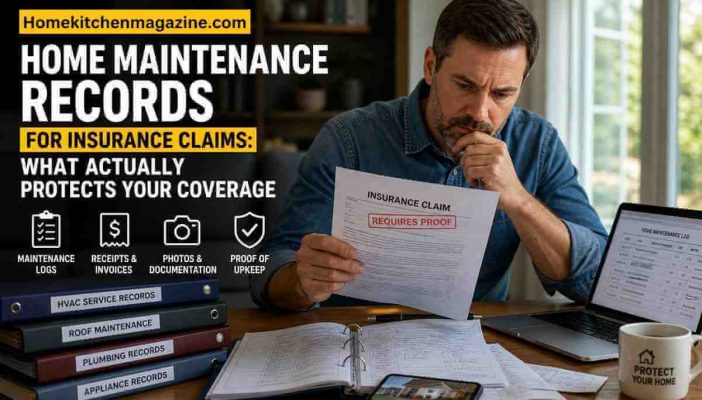
This guide breaks down exactly how home maintenance records for insurance claims work, what insurers expect, and how to build a system that protects your coverage before anything goes wrong.
Why Home Maintenance Records Matter More Than The Damage Itself
Insurance doesn’t just cover damage.
It evaluates responsibility.
Quick Answer
Home maintenance records for insurance claims prove that damage was sudden—not caused by neglect. Without documentation, insurers may classify damage as preventable, leading to reduced payouts or full claim denial.
What Insurers Are Really Looking For
When reviewing a claim, insurers assess:
- Was the system maintained?
- Was the issue predictable?
- Was failure sudden or gradual?
If you cannot answer these with evidence, the claim becomes weaker—regardless of damage severity.
This is exactly where many homeowners run into issues outlined in
Water Damage Claim Denied? 7 Reasons Insurers Push Back (And How To Respond)
What Counts As Valid Maintenance Documentation
Not all records are equal.
Insurers prioritize documentation that proves consistency and intent, not just isolated repairs.
Core Documentation Types
1. Maintenance Logs
- Dates of inspections
- Systems checked
- Observations recorded
2. Repair Receipts
- Plumbing work
- Electrical upgrades
- Appliance servicing
3. Inspection Reports
- Professional home inspections
- Pre-sale evaluations
- Safety system reviews
4. Photo Evidence
- Before/after maintenance
- Condition of key systems
- Timestamped records
5. Replacement Records
- Supply lines
- Detectors
- Shut-off valves
The Most Important Systems To Document (High-Risk Areas)
Not all systems carry equal risk.
Focus documentation where claims most often occur.
🔧 Priority Systems
- Water systems (highest risk)
- Electrical panels and load capacity
- Roofing and drainage
- Safety systems (detectors, shut-off devices)
Water-related issues alone drive a large portion of claims, especially when tied to failures discussed in
How to Prevent Costly Water Damage at Home
The 5-Part Documentation System That Actually Works
This is the structure used in real-world claim defense.
Step 1 — Create A Central Maintenance Log
Track:
- Inspection dates
- Observations
- Actions taken
Keep it simple—but consistent.
Step 2 — Document Replacement Cycles
Especially for:
- Braided stainless supply lines
- Shut-off valves
- Appliances
These are failure points discussed in
How Long Do Braided Stainless Steel Supply Lines Really Last
Step 3 — Capture Visual Evidence
Take photos:
- Under sinks
- Behind appliances
- Electrical panels
Images validate condition—far more than written notes.
Step 4 — Store Receipts And Reports
Keep:
- Contractor invoices
- Inspection reports
- Service confirmations
Digital storage is preferred.
Step 5 — Review Annually
Update logs and verify:
- System condition
- Replacement schedules
- Risk indicators
This aligns directly with
Home Safety Inspection: What to Check Before Problems Appear
Common Documentation Mistakes That Lead To Claim Denial
These mistakes appear repeatedly in denied claims.
🚫 No Maintenance History
Only documenting after failure creates a credibility gap.
🚫 Incomplete Records
Missing dates, vague notes, or no proof of work.
🚫 Ignoring High-Risk Components
Supply lines, valves, and pressure systems are often undocumented.
🚫 No Visual Proof
Without photos, claims rely entirely on written statements.
🚫 Reactive Documentation
Records created after damage carry less weight.
How Documentation Affects Claim Outcomes
Without Documentation
- Claim questioned
- Damage labeled “gradual”
- Payout reduced or denied
With Documentation
- Proof of maintenance
- Higher credibility
- Faster approval
- Stronger negotiation position
Insurance doesn’t reward damage.
It rewards predictability.
Recommended Tools & Upgrades
If you want to reduce risk and strengthen your documentation:
- Leak detection sensors for early warning
- Automatic water shut-off valves
- High-quality braided stainless supply lines
- Water pressure regulators
These tools don’t just prevent damage.
They create documentable proof of prevention effort, which strengthens claims significantly.
Expert Insight: What Actually Wins Claims
Across real claim scenarios:
Winning claims have:
- Consistent maintenance logs
- Clear replacement records
- Visual documentation
- Evidence of preventive action
Denied claims often share one trait:
Lack of proof.
FAQ
Do I Need Professional Records For Insurance Claims?
Not always. Personal logs are valid if consistent and detailed, but professional reports add credibility.
How Far Back Should Maintenance Records Go?
At least 3–5 years for major systems. Longer is better.
Can Photos Alone Be Enough?
No. Photos support documentation—but should be combined with logs and receipts.
What Is The Most Important Record?
Water system maintenance—because it drives the highest claim frequency.
What To Do Next
If your documentation doesn’t exist yet, start small:
- Create a maintenance log today
- Photograph key systems
- Track next inspection date
- Replace high-risk components proactively
Then connect your system with structured frameworks like:
- Kitchen Leak Risk Audit Checklist: 15 Points Homeowners Miss Every Year
- Preventive Maintenance Strategies That Protect Property Value
Because once damage happens, documentation is no longer optional.
It becomes your only defense.
And the difference between approval and denial is rarely the damage.
It’s the record behind it.