Smoke detector placement is rarely discussed until a fire happens—and by then, it’s already too late. In many homes, alarms are installed as an afterthought: wherever there is space, wherever it looks neat, wherever it feels “high enough.” But smoke does not move politely upward in straight lines. It drifts, it stalls, it follows airflow, and it exploits every closed door and hallway turn. Understanding where smoke travels is the difference between early warning and silence.
Quick Answer: Where should smoke detectors be installed?
Install smoke alarms inside every bedroom, outside each sleeping area (hallway), and on every level of the home. Place them on the ceiling (preferred) or high on the wall, away from corners and airflow “dead zones,” and keep them away from cooking appliances to reduce nuisance alarms.
Smoke Detector Placement Guide for Every Home Layout
Step 1 — Understand smoke behavior (why placement matters)
Smoke generally rises, but it doesn’t rise straight up like a cartoon. It moves with:
- heat plumes from fires,
- HVAC airflow,
- open stairwells,
- hallways and door gaps.
That means the best placement is not “anywhere high.” The best placement is where smoke will reach the alarm early, before it spreads.
Step 2 — The 3 non-negotiable placement zones
1) Inside every bedroom
Bedroom doors slow smoke. If the alarm is only in the hallway, you may lose precious warning time—especially at night.
2) Outside each sleeping area
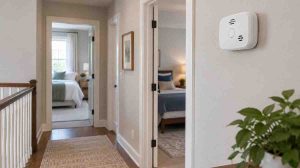
Place an alarm in the hallway outside bedrooms, positioned so it can detect smoke coming from living areas.
3) On every level of the home
Basements and upper floors need their own alarms. Fires often start out of sight—laundry areas, garages (if attached), and electrical sources are common risk zones.
Step 3 — Ceiling vs wall: exact positioning that works
Ceiling placement (best option)
- Install near the center of the ceiling when possible.
- Avoid corners where airflow can stall.
Wall placement (when ceiling isn’t possible)
- Install high on the wall, close to the ceiling.
- Keep it below the ceiling line enough to avoid the “dead air” zone that forms at the top.
Rule of thumb: If you have a choice, choose the ceiling.
Step 4 — Room-by-room placement guide (practical)
Bedrooms
- One alarm inside each bedroom.
- If you have kids, make sure the alarm is not blocked by furniture or thick curtains.
Hallways
- Install outside the sleeping area.
- For long hallways, add additional alarms so smoke can’t travel too far before detection.
Living room / family room
- Add an alarm if the living area is far from the hallway detector or has multiple exits.
- Open layouts often need extra coverage because airflow patterns vary.
Kitchen (special placement)
The kitchen is the #1 place where people install detectors incorrectly.
Do this instead:
- Place a smoke alarm outside the kitchen area, not directly above the stove.
- Keep distance from cooking appliances to reduce nuisance alarms.
If you regularly get nuisance alarms, don’t remove the detector—fix placement and consider a detector type designed to reduce false alarms.
Stairs & multi-story homes
- Place an alarm near the stairwell because smoke often travels upward quickly.
- Upper floors should always have coverage independent of the ground floor.
Basement
- Install at the bottom of stairs or near areas with potential ignition sources.
- Basements often have poor airflow and delayed detection if not covered.
Step 5 — How many smoke detectors do you actually need?
Use this fast count:
- 1 inside each bedroom
- 1 outside each sleeping area
- 1 on each level
Then add extras for: - long hallways,
- open-plan areas,
- homes with multiple wings or split levels.
If your home has a complex layout, treat each “sleeping zone” like its own mini-home: it needs inside + outside coverage.
Common placement mistakes that reduce protection
1) Installing too close to the stove
It causes nuisance alarms, then people disable alarms—worst outcome.
2) Skipping bedroom alarms
Doors buy time for smoke. That time also delays detection.
3) Installing near vents, fans, or windows
Airflow can push smoke away from the sensor.
4) Installing only one alarm for the whole house
Homes are not one room. Smoke doesn’t travel instantly.
5) Forgetting basements or upper floors
Fires don’t “schedule” themselves for visible areas.
Maintenance checklist (do this so your alarm works when needed)
- Test alarms regularly.
- Replace batteries on schedule (or use long-life options).
- Keep alarms clean—dust and grease can reduce sensitivity.
- Replace old units at recommended intervals.
Related guides
For a complete safety setup, continue with:
- Safety & Sustainability hub
- Carbon Monoxide Detector Placement
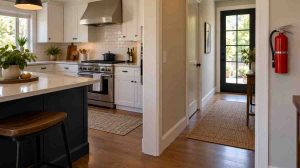
- For suppression planning, use our fire extinguisher placement guide to choose visible locations near exit paths without putting the extinguisher beside the hazard you may need to escape.
- Kitchen Fire Prevention Basics
Smoke and carbon monoxide alarms solve different detection problems, so their placement rules should not be treated as interchangeable. Our carbon monoxide detector placement guide explains sleeping-area coverage, mounting-height guidance, attached-garage placement, and the locations homeowners should avoid.
FAQ
Should I install smoke detectors in the kitchen?
Avoid placing them directly in the kitchen near cooking appliances. Place them just outside the kitchen area for early detection without constant false alarms.
Is one smoke detector enough for a small house?
Usually not. You still need coverage inside bedrooms, outside sleeping areas, and on each level.
Where should smoke detectors be installed in a two-story home?
At minimum: inside bedrooms, outside sleeping areas, and one on each level—plus near stairwells for better early detection.
Can I place a smoke detector near an air conditioner vent?
Avoid it. Strong airflow can redirect smoke away from the sensor and delay detection.
Closing
Smoke detectors only protect you when they detect smoke early—and early detection depends heavily on placement. If you want to strengthen your entire home safety framework, build outward from this guide using our Safety & Sustainability hub as your map.