Most kitchen leaks don’t start with pipes. They start with connectors.
Behind the dishwasher. Under the sink. Attached to the refrigerator’s ice maker. A braided stainless steel supply line quietly carries pressurized water day after day—until it doesn’t.
When reviewing plumbing-related damage cases, one component appears repeatedly at the center of failure: the braided stainless connector.
The outer braid looks strong. The fittings appear solid. The line feels durable. Yet years later, the inner rubber core weakens, the crimp collar loosens, and rupture occurs suddenly.
So how long do braided stainless steel supply lines last?
The answer isn’t marketing-driven. It’s failure-pattern driven.
What A Braided Stainless Steel Supply Line Really Is
Before discussing lifespan, understand construction.
A typical braided stainless steel supply line includes:
- Inner rubber or polymer tube (carries water)
- Stainless steel braided exterior (reinforcement)
- Crimped metal ferrules at both ends
- Threaded connectors
The stainless braid does not carry water.
The inner tube does.
When people ask how long braided stainless steel supply lines last, they’re really asking:
How long does the inner rubber core remain structurally reliable under pressure?
Average Lifespan: The Realistic Range
In practical residential use:
- Expected lifespan: 5–10 years
- Conservative replacement window: 7 years
- High-pressure environments: Possibly shorter
Some manufacturers claim longer durability. However, inspection data and plumbing experience consistently show increased failure probability after the 7–10 year mark.
The key insight:
Braided stainless lines rarely degrade gradually. They often fail suddenly.
Why Braided Stainless Steel Supply Lines Fail
Understanding failure modes helps determine replacement timing.
1. Inner Core Degradation
The inner rubber tube experiences:
- Constant pressure
- Temperature changes
- Chemical exposure from water treatment
Over time, elasticity decreases. Micro-cracks form internally.
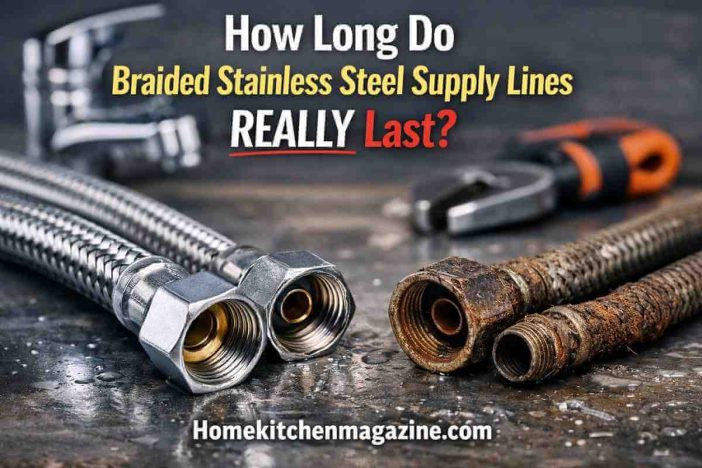
Outer braid may still look perfect while inner core weakens.
2. Crimp Collar Corrosion
The metal crimp ring connecting hose to fitting can corrode due to:
- Moisture exposure
- Cabinet humidity
- Cleaning chemicals
Corroded crimps reduce structural integrity, increasing rupture risk.
3. Excessive Water Pressure
Normal pressure: 40–60 psi
Above 80 psi: Increased stress on connectors
High pressure accelerates failure timeline significantly.
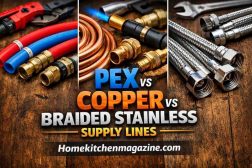
As discussed in PEX vs Copper vs Braided Stainless Supply Lines: Which Is Safest for Kitchens?, material strength cannot compensate for unmanaged pressure.
4. Vibration Stress
Dishwashers and garbage disposals create vibration.
Repeated micro-movement stresses fittings and crimps over years.
Kitchen environments amplify wear compared to bathroom supply lines.
Failure Timeline Pattern
Based on observed plumbing patterns:
Years 0–3:
Low failure probability. Installation quality most important factor.
Years 4–6:
Moderate risk begins. Corrosion and inner fatigue may start.
Years 7–10:
Failure probability increases significantly.
Beyond 10 Years:
Proactive replacement strongly recommended.
This aligns with risk reduction strategies in Water Leak Prevention Around Sinks, Dishwashers, and Supply Lines, where proactive component replacement prevents catastrophic events.
Warning Signs Before Failure
Braided stainless lines rarely give dramatic warning—but subtle signs exist.
Look for:
- Rust on crimp collar
- Bulging or kinks
- Mineral buildup at fittings
- Slight moisture at connection points
- Stiffness in hose flexibility.
These early indicators are often overlooked during routine checks, which is why a structured approach like the kitchen leak risk audit checklist helps ensure aging supply lines are identified before sudden failure occurs.
If any of these appear, replacement should not be delayed.
Why Sudden Ruptures Are So Damaging
When braided stainless lines fail, they often rupture fully.
Unlike slow copper pinhole leaks, rupture can release:
- Dozens of gallons in minutes
- Continuous flow until shut-off
- Rapid cabinet and floor damage
This is why pairing braided stainless replacement cycles with Are Automatic Water Shut-Off Valves Worth It for Kitchens? dramatically reduces exposure severity.
Stopping water flow within seconds changes outcome entirely.
Should You Replace Them Proactively?
Short answer: Yes.
If braided stainless supply lines are:
- Older than 7 years
- Installed during prior renovation
- Of unknown age
- Connected to high-use appliances
Replacement cost is low compared to repair exposure.
In preventive maintenance terms, braided connectors are considered consumable components—not lifetime parts.
Cost of Replacement vs Risk Exposure
Replacement typically involves:
- New braided stainless connector
- Basic tools
- Short service interruption
Compare that to:
- Cabinet replacement
- Flooring removal
- Mold remediation
- Insurance claim complications
The cost-benefit ratio strongly favors proactive replacement.
This mirrors structured risk logic outlined in the Home Safety, Maintenance & Prevention hub, where predictable maintenance reduces unpredictable repair.
Do Higher-End Braided Lines Last Longer?
Premium braided lines may include:
- Reinforced inner tubing
- Higher-grade stainless braid
- Improved crimp design
However, all rubber-core supply lines experience aging.
Material upgrades extend lifespan modestly—but do not eliminate replacement need.
No braided stainless supply line should be considered permanent.
Replacement Best Practices
When replacing braided stainless supply lines:
- Replace both ends at same time
- Inspect shut-off valve condition
- Verify water pressure
- Avoid overtightening
- Ensure no twisting during installation
Installation errors reduce lifespan significantly.
Integrating Replacement Into Maintenance Schedule
To avoid guesswork:
- Document installation date
- Replace every 7 years
- Inspect annually
- Combine with leak detector testing
This integrates well with How Often Home Safety Systems Should Be Checked, ensuring water systems remain stable.
Predictable replacement prevents unpredictable failure.
Insurance & Inspection Perspective
From inspection standpoint:
- Old braided lines raise red flags
- Visible corrosion triggers recommendations
- Insurance claims often trace rupture origin to supply connectors
The Insurance Information Institute highlights plumbing failures as frequent claim sources.
Replacing aging braided connectors reduces both claim frequency and severity.
Recommended Upgrades For Water Protection
For homeowners serious about preventing major damage, these upgrades provide the highest impact:
- Automatic water shut-off valve systems
- Smart leak detection sensors
- Pressure regulators to stabilize flow
These are not optional in high-risk kitchens—they are risk-control tools.
FAQ – People Also Ask
How Long Do Braided Stainless Steel Supply Lines Last?
Typically 5–10 years, with proactive replacement recommended around year 7.
Do They Fail Without Warning?
Often yes. Outer braid can appear intact while inner core deteriorates.
Should I Replace Them During Appliance Upgrades?
Yes. Appliance replacement is ideal timing for supply line reset.
Are Braided Stainless Lines Better Than Plastic Tubing?
Yes, generally more durable—but still require scheduled replacement.
Reference
Best practices align with:
- InterNACHI plumbing inspection guidelines
- Insurance Information Institute data on plumbing-related claims
Both emphasize proactive replacement and early detection as primary loss prevention strategies.
Wrapping Up: Treat Them As Scheduled Components, Not Permanent Hardware
How long do braided stainless steel supply lines last?
Long enough to create false confidence.
Not long enough to ignore.
They are strong—but not eternal.
Flexible—but not invulnerable.
The safest kitchens operate on scheduled replacement, not reactive repair.
Replace before failure.
Document installation dates.
Control water pressure.
Pair with leak detection.
That is how braided stainless supply lines remain protection—not risk.