
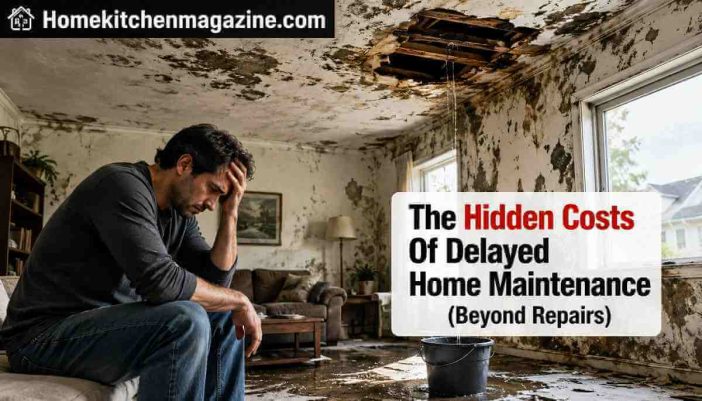
The ceiling stain looked harmless.
Not urgent.
Not dangerous.
Easy to postpone.
Six months later, the drywall had softened, insulation was saturated, and a buyer’s inspector was documenting moisture spread inside the wall cavity.
The repair itself was not the most expensive part.
The uncertainty was.
That pattern appears repeatedly across home inspections and property evaluations. Delayed maintenance rarely creates a single problem. It creates cascading risk—where one ignored issue quietly affects insurance perception, repair scope, resale confidence, and long-term property stability.
That is the hidden cost most homeowners never calculate.
Why Delayed Home Maintenance Becomes So Expensive
Most homeowners evaluate maintenance based on:
- immediate inconvenience,
- visible damage,
- or upfront repair cost.
Real-world property deterioration behaves differently.
The true cost comes from:
- time,
- spread,
- compounding exposure,
- and delayed detection.
A loose dishwasher connector may cost very little to replace.
But if unnoticed:
- cabinet bases swell,
- flooring absorbs moisture,
- mold remediation becomes necessary,
- insurance complications begin,
- and inspection reports become more aggressive.
The original repair was minor.
The delay changed everything.
The Five Hidden Costs Most Homeowners Underestimate
1. Damage Spreads Beyond The Original Failure Point
Small problems rarely remain isolated.
Examples:
- slow plumbing leaks spread into flooring,
- poor drainage affects foundations,
- overloaded circuits affect multiple appliances,
- roof moisture reaches insulation and framing.
This is why guides like
“How to Prevent Costly Water Damage at Home”
focus heavily on early detection instead of emergency repair.
The longer maintenance is delayed, the less predictable the damage path becomes.
2. Insurance Claims Become More Complicated
Insurance companies distinguish between:
- sudden damage,
- and gradual deterioration.
That distinction matters.
A sudden pipe rupture may qualify differently than:
- months of unnoticed moisture,
- repeated seepage,
- or visible long-term neglect.
This overlaps directly with issues discussed in:
“Homeowners Insurance And Water Damage: What Counts As Sudden vs Gradual?”
The hidden cost is not only repair expense.
It is reduced claim confidence.
3. Buyer Confidence Drops Faster Than Homeowners Expect
Homebuyers rarely panic over one small issue.
They react to patterns.
Examples:
- multiple deferred repairs,
- aging connectors,
- inconsistent maintenance records,
- moisture indicators,
- neglected systems.
Inspection reports amplify uncertainty.
That uncertainty often lowers:
- offer strength,
- negotiation leverage,
- and perceived property reliability.
This is exactly why
“Inspection Red Flags That Lower Home Value”
matters beyond cosmetic appearance.
4. Small Repairs Become System Repairs
One neglected component often forces broader replacement later.
Example:
A $20 supply line fails.
Water spreads under flooring.
Cabinets must be removed.
Subfloor dries unevenly.
Now the project includes:
- flooring,
- cabinetry,
- moisture remediation,
- repainting,
- and labor coordination.
The hidden cost is escalation scope.
5. Stress And Disruption Become Permanent Background Noise
This part is rarely discussed honestly.
Delayed maintenance creates:
- uncertainty,
- recurring anxiety,
- emergency scheduling,
- budget instability,
- and household disruption.
Homes become harder to trust.
And trust is what makes a home feel stable.
The Real Financial Equation Most Homeowners Miss
Most maintenance decisions are evaluated like this:
Repair Cost Today
vs
Repair Cost Later
The real equation looks more like this:
Repair Cost
+ Damage Spread
+ Insurance Exposure
+ Inspection Pressure
+ Time Disruption
+ Property Value Impact
That difference changes decision-making completely.
The key is knowing when a small maintenance expense can prevent a much larger repair. Our guide to preventive home maintenance vs. reactive repairs explains how to compare both approaches before deciding whether to act now or postpone the work.
Why “Minor Issues” Create Major Inspection Pressure
Inspectors are trained to interpret patterns.
A single issue may not concern them.
But clusters do.
Example:
- old braided supply lines,
- moisture odor,
- soft cabinet base,
- missing maintenance documentation,
- outdated detectors.
Together, these suggest:
inconsistent system management.
That affects:
- buyers,
- insurers,
- lenders,
- and negotiation dynamics.
This is why structured frameworks such as
“Home Safety Inspection: What to Check Before Problems Appear”
become valuable long before a property is listed.
Original Value Section: The Delayed Maintenance Escalation Framework
Below is a simplified escalation model homeowners can use.
| Stage | What Homeowners See | What Is Actually Happening |
|---|---|---|
| Stage 1 | Small inconvenience | Early system instability |
| Stage 2 | Cosmetic symptoms | Hidden material exposure |
| Stage 3 | Repeated minor issues | Structural or system spread |
| Stage 4 | Inspection concerns | Risk profile increases |
| Stage 5 | Expensive repairs | Compounded damage + uncertainty |
Most costly home repairs do not begin at Stage 5.
They begin at Stage 1.
The Most Common Areas Where Delayed Maintenance Escalates Fastest
Water Systems
Includes:
- dishwasher lines,
- refrigerator connectors,
- sink plumbing,
- shut-off valves.
Water damage compounds quietly.
The article:
“Kitchen Leak Risk Audit Checklist: 15 Points Homeowners Miss Every Year”
covers many early-stage indicators homeowners overlook.
Electrical Systems
Electrical problems often begin with:
- breaker overload,
- outdated panels,
- overloaded kitchen circuits,
- extension cord dependency.
The risk is not only failure.
It is unpredictable system behavior.
Drainage And Exterior Water Control
Poor grading and gutter overflow can quietly affect:
- foundations,
- crawlspaces,
- moisture balance,
- and structural stability.
Damage often appears far from the original source.
Why Preventive Maintenance Protects Property Value
Preventive maintenance does more than reduce repair costs.
It protects:
- predictability,
- inspection confidence,
- insurance clarity,
- and buyer trust.
That is why
“Preventive Maintenance Strategies That Protect Property Value”
is fundamentally about risk control—not aesthetics.
Homes with documented maintenance history feel:
- safer,
- more stable,
- and more trustworthy.
That perception matters financially.
Recommended Tools & Upgrades
If you want to reduce delayed maintenance risk, these are among the most practical upgrades homeowners implement:
- Leak detection sensors
- Automatic water shut-off valves
- Water pressure regulators
- Structured maintenance logs
- Annual inspection checklists
- Braided supply line replacement tracking
These systems do not eliminate risk entirely.
They reduce:
- uncertainty,
- exposure duration,
- and escalation speed.
Practical Prevention Framework
Step 1 — Treat Small Issues As Signals
A small leak is not only a leak.
It is evidence:
- of wear,
- pressure,
- vibration,
- or aging systems.
Step 2 — Document Maintenance Activity
Track:
- replacement dates,
- inspections,
- upgrades,
- observed changes.
This becomes valuable during:
- insurance reviews,
- inspections,
- and resale.
Step 3 — Replace Components Before Failure
Especially:
- supply lines,
- shut-off valves,
- aging detectors,
- worn seals.
Reactive replacement is always more disruptive.
Step 4 — Schedule Inspection Cycles
Reliable homes operate on review cycles—not memory.
That is why:
“How Often Home Safety Systems Should Be Checked”
should function as an operational framework, not just a reminder list.
FAQ
Does delayed maintenance always lower home value?
Not immediately. However, repeated deferred maintenance patterns often reduce buyer confidence and increase inspection concerns.
What maintenance issue becomes expensive fastest?
Water-related problems escalate rapidly because moisture spreads silently behind surfaces before visible symptoms appear.
Can maintenance documentation help during insurance claims?
Yes. Organized maintenance records help demonstrate responsible ownership and clarify timelines during claim reviews.
Are small maintenance issues worth fixing immediately?
Often yes—especially when they involve water, electrical systems, drainage, or safety components that can affect larger systems later.
What Long-Term Home Stability Actually Looks Like
Stable homes are rarely perfect.
But they are predictable.
The difference matters.
A predictable home:
- passes inspections more smoothly,
- creates less insurance friction,
- maintains stronger buyer confidence,
- and experiences fewer emergency failures.
The hidden costs of delayed home maintenance are not hidden because they are rare.
They are hidden because they accumulate slowly.
That accumulation is what turns small problems into expensive uncertainty.
And uncertainty is usually what costs homeowners the most.
This Guide Is Part Of Our Home Safety, Maintenance & Prevention Hub
Explore more long-term prevention frameworks, inspection systems, and risk-reduction strategies inside our Home Safety, Maintenance & Prevention hub.
Reference
- Insurance Information Institute
- InterNACHI inspection guidance
- National Fire Protection Association (NFPA)