
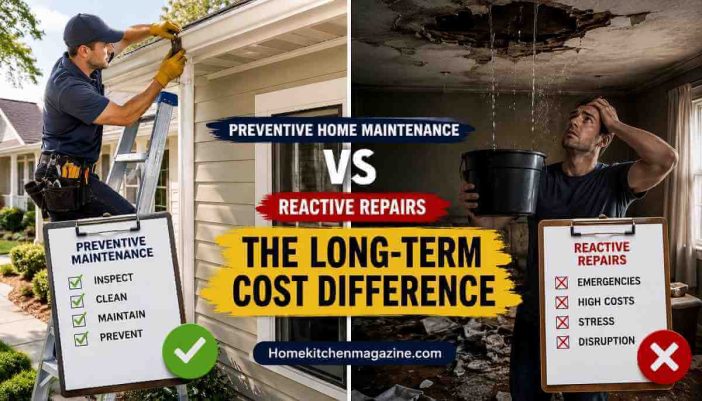
The leak under the sink had been there for months.
Not enough to flood the kitchen.
Not enough to trigger panic.
Just enough to be ignored.
Then the cabinet floor softened. The moisture spread beneath the flooring. Mold testing became necessary. Insurance questions followed. Suddenly, what looked like a minor repair had become a multi-system problem.
This is how reactive homeownership usually begins.
Not with catastrophe.
With postponement.
And over time, postponement becomes expensive.
What Preventive Home Maintenance Actually Means
Preventive home maintenance is the process of:
- identifying small risks early,
- correcting wear before failure,
- and maintaining system stability over time.
Reactive repairs operate differently.
The system is ignored until:
- visible failure,
- urgent damage,
- or operational disruption forces action.
That distinction changes:
- repair scope,
- cost predictability,
- inspection outcomes,
- and long-term property reliability.
Why Reactive Repairs Often Cost More Than Expected
Homeowners usually compare:
- maintenance cost today
vs - repair cost later.
The real equation is larger.
Reactive repairs often include:
- emergency labor,
- expanded damage zones,
- temporary displacement,
- insurance complications,
- accelerated material deterioration,
- and buyer confidence issues.
The hidden cost is rarely the original failure.
It is the escalation surrounding it.
The Financial Difference Between Prevention And Reaction
Preventive Maintenance Costs Tend To Be Predictable
Examples:
- replacing braided supply lines,
- annual inspections,
- water pressure checks,
- detector testing,
- seal replacement,
- drainage cleaning.
These costs are:
- planned,
- manageable,
- and usually limited in scope.
Reactive Repairs Are Usually Compounded
Example:
A dishwasher supply connector fails unexpectedly.
Now the homeowner may face:
- flooring removal,
- cabinet replacement,
- moisture remediation,
- drywall repair,
- insurance documentation,
- and contractor scheduling delays.
The original component cost may have been insignificant.
The exposure cost was not.
This is exactly why:
“How to Prevent Costly Water Damage at Home”
focuses heavily on early intervention instead of emergency cleanup.
Why Preventive Maintenance Protects Property Value
Properties lose value less from age—and more from uncertainty.
Buyers tolerate:
- older systems,
- normal wear,
- cosmetic aging.
What concerns them is:
- unpredictable maintenance history,
- recurring problems,
- and unclear risk exposure.
Homes with:
- documented maintenance,
- stable systems,
- and fewer emergency repairs
typically create stronger inspection confidence.
This aligns directly with:
“Inspection Red Flags That Lower Home Value (What They Really Mean)”
Predictability protects value.
Original Value Section: The Escalation Cost Framework
| Scenario | Preventive Action | Reactive Outcome |
|---|---|---|
| Aging supply line | Scheduled replacement | Water damage spread |
| Electrical overload signs | Panel assessment | Emergency outage or fire risk |
| Minor roof moisture | Early sealing | Structural moisture intrusion |
| Poor drainage | Grading correction | Foundation moisture exposure |
| Weak shut-off valve | Preventive replacement | Delayed emergency response |
The largest repair bills often begin as the smallest ignored signals.
The Psychological Trap Behind Reactive Repairs
Most homeowners delay maintenance because:
- the issue still “works,”
- the damage feels invisible,
- or urgency appears low.
This creates:
delayed consequence bias.
The human brain discounts slow risk accumulation.
That is why:
- slow leaks,
- overloaded circuits,
- aging connectors,
- and drainage issues
are often ignored until visible failure appears.
The problem is not awareness.
It is timing.
How Preventive Maintenance Reduces Insurance Friction
Insurance companies evaluate:
- risk predictability,
- maintenance patterns,
- and damage progression.
Preventive maintenance helps demonstrate:
- responsible ownership,
- documented care,
- and lower negligence risk.
Reactive ownership patterns often create:
- unclear timelines,
- gradual damage disputes,
- and claim complications.
This becomes especially important in situations discussed in:
“Homeowners Insurance And Water Damage: What Counts As Sudden vs Gradual?”
The Hidden Operational Costs Of Reactive Repairs
Reactive repairs disrupt:
- schedules,
- budgets,
- contractor availability,
- and household stability.
Emergency repairs usually involve:
- faster decisions,
- fewer contractor options,
- and higher stress environments.
Preventive systems reduce:
- urgency,
- chaos,
- and emergency dependency.
That operational stability has real value—even when difficult to quantify directly.
What Preventive Homeowners Usually Do Differently
Across stable properties, several patterns repeat consistently.
They Inspect Before Failure
Instead of waiting for symptoms.
This mirrors the framework inside:
“Home Safety Inspection: What to Check Before Problems Appear”
They Replace Components Predictably
Especially:
- braided supply lines,
- shut-off valves,
- detectors,
- seals,
- and aging connectors.
They Track Maintenance Activity
Documentation matters.
Especially for:
- insurance,
- inspections,
- and future buyers.
The article:
“How To Document Home Maintenance For Insurance Claims”
explains why maintenance records increasingly matter in property ownership.
They Think In Systems, Not Individual Repairs
A single issue is rarely isolated.
Water affects:
- flooring,
- cabinetry,
- insulation,
- electrical systems,
- and air quality.
System thinking reduces compounding damage.
Recommended Tools & Upgrades
If you want to reduce reactive repair risk, these are among the most effective homeowner investments:
- Leak detection sensors
- Automatic water shut-off valves
- Water pressure regulators
- Structured maintenance logs
- Moisture detection tools
- Preventive inspection schedules
These tools do not eliminate problems entirely.
They reduce:
- delayed detection,
- exposure duration,
- and maintenance uncertainty.
Practical Framework: When To Prioritize Preventive Action
Preventive maintenance becomes especially important when:
- systems are aging,
- water pressure is high,
- inspection history is inconsistent,
- the property has experienced prior leaks,
- or buyers/insurance evaluations may occur soon.
Small interventions matter most before visible failure appears.
FAQ
Is preventive maintenance always cheaper than reactive repairs?
Not always immediately. However, preventive maintenance usually limits escalation, emergency labor, and damage spread over time.
Why do homeowners delay maintenance?
Because many problems remain operational long after risk begins accumulating. Delayed consequences reduce perceived urgency.
Does preventive maintenance help during inspections?
Yes. Predictable maintenance history improves inspection confidence and reduces perceived uncertainty.
What systems should homeowners prioritize first?
Water-related systems, electrical load issues, drainage, shut-off valves, and aging connectors typically deserve early attention.
Stable Homes Are Built Through Predictability
The safest homes are rarely the newest.
They are the most predictable.
Preventive home maintenance vs reactive repairs is ultimately a decision about:
- stability,
- risk tolerance,
- and long-term ownership strategy.
Reactive ownership often creates:
- larger disruptions,
- accelerated damage,
- and financial uncertainty.
Preventive ownership creates:
- smaller interventions,
- stronger inspection outcomes,
- and more stable property performance over time.
The difference is rarely dramatic in one month.
But across years, the gap becomes impossible to ignore.
This Guide Is Part Of Our Home Safety, Maintenance & Prevention Hub
Explore more frameworks covering:
- water damage prevention,
- inspection readiness,
- maintenance systems,
- and long-term property protection inside our Home Safety, Maintenance & Prevention hub.
Reference
- Insurance Information Institute
- InterNACHI
- National Association of Home Builders (NAHB)