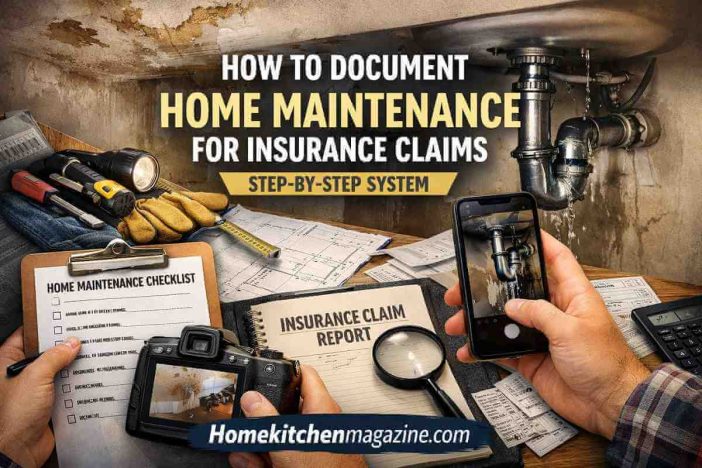
The pipe didn’t fail because it was old.
It failed because no one could prove it wasn’t neglected.
When insurance claims are denied, it’s rarely because damage didn’t happen. It’s because the story behind the damage is unclear.
No inspection records.
No replacement history.
No maintenance timeline.
In that silence, insurers make one assumption:
Neglect.
Learning how to document home maintenance for insurance claims is not paperwork—it is protection. It transforms maintenance from invisible effort into verifiable evidence.
And in insurance, evidence decides outcomes.
What “Documenting Home Maintenance” Actually Means
Quick Answer
Documenting home maintenance means creating a consistent, verifiable record of inspections, repairs, and replacements that proves your home was properly maintained before damage occurred.
In Practical Terms, It Includes
- Inspection dates and results
- Component installation and replacement history
- Maintenance schedules followed
- Photos before and after checks
- Notes on system condition
This is not about perfection.
It’s about consistency.
Why Documentation Matters More Than Most Homeowners Realize
Insurance decisions are based on three questions:
- Was the damage sudden?
- Was the system properly maintained?
- Was the homeowner reasonably responsible?
If you cannot answer the second question with evidence, the first becomes irrelevant.
Whether a leak is interpreted as sudden or gradual often depends on the maintenance history available for review. Documentation helps insurers reconstruct timelines that homeowners may otherwise struggle to prove.
As explained in Water Damage Claim Denied? 7 Reasons Insurers Push Back, lack of documentation is one of the most common causes of claim rejection.
The Core System: How To Document Home Maintenance For Insurance Claims
Below is the system used by disciplined homeowners, property managers, and experienced inspectors.
Step 1 — Create A Simple Maintenance Log Structure
You don’t need complex software.
You need a consistent format.
Homeowners who prefer a ready-made template can adapt the Kitchen Water Safety Maintenance Log and customize it for other household systems as needed.
Minimum fields:
| Field | Purpose |
|---|---|
| Date | When inspection occurred |
| Area/System | Kitchen plumbing, HVAC, electrical |
| Action | Checked, repaired, replaced |
| Observation | Condition notes |
| Next Action | Monitor / replace / no action |
This forms the foundation of your documentation system.
Step 2 — Track Component Age (Critical For Insurance)
Many claims fail because homeowners cannot answer:
“When was this installed?”
Track:
- Supply lines (braided, PEX, copper)
- Appliances (dishwasher, refrigerator)
- Shut-off valves
- Water heaters
For example:
Understanding lifespan from
How Long Do Braided Stainless Steel Supply Lines Really Last?
helps justify proactive replacement.
Age tracking proves foresight—not neglect.
Insurance disputes involving plumbing failures often become easier to resolve when homeowners can demonstrate that replacement decisions were based on expected service life rather than waiting for visible deterioration.
Step 3 — Document Inspections Consistently
Use a predictable schedule:
- Quarterly quick checks
- Annual full inspection
Follow a system like:
Kitchen Plumbing Maintenance Schedule: A 12-Month Preventive Calendar
Then log each inspection.
Consistency matters more than complexity.
Step 4 — Capture Photo Evidence (Before It’s Needed)
Photos are one of the strongest forms of proof.
Capture:
- Under-sink areas
- Supply line condition
- Appliance connections
- Shut-off valves
Best practice:
- Take photos during routine inspections
- Store with date stamp
When a claim happens, you already have evidence.
Step 5 — Record Repairs And Replacements
When something is replaced:
- Log the date
- Note the component
- Keep receipt if possible
Example:
“Kitchen braided supply line replaced – March 2025”
This single entry can determine claim approval years later.
Step 6 — Use A Structured Checklist System
Instead of guessing what to inspect, use:
Kitchen Leak Risk Audit Checklist: 15 Points Homeowners Miss Every Year
Then document results.
Checklists create repeatable structure.
Documentation creates proof.
Step 7 — Maintain A Central Storage System
Choose one:
- Printed binder (recommended for accessibility)
- Digital folder (Google Drive / cloud)
- Hybrid (best option)
Key rule:
If it’s scattered, it doesn’t exist.
What Strong Documentation Looks Like (Real Example)
Weak Documentation
- “We check things regularly”
- No dates
- No photos
- No records
Result: Claim vulnerability
Strong Documentation
- Quarterly logs
- Replacement history
- Photo archive
- Inspection checklist records
Result: Claim credibility
Common Mistakes That Lead To Claim Denial
1. Relying On Memory
Memory is not evidence.
2. No Replacement Tracking
Old components without records suggest neglect.
3. Inconsistent Inspections
Irregular logs weaken credibility.
4. No Photo Documentation
Visual proof is powerful in disputes.
5. Delayed Documentation
Records created after damage are less credible.
How Documentation Protects Property Value
Documentation does more than support claims.
It:
- Improves inspection outcomes
- Builds buyer confidence
- Reduces negotiation pressure
- Signals responsible ownership
For sellers, documentation becomes especially valuable because previous leaks accompanied by invoices, inspection reports, and maintenance logs usually generate less concern than unexplained stains or cosmetic repairs.
Small moisture indicators often become negotiation points only when homeowners cannot explain their origin, duration, or remediation history.
This aligns with value frameworks in
Kitchen Water Damage Cost Breakdown: What Insurance Doesn’t Tell You
Predictability increases value.
Maintenance records also reduce uncertainty surrounding previous leaks, helping buyers and insurers evaluate condition using evidence rather than assumptions. This can influence both repair discussions and long-term ownership costs.
Expert Insight: What Adjusters Look For First
From real-world claim patterns, adjusters prioritize:
- Evidence of recent maintenance
- Absence of long-term neglect indicators
- Timeline clarity
Many of the same records requested by insurance adjusters are also reviewed indirectly during property inspections, where professionals attempt to determine whether moisture exposure is historical, ongoing, or unresolved. - Component age consistency
Missing records frequently amplify inspection concerns because buyers and inspectors may interpret undocumented repairs as unresolved risks rather than completed maintenance events.
Documentation answers these instantly.
Without it, assumptions take over.
Documentation influences far more than insurance outcomes. It affects inspections, buyer confidence, disclosure conversations, and the perceived reliability of a property over time.
FAQ – People Also Ask
What Is The Best Way To Document Home Maintenance?
Use a simple log system with dates, actions, and observations, supported by photos and replacement records.
Do Insurance Companies Require Maintenance Records?
Not always required upfront—but critical when disputes arise.
How Often Should Maintenance Be Documented?
Quarterly inspections and annual full reviews provide strong coverage.
Can Documentation Prevent Claim Denial?
Yes. It strengthens your position by proving responsible ownership and maintenance behavior.
Maintenance records bridge the gap between prevention, insurance interpretation, inspection findings, and future resale decisions. Without records, even responsible ownership becomes difficult to verify.
Wrapping Up: Documentation Turns Maintenance Into Protection
Most homeowners maintain their homes.
Few can prove it.
And in insurance, proof is everything.
Learning how to document home maintenance for insurance claims transforms:
Effort → Evidence
Routine → System
Maintenance → Financial protection
If you:
- Track component age
- Log inspections
- Capture photos
- Document replacements
you don’t just maintain your home.
You protect your claim, your value, and your financial stability.
Documentation is not extra work.
It is the difference between coverage and denial.
Reference
This system aligns with:
- Insurance Information Institute guidelines on claim documentation
- InterNACHI inspection standards for maintenance verification
Both emphasize consistency and recordkeeping.