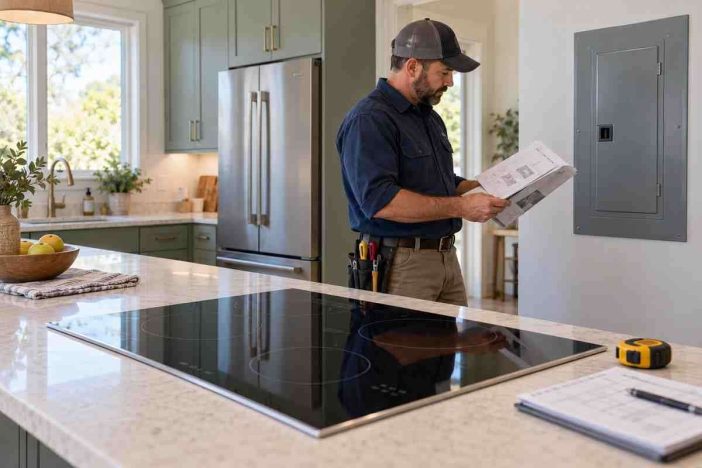
The induction cooktop is already in the shopping cart.
It is the right width. The cutout dimensions look workable. The reviews are strong. The price fits the remodel budget.
Then someone asks:
“What electrical circuit does it need?”
That question can change the project.
A full-size induction cooktop may require a dedicated 208- or 240-volt electrical supply, but the required circuit can differ substantially between models. One cooktop may call for a 30-amp circuit, another 40 amps, and another 50 amps.
That means the correct electrical requirement cannot be determined from one assumption such as:
“Induction cooktops use 40 amps.”
The useful sequence is:
exact model → nameplate/install guide → voltage → required circuit → connection method → existing branch circuit → panel capacity → local code
Do that before the countertop is cut and before the appliance is delivered.
Quick Answer
Most full-size built-in induction cooktops sold for U.S. residential kitchens use a dedicated higher-voltage circuit, commonly 208 or 240 volts, but the required amperage varies by model.
For example, one current manufacturer family specifies:
| Example Cooktop | Electrical Supply | Dedicated Circuit |
|---|---|---|
| 24-inch induction model | 240/208 V, 60 Hz | 30 A |
| 30-inch induction model | 240/208 V, 60 Hz | 40 A |
| 36-inch induction model | 240/208 V, 60 Hz | 50 A |
Those numbers are examples, not universal sizing rules.
Before purchasing an induction cooktop:
- identify the exact model number;
- obtain its current installation instructions;
- confirm voltage and required electrical service;
- determine whether the existing circuit matches those requirements;
- verify whether the appliance is hardwired or uses another approved connection method;
- have available panel/service capacity evaluated when necessary;
- apply the electrical code and local requirements adopted where the home is located.
Do not increase a breaker size simply because the new cooktop requires more amperage. Breaker, conductor, connection, grounding, appliance listing, and system capacity must work together.
Start With the Exact Cooktop Model, Not Its Width
A 30-inch cooktop does not automatically equal one circuit size.
Width can correlate with cooking capacity, but electrical requirements are ultimately model-specific.
The correct sources are:
- the appliance nameplate;
- manufacturer specifications;
- the current installation guide;
- applicable electrical requirements for the installation.
A manufacturer may offer several cooktops with similar exterior dimensions but different connected loads, element arrangements, bridge zones, electronics, or power-management features.
Even within one product family, circuit requirements can change as width and capacity increase.
That is why electrical planning should happen before purchase, not after the appliance arrives.
The Five Electrical Specifications You Need to Verify
1. Supply Voltage
Full-size built-in induction cooktops commonly operate on a higher-voltage residential supply rather than the standard 120-volt receptacle used by portable countertop appliances.
Some models are designed for 240/208 VAC service.
Others may specify requirements differently.
Do not assume that because a cooktop can physically fit the opening, the existing supply voltage is compatible.
Also distinguish 208 volts from 240 volts.
Some appliances are listed to operate on either supply, while performance or rated output may differ. Other appliances may have more specific requirements.
The model documentation controls.
2. Required Circuit Amperage
This is one of the most commonly oversimplified requirements.
A full-size induction cooktop is not automatically a “40-amp appliance” or a “50-amp appliance.”
Current manufacturer examples demonstrate that different models can call for:
- 30 A;
- 40 A;
- 50 A.
Other products can differ.
Use the manufacturer’s specified electrical service rather than selecting a breaker from a generic online chart.
3. Dedicated Circuit Requirement
High-demand fixed cooking appliances commonly require their own branch-circuit planning rather than sharing a circuit with countertop appliances.
HKM’s Dedicated Kitchen Circuits guide explains the broader distinction between fixed high-demand appliances and shared kitchen loads.
For an induction cooktop, verify whether the manufacturer requires a separate circuit serving only that appliance.
A dedicated circuit is not simply about preventing inconvenience.
It allows the branch circuit and overcurrent protection to be designed around the known appliance load instead of combining unrelated equipment.
4. Connection Method
Do not assume the new cooktop plugs into the same receptacle used by another appliance.
Built-in cooktops may use a factory-supplied conduit and a permanent electrical connection.
Other appliance types and models may use different approved configurations.
The important planning question is:
How does this exact model connect to the electrical system?
That determines:
- junction-box planning;
- electrical location;
- cabinet clearance;
- accessibility;
- installation sequencing.
Do not improvise with adapters, extension cords, or receptacle conversions that are not permitted by the appliance instructions and applicable electrical requirements.
5. Required Electrical Protection
The dedicated-circuit question is only one part of compliance.
Depending on the electrical code edition adopted by your jurisdiction, installation type, appliance, and other conditions, additional requirements may apply to protection such as GFCI or AFCI.
Recent National Electrical Code editions have expanded protection requirements around kitchens and cooking equipment.
Because code adoption and amendments vary geographically, do not copy protection requirements from an installation in another state or from an older remodel.
The local code in force and the authority having jurisdiction matter.
Real-World Example: Why “Induction Needs 40 Amps” Is Wrong
Consider three current built-in induction cooktops from the same manufacturer family.
One 24-inch model specifies a 30-amp dedicated circuit.
A 30-inch model specifies 40 amps.
A 36-inch model specifies 50 amps.
They all belong to the same basic appliance category.
If the homeowner had memorized:
“Induction cooktops need 40 amps,”
that rule would be wrong for two of those three examples.
The practical lesson is simple:
The model number is more useful than the appliance category.
Complete this record before ordering a built-in induction cooktop. Use the exact manufacturer installation instructions rather than generic circuit-size rules.
1. Appliance identified
2. Manufacturer electrical requirement
3. Existing kitchen setup
4. Existing branch circuit
5. Panel and capacity
6. Installation requirements
7. Conversion planning
8. Purchase decision
Can You Reuse an Existing Electric Cooktop Circuit?
Possibly.
But “there is already an electric cooktop here” is not enough information.
Before reusing an existing branch circuit, the installation needs to be evaluated for compatibility with the new appliance.
Important questions include:
- Does the existing supply voltage match?
- Is the existing circuit rating appropriate for the new model?
- Does the manufacturer require a dedicated circuit?
- Is the existing connection method compatible?
- Are the existing conductors and terminations appropriate?
- Is grounding correctly provided?
- Does the new appliance require different electrical protection?
- Is the circuit condition acceptable?
- Does the existing installation comply with applicable requirements?
In some replacement scenarios, an induction cooktop can use electrical infrastructure similar to the electric cooktop it replaces.
Manufacturer replacement documentation even shows cases where an older electric or induction cooktop and its induction replacement have the same electrical requirement.
But that is evidence for those specific models, not permission to assume every electric-to-induction swap is plug-and-play.
Verify first.
Gas to Induction Is a Different Conversion
Replacing a gas cooktop with induction can create a much larger electrical project.
A gas cooktop may have used only a modest 120-volt electrical connection for ignition or controls.
A full-size induction cooktop can require a dedicated higher-voltage, high-amperage branch circuit.
That can mean evaluating:
- electrical service capacity;
- panel capacity;
- breaker space;
- new branch-circuit routing;
- junction-box location;
- cabinet access;
- electrical permits or inspection;
- gas-line decommissioning by the appropriate professional.
The U.S. Department of Energy’s induction guidance specifically identifies the electrical system as a planning issue when converting from gas to induction.
This does not mean every gas-to-induction conversion needs a panel replacement.
It means the house must be evaluated for the new load.
Does an Induction Cooktop Require a Panel Upgrade?
Not automatically.
The cooktop’s circuit requirement and the home’s overall service capacity are related questions, but they are not the same question.
Imagine two homes purchasing the same 40-amp induction cooktop.
Home A already has appropriate service capacity, panel space, and a compatible branch circuit.
Home B has limited capacity, no suitable circuit, several other planned electrification loads, and a crowded panel.
The appliance is identical.
The infrastructure decision is different.
Our Kitchen Electrical Load Planning for Modern Homes guide explains why electrical capacity should be evaluated as a system rather than appliance by appliance.
Panel space is not the same as electrical capacity
An empty breaker position does not prove the service can accept another major load.
Likewise, a visually full panel does not by itself answer the entire capacity question.
A proper evaluation may consider:
- existing household loads;
- heating and cooling equipment;
- electric water heating;
- ovens and other cooking equipment;
- dryers;
- EV charging;
- future electrification plans;
- service size;
- calculated demand.
If a broader upgrade appears likely, use our Kitchen Electrical Panel Upgrade guide to understand the planning factors before assuming a larger panel is automatically required.
Circuit Requirement Is Not the Same as Energy Consumption
This distinction is important.
A cooktop requiring a 40-amp or 50-amp circuit does not mean it continuously consumes that maximum amount of electricity every time you cook.
The electrical system must be designed to safely supply the appliance according to its rated requirements.
Actual energy use varies with:
- number of cooking zones used;
- selected power levels;
- boost functions;
- cooking duration;
- power-management behavior;
- cookware and cooking method.
Do not use breaker amperage as a shortcut for estimating the monthly electricity bill.
Electrical capacity and energy consumption answer different questions.
Why Breaker Size and Wire Size Must Not Be Guessed Separately
A common remodeling mistake is treating the breaker as an independent upgrade.
For example:
“The new cooktop needs more power, so just install a larger breaker.”
That is not an acceptable planning method.
The breaker protects a branch circuit whose conductors, terminals, connection method, equipment ratings, and other conditions must be compatible with the load and applicable code.
Increasing overcurrent protection without confirming the rest of the circuit can remove protection the existing wiring depended on.
The correct process is:
appliance requirement → branch-circuit design → conductor/termination evaluation → overcurrent protection → code compliance
not:
new appliance → bigger breaker.
Electrical modifications should be evaluated and performed by qualified personnel where required.
What About Portable Induction Burners?
Portable induction hobs are a different appliance category.
Many countertop induction units are designed for standard household receptacles and have much lower total power than a full-size built-in cooktop.
That makes them useful for:
- testing induction cooking before a remodel;
- rentals;
- supplemental cooking;
- temporary kitchens;
- households not ready for a full electrical conversion.
Do not use the electrical requirements of a portable 120-volt unit to plan a built-in induction cooktop.
Likewise, do not assume a full-size cooktop can simply be adapted to a standard kitchen receptacle.
Induction Cooktop vs Induction Range: Do Not Mix the Specifications
A cooktop and a range are not the same appliance.
An induction cooktop contains the cooking surface only.
An induction range combines the induction cooking surface with an electric oven.
That changes the connected appliance load and can change electrical requirements substantially.
For example, one current induction range manufacturer specifies a 50-amp dedicated 240-volt circuit for certain range models.
That does not mean its stand-alone cooktops all require 50 amps.
Always verify whether a specification refers to:
- portable hob;
- built-in cooktop;
- freestanding/slide-in range;
- separate wall oven plus cooktop.
Comparing the wrong appliance type is an easy way to plan the wrong circuit.
If you are still deciding between cooking technologies rather than planning the electrical installation, our Induction vs Gas vs Electric Stove guide addresses the broader appliance comparison.
A Pre-Purchase Electrical Decision Framework
Before ordering the cooktop, move through these five gates.
Gate 1: Appliance
Record:
- exact manufacturer;
- exact model;
- installation guide;
- rated voltage;
- required electrical service;
- connection method.
If those values are unknown, electrical planning is premature.
Gate 2: Existing Branch Circuit
Determine whether an existing cooktop circuit is present.
Do not merely identify a large breaker and assume it belongs to the cooktop.
The circuit should be positively identified and evaluated.
Gate 3: Panel and Household Capacity
Ask whether the new cooktop fits the home’s broader electrical demand.
This becomes particularly important during:
- gas-to-induction conversion;
- whole-kitchen remodeling;
- electrification projects;
- simultaneous EV or HVAC upgrades.
Gate 4: Code and Manufacturer Requirements
Check the requirements actually applicable to the project.
The current National Electrical Code is a model standard, while jurisdictions adopt and amend electrical codes on different schedules.
Manufacturer installation requirements also remain part of the installation.
Gate 5: Physical Installation
Electrical compatibility alone does not complete the project.
Confirm:
- cutout dimensions;
- cabinet clearances;
- junction or supply location;
- ventilation clearances where specified;
- access for service;
- compatibility with drawers or ovens below the cooktop.
A cooktop can be electrically compatible and still be physically unsuitable for the cabinet.
Planning Matrix: What Your Existing Kitchen May Need
| Existing Cooking Setup | Likely Electrical Planning Question |
|---|---|
| Existing induction cooktop | Does the replacement match the existing voltage, circuit, and connection? |
| Existing conventional electric cooktop | Can the existing branch circuit meet the exact induction model requirement? |
| Gas cooktop | Is a new higher-voltage dedicated circuit and capacity review needed? |
| Portable induction hob | Full-size built-in installation requires a separate evaluation |
| Electric range replaced by cooktop + wall oven | Each new appliance must be evaluated separately |
| Kitchen remodel with several new electric appliances | Whole-kitchen load planning becomes important |
The table is a planning framework, not an installation specification.
Common Induction Electrical Planning Mistakes
Buying the Cooktop Before Checking the Electrical Requirement
This can turn a simple appliance purchase into unexpected panel, wiring, drywall, or cabinet work.
Check first.
Assuming Every 30-Inch Cooktop Uses the Same Circuit
Exterior width is not an electrical specification.
Model documentation controls.
Assuming 240 Volts Automatically Means the Circuit Is Compatible
Voltage is only one variable.
Circuit rating, conductors, connections, grounding, protection, and equipment requirements also matter.
Assuming an Existing Electric Circuit Is Automatically Reusable
It may be reusable.
It may also be incompatible with the new appliance.
Verification is cheaper than discovering the problem after countertop installation.
Assuming a New Cooktop Automatically Requires a 200-Amp Service
No single appliance specification should be used to declare that every home requires a particular service size.
Evaluate total household demand.
Increasing the Breaker Without Evaluating the Branch Circuit
This treats the protection device as if it creates circuit capacity.
It does not.
Confusing Maximum Electrical Capacity With Monthly Energy Use
A high-capacity circuit does not mean the cooktop continuously operates at that maximum load.
Capacity planning and energy-cost estimation are separate tasks.
Warning Signs the Existing Electrical System Deserves Review
An induction upgrade is also a useful moment to notice broader electrical problems.
Professional evaluation becomes particularly important if you find:
- repeated breaker trips;
- burning odor;
- buzzing at the panel or connection;
- visible heat damage;
- damaged electrical equipment;
- unexplained flickering associated with large loads;
- questionable previous modifications;
- no clearly identified circuit;
- a panel with little apparent expansion flexibility;
- conflicting appliance and circuit ratings.
Do not continue operating equipment that shows signs of overheating, arcing, burning, or other electrical failure.
Our Kitchen Circuit Overload Warning Signs guide explains why breaker trips and other symptoms should be treated as evidence to diagnose rather than simply bypass.
What to Give the Electrician Before Installation Day
The most useful document is not a photo of the cooktop.
It is the exact model installation guide.
Provide:
- manufacturer;
- model number;
- installation instructions;
- cooktop location;
- planned cabinet configuration;
- existing appliance type;
- whether the project is gas-to-induction;
- other major electrical upgrades planned at the same time.
This lets the electrical review answer the right question:
“What does this appliance require in this house?”
rather than:
“What do induction cooktops usually need?”
Frequently Asked Questions
Do induction cooktops need 240 volts?
Many full-size built-in induction cooktops are designed for 208/240-volt electrical supplies, but this is not a universal specification for every induction appliance. Portable countertop induction units commonly use standard household receptacles. Check the exact model documentation.
How many amps does an induction cooktop need?
It varies. Current full-size manufacturer examples include 30-, 40-, and 50-amp dedicated circuits. Do not select the circuit from cooktop width or a generic internet recommendation.
Does an induction cooktop need a dedicated circuit?
Full-size built-in induction cooktops commonly require a separate branch circuit. Confirm the exact manufacturer’s requirement and the electrical code applicable to the installation.
Can I put an induction cooktop on my existing electric stove circuit?
Possibly, but only if the existing electrical supply matches the new appliance’s requirements and the complete branch circuit is suitable. An electrician may need to verify voltage, circuit rating, conductors, connections, grounding, protection, and panel capacity.
Do I need to upgrade my panel for induction?
Not necessarily. A gas-to-induction conversion can introduce a substantial new electric load, but whether the panel or service requires modification depends on the home’s existing electrical system and calculated demand.
Can I install a bigger breaker for a higher-power induction cooktop?
Do not increase breaker size simply to match a new appliance. The branch circuit must be designed as a complete system, including conductors and equipment ratings.
Is 208 volts the same as 240 volts for an induction cooktop?
No. Some induction cooktops are designed to operate on either 208 or 240 volts, but their performance or ratings may differ. Other appliances can have different requirements. Follow the exact model specifications.
Are induction cooktops hardwired?
Many built-in induction cooktops use a permanent connection or factory conduit, but connection methods vary. Verify the installation instructions before planning an outlet or junction box.
Does an induction cooktop need GFCI protection?
That depends on the electrical code adopted where the home is located, the appliance and connection, and other installation conditions. Recent NEC editions have expanded GFCI requirements for kitchen and cooking-equipment circuits, so older installations should not be used as universal examples.
Final Takeaway
The most important induction cooktop electrical requirement is not 40 amps, 50 amps, or even 240 volts.
It is the requirement printed for the exact cooktop you intend to install.
Start with:
model → voltage → required circuit → connection → existing branch circuit → panel capacity → applicable code
That sequence prevents two expensive mistakes:
buying a cooktop the existing electrical system cannot support, and paying for electrical upgrades the house does not actually need.
For broader decisions involving circuits, appliances, load planning, and kitchen infrastructure, continue with the Kitchen Systems, Appliances & Efficiency Hub.
Induction is not difficult to plan when the appliance and the electrical system are treated as one project.