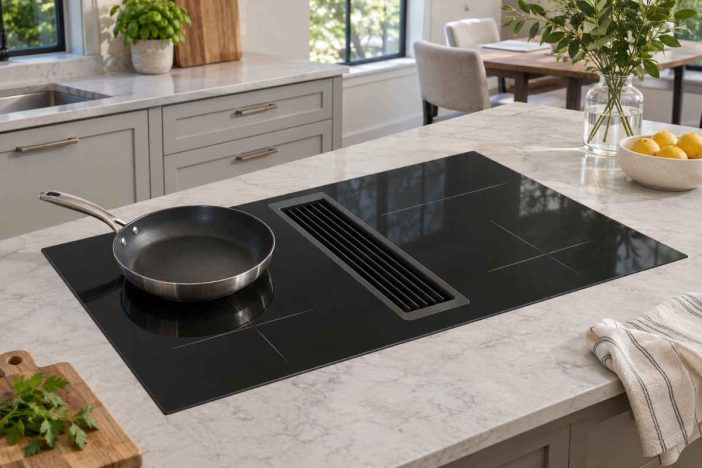
An induction cooktop can fit the opening in your countertop and still be a poor fit for the cabinet below. On an island, the blower and duct may take up space you planned to use for drawers. When replacing an older downdraft, the existing opening and exhaust route may look reusable until you compare them with the new model’s installation drawings. Check both before ordering the cooktop or cutting the counter.
Is an Induction Cooktop with Downdraft Ventilation Worth It?
It can be worth it if an overhead hood is impractical, the cooktop and exhaust system fit your cabinet, and the intake can serve the pans and cooking zones you use most. A well-positioned overhead hood that exhausts outdoors is generally the better starting point if you frequently sear, fry, or cook with tall pots on the front zones. If your only downdraft option is recirculating, check what your home needs for kitchen exhaust before you buy.
Compare Three Ways to Vent an Induction Cooktop
Induction cooktop with a built-in downdraft
The intake is part of the cooktop, often between the cooking zones. It keeps the view across an island open. Measure the usable cabinet space for the appliance body, blower, and duct or recirculation kit. Check whether drawers or an oven below are permitted for the exact model and setup.
Induction cooktop with a separate pop-up downdraft
A separate intake rises behind the cooktop when you use it. It can be an option if the counter is deep enough for both units and the manufacturers allow the pairing. Check the required space behind and below the cooktop. As one example, Thermador’s downdraft guidance describes installations behind compatible Masterpiece cooktops.
Induction cooktop with an overhead hood
A hood with a canopy above the cooking surface can intercept the rising plume. Consider this setup first if you cook frequently with high heat or use large pans on the front zones. Check coverage, mounting height, and a practical route outdoors. On an island, also check whether the ceiling can accommodate the support and ductwork the hood requires.
What a CFM Rating Tells You About Downdraft Performance
Airflow, measured in cubic feet per minute (CFM), describes how much air the fan moves under stated conditions. Capture efficiency describes the share of released contaminants the system captures under a defined test. Intake position, cookware placement, and the installed duct route all affect how useful that airflow is. For more on these trade-offs, see our range hood CFM sizing guide.
Bring your usual cookware sizes to the discussion. If you sear on a front zone or boil in a tall stockpot, ask the dealer to show where those pans sit relative to the intake. A showroom steam demonstration can help you see the setup. An independently measured capture rating, when available, provides stronger evidence about performance under its stated test conditions.
In a field study of installed cooking exhaust devices, researchers found that rear-mounted downdrafts captured combustion products more effectively from rear burners than from front burners. The intake position is worth checking on any model. Use model-specific evidence to assess today’s center-intake induction cooktops. See the Berkeley Lab field study.
Ducted or Recirculating Downdraft?
Ducted exhaust carries captured air outside. Trace the entire route, including the transition at the cooktop, bends, available cabinet or floor space, and the exterior termination. Ask the installer to check the route against the model’s allowed duct sizes, fittings, and length limits. The existing duct is worth reusing only if the new installation instructions and local requirements allow it. See our range hood duct sizing guide for how elbows and transitions affect the route.
Recirculating ventilation filters the captured air and returns it to the kitchen. A grease filter catches grease, and an activated-carbon filter may help reduce some odors. Moisture and heat stay indoors. Confirm the compatible kit, where the return air exits the cabinet, and how you will access the filters. Ask the installer or permit office how the project will meet any required kitchen exhaust. The EPA’s cooking ventilation guidance explains the benefits of outdoor exhaust and options for improving ventilation.
Induction removes combustion at the cooktop, but other fuel-burning equipment in the home can still matter when an exhaust fan depressurizes the house. The 2024 International Residential Code, Chapter 15 is a model code. Have the installer confirm the edition and amendments adopted where you live, including any makeup-air requirement. For questions about airflow, pressure, and other appliances, see our range hood makeup air guide.
What Two U.S. Models Show About Installation
The JennAir JIDT836SBL reference guide shows a flush-install cutout drawing and separate drawings for ducted and recirculating installations. It identifies a separately sold recirculation kit, W11751835. Give the installer the drawing for your intended mounting and venting method. See the JennAir model reference guide and owner’s manual.
The Fisher & Paykel CID364DTB4 quick reference guide lists a rear outlet, with ducting provided by the installer. The manufacturer lists KRECIRCDDFT as a compatible recirculation kit. Check whether the rear duct route occupies space you had planned for a drawer. See the Fisher & Paykel model specifications and installation downloads and the compatible kit listing.
Both manufacturers list these examples as 36-inch cooktops. Use each model’s cutout drawing and installation instructions to verify the opening, clearances, and service space. The sales width alone cannot tell you whether either one fits an existing cutout.
What to Verify Before You Order
- Exact model and existing opening. Record the full model number and the opening’s width, depth, corner shape, and countertop thickness. Have the installer check the required support and clearances before anyone cuts the countertop.
- Usable cabinet space. Show the installer drawers, shelves, plumbing, and any oven below. Ask them to mark the space needed for the blower, duct or recirculation kit, and future service.
- Exhaust route and local requirements. Identify the exterior outlet or the location of the recirculating air return. Confirm the allowed route and any required exhaust, makeup air, permits, and inspections before ordering cabinets.
- Electrical supply. Give a licensed electrician the model’s nameplate and installation instructions. Have them check voltage, circuit capacity, and connection location before reusing an existing circuit. A separate pop-up system may have its own supply requirements. See our induction cooktop electrical requirements guide.
- Installed cost and filter access. Ask for one written quote that includes any countertop work, cabinet changes, ducting, electrical work, required accessories, and permits. Confirm that you can remove and clean the grease filter, and find out how to service or replace any carbon filter according to the manufacturer’s instructions.
How the Decision Changes in Three Common Kitchens
Replacing an older downdraft in a finished countertop
Compare the opening, duct location, and electrical supply before paying for a replacement. If the new inlet or blower lands where a cabinet partition sits, get a price for cabinet and duct changes. This is the point to decide whether reusing the countertop still saves enough to justify the project.
Planning a new island with open sightlines
An integrated downdraft is worth pricing while the island is still on paper. Have the cabinet designer and ventilation installer review the same drawing and mark the drawers you can keep. If the duct route or intake position conflicts with how you cook, compare that cost and trade-off with an overhead island hood.
Remodeling a kitchen with no route outdoors
Check the approved kitchen ventilation strategy with the installer or permit office before committing to a recirculating model. A compatible kit may solve the appliance’s installation problem. You still need to know how the kitchen will handle steam and meet any required exhaust. Compare the available options before finalizing the cabinet layout.
The Bottom Line
Buy a downdraft induction cooktop after the installer confirms the exact model fits, the ventilation plan works in your home, and the intake location makes sense for your everyday cookware. If you regularly cook over high heat at the front and can install a properly sized hood that vents outdoors, price that setup alongside the downdraft before making your decision.