The new water heater was supposed to be the efficient one.
It arrived with a higher efficiency rating, a digital control panel, and the promise of using far less electricity than the conventional tank it replaced. Then the first utility bill arrived. The total looked disappointingly familiar—or worse, higher.
At that point, the easiest conclusion is that the equipment has failed to deliver.
But a heat pump water heater can use more electricity than expected for several different reasons. Some involve the way the unit operates. Others involve its installation, household hot-water demand, or changes elsewhere in the electricity bill.
And sometimes the water heater is performing exactly as intended, while the comparison itself is misleading.
The first task is to establish what actually increased: the home’s electricity consumption, the cost per kilowatt-hour, or the water heater’s own energy use.
That distinction determines what to investigate next.
Quick Answer: Why Is My Heat Pump Water Heater Using So Much Electricity?
If a heat pump water heater is using too much electricity, first check its operating mode and whether electric-resistance backup heating is being used frequently.
Other possibilities include restricted airflow, low surrounding-air temperatures, unusually high hot-water demand, maintenance problems, installation conditions, or equipment faults.
However, a higher electricity bill does not necessarily mean the water heater is using excessive energy. Utility-rate changes, increased household consumption, longer billing periods, or a switch from gas to electric water heating can change the bill even when the new appliance is operating efficiently.
Before making adjustments:
- Compare actual electricity consumption rather than bill totals alone.
- Confirm the water heater’s current operating mode.
- Check accessible maintenance indicators and manufacturer alerts.
- Review installation conditions and changes in household demand.
- Contact a qualified professional if the evidence suggests a fault or unsafe condition.
The following diagnostic sequence helps separate those possibilities without dismantling equipment or making assumptions about its performance.
First, Determine Whether the Electricity Bill Really Increased
A higher bill is a reason to investigate. It is not yet a diagnosis.
Find the latest electricity bill and a comparable earlier bill. Ideally, compare billing periods with similar weather, occupancy, and household routines.
Record the following information:
| Bill detail | Previous period | Current period |
|---|---|---|
| Billing days | Record | Record |
| Total electricity used (kWh) | Record | Record |
| Average kWh per day | Calculate | Calculate |
| Total electricity charges | Record | Record |
| Effective cost per kWh | Calculate cautiously | Calculate cautiously |
| Major household changes | Record | Record |
Average daily electricity use = total kWh ÷ billing days.
This helps account for billing periods of different lengths.
A higher bill with similar kWh is a pricing question
Imagine two hypothetical bills.
The household uses 900 kWh during each 30-day period.
In the first period, the illustrative total variable electricity cost is $0.15 per kWh.
In the second period, it is $0.19 per kWh.
The variable energy cost changes from $135 to $171 even though consumption remains exactly the same.
That $36 difference does not demonstrate that any appliance became less efficient.
Actual utility bills can also contain fixed charges, separate delivery charges, taxes, demand charges, or time-dependent rates. Review the applicable tariff before attributing a change to equipment.
Higher kWh does not identify the water heater
Suppose electricity consumption rises from 900 to 1,080 kWh in otherwise similar 30-day billing periods.
That is an increase of 180 kWh, or 6 kWh per day.
The difference deserves investigation, but it does not establish where the additional electricity went.
Air conditioning, electric space heating, a clothes dryer, a new appliance, increased occupancy, and water heating could all contribute.
If your household has several unexplained energy loads, begin with our DIY home energy audit to distinguish whole-house changes from a suspected appliance problem.
Did the previous water heater use natural gas?
This is an especially important comparison.
If the old water heater burned natural gas and the new unit uses electricity, the electricity bill may increase simply because water heating has moved from one energy source to another.
The correct financial comparison is then between combined household energy costs, not electricity costs alone.
Review both gas and electric bills, accounting for changes in rates, heating demand, and other fuel uses.
An increase in purchased electricity is not automatically an increase in total energy spending.
Check Which Operating Mode the Water Heater Is Using
Many residential heat pump water heaters are hybrid systems.
They use a heat pump to transfer heat from surrounding air into stored water. Some models can also activate conventional electric-resistance heating elements when additional heating is needed.
According to the U.S. Department of Energy’s guidance on efficient residential water heaters, operating modes can make a substantial difference to electricity consumption.
The exact names vary by manufacturer.
| Operating mode | Typical function | Electricity-use implication |
|---|---|---|
| Heat Pump Only / Efficiency | Prioritizes heat-pump operation | Usually most efficient, but slower recovery |
| Hybrid / Auto | Combines heat-pump operation with backup heating when needed | Balances efficiency and hot-water availability |
| Electric / Resistance | Uses conventional resistance elements | Generally higher electricity demand |
| High Demand | Supports faster recovery during heavy hot-water use | May increase resistance-heating operation |
| Vacation | Reduces energy use during extended absence | Behavior varies by model |
The resistance-heating clue
Resistance heating may be necessary under certain conditions. Its occasional use does not automatically indicate a defect.
The concern is frequent or unexplained reliance on resistance heating, especially when the household expected normal heat-pump operation.
Check the current mode displayed by the water heater and consult the exact model’s operating manual.
If the unit has been left in a resistance-only or high-demand setting, that may explain disappointing efficiency.
However, do not force an operating mode that cannot reliably satisfy the household’s hot-water needs.
Some models also restrict heat-pump operation under certain ambient conditions or when faults occur.
Changing a control setting without understanding why the unit selected its existing mode can hide an unresolved problem.
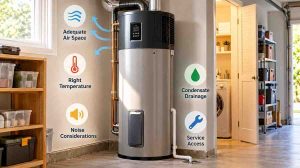
The Room May Be Working Against the Heat Pump
A heat pump water heater uses heat available in surrounding air.
That makes installation conditions important even after the appliance has been successfully installed.
Three problems deserve particular attention.
1. The surrounding air is too cold
Heat-pump efficiency and available heating capacity depend partly on ambient temperature.
ENERGY STAR explains that many integrated residential models are designed for spaces with ambient temperatures approximately between 40°F and 120°F, although actual manufacturer limits differ.
When a space becomes too cold, some hybrid systems may use electric-resistance heating more frequently or operate differently.
Consider the difference between a warm garage in summer and the same unheated garage during a freezing winter.
An appliance may fit the space physically but experience unfavorable conditions for part of the year.
Do not assume that all models have the same minimum operating temperature.
2. Airflow is restricted
Heat pump water heaters require access to enough air.
Problems may arise when:
- a unit is installed in a closet without adequate approved ventilation;
- intake or exhaust openings are obstructed;
- stored belongings crowd the equipment;
- ducting does not match the manufacturer’s requirements; or
- an air filter is neglected.
Restricted airflow can interfere with normal operation. Depending on the model, controls may respond by limiting heat-pump operation or reporting a fault.
A visible obstruction may be easy to identify, but the required clearance and air-volume specifications must come from the actual installation manual.
3. The water heater is cooling conditioned indoor air
A heat pump water heater removes heat from its surroundings.
If it operates within conditioned living space during cold weather, the home’s heating system may need to replace some of the heat removed.
That does not necessarily increase the water heater’s separately measured electricity consumption.
Instead, it can change the whole-home heating load.
This is one reason a winter electricity or gas bill may fail to reflect the full energy consequences of operating a heat pump water heater.
For a detailed explanation of these placement issues, read our heat pump water heater location guide, which compares garages, basements, and closets.
Check the Air Filter and Maintenance Alerts
Unlike a conventional resistance-only tank, an integrated heat pump water heater has an air-handling system.
Dust and neglected maintenance can affect performance.
ENERGY STAR’s installation guidance identifies air-filter cleaning and condensate-line maintenance as common routine requirements.
Recommended intervals depend on the model and operating environment. Its guidance discusses checking or cleaning filters approximately every 6–12 months, with more frequent attention in dusty spaces.
Use the specific manufacturer’s instructions rather than a universal schedule.
During a safe visual inspection, check whether:
- the display shows a filter reminder;
- the accessible air intake appears obstructed;
- the surrounding area has accumulated excessive dust;
- stored items block access; or
- a service or fault notification is present.
If the manufacturer provides a homeowner-accessible filter-cleaning procedure, follow it exactly.
Do not remove electrical covers, reach into moving equipment, disconnect refrigerant components, or bypass protective controls.
Does a clogged condensate line increase electricity consumption?
A blocked condensate line is not itself proof of high electrical use.
However, drainage problems can interfere with operation, trigger faults, or create water-damage risks.
Standing water, repeated condensate alerts, or unexplained leakage deserve prompt attention.
Do not continue operating equipment against manufacturer safety instructions when a fault or leak is present.
Review What Changed About Hot-Water Demand
A water heater cannot reduce the amount of hot water a household requests.
Increased usage can overwhelm expected efficiency gains.
Consider whether any of the following occurred after installation:
- additional residents or long-term guests;
- more frequent showers;
- increased laundry;
- larger or more frequent baths;
- new hot-water appliances;
- a change in water-heater temperature setting;
- unusually frequent simultaneous hot-water use; or
- a recirculation system with longer operating hours.
The high-demand recovery problem
Heat pump heating is efficient, but it may recover stored hot water more slowly than conventional electric-resistance heating.
During periods of heavy usage, some hybrid models activate resistance elements to increase recovery.
The resulting energy consumption can be higher than expected from a heat-pump-only operating assumption.
ENERGY STAR notes that appropriate tank sizing and operating modes help reduce unnecessary resistance heating.
The solution is not automatically to reduce hot-water availability.
It may involve reviewing household demand, equipment capacity, control settings, and whether the installed system was appropriately selected.
Don’t overlook hot-water leaks
A leaking hot-water faucet or continuously running hot-water recirculation loop can create additional heating demand.
If the tank repeatedly replaces water that is being lost or cooled unnecessarily, electricity consumption may rise even though the heating equipment itself remains functional.
Check accessible faucets, visible pipes, and obvious water-use changes.
If you suspect a concealed plumbing leak, arrange appropriate professional inspection rather than opening walls or dismantling connections without the necessary expertise.
Seven Causes to Check Before Assuming the Water Heater Is Defective
Use the following table to match the observation to the next reasonable action.
| What you notice | Possible explanation | First verification |
|---|---|---|
| High electricity bill but similar kWh | Rate or billing change | Compare rate details and billing days |
| Higher electricity use after switching from gas | Energy source changed | Compare combined gas and electricity costs |
| Unit remains in Electric/Resistance mode | Settings or an operating restriction | Check display, manual, and alerts |
| Higher consumption during cold weather | Ambient temperature or heating interaction | Review room temperatures and seasonal conditions |
| Frequent backup heating during peak demand | Hot-water demand or recovery requirements | Review operating mode and usage pattern |
| Filter warning or restricted intake | Maintenance or airflow issue | Follow manufacturer maintenance instructions |
| Repeated fault codes or abnormal operation | Equipment or installation problem | Record error codes and contact qualified service |
This table is a diagnostic screening tool.
It cannot establish a component failure or confirm that any particular repair is necessary.
The goal is to narrow the investigation and prevent unnecessary purchases or service work.
How Much Electricity Should a Heat Pump Water Heater Use?
There is no reliable daily kWh figure that applies to every household.
Electricity consumption depends on:
- tank size;
- product efficiency;
- ambient air temperature;
- incoming water temperature;
- hot-water volume;
- temperature settings;
- operating mode;
- backup resistance-heating frequency; and
- household usage patterns.
ENERGY STAR publishes estimated savings for certified heat pump water heaters compared with conventional electric-resistance models.
For example, its published household-of-four illustration estimates approximately 3,760 kWh of annual electricity savings under the program’s stated assumptions.
That is a comparison estimate, not a guaranteed saving for a particular home or a universal daily-consumption target.
A household with lower hot-water demand, different temperatures, or different equipment may see a different result.
The better measurement question
Instead of asking whether your water heater uses a supposedly normal number of kWh per day, ask:
Is this unit using more energy than its expected performance under comparable conditions would reasonably suggest?
That requires better evidence than a generic online consumption range.
Useful sources may include:
- the model-specific EnergyGuide label;
- manufacturer specifications;
- applicable product efficiency listings;
- an installed monitoring feature;
- compatible energy-monitoring data; and
- professional measurement.
Manufacturer-app estimates may be useful for tracking trends, but they should not automatically be treated as revenue-grade measurements.
Do not connect an ordinary household plug-in electricity meter to hardwired or incompatible 240-volt water-heating equipment.
If dedicated circuit measurement is required, have a qualified electrician determine the appropriate method.
The Seven-Day Evidence Log
A single day can be misleading.
The water heater may experience unusually heavy demand, a cold weather event, visitors, or a temporary operating-mode change.
Where it is safe and practical, collect seven consecutive days of observations without changing multiple variables simultaneously.
Record:
| Observation | What to write down |
|---|---|
| Water heater model | Manufacturer and model number |
| Operating mode | Mode shown on the control panel |
| Warning messages | Exact text or error code |
| Ambient conditions | Approximate temperature around the unit |
| Hot-water demand | Normal, unusually high, or unusually low |
| Filter / intake condition | Clear, restricted, or not safely accessible |
| Energy use | Manufacturer-app or dedicated measured kWh, if available |
| Household changes | Guests, laundry, heating/cooling use, unusual events |
The record becomes more useful when you note timing.
For instance:
“Backup resistance operation appeared repeatedly during a week of unusually high hot-water demand” gives a technician more context than “the water heater seems inefficient.”
A hypothetical comparison
Consider a household whose water heater reports the following daily consumption over two separate seven-day periods:
- First period: 21 kWh total.
- Second period: 49 kWh total.
Those numbers equal averages of 3 kWh per day and 7 kWh per day, respectively.
The second period used more than twice as much water-heating electricity.
But the difference alone does not tell us whether the cause was unusually heavy hot-water demand, colder ambient air, a change in operating mode, or equipment trouble.
The next step is to compare the conditions and operating records for both periods.
This is why documenting context matters more than treating a single daily kWh value as a diagnosis.
The figures above are hypothetical and are not presented as a field test or manufacturer benchmark.
A Practical Decision: Monitor, Adjust, or Call for Service?
Not every disappointing bill requires an immediate service appointment.
But some observations should never be treated as ordinary efficiency concerns.
Monitor when the evidence is incomplete
Monitoring may be appropriate when:
- the unit is providing normal hot water;
- there are no fault or safety warnings;
- the only concern is one unexpectedly expensive bill;
- billing periods or rates changed; or
- usage and weather conditions were unusual.
Collect more comparable information before attributing the change to the water heater.
Review approved settings and maintenance
A homeowner may be able to check operating mode, read the manual, clear surrounding obstructions, or perform manufacturer-approved filter maintenance.
Any changes should follow the exact product instructions.
Do not arbitrarily lower storage temperatures to reduce electricity use. Hot-water temperatures involve both scald prevention and microbial-control considerations, and appropriate settings depend on the installation and applicable guidance.
Arrange qualified service when symptoms indicate malfunction
Professional evaluation is appropriate if:
- the unit repeatedly displays error codes;
- expected heat-pump operation does not occur;
- the equipment unexpectedly remains in resistance-only operation;
- hot-water delivery deteriorates without an obvious usage explanation;
- abnormal noises or repeated protective shutdowns occur;
- leakage or condensate problems persist; or
- manufacturer-recommended checks do not explain excessive measured consumption.
If you notice electrical burning smells, damaged wiring, exposed energized components, significant water leakage near electrical equipment, or another immediate safety concern, stop the DIY investigation and seek appropriate professional assistance.
Do not open electrical panels, bypass safety controls, modify refrigerant components, or attempt unsafe troubleshooting.
What to Tell a Technician So the Visit Is More Useful
A vague complaint such as “my heat pump water heater uses too much power” may be difficult to investigate.
A more useful service request contains evidence.
Before contacting the installer or manufacturer, gather:
- The exact make and model.
- Installation date.
- Location and typical surrounding temperature.
- Current operating mode.
- Any error messages or alerts.
- Recent changes in household hot-water demand.
- Available appliance-energy records.
- Comparable utility bills.
- Relevant maintenance history.
- A clear description of when the problem began.
Ask the technician to explain what they measured, which operating conditions were observed, and whether the findings indicate a repair, installation correction, or normal operation.
If repair is recommended, request a written description of the fault and proposed work.
Do not approve equipment replacement solely because estimated energy use differs from an online average.
For broader context on household electrical loads, our guide to appliances that use the most electricity in the home can help identify competing explanations for a higher whole-house bill.
Verify Whether the Intervention Worked
After a documented correction, repeat the measurement process.
For appliance-level monitoring, compare kWh over similar periods of hot-water demand and ambient conditions.
For whole-house electricity, compare normalized daily use while accounting for other appliances, weather, and occupancy.
Do not assume that a lower monthly bill proves the water heater repair was successful. Electricity rates and household consumption can change independently.
Likewise, an unchanged whole-house bill does not automatically prove that a water heater improvement failed.
The strongest evidence combines:
- an identified cause;
- a documented correction;
- normal equipment operation; and
- a measurable change consistent with the correction.
If the unit is operating normally but the household remains concerned about overall energy spending, energy-saving measures for the whole home can help identify other practical opportunities.
Common Questions About Unexpected Electricity Use
Why did my electric bill increase after switching from a gas water heater?
A gas-to-electric replacement shifts water-heating energy from the gas bill to the electricity bill. Even an efficient heat pump water heater may therefore increase purchased electricity. Compare combined energy spending and account for rate changes, weather, household demand, and other uses before judging the replacement’s financial performance.
Is Hybrid mode less efficient than Heat Pump Only mode?
Hybrid mode may use resistance elements when faster recovery is needed, so it can consume more electricity than heat-pump-only operation under comparable conditions. However, Hybrid mode can better meet substantial hot-water demand. The appropriate setting depends on the model, operating environment, household requirements, and manufacturer’s guidance.
Should I replace the water heater if it is using too much electricity?
Not based on the electricity bill alone. First determine whether consumption really increased, whether resistance heating is operating unusually often, and whether maintenance, installation conditions, or changed demand explain the result. A qualified technician should evaluate suspected faults before a functioning system is condemned.
Make the Energy Use Explainable Before Spending More
A heat pump water heater using too much electricity deserves a careful investigation, not an immediate assumption that the technology has failed.
Begin with the bill. Determine whether the change involves electricity consumption, utility pricing, or a shift from another fuel. Then examine operating mode, backup heating, surrounding-air conditions, maintenance, and hot-water demand.
If something remains unexplained, collect consistent observations and involve a qualified service professional.
The purpose is not to force the lowest possible kWh reading at the expense of reliable hot water or safe operation.
It is to establish whether the equipment is operating as designed and whether the household’s energy use matches its actual needs.
For a systems-based approach to maintaining equipment, reducing resource waste, and verifying household efficiency improvements, continue with our Sustainable & Efficient Living hub.