
The old water heater sits in a corner of the garage, quietly doing its job until the day it doesn’t. When replacement becomes inevitable, a heat pump water heater looks attractive: less electricity for hot water, modern controls, and the possibility of lower operating costs.
Then comes the complication.
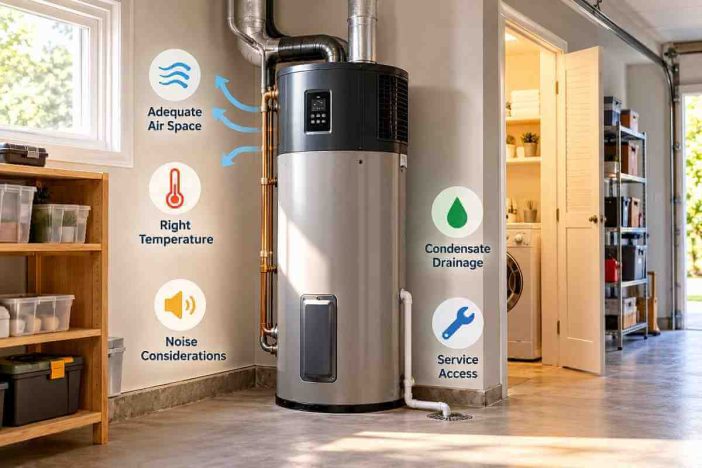
The replacement unit may be taller. It needs air to operate. It produces condensate. Its fan and compressor make noise. In winter, the surrounding space may become colder. A closet that comfortably accommodates a conventional electric tank may not support an efficient heat-pump installation without additional design work.
The equipment may be efficient on paper, but its location determines whether the installation can deliver the expected performance.
For homeowners comparing a garage, basement, or utility closet, the correct approach is to evaluate the space before choosing the water heater.
Quick Answer: Where Should a Heat Pump Water Heater Go?
A heat pump water heater generally belongs in a location that provides adequate air, acceptable operating temperatures, a code-compliant condensate drain, sufficient physical clearance, and reasonable access for maintenance.
A garage or basement can be a practical option when these conditions are satisfied. A utility closet may also work, but smaller enclosed spaces often require manufacturer-approved louvers, ducts, or other ventilation arrangements.
There is no universally best location. The correct choice depends on the exact model, the climate, the building, and the household’s hot-water needs.
Before purchasing, obtain the manufacturer’s installation manual and have a qualified installer confirm that the proposed location meets its requirements.
Why Heat Pump Water Heater Location Matters
A conventional electric-resistance water heater generates heat through electric heating elements.
A heat pump water heater primarily transfers heat from surrounding air into water using a refrigeration cycle. Many residential hybrid models also contain resistance elements that can assist with high hot-water demand or certain operating conditions.
According to the U.S. Department of Energy’s Building Science Education resources, heat pump water heaters can be two to three times more efficient than conventional electric-resistance water heaters under suitable conditions.
But that efficiency advantage depends partly on where the heat comes from.
When the unit runs, it removes heat from the surrounding air. The exhaust air is cooler, and moisture may condense on the evaporator coil.
The surrounding environment therefore matters in several ways:
- A poorly ventilated enclosure can reduce available heat and compromise operation.
- A cold room can affect efficiency or trigger different operating modes.
- A conditioned space may experience an additional heating load during winter.
- A nearby living area may be exposed to compressor and fan noise.
- Condensate needs a reliable disposal route.
- Equipment and filters must remain accessible for future service.
A suitable location must satisfy all these conditions together. Passing only one or two is not enough.
Garage vs. Basement vs. Closet: The Practical Comparison
The following table is a screening tool, not installation approval.
| Factor | Garage | Basement | Utility Closet |
|---|---|---|---|
| Air availability | Often favorable if sufficiently open | Often favorable in a large open area | Frequently constrained |
| Temperature | Depends on climate and insulation | Often more stable, but varies | Depends on surrounding rooms |
| Condensate disposal | May require drain or pump | May use appropriate drain or pump | Frequently needs planned routing |
| Noise exposure | Often away from living areas | Depends on room proximity | Can be noticeable near occupied rooms |
| Service access | Usually manageable | Depends on stairs and clearance | Often restricted |
| Main concern | Extreme temperatures or exposure | Cooling interaction and dampness | Airflow, clearance, and noise |
None of these locations should be approved solely from this table.
The manufacturer’s specific requirements and local installation rules take precedence.
Installing a Heat Pump Water Heater in a Garage
A garage can be an attractive location because it may provide ample air and physical separation from bedrooms or living rooms.
However, the advantages depend on climate and garage conditions.
When the garage makes sense
A garage is worth considering when:
- the unit will be protected from weather and physical damage;
- ambient temperatures remain within the model’s permitted operating range;
- the available air volume or approved ducting meets manufacturer requirements;
- plumbing and electrical connections are suitable;
- condensate has a reliable drainage route;
- required access and service clearances are available; and
- applicable local code requirements can be satisfied.
In a relatively warm climate, an unconditioned garage may supply usable ambient heat for much of the year.
That does not mean every warm-climate garage is suitable. Extreme temperatures, inadequate airflow, and improper installations can still create problems.
The cold-climate problem
In a cold region, garage temperatures can fall enough to reduce heat-pump performance or move outside the manufacturer’s permitted operating range.
A hybrid model may rely more heavily on resistance heating under some conditions. A sufficiently cold or freezing installation space may be unsuitable altogether.
Do not assume that a water heater can remain in an unheated garage merely because the existing electric tank has operated there for years.
The old tank’s location is not proof that the new heat-pump model will perform properly.
A qualified installer should assess the actual garage temperature conditions, freeze protection, code requirements, and manufacturer instructions.
Installing a Heat Pump Water Heater in a Basement
Basements are often considered suitable because they can provide a relatively large volume of air and a convenient location for plumbing equipment.
They also introduce an important energy tradeoff.
What happens when the unit takes heat from basement air?
The heat pump extracts heat from its surroundings to warm the tank water.
As a result, the basement may become cooler during operation.
In summer, that cooling might be welcome. In winter, the result depends on whether the basement is conditioned, how it interacts with the rest of the building, and where replacement heat ultimately comes from.
An especially important distinction is whether the surrounding heat is effectively free or supplied by the home’s heating system.
If the heating system must replace heat removed from conditioned indoor air, some of the water heater’s apparent operating advantage can be offset by additional space-heating demand.
The actual outcome varies by house and climate.
Do not treat incidental dehumidification as a replacement for moisture control
Heat pump water heaters may remove moisture from surrounding air while operating.
That can be a useful side effect, but it is not the same as operating a dedicated dehumidifier controlled by indoor humidity.
In an investigation published by Fine Homebuilding, measured moisture removal varied with operating conditions and was substantially lower than the output of a dedicated dehumidifier in the reported household.
The critical reason is that a water heater operates to satisfy hot-water demand, not to maintain a specific indoor humidity level.
Therefore:
A damp basement still needs its underlying moisture problem addressed.
Water intrusion, drainage failures, leaks, and persistent humidity should not be ignored simply because a heat pump water heater is being installed.
For a broader view of identifying energy problems before buying equipment, use our DIY home energy audit to establish what the house actually needs.
Installing a Heat Pump Water Heater in a Closet
A utility closet is often the most challenging of the three common locations.
A conventional electric water heater may fit behind a solid door without needing significant room air for its heating process.
A heat pump water heater operates differently.
It needs an adequate source of air, and many models have restrictions on enclosure size, venting, and duct configuration.
The closet-volume mistake
A homeowner may measure the floor space and conclude that a replacement fits.
But fitting physically is not the same as having enough air.
ENERGY STAR’s design guidance discusses models requiring approximately 450–700 cubic feet of available air volume, depending on equipment and configuration. Those numbers are examples from its guidance, not a universal requirement for every model.
For illustration:
A closet measuring 3 feet by 4 feet with an 8-foot ceiling has a gross volume of:
3 × 4 × 8 = 96 cubic feet.
That is considerably less than the air volume required by many typical integrated heat pump water heaters.
The calculation does not by itself establish whether the installation is permissible. Approved ducting, ventilation openings, and model-specific configurations can change the result.
It does show why simply replacing the old tank with a heat pump model in the same enclosed space can be a mistake.
Are louvered doors enough?
Not automatically.
Some manufacturer-approved installations may use louvered doors or appropriately sized transfer-air openings. Others require specific duct arrangements or have different restrictions.
ENERGY STAR discusses ventilation approaches involving sufficient free air area, including examples totaling 240 square inches of free area in certain configurations.
Free area is not the same as a grille’s outside dimensions.
The effective open area depends on the grille or louver design.
Do not drill random holes in a closet door or assume that an ordinary decorative grille satisfies the water heater’s installation instructions.
The noise question
Closets located next to bedrooms, home offices, or living areas deserve extra scrutiny.
Unlike a simple electric-resistance tank, a heat pump water heater contains operating components that produce audible sound.
Check the specific model’s published noise information and consider where sound may travel through doors, walls, and shared structures.
A location can satisfy technical requirements and still be undesirable for everyday comfort.
Five Checks Before Approving the Installation Location
Before ordering the equipment, complete these five checks.
1. Confirm the actual air requirements
Find the installation manual for the exact model, not merely its brand or product family.
Verify:
- required ambient air volume;
- permitted intake and exhaust arrangements;
- whether ducting is supported;
- minimum air-opening requirements;
- clearances around intake and exhaust; and
- restrictions on enclosed locations.
Do not assume that two water heaters with similar tank capacities have identical installation requirements.
2. Check the temperature range
Determine the expected temperatures in the proposed installation space throughout the year.
A garage that feels comfortable during a summer inspection may become very cold in January.
A basement that appears stable may experience substantial seasonal changes or localized cooling.
Compare these conditions with the manufacturer’s published operating limits and the installer’s assessment.
3. Plan condensate removal
Heat pump water heaters can produce condensate during operation.
ENERGY STAR’s installation guidance emphasizes routing this water to an appropriate drain and using a condensate pump when gravity drainage is impractical.
Before approving the location, determine:
- where condensate will go;
- whether gravity drainage is feasible;
- whether a pump is required;
- how freezing will be prevented where relevant;
- how leaks or drain failures will be managed; and
- whether routing satisfies applicable codes.
Do not rely on an improvised container that someone must remember to empty.
4. Confirm service and equipment access
A successful installation needs enough space not only for the tank but also for ongoing service.
Verify access to:
- air filters;
- control panels;
- serviceable components;
- electrical connections;
- plumbing connections;
- drain components; and
- required safety devices.
Also consider the route for bringing the replacement equipment into the space.
Stairs, narrow doors, low ceilings, and awkward corners can change the practical feasibility of the project.
5. Assess comfort and whole-home energy consequences
Ask where the heat being transferred into the tank ultimately originates.
If the unit draws heat from conditioned indoor space during winter, the home’s heating system may need to replace some of that heat.
If the unit operates in a hot garage during summer, the cooling effect may be welcome, but it should not be counted as guaranteed whole-house air-conditioning savings.
The correct question is not only whether the water heater has a high efficiency rating.
It is whether the whole installation makes sense in this particular house.
The Location-First Decision Framework
Use the following screening sequence before selecting a model.
| Question | If yes | If no |
|---|---|---|
| Does the location meet model-specific air requirements? | Continue | Change design or location |
| Are temperatures within the permitted range? | Continue | Reassess location and model |
| Is code-compliant condensate drainage feasible? | Continue | Plan an appropriate solution |
| Are required clearances and service access available? | Continue | Reassess layout |
| Is operating noise acceptable? | Continue | Consider isolation or relocation |
| Are electricity, plumbing, and installation conditions suitable? | Request professional confirmation | Obtain a scope of required upgrades |
The objective is not to award a numerical score to the garage, basement, or closet.
It is to prevent a homeowner from treating one attractive feature—such as abundant space—as proof that the entire installation is suitable.
Every critical requirement must pass.
Example: A compact utility closet
Consider a hypothetical household replacing a standard electric water heater in a small indoor closet.
The proposed heat pump model fits the floor area, and its tank capacity appears adequate.
However, the enclosure does not provide the manufacturer’s required air access. The existing door is solid, the closet borders a bedroom, and no condensate route has been planned.
Buying the unit immediately would be premature.
The homeowner should request an installation proposal that addresses approved air access, condensate drainage, noise, access requirements, and any necessary changes to the closet.
The final recommendation might involve approved ducting, modifying the enclosure, choosing another location, or selecting a different water-heating solution.
The point is not to force the heat pump water heater into the available space.
It is to select a water-heating system that can operate appropriately in the home.
Location Is Only Half the Buying Decision
Even a suitable installation space does not establish that a particular model meets household needs.
Hot-water capacity matters.
Heat pump water heaters vary in storage capacity, first-hour rating, recovery characteristics, operating modes, and efficiency.
A household with several consecutive showers, frequent laundry, or substantial simultaneous hot-water demand needs to assess the expected usage pattern.
Two tanks with the same nominal gallon capacity may not deliver identical first-hour performance.
Check the manufacturer’s ratings and compare them with the household’s realistic peak-hour demand.
A model that regularly relies on backup resistance heating to satisfy unusually high demand may not achieve the operating results implied by its most efficient mode.
Similarly, a larger tank is not automatically the right answer. Space, installed cost, standby losses, and usage patterns still matter.
Our discussion of appliances that use the most electricity in the home provides broader context for why water heating deserves attention in household energy planning. Individual appliance consumption, however, must be evaluated using actual equipment and usage rather than generic averages.
Compare Installed Cost, Not Just the Sticker Price
A heat pump water heater can be more expensive to purchase than a conventional electric-resistance tank.
Its installation may also require work that a straightforward tank replacement would not.
Potential cost components include:
- the water heater itself;
- professional labor;
- electrical adjustments;
- plumbing modifications;
- condensate piping or a pump;
- approved ducting or ventilation modifications;
- equipment removal and disposal;
- permit and inspection costs; and
- future service and maintenance.
Ask the installer for a written quote that separates the appliance cost from installation requirements.
For an economic comparison, use the following basic framework:
Annual net operating savings = annual cost of the existing system − annual cost of the proposed system.
Simple payback period = additional upfront installed cost ÷ annual net operating savings.
For example, if a replacement costs an additional $1,500 and produces an estimated $250 in annual net savings, the simple payback would be six years.
This is an illustration, not an expected result for every household.
A more complete assessment should consider equipment life, maintenance, future utility prices, changes in household demand, climate effects, financing costs, and any verified incentives available at the time of purchase.
Do not assume that incentives or tax credits remain available simply because an older article mentions them.
For broader home improvement decisions, our guide to eco-friendly home improvements discusses how upgrades fit into long-term household planning.
Questions to Ask the Installer Before Signing
A good installation proposal should explain why the selected location and equipment are suitable.
Ask:
- Which exact water-heater model is being proposed?
- Does the current room meet its air-volume and ventilation requirements?
- What are its allowed operating temperatures?
- Where will intake and exhaust air travel?
- How will condensate be drained?
- Are noise and vibration likely to affect nearby rooms?
- What clearance will remain for filters and service?
- Does the electrical installation require modification?
- How does the selected capacity match peak hot-water demand?
- What happens when the heat pump cannot meet demand using its most efficient mode?
- Which permits and inspections are required?
- What operating-cost assumptions support the recommendation?
An installer who can document these answers provides a stronger basis for decision-making than a quote based only on tank size and advertised savings.
For more information on installation planning, consult ENERGY STAR’s Heat Pump Water Heater Design Considerations and the DOE Building America installation checklist.
These references provide technical context, but the exact product instructions and applicable local codes govern an actual installation.
Common Questions Before Installation
Can a heat pump water heater go in an unheated garage?
Potentially, but the garage must remain within the selected model’s permitted operating conditions. In cold climates, low ambient temperatures can reduce performance or make an installation unsuitable. Freeze protection, air availability, drainage, and local codes must also be considered before selecting the location.
Can a heat pump water heater be installed behind a closed closet door?
Only when the complete installation complies with the model’s requirements. A solid door in a small enclosure may prevent adequate air access. Some models support approved louvers or duct configurations, but those arrangements must be designed according to the manufacturer’s instructions rather than improvised.
Will a heat pump water heater make my basement too cold?
It can cool surrounding air during operation, but the effect depends on the basement, climate, operating frequency, and interaction with the home’s heating system. The impact may be minor in some houses and more noticeable in others. Location and whole-home energy consequences should be evaluated together.
Choose the Location Before You Choose the Model
A heat pump water heater location decision should begin with the building, not the appliance brochure.
A garage may provide space but expose equipment to unfavorable temperatures. A basement may offer stable conditions but introduce seasonal heating interactions. A closet may be conveniently located but require more ventilation, drainage, and service planning than expected.
The most dependable approach is to verify the room’s constraints, compare compatible models, obtain a professional installation assessment, and evaluate the full installed cost.
A water heater cannot deliver its intended benefits simply because it has an impressive efficiency rating.
It needs an installation that allows it to operate as designed.
For a broader approach to reducing energy and water waste without purchasing unnecessary equipment, explore our Sustainable & Efficient Living hub.


