The pan flares faster than expected.
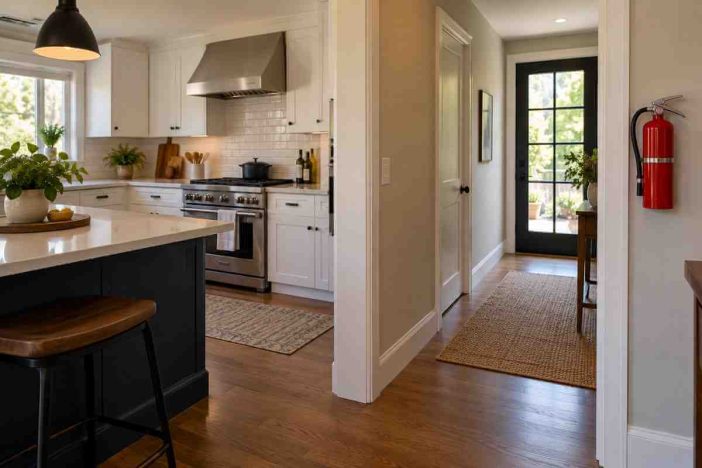
For a second, the kitchen still looks familiar: range, counter, doorway, cabinets. Then the space between the cooktop and the fire extinguisher becomes the most important part of the room.
If the extinguisher hangs beside the stove, reaching it may mean moving toward the flames.
If it is buried under the sink, opening a cabinet and moving cleaning supplies wastes time.
If it is in a pantry behind the fire, it may as well be somewhere else in the house.
That is why good fire extinguisher placement is not simply about putting equipment close to a hazard.
It is about keeping the equipment reachable while preserving your way out.
Quick Answer: Where Should Fire Extinguishers Go in a Home?
Place a home fire extinguisher where it is:
- visible;
- readily accessible;
- near a normal escape route;
- separated from the most likely ignition point;
- appropriate for the hazards it is intended to address;
- protected from damaging heat, moisture, weather, and obstruction.
For a kitchen, that usually means near the exit side of the room rather than beside the stove.
For a garage or workshop, think near a usable doorway rather than beside fuel, tools, machinery, or the workbench.
For another level of the home, choose a visible point on the normal route toward an exit or stairway rather than hiding the extinguisher deep inside one room.
The American Red Cross similarly advises locating home extinguishers near an exit and away from heat sources. It also emphasizes that anyone attempting to use one should have a usable exit behind them.
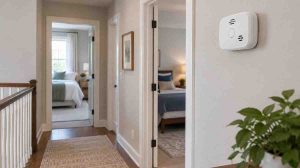
Placement does not replace detection. A well-positioned extinguisher should sit within a broader plan that includes correctly located smoke alarms and a practiced escape strategy.
Rule 1: Put the Escape Route Before the Fire Extinguisher
The most useful question is not:
“Where is a fire most likely to start?”
Ask instead:
“Can I reach the extinguisher without allowing that fire to get between me and the exit?”
That changes many common placement decisions.
A kitchen extinguisher immediately beside a range looks logical because it is close to the hazard.
But if flames rise from the range, you may have to approach the fire to retrieve it.
Moving the extinguisher toward the kitchen doorway can create a safer sequence:
see fire → alert others → move toward exit → reach extinguisher → decide whether the fire is still small enough to address.
The U.S. Fire Administration advises using a portable extinguisher only when conditions such as a small, contained fire, tolerable smoke conditions, and a clear escape route are present.
That makes the escape route part of the extinguisher-placement decision.
Rule 2: Kitchen Placement Should Be Near the Way Out, Not the Stove
Cooking remains the leading cause of residential building fires in the latest U.S. Fire Administration national estimates. For 2024, USFA estimated 160,300 residential cooking fires.
The kitchen therefore deserves special attention—but proximity can be misleading.
Better kitchen locations
Look for a position:
- near a kitchen doorway or normal exit;
- visible from the working area;
- accessible without reaching across the cooktop;
- separated from the oven, range, toaster oven, or other heat source;
- free from cabinet doors or stored objects that could block access.
Locations to reconsider
Avoid making the extinguisher difficult to reach by placing it:
- directly above the range;
- immediately beside a cooktop;
- behind a refrigerator;
- at the back of a deep cabinet;
- underneath a sink crowded with cleaning products;
- behind a pantry door;
- beyond the likely fire relative to the room exit.
Think of the extinguisher as equipment you should be able to collect while moving toward safety, not equipment that requires moving deeper into the hazard zone.
A fire extinguisher is also not the correct response to every cooking fire. For example, water should never be thrown onto burning cooking oil. If a fire is spreading, producing significant smoke, or threatening the escape route, evacuation takes priority over trying to save the kitchen.
Rule 3: Treat the Garage and Workshop as Different Hazards
A garage may combine several risk types in one space:
- vehicles;
- power tools;
- batteries and chargers;
- paints or solvents;
- fuels;
- combustible storage;
- electrical equipment.
That makes “put the extinguisher next to the workbench” an incomplete rule.
A fire at the bench could block it.
Likewise, an extinguisher mounted behind a parked vehicle may technically be in the garage while remaining difficult to reach.
A stronger location is usually near a normal exit from the garage, provided the location is visible, accessible, and suitable for the extinguisher manufacturer’s storage requirements.
The U.S. Fire Administration specifically identifies garages as areas with additional fire risks and recommends keeping combustible materials and flammable products under control.
Do not mount an extinguisher where fuel containers, shelving, bicycles, lawn equipment, or a vehicle can routinely block it.
Rule 4: Give Basements and Utility Areas an Exit-Side Location
Basements create a different problem.
The likely ignition source may be near:
- heating equipment;
- electrical equipment;
- a dryer;
- a workshop;
- stored combustibles.
But mounting an extinguisher immediately beside one of those hazards can force someone deeper into the basement if a fire begins there.
Instead, evaluate the route to the stairs or exterior basement exit.
The extinguisher should be reachable before the hazard blocks the route.
Do not position it:
- above a furnace;
- on a water heater;
- directly beside the dryer;
- behind storage;
- where electrical equipment or a utility fire could prevent access.
Laundry-related fire prevention also extends beyond the extinguisher itself. Restricted dryer exhaust deserves separate attention, which is why HKM maintains a dedicated dryer vent inspection guide.
Rule 5: Think in Levels and Escape Routes, Not Just Rooms
A large house may need more than one extinguisher for practical accessibility.
However, avoid turning a generic internet recommendation into a universal legal requirement.
Local codes, dwelling types, insurer requirements, building rules, and fire-department recommendations can vary.
For a typical multilevel home, a practical planning exercise is to ask whether someone on each main level can reach an appropriate extinguisher without crossing a likely fire zone.
Potential locations include:
- an entrance hallway;
- a landing with clear access to stairs;
- a visible wall along the normal exit route;
- a kitchen doorway;
- an accessible garage exit;
- a basement stair area.
A unit buried inside one bedroom may be accessible to one occupant while unavailable to everyone else.
For that reason, shared circulation spaces often deserve consideration before private rooms.
Rule 6: Do Not Hide Equipment to Protect the Décor
Fire extinguishers are visually awkward.
That makes them easy targets for “cleaning up” during a renovation.
They disappear:
- inside closets;
- behind curtains;
- behind cabinet doors;
- behind furniture;
- behind coats;
- inside locked cabinets.
The room looks better.
The emergency response becomes worse.
USFA identifies easy access as a fundamental maintenance concern: objects should not block or limit the ability to reach the extinguisher. It also advises checking pressure, visible working parts, condition, and manufacturer instructions.
If an extinguisher must be stored in a cabinet because of a particular installation or local requirement, the arrangement should remain easy to identify and open.
The goal is not maximum visual concealment.
It is predictable access under stress.
Rule 7: Match the Extinguisher to the Hazard Before Finalizing the Location
Location and extinguisher type are connected.
In the United States, multipurpose A-B-C extinguishers are widely available for common household hazards involving ordinary combustibles, flammable liquids, and energized electrical equipment.
USFA recommends looking for an extinguisher listed by a recognized testing laboratory and selecting a unit that the intended user can safely handle.
Do not assume one label system applies worldwide.
For example, terminology for cooking-oil fires differs among the United States, United Kingdom, Australia, and other markets. Local standards and manufacturer labels should control the purchase decision.
The same applies to unusual hazards such as a specialized workshop, large battery installation, commercial-style cooking equipment, or another nonstandard home environment.
Choose the extinguisher first.
Then confirm the location suits both the hazard and the equipment.
The HKM Exit-First Placement Test
A useful placement plan can be tested with seven questions.
| Question | Pass | Reconsider the location when |
|---|---|---|
| 1. Can I reach it while moving toward an exit? | The extinguisher is on or beside the escape route | You must move deeper into the room |
| 2. Can a likely fire block access? | Hazard and extinguisher are separated | It hangs beside the main ignition source |
| 3. Is it immediately visible? | The location is obvious | It is hidden behind storage or décor |
| 4. Is access predictable? | Nothing normally blocks it | Doors, vehicles, coats, furniture, or boxes obstruct it |
| 5. Is the extinguisher suitable for the hazard? | Label and manufacturer guidance match intended use | The unit was chosen only by size or price |
| 6. Is the storage environment appropriate? | It stays within manufacturer conditions | Heat, moisture, weather, or physical damage threaten it |
| 7. Can the user preserve an escape route? | The fire cannot trap the user between hazard and exit | Using the extinguisher requires turning away from the only exit |
This is an editorial decision framework, not a substitute for fire code, manufacturer requirements, or local fire-department advice.
The important shift is from asking:
“Is there an extinguisher in the room?”
to:
“Could someone safely reach it while preserving the option to leave?”
That distinction is what turns presence into useful placement.
Be Careful With Universal Distance and Mounting Rules Online
Search results frequently offer precise numbers for residential extinguisher spacing.
Some of those numbers originate from standards written for workplaces, commercial occupancies, or particular fire-hazard classifications.
They should not automatically be treated as universal residential law.
NFPA guidance emphasizes visibility and accessibility, but its own portable-extinguisher fact sheet also distinguishes one- and two-family dwellings from occupancies where extinguishers are required under NFPA 1.
That does not mean extinguishers are unnecessary in houses.
It means the safer editorial approach is to distinguish:
good safety planning
from
a legally mandated residential spacing rule.
For installation height, mounting bracket, environmental limits, inspection procedures, and replacement requirements, follow the extinguisher manufacturer’s instructions and any applicable local rules.
Do not move an extinguisher solely to satisfy an unexplained number copied from another article.
Placement Needs Maintenance Too
A good location can become a bad location over time.
A hallway that was clear last year may now contain:
- a shoe cabinet;
- stroller;
- coat rack;
- storage boxes.
A garage extinguisher can disappear behind shelving.
A kitchen remodel can place a new cabinet in front of the old mounting point.
That is why placement should be reviewed during routine home maintenance.
Include the extinguisher when working through your essential home maintenance checklist.
At the same time, inspect what the manufacturer tells you to inspect, which may include:
- pressure indication;
- pin and tamper seal;
- hose or nozzle;
- corrosion;
- dents or physical damage;
- label readability;
- service or replacement information;
- unobstructed access.
A green pressure gauge alone does not answer whether the extinguisher is correctly located.
An Extinguisher Does Not Replace Detection or Evacuation
Fire safety works in layers.
The extinguisher is the suppression layer for a limited situation.
Smoke alarms provide early warning.
A home escape plan determines what happens when suppression is unsafe or unsuccessful.
Carbon monoxide alarms address an entirely different invisible hazard. For that layer, use the separate carbon monoxide detector placement guide.
That distinction matters because homeowners can accumulate safety equipment and mistake quantity for protection.
Equipment works only when:
- it is appropriate;
- it is maintained;
- it is accessible;
- occupants know its limitations;
- the escape route remains the priority.
A broader home safety inspection can help review those layers together instead of treating each device as an isolated purchase.
Know When Not to Use the Fire Extinguisher
Having an extinguisher nearby does not create an obligation to fight a fire.
USFA recommends considering extinguisher use only when people have been alerted, emergency services have been called, the fire remains small and contained, smoke conditions are safe enough, the user is physically capable, and a clear escape route remains available.
The Red Cross similarly emphasizes keeping an exit behind you and abandoning the attempt if the fire does not quickly respond.
Leave instead of attempting suppression when:
- the fire is spreading;
- smoke is increasing;
- you do not know what is burning;
- you do not have an appropriate extinguisher;
- the escape route is threatened;
- the extinguisher cannot be reached safely;
- you are unsure whether you can operate it;
- someone still needs help evacuating.
Property is replaceable.
An escape route can disappear in seconds.
Frequently Asked Questions
Should a fire extinguisher be kept next to the stove?
Usually, directly beside or above the stove is a poor location because a cooking fire could block access. A safer candidate is typically toward the kitchen exit, where the extinguisher remains visible and reachable without moving through the likely fire area. Follow the unit’s instructions and local guidance.
Is it okay to keep a fire extinguisher under the kitchen sink?
An under-sink cabinet can make the extinguisher harder to see and may become crowded with cleaning supplies, plumbing, and stored products. A visible position near the kitchen exit is often more practical. Whatever location you use should remain dry, accessible, unobstructed, and compatible with manufacturer instructions.
Do I need a fire extinguisher on every floor?
Some fire-safety organizations and manufacturers recommend coverage on each main level, but requirements vary by jurisdiction and dwelling type. Instead of assuming a universal code, review local guidance and make sure occupants can reach an appropriate extinguisher without crossing a likely fire or losing access to an exit.
What type of fire extinguisher is best for a house?
In the United States, multipurpose A-B-C extinguishers are commonly used for ordinary household hazards. The correct choice still depends on what could burn, the intended user, local guidance, and product labeling. Specialized cooking, workshop, battery, or other hazards may require different equipment or professional advice.
Sources and Verification
This guide was cross-checked against current guidance from:
- U.S. Fire Administration, including extinguisher selection, appropriate-use criteria, accessibility, inspection, and current residential fire statistics.
- American Red Cross, including home extinguisher placement near exits, protection from heat, and escape-first use principles.
- National Fire Protection Association, including portable-extinguisher visibility, accessibility, occupancy distinctions, and placement standards.
Manufacturer instructions and applicable local fire regulations should take precedence when they provide model- or jurisdiction-specific requirements.
Build the Escape Route Around the Extinguisher
The strongest fire extinguisher placement plan begins with a route, not a wall bracket.
Identify where a fire could start.
Identify how people would leave.
Then place the extinguisher where it can be reached without sacrificing that escape route.
Keep it visible.
Keep access clear.
Match it to the hazard.
Review the location when rooms or storage arrangements change.
And remember that the safest decision during a growing fire may still be to leave rather than fight it.
For a wider prevention-first approach, continue through the Home Safety, Maintenance & Prevention hub.