Carbon monoxide alarms can be installed in a home and still leave important gaps if they are placed by habit rather than by coverage. This guide explains where CO alarms belong, why there is no universal mounting-height rule, and how sleeping areas, fuel-burning appliances, attached garages, and airflow should change the placement plan.
<!– FEATURED IMAGE PLACEMENT –>
The alarm is plugged into the nearest convenient outlet.
It has a green light. It chirped when the test button was pressed. Nothing about it looks neglected.
But convenience is not the same thing as coverage.
A carbon monoxide alarm at the far end of a ground floor may do little to answer the more practical questions: Is there protection near the bedrooms? What happens in the basement? What if the home has an attached garage? Is the alarm sitting beside a furnace because someone assumed “closer to the source is better”?
And then comes the most persistent question of all:
Should a carbon monoxide detector be installed high or low?
That question receives surprisingly contradictory answers because it starts with the wrong assumption. There is no single mounting height that overrides the manufacturer’s instructions, the layout of the home, applicable codes, and the locations that actually need coverage.
The better approach is to design the alarm layout in the right order.
Quick Answer: Where Should Carbon Monoxide Detectors Be Placed?
For a U.S. home, begin with these seven rules:
- Place a CO alarm on every level of the home, including the basement.
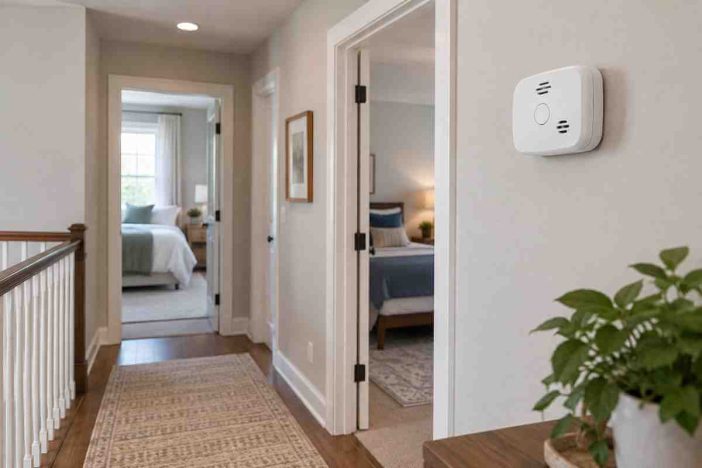
- Provide coverage outside each separate sleeping area.
- Pay special attention to the living space adjoining an attached garage and rooms above it.
- Do not automatically install an alarm directly beside or above a fuel-burning appliance.
- Follow the specific alarm manufacturer’s mounting-height instructions rather than a universal high-versus-low rule.
- Avoid locations where vents, windows, furniture, curtains, humidity, or other environmental conditions can interfere with the unit.
- Where practical, use interconnected alarms so a problem on one level can warn occupants elsewhere.
The U.S. Consumer Product Safety Commission recommends CO alarms on every level and outside sleeping areas, and identifies interconnected units as preferable because one alarm can cause the others to sound.
The U.S. Environmental Protection Agency adds useful layout detail: alarms should cover every level of livable space, be near or inside sleeping areas, and provide protection inside the home near an attached garage and in rooms above it.
These are starting points.
Your specific alarm instructions and applicable state, local, fire, and building requirements remain important because placement requirements can vary.
Start With Coverage, Not Mounting Height
One of the easiest ways to design a weak alarm layout is to begin by asking:
“Should it be five feet high?”
That detail matters only after you have answered more fundamental questions:
- Which floors need coverage?
- Where are people sleeping?
- Where are fuel-burning appliances?
- Is there an attached garage?
- Can an alarm on one side of the house be heard from the bedrooms?
- Does the manufacturer permit wall, ceiling, or receptacle mounting?
Think of carbon monoxide detector placement as a coverage problem first and a mounting problem second.
That is consistent with HKM’s broader approach to long-term home safety systems: a device adds protection only when the system around it is designed, tested, and maintained correctly.
Rule 1: Put CO Protection on Every Level
A single alarm near the bedrooms is better than no alarm, but it is not a complete whole-home layout.
For U.S. homes, CPSC recommends alarms on every level of the home and outside sleeping areas.
EPA guidance similarly calls for a central alarm location on every level of the home’s livable space, including the basement.
This matters because potential carbon monoxide sources can be separated from sleeping occupants by:
- floors;
- stairways;
- closed doors;
- HVAC pathways;
- different sections of the house.
A basement furnace problem should not depend entirely on a device two floors away discovering the gas later.
For a typical two-story home with a basement, start by mapping coverage across:
Basement → main floor → upper floor
Then add sleeping-area coverage rather than assuming one centrally located alarm satisfies every requirement.
Rule 2: Protect Each Separate Sleeping Area
Nighttime coverage deserves special attention because occupants may not recognize a developing problem while asleep.
CPSC specifically recommends CO alarms outside sleeping areas.
The phrase “each separate sleeping area” matters.
Consider a one-story home with the primary bedroom at one end of the house and two bedrooms in a separate wing.
A single alarm in one bedroom hallway may not provide the same practical coverage for the other sleeping zone.
Ask:
Where would an alarm need to sound so that people behind closed bedroom doors can receive the warning?
Local codes or a particular manufacturer’s instructions may require additional alarms, including units inside bedrooms.
Do not reduce the decision to a universal alarm count. Layout matters.
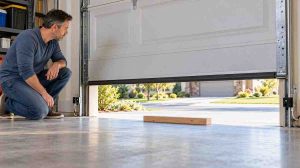
Rule 3: Treat an Attached Garage as a Separate Placement Problem
An attached garage changes the CO risk map even when the house itself has relatively few fuel-burning appliances.
Vehicle exhaust and fuel-powered equipment can produce carbon monoxide.
Running a vehicle inside an attached garage is unsafe even if the garage door is open.
For alarm placement, EPA recommends protection inside the home near the door leading to the attached garage and in rooms located above the garage.
That distinction is important.
It does not automatically mean a standard residential CO alarm should be placed inside the garage itself.
Garages can experience temperature, humidity, dust, and other environmental conditions outside the operating limits of some consumer alarms.
Unless the device is specifically suitable for that environment and local requirements support the location, prioritize the adjacent living space according to the alarm instructions.
For a broader property review, HKM’s home safety inspection framework can help identify how garage access, detectors, electrical systems, ventilation, and other risk points interact.
Rule 4: Do Not Put the Alarm Directly Over the Furnace Just Because It Is the Source
Another intuitive placement mistake is:
“If the furnace can make carbon monoxide, the detector should sit right beside the furnace.”
Not necessarily.
CPSC advises against installing CO alarms in kitchens or directly above fuel-burning appliances.
EPA recommends placing alarms at least 15 feet away from fuel-burning appliances in its general household guidance.
Why avoid crowding the source?
An alarm needs to monitor the occupied environment according to its design—not simply sample the immediate plume from normal appliance operation.
Locations directly adjacent to equipment may also expose a unit to environmental conditions that affect performance or contribute to nuisance alarms.
A better sequence is:
identify source → observe manufacturer clearance → protect occupied space → confirm sleeping-area and floor coverage.
If your alarm manual specifies a different clearance or your local code is more restrictive, follow the specific requirement.
Rule 5: Stop Looking for One Universal CO Detector Height
This is where much of the online advice becomes unreliable.
You may read:
- mount it near the floor;
- mount it five feet high;
- mount it at breathing height;
- mount it close to the ceiling.
Those recommendations cannot all be universal.
Carbon monoxide does not form a neat low layer in a room. It mixes with surrounding air.
More importantly, consumer CO alarms are manufactured in different formats:
- plug-in alarms;
- wall-mounted alarms;
- ceiling-capable alarms;
- combination smoke/CO alarms.
CPSC states that CO alarms may be installed in a plug-in receptacle or high on a wall, while also directing consumers to follow the manufacturer’s installation instructions.
That is the safer hierarchy.
Use the location requirements first, then mount the specific product the way its listing and manual require.
Do not move an approved plug-in alarm to an improvised five-foot extension simply because an internet article gives “five feet” as a universal rule.
Likewise, do not automatically install a wall-mounted model near the floor because you were told carbon monoxide “sinks.”
Combination smoke and CO alarms need extra care
A combination device is detecting two different hazards.
Do not take a placement rule from a standalone CO alarm and assume it overrides the instructions for a combination unit.
Smoke-alarm placement has its own requirements involving ceilings, walls, bedrooms, sleeping areas, kitchens, and airflow.
If you are planning a combined system, first review HKM’s smoke detector placement guide, then use the installation instructions for the exact combination alarm to resolve the final mounting position.
Rule 6: Keep Alarms Away From Bad Airflow and Obstructions
Correct floor coverage can still be undermined by a poor location within the room.
CPSC specifically cautions against locations near heating vents or where furniture or draperies could cover the alarm.
Manufacturer instructions may also restrict locations near:
- windows;
- exterior doors;
- supply or return vents;
- ceiling fans;
- dead-air corners;
- bathrooms or unusually humid areas;
- direct sunlight;
- excessively hot or cold spaces.
The exact exclusions depend on the device.
The practical principle is simple:
The alarm needs representative room air and should remain unobstructed.
Do not hide a detector behind:
- a curtain;
- a tall cabinet;
- a television;
- shelving;
- decorative panels.
And do not choose a location simply because the device is less visible there.
A safety device is not home décor that needs to disappear.
Rule 7: Think About Warning Distribution, Not Just Sensor Distribution
An alarm detecting CO in the basement is useful.
An alarm detecting CO in the basement and waking someone upstairs is more useful.
CPSC identifies interconnected CO alarms as the preferred arrangement because when one alarm sounds, connected alarms can sound as well.
Interconnection can be:
- hardwired;
- wireless;
- incorporated into certain compatible alarm systems.
Compatibility matters.
Do not assume alarms from unrelated systems will communicate simply because both advertise wireless features.
Even without interconnection, your placement plan should consider whether alarms serving sleeping areas can be heard reliably.
This is particularly important in:
- larger homes;
- multi-story homes;
- homes with separated bedroom wings;
- finished basements;
- homes with occupants who sleep behind closed doors.
The HKM Carbon Monoxide Placement Priority Framework
When recommendations seem contradictory, use this hierarchy.
| Priority | Question | What takes precedence |
|---|---|---|
| 1 | What does this exact alarm require? | Manufacturer installation instructions and product listing |
| 2 | Does local law require additional locations? | Applicable building, fire, landlord, or residential code |
| 3 | Are sleeping areas protected? | Coverage outside each separate sleeping zone |
| 4 | Is every level covered? | Whole-home vertical coverage, including basement |
| 5 | Is there an attached garage or combustion source? | Garage-adjacent living space and source-clearance rules |
| 6 | Is airflow suitable? | Avoid vents, windows, dead air, obstructions, and unsuitable environments |
| 7 | Can occupants receive the warning? | Audibility and, where practical, interconnection |
This ordering resolves one of the biggest problems in carbon monoxide detector placement.
“How high?” is not Priority 1.
It sits underneath product-specific installation requirements and a much larger coverage problem.
Room-by-Room Examples
One-story home with bedrooms grouped together
Start with:
- an alarm serving the sleeping area;
- appropriate central coverage for the home’s occupied level;
- additional protection required by the device instructions or local code.
If the sleeping hallway and central location overlap appropriately, one unit may satisfy more than one placement objective—but do not assume this without checking the actual layout.
Two-story home with a basement
Plan coverage across all three levels:
- basement;
- main level;
- second level.
Then verify that each separate sleeping area also has the required coverage.
If the basement contains a furnace or other fuel-burning appliance, respect required appliance clearance rather than mounting the alarm directly above the equipment.
Split-bedroom floor plan
A house with bedrooms on opposite sides of the building may need more than one sleeping-area alarm even though every bedroom is technically on the same floor.
Distance and closed doors matter.
Map sleeping zones, not just floors.
Home with an attached garage
Provide the recommended protection inside the house near the connecting garage door.
If occupied rooms are located over the garage, include them when planning coverage.
Do not run a vehicle in the garage as a “test” of the alarm.
Home with combination smoke and CO alarms
Do not solve the mounting-height question by averaging the recommendations for two separate devices.
Use the instructions written for the actual combination unit.
The product has been designed and listed to operate from permitted mounting locations.
Seven Placement Mistakes That Create False Confidence
1. Installing one alarm for the entire house
One device cannot automatically provide appropriate protection for every level and separated sleeping area.
2. Putting the alarm beside the furnace
Closer is not automatically better.
Respect appliance-clearance guidance.
3. Following a universal five-foot rule without reading the manual
Different alarm designs permit different mounting locations.
4. Putting a standard alarm inside the garage by default
Protect the adjoining living space as recommended unless the device and applicable requirements specifically support garage installation.
5. Hiding the alarm behind furniture or curtains
A correctly chosen room with a physically obstructed sensor is not a good installation.
6. Copying smoke-alarm placement rules onto a standalone CO alarm
Smoke and carbon monoxide detection overlap as home-safety systems, but they are not identical placement problems.
7. Treating a working test button as proof that the sensor is accurate
This is an especially important distinction.
CPSC notes that pressing the test button checks whether the alarm circuitry is operating; it does not verify the accuracy of the carbon monoxide sensor.
That is why product age and replacement instructions still matter even when the alarm sounds during its monthly test.
What to Do If a Carbon Monoxide Alarm Sounds
An active CO alarm is not the time to diagnose furnace settings, unplug the alarm, open a browser, or assume the battery is failing.
CPSC advises people who suspect carbon monoxide poisoning to get outside to fresh air immediately and call 911.
Follow the emergency instructions supplied with your alarm and directions from emergency responders.
Do not deliberately expose an alarm to:
- vehicle exhaust;
- generator exhaust;
- a gas burner;
- charcoal;
- combustion fumes;
to see whether the sensor responds.
Use the manufacturer’s specified test procedure.
A CO alarm is also not a substitute for correct installation, ventilation, and maintenance of fuel-burning equipment.
Placement Is Only Half the Safety System
Once the alarms are installed, maintenance becomes the next failure point.
EPA and CPSC recommend monthly testing of CO alarms.
Use the test procedure for your specific model.
Also record:
- installation date;
- manufacturer and model;
- battery type;
- last monthly test;
- replacement date or end-of-life guidance;
- whether alarms are interconnected;
- which sleeping area or level each alarm protects.
Replacement life varies between products, so do not create one universal replacement interval unless the manufacturer specifies it for your unit.
HomeKitchenMagazine’s guide to how often home safety systems should be checked can help integrate alarm testing with the rest of the home’s recurring safety schedule.
You can also record the installation and test dates within an essential home maintenance checklist rather than relying on memory.
Frequently Asked Questions
How high should a carbon monoxide detector be installed?
There is no single mounting height that applies to every CO alarm. Plug-in, wall-mounted, ceiling-capable, and combination alarms have different installation requirements. Follow the exact manufacturer’s instructions and applicable local code rather than relying on a generic “five feet high” or “near the floor” rule.
How far should a CO detector be from a furnace?
EPA household guidance recommends locating CO alarms at least 15 feet from fuel-burning appliances. Do not automatically mount an alarm directly over a furnace, boiler, fireplace, or water heater. Your alarm’s instructions or local requirements may specify a different clearance, so follow the applicable product-specific rule.
Should I put a carbon monoxide detector inside an attached garage?
Do not assume a standard residential alarm belongs inside the garage. EPA recommends protection inside the home near the door connecting to an attached garage and in rooms above the garage. Garage temperature and environmental conditions may exceed some alarms’ operating limits, so check the device instructions.
Is a combination smoke and carbon monoxide alarm placed like a CO-only alarm?
Not necessarily. A combination alarm has to perform both smoke and carbon-monoxide detection, so its approved installation locations may differ from a standalone CO device. Use the combination unit’s own instructions instead of combining generic advice from separate smoke- and CO-alarm articles.
Build the Coverage Map Before You Drill the Hole
Good carbon monoxide detector placement is not about finding one perfect wall height.
It is about building overlapping protection around the way the home is actually occupied.
Start with every level.
Protect each separate sleeping area.
Account for the attached garage.
Respect clearance from fuel-burning appliances.
Avoid poor airflow and obstructions.
Then let the exact alarm instructions determine where that particular device can be mounted.
Once installed, test it on schedule and record when it should be replaced.
That approach is less memorable than a viral “five-foot rule.”
It is also far more useful.
Sources and Verification
This guide is based primarily on current safety guidance from the U.S. Consumer Product Safety Commission (CPSC) and the U.S. Environmental Protection Agency (EPA), supported where useful by manufacturer installation guidance.
For any individual installation, the product’s current instructions and applicable state or local requirements take precedence over generalized online advice.
This article provides homeowner safety information. It does not replace fire-code interpretation, appliance inspection, medical advice, or emergency response instructions.