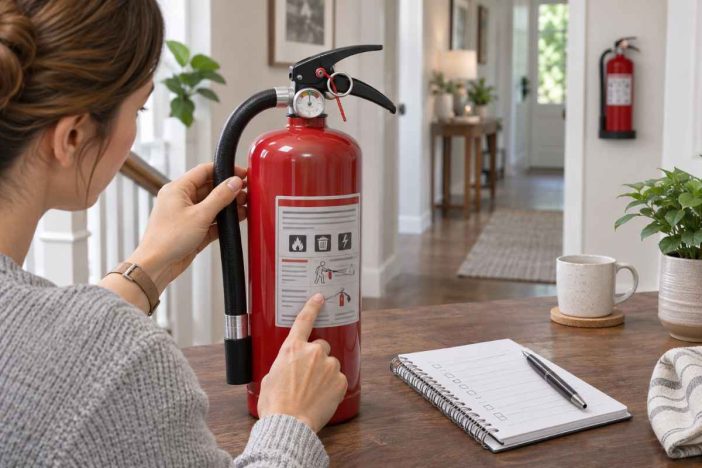
The extinguisher has been hanging in the same place for years.
The pin is still there. The cylinder looks clean. Maybe the gauge is green.
Then something changes.
Perhaps it was discharged for only a second during a small cooking fire. Perhaps the gauge has drifted toward the red. Perhaps you finally notice the manufacture date and realize you have no idea when anyone last inspected it.
Now the question becomes practical:
Should this fire extinguisher be recharged, professionally serviced, or replaced?
There is no reliable answer based on age alone.
Some extinguishers are designed to be recharged and returned to service. Others are nonrechargeable units that should be replaced rather than opened and refilled. Physical damage, corrosion, missing service history, a product recall, or manufacturer instructions can also override what the pressure gauge appears to say.
The safest decision sequence is:
identify the extinguisher → confirm whether it is rechargeable → check for any discharge → inspect pressure and physical condition → verify age and service requirements → check recalls → choose professional service or replacement
Quick Answer
A fire extinguisher should generally enter one of three paths:
| Condition | Likely Next Step |
|---|---|
| Rechargeable unit, used even briefly | Professional inspection and recharge/service |
| Nonrechargeable or disposable unit that has been used | Replace according to manufacturer instructions |
| Pressure abnormal, damage present, or status uncertain | Remove reliance on the unit and obtain professional/manufacturer guidance |
| Rechargeable, unused, normal pressure, good condition | Continue required inspection and maintenance |
| Recalled model | Follow the recall remedy rather than normal maintenance assumptions |
| Service or testing history cannot be verified | Have the extinguisher evaluated before relying on it |
These are decision paths, not universal replacement rules.
The U.S. Fire Administration specifically notes that some extinguishers can be recharged while others need replacement when pressure becomes too low. It also recommends checking pressure, hoses, nozzles, dents, rust, cleanliness, and the manufacturer’s instructions.
First Understand the Difference Between Recharge and Replacement
Recharge and replacement solve different problems.
Recharging means returning a serviceable rechargeable extinguisher to its specified operating condition using the correct extinguishing agent and pressure, typically as part of professional fire-equipment service.
Replacement means removing the existing extinguisher from protection and obtaining another appropriate unit.
The mistake is assuming every extinguisher can take either path.
It cannot.
Before thinking about price, age, pressure, or service intervals, identify what you actually own.
Check 1: Is the Fire Extinguisher Rechargeable or Nonrechargeable?
This is the most important first check.
Look at:
- the cylinder label;
- model number;
- manufacturer’s instructions;
- service markings;
- product documentation.
A rechargeable or refillable extinguisher is designed to undergo appropriate maintenance and be restored to service by qualified fire-equipment personnel.
A nonrechargeable or disposable extinguisher is not simply a cheaper rechargeable extinguisher. Its service path is different.
If a disposable unit has been discharged or reaches a manufacturer-defined replacement condition, trying to find someone to “top it up” is the wrong approach.
Do not determine serviceability solely from:
- whether the cylinder is metal;
- whether a pressure gauge is present;
- how expensive the unit was;
- how large it looks;
- what another extinguisher in the house requires.
Read the specific label.
Why this check comes before age
A ten-year-old rechargeable extinguisher with documented professional maintenance is a completely different maintenance question from a ten-year-old disposable unit whose manufacturer specifies replacement at a particular age.
That is why:
type first → age second
is more reliable than:
old = replace.
For broader placement and accessibility planning, see our fire extinguisher placement guide, which explains why an extinguisher must remain reachable without forcing someone toward the fire.
Check 2: Has the Extinguisher Ever Been Discharged?
Treat this as a yes-or-no question.
Do not ask:
“Was very much agent used?”
A brief discharge still matters.
Once an extinguisher has been operated, you should not simply return it to the wall because:
- the gauge still looks acceptable;
- the extinguisher still feels heavy;
- only a small amount came out;
- the fire was tiny.
A rechargeable unit normally needs to follow its manufacturer’s post-use service and recharge instructions.
A nonrechargeable unit generally follows its replacement instructions.
The important principle is:
fire extinguisher use changes its service status.
Do not test-fire an extinguisher to see whether it still works
Discharging it intentionally is not an appropriate routine inspection method.
A visual and maintenance check is very different from releasing extinguishing agent.
If you want to know whether a questionable unit remains serviceable, use the label, manufacturer instructions, recall information, and qualified fire-equipment service—not a test spray.
Check 3: What Does the Pressure Indicator Actually Show?
Many stored-pressure extinguishers have a gauge.
If yours does, check whether the indicator is within the operating range specified on the extinguisher.
A needle outside that range deserves attention.
But the reverse is equally important:
a green gauge does not prove the entire extinguisher is safe or serviceable.
The pressure gauge cannot tell you whether:
- the cylinder is badly corroded;
- the hose is damaged;
- the nozzle is obstructed;
- the pin or tamper seal is missing;
- the extinguisher was improperly serviced;
- the product has been recalled;
- internal maintenance is overdue;
- the cylinder has suffered structural damage.
Pressure is one checkpoint.
It is not the whole inspection.
What if the extinguisher has no gauge?
Do not invent a test.
Some extinguishers use different status or pressure-verification systems.
Follow the label and manufacturer instructions for that particular unit.
Check 4: Inspect the Cylinder, Hose, Nozzle, Pin, and Label
Physical condition can override every other part of your decision.
The U.S. Fire Administration recommends checking whether the can, hoses, and nozzles are damaged, dented, or rusted.
Look for obvious conditions such as:
- corrosion or significant rust;
- dents or deformation;
- damaged hose;
- cracked or damaged nozzle;
- missing pin;
- broken or unexplained tamper seal;
- leakage or residue;
- damaged handle or valve;
- illegible instructions;
- evidence of severe impact;
- evidence of fire or excessive heat exposure.
Do not sand, drill, weld, puncture, disassemble, or pressure-test a questionable cylinder yourself.
A pressurized fire extinguisher is not an ordinary metal container.
Corrosion deserves particular caution
Surface dirt and structural corrosion are not the same thing.
An extinguisher with meaningful corrosion, pitting, or mechanical damage may require removal from service and professional evaluation rather than recharge.
Professional standards include hydrostatic testing requirements precisely because cylinder integrity cannot always be judged from appearance alone.
Hydrostatic testing is not a homeowner DIY test.
It requires appropriate procedures, facilities, and trained personnel.
Record what you can verify from the extinguisher label, condition, and service history. Do not discharge, open, puncture, or pressure-test the cylinder to complete this checklist.
1. Extinguisher type
2. Use history
3. Pressure / status
4. Physical condition
5. Age and service history
6. Recall check
7. Next action
Check 5: Find the Manufacture Date and Service History
Now check time.
Not before.
Look for:
- manufacture date;
- service tag;
- recharge record;
- maintenance label;
- inspection record;
- hydrostatic-test information where applicable;
- manufacturer replacement instructions.
Do not assume that one internet statement such as:
“Every fire extinguisher lasts X years”
applies to every portable extinguisher.
Different extinguisher designs, agents, cylinders, manufacturers, and service classifications can have different requirements.
Age is a trigger to verify, not a universal verdict
Finding an old manufacture date should cause you to ask:
- What type of extinguisher is this?
- Is it rechargeable?
- What does its manufacturer require?
- Has required professional service been performed?
- Is there documentation?
- Is the cylinder still eligible for continued service?
An old extinguisher with no identifiable history deserves more scrutiny than one with traceable maintenance.
This is where a structured essential home maintenance checklist becomes useful: safety equipment should live inside a recurring maintenance system rather than depend on memory.
What Hydrostatic Testing Means
Hydrostatic testing evaluates the structural integrity of a pressurized cylinder under controlled conditions.
The important homeowner takeaway is not how to perform it.
It is that recharge and cylinder integrity are separate questions.
An extinguisher can contain the correct agent and still have a cylinder that should not remain in service.
Professional standards specify hydrostatic testing intervals based on extinguisher type and also identify circumstances where cylinder damage or corrosion changes what should happen next.
OSHA’s workplace rules, for example, require hydrostatic testing to be performed by trained people with suitable equipment and facilities.
Residential requirements can differ, but the safety lesson carries over:
do not improvise pressure testing at home.
Check 6: Check the Model for Recalls or Safety Notices
This step is easy to overlook.
A unit can appear normal and still be subject to a manufacturer or regulator recall.
The U.S. Consumer Product Safety Commission has previously recalled millions of fire extinguishers because certain models could fail to discharge, require excessive force, or experience nozzle-related problems.
That does not mean your extinguisher is recalled.
It means model identification matters.
Record:
- manufacturer;
- model number;
- date code or manufacture date;
- serial information if applicable.
Then check the manufacturer and official recall database.
If the unit is recalled, follow the recall remedy.
Do not decide:
“The gauge is green, so the recall doesn’t matter.”
A recall can concern a failure mode that the gauge does not reveal.
Check 7: Does Professional Service Still Make Sense?
If the extinguisher is rechargeable and otherwise serviceable, professional maintenance or recharge may be the correct path.
But the final decision should consider more than whether a technician can physically add agent.
Ask:
- Is the model intended to remain in service?
- Is required testing current?
- Is the cylinder in acceptable condition?
- Are replacement parts and proper agent available?
- Is service documentation available?
- Does the manufacturer support continued service?
- Is the unit subject to a recall?
- Will professional service restore it to a clearly documented ready condition?
The objective is not to preserve an old cylinder at any cost.
The objective is to maintain reliable fire protection.
Recharge vs Replace Decision Matrix
| Situation | Recharge / Professional Service | Replace |
|---|---|---|
| Rechargeable unit used | Usually evaluate/recharge | If condition or manufacturer guidance requires |
| Disposable unit used | No | Usually yes |
| Pressure outside acceptable range | Evaluate professionally | If nonserviceable/disposable |
| Missing pin or damaged seal | Evaluate cause and serviceability | If damage makes unit unsuitable |
| Damaged hose/nozzle | Possible professional repair on serviceable unit | If parts/service unavailable or unit is disposable |
| Serious corrosion or cylinder damage | Do not assume recharge | Often removal from service/evaluation |
| Unknown maintenance history | Professional evaluation | If status cannot be restored reliably |
| Recalled model | Follow recall remedy | Often specified by recall |
| Unit meets manufacturer requirements and is in good condition | Continue prescribed maintenance | Not solely because another unit is newer |
This matrix intentionally avoids universal age limits.
The extinguisher’s own requirements still control.
When Replacement Is the Cleaner Decision
Replacement becomes especially reasonable when:
- the extinguisher is nonrechargeable and has been discharged;
- the manufacturer specifies replacement;
- the model is recalled with a replacement remedy;
- the cylinder is damaged or unsuitable for continued service;
- important components cannot be properly serviced;
- required documentation or serviceability cannot be established;
- professional service determines that continued use is inappropriate.
Do not confuse “replace” with “throw it in the trash.”
Pressurized cylinders can require specific disposal or recycling procedures.
Do Not Put a Questionable Extinguisher Back Into Service
This is an important distinction.
A questionable extinguisher is not merely an item on a future maintenance list.
It may be part of the home’s fire-protection plan.
If you remove an extinguisher from its location for service, replacement, or recall handling, consider whether that leaves the home without the protection you intended for that area.
Do not assume another extinguisher hidden elsewhere provides equivalent practical access.
Our fire extinguisher placement guide explains why access and escape-route position are part of effective protection.
How to Dispose of an Old Fire Extinguisher Safely
Disposal rules vary by location.
A fire extinguisher may still contain:
- pressure;
- extinguishing agent;
- a pressurized cylinder requiring controlled handling.
Do not puncture, drill, burn, crush, or dismantle the cylinder in an attempt to convert it into normal household trash.
Instead:
- identify the extinguisher;
- check the manufacturer instructions;
- ask the local fire-equipment service provider, municipal waste program, hazardous-waste program, or appropriate local authority what disposal route applies.
Some communities accept extinguishers through recycling or household hazardous-waste programs.
Others use different procedures.
Follow the local rules for the specific unit.
Build Fire Extinguisher Checks Into Home Maintenance
The best time to discover an extinguisher problem is not during a fire.
Include it in a repeatable home-safety review.
A routine visual check can include:
- accessibility;
- pressure or status indicator;
- pin and seal;
- hose;
- nozzle;
- visible corrosion;
- physical damage;
- label readability;
- manufacturer/service information.
The exact inspection and maintenance schedule should follow the product instructions and any applicable local requirements.
Our Home Safety Inspection framework already treats fire extinguisher accessibility as part of a broader fire-safety inspection rather than an isolated purchase.
For whole-home routines, How Often Home Safety Systems Should Be Checked explains how recurring reviews prevent safety equipment from quietly disappearing into the background.
A Green Gauge Is Not a Lifetime Warranty
One of the most useful conclusions from this process is simple:
green pressure does not equal guaranteed readiness.
A gauge tells you something important about pressure.
It does not tell you everything about:
- structural integrity;
- service history;
- recall status;
- internal condition;
- component damage;
- manufacturer-defined service life.
That is why the decision needs multiple checks.
What Not to Do
Avoid shortcuts that create false confidence:
- Do not test-fire the extinguisher for reassurance.
- Do not drill, puncture, or open a pressurized cylinder.
- Do not add pressure with household equipment.
- Do not substitute an unknown extinguishing agent.
- Do not assume every extinguisher can be recharged.
- Do not assume every old extinguisher must automatically be discarded.
- Do not rely on gauge color alone.
- Do not ignore a recall because the extinguisher looks normal.
- Do not hide a questionable unit back on the wall and postpone the decision.
When professional servicing is required, use a qualified fire-equipment service provider.
The Seven-Check Decision Sequence
Before deciding, record these seven answers:
- Type: Is it rechargeable or nonrechargeable?
- Use: Has it ever been discharged?
- Pressure: Is its pressure/status indication normal?
- Condition: Is there corrosion, damage, leakage, or component deterioration?
- History: Can you verify manufacture date and required service?
- Recall: Is the model subject to a current recall or safety notice?
- Serviceability: Can qualified service restore it to documented ready condition?
If you cannot confidently answer the first six, you are not yet ready to answer the seventh.
That framework is more reliable than judging the extinguisher by age, price, or appearance alone.
Frequently Asked Questions
Can you recharge a fire extinguisher after using it once?
If the extinguisher is designed to be rechargeable, even partial use normally means it should follow the manufacturer’s professional service/recharge procedure before being returned to protection. A nonrechargeable unit generally follows its replacement instructions.
Should I replace a fire extinguisher if the gauge is in the red?
A pressure indication outside the specified operating range requires action, but the correct action depends on whether the unit is rechargeable and serviceable. Some can be professionally recharged; others require replacement.
Is a fire extinguisher still good if the gauge is green?
A green gauge is useful but not sufficient by itself. Physical condition, service requirements, manufacturer instructions, recalls, and maintenance history also matter.
Do fire extinguishers expire?
There is no single universal replacement age for every fire extinguisher. Manufacturers and extinguisher types have different service and replacement requirements. Verify the date, label, manual, and service history for the specific unit.
Can I recharge a fire extinguisher myself?
Homeowners should not improvise fire extinguisher recharge, pressure testing, or cylinder servicing. Rechargeable units should be handled using the procedures, equipment, agent, and service requirements specified for that extinguisher.
What should I do with a rusty fire extinguisher?
Do not assume that adding pressure or agent makes a corroded cylinder safe. Significant corrosion or physical damage requires proper evaluation, and the extinguisher may need to be removed from service.
Should I replace a recalled extinguisher even if the gauge is green?
Follow the official recall remedy. A recall can involve problems unrelated to the pressure indication, including discharge or component failures.
Where should I keep the replacement extinguisher?
Keep it visible and readily accessible while preserving a clear escape route. Avoid placing it where the likely fire could block access. Our fire extinguisher placement guide provides the room-by-room framework.
Sources and Verification
This guide was cross-checked against current information from:
- U.S. Fire Administration (USFA) for residential extinguisher maintenance, pressure, damage, accessibility, and recharge-versus-replacement principles;
- NFPA 10, 2026 edition, the current Standard for Portable Fire Extinguishers, covering inspection, maintenance, testing, and recharging;
- U.S. Consumer Product Safety Commission (CPSC) for extinguisher recall verification;
- manufacturer maintenance and service guidance for rechargeable and nonrechargeable units.
For model-specific decisions, the extinguisher label and manufacturer instructions take precedence over generic advice.
Final Takeaway
The right question is not simply:
“How old is my fire extinguisher?”
Ask instead:
What type is it, has it been used, is its pressure normal, is the cylinder undamaged, is its service history current, is it recalled, and can it still be professionally restored to reliable service?
A rechargeable extinguisher may deserve professional service rather than replacement.
A disposable unit may need replacement instead of recharge.
A damaged or recalled extinguisher can require removal regardless of what its gauge shows.
That is why fire extinguisher recharge or replace is best treated as a seven-check decision—not an age rule.
For a broader preventive framework connecting fire safety, water risk, electrical systems, inspections, and maintenance, continue with the Home Safety, Maintenance & Prevention Hub.