
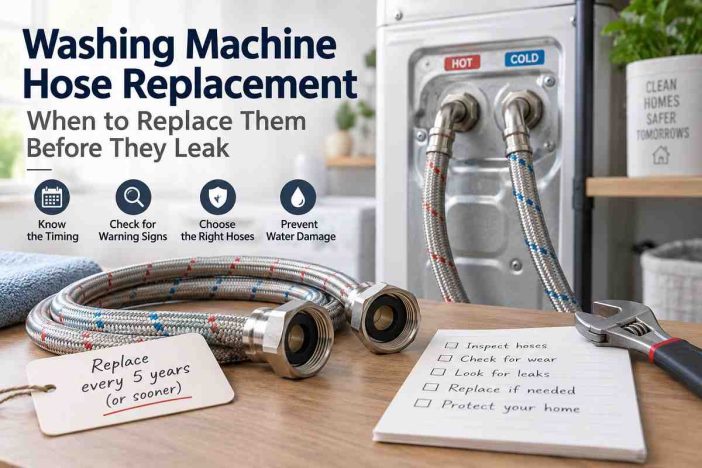
The laundry room is quiet. The washer has finished its cycle, the floor is dry, and nothing suggests a problem.
Behind the appliance, however, two flexible hoses connect the machine to the home’s pressurized water supply. Their condition may be difficult to judge from the front of the washer. A hose can appear serviceable even when its replacement history is unknown.
That creates an uncomfortable maintenance question: should you wait until a washing machine hose starts leaking, or replace it before visible damage appears?
The answer depends on the manufacturer’s instructions, the hose’s age, its physical condition, and whether the surrounding connections can be inspected safely.
When Should You Replace Washing Machine Hoses?
A practical starting point is five years, or sooner if damage appears, when that interval is specified by the appliance or hose manufacturer.
Whirlpool recommends replacing washing machine inlet hoses after five years of use to reduce the risk of failure. Its instructions also call for periodic inspection and earlier replacement when bulges, kinks, cuts, wear, or leaks are found.
The Insurance Information Institute recommends annual checks of appliance hoses and faucets, immediate replacement of cracked or leaking hoses, and replacement of hoses every five to seven years.
These recommendations provide useful maintenance benchmarks, but they are not universal warranties or guaranteed service lives.
Always follow the instructions for your specific washer and replacement hose. A manufacturer may specify different requirements for a particular model or component.
Do not wait for the recommended replacement interval if a hose is already leaking or visibly damaged.
If you do not know when the hoses were installed, treat their age as unverified rather than assuming they are relatively new.
Why a Dry Hose Is Not Necessarily a Reliable Hose
A washing machine supply hose is different from a drain hose.
The supply hose connects the home’s water plumbing to the appliance’s inlet valve. When its shut-off valve is open, the hose may remain under household water pressure even when the washer is not running.
The drain hose carries discharged water away from the appliance during operation.
Both deserve inspection, but they have different failure mechanisms and installation requirements.
A dry floor confirms only that no water is currently visible. It does not establish the age or remaining service life of a supply hose.
Potential problems include:
- Deterioration of the hose material.
- Damage near a connector or crimp.
- Kinking or compression behind the washer.
- Corrosion at metal fittings.
- Poorly seated or deteriorated sealing washers.
- Incorrect installation or incompatible replacement parts.
Not every visible mark indicates imminent failure. Nevertheless, damaged hoses should not be kept in service simply because they have not leaked yet.
For a broader explanation of how appliance connections fit into household water protection, see our guide to preventing costly water damage at home.
Seven Signs That a Washing Machine Hose Needs Attention
A useful inspection focuses on the entire connection, not just the middle of the hose.
1. Bulges or unusual swelling
A bulge is a reason to stop relying on the hose and arrange replacement.
Do not squeeze, bend, or pressurize a suspicious hose to determine whether it will hold.
2. Cracks, cuts, or visible abrasion
Damage to the outer material can indicate deterioration or contact with surrounding surfaces.
Check whether the hose has been rubbing against the wall, appliance cabinet, or another component.
3. Persistent kinks or crushing
A washer pushed too close to the wall can compress its supply hoses.
A sharply kinked hose may restrict flow or experience unwanted mechanical stress.
Do not assume that straightening an old, damaged hose restores its reliability.
4. Moisture around a connection
Water at the wall valve or washer inlet deserves prompt attention.
The source might be the hose connection, valve, or another nearby component.
If water is leaking, stop using the washer and shut off its supply valves if they can be reached safely. Have the source identified before returning the appliance to service.
5. Corrosion or mineral deposits
Rust, discoloration, or mineral deposits around fittings can indicate previous moisture exposure.
They do not establish the precise cause on their own.
A plumber or qualified appliance technician may need to distinguish a defective hose connection from a deteriorating shut-off valve or appliance inlet.
6. An unknown installation date
A hose with no replacement record presents a maintenance uncertainty.
Check receipts, installation documents, appliance records, or a date written on the hose.
If its age cannot be established, consider preventive replacement using the manufacturer’s guidance rather than inventing a service-life estimate.
7. A hose that has been reused after moving the washer
Moving an appliance can change hose routing and place stress on its connections.
Inspect the hoses after relocation and follow the installation instructions. Replace damaged or aging components rather than automatically reusing them.
The Supply Hose Inspection: A Practical Decision Framework
The following framework separates routine maintenance from conditions that require immediate action.
| What you find | Appropriate next step |
|---|---|
| Active leakage | Stop using the washer, safely isolate its water supply, and arrange repair. |
| Bulge, cut, or damaged fitting | Arrange replacement before further use. |
| Hose at or beyond its specified replacement interval | Schedule replacement. |
| Unknown hose age | Verify records or arrange a preventive replacement assessment. |
| Hose looks sound and is within its documented service interval | Continue inspections according to the manufacturer’s guidance. |
| Valve cannot be closed or is leaking | Contact a qualified plumber; do not force it. |
This framework is a maintenance decision aid, not a diagnostic test.
It does not determine whether a hose is structurally sound or guarantee that a particular component will not fail.
The two-minute visual check
You can begin with a non-invasive inspection.
- Make sure the washer is not operating.
- Look for visible moisture around the appliance and accessible connections.
- Check the exposed hoses for obvious kinks, abrasion, or swelling.
- Look for corrosion or staining around accessible fittings.
- Confirm that you know where the washer’s water shut-off valves are located.
- Record any findings and the hose’s known installation date.
Do not reach behind a running appliance, pull a heavy washer forward alone, or move electrical equipment through standing water.
If the connections cannot be viewed safely, arrange a professional inspection instead.
For a broader review of household hazards, use our home safety inspection guide.
Rubber vs. Braided Washing Machine Hoses: What Actually Matters?
Replacement decisions should not depend on appearance alone.
Rubber and braided hoses are available in different specifications, and the outer covering does not reveal every characteristic of the internal hose or its fittings.
| Selection factor | What to verify |
|---|---|
| Appliance compatibility | Manufacturer-approved connection type and dimensions. |
| Hose material | Suitability for the intended water supply and operating conditions. |
| Length | Enough room for correct routing without stretching or sharp bends. |
| Fittings | Compatible connectors and suitable corrosion resistance. |
| Seals | Correct new sealing washers where specified. |
| Replacement interval | Instructions supplied with the appliance and hose. |
Braided hoses can be a reasonable option when they meet the appliance manufacturer’s requirements. However, a braided exterior does not make a hose maintenance-free.
Whirlpool sells both rubber and braided washer supply hoses and recommends replacement after five years for the relevant accessories.
That is an important distinction: choose a compatible, properly installed hose with documented maintenance requirements, not simply the product with the strongest marketing language.
A high advertised burst-pressure rating should not be interpreted as a promise that a hose cannot leak or that its fittings will last indefinitely.
How to Plan a Safe Washing Machine Hose Replacement
Replacing supply hoses may be straightforward in some installations. Others involve corroded valves, inaccessible connections, fragile appliance fittings, or heavy equipment.
The appropriate procedure is the one specified in your washer’s installation manual.
Before starting
Identify the appliance’s model number and obtain its installation instructions.
Confirm that the replacement hoses are compatible with the machine, water connections, and installation conditions.
You should also verify that the shut-off valves work.
If a valve is seized, damaged, or leaking, do not force it. Arrange professional service.
The general replacement sequence
For an installation suitable for homeowner maintenance, the process generally involves:
- Disconnecting electrical power according to the appliance instructions.
- Closing the hot and cold water supply valves.
- Preparing a bucket or towels for residual water.
- Disconnecting the old hoses according to the manufacturer’s procedure.
- Inspecting accessible connection points without damaging the appliance inlet.
- Installing compatible new hoses and seals as instructed.
- Routing the hoses without sharp bends, twisting, or compression.
- Restoring the water supply and checking connections for leaks.
- Completing any required operational checks before returning the washer to service.
This is an overview, not a substitute for model-specific installation instructions.
Do not apply a universal tightening formula. Connection materials and manufacturer requirements vary, and overtightening can damage fittings.
Whirlpool’s installation guidance specifically addresses checking old sealing washers, using new washers with replacement hoses, and checking connections for leaks after installation.
If you cannot safely move the appliance, reach the valves, or verify the connections, hire a qualified professional.
After replacement
Record the installation date and keep the product information.
Check the connections according to the manufacturer’s instructions after the water supply is restored and during subsequent operation.
A hose replacement should not be considered complete if the wall valve, appliance inlet, or surrounding plumbing is still leaking.
What About the Washing Machine Drain Hose?
The drain hose should not be confused with the pressurized supply hoses.
Its purpose is to carry wastewater from the appliance into a laundry sink, standpipe, or another approved drain connection.
A drain hose can cause water damage if it becomes detached, damaged, blocked, or incorrectly positioned.
Check that it is properly routed and secured according to the washer’s installation instructions.
Do not push an excessive length into a standpipe or seal the drain connection unless the manufacturer specifically requires that configuration.
Incorrect installation can interfere with drainage or contribute to siphoning problems.
If the drain repeatedly overflows, the issue may involve the building’s drainage system rather than the hose itself. A plumber may be needed.
Why Replacing a Hose Is Only One Part of Leak Prevention
A new supply hose does not correct every laundry-room water risk.
Consider a washer installed on an upper floor.
Even if the supply hoses are new, a leaking inlet valve, disconnected drain hose, or overflowing standpipe could still allow water to reach the flooring and rooms below.
A more complete prevention strategy addresses three separate questions:
Can the failure be reduced?
Use compatible components, follow installation instructions, inspect connections, and replace aging hoses.
Can escaping water be detected?
A properly positioned water sensor may provide an early warning when water reaches it.
Can the water be stopped?
Accessible shut-off valves and appropriately designed automatic shut-off systems can help limit continued water flow.
The leak detection sensor guide explains how to match monitoring options to different home layouts and response needs.
A sensor does not repair a defective hose, and an alert alone cannot stop water unless someone responds or the system includes compatible automatic shut-off equipment.
For a laundry room above finished living space, consider having a qualified professional assess drainage, containment, and shut-off arrangements.
The appropriate protection depends on the building, local requirements, and appliance configuration.
The Maintenance Record Most Homeowners Forget
Replacing a hose without recording the date creates the same uncertainty for the next homeowner—or for you several years later.
A useful record does not need to be complicated.
Record the following information:
| Field | Example |
|---|---|
| Component | Washing machine hot and cold supply hoses |
| Installation date | September 20, 2026 |
| Product | Manufacturer and model |
| Installer | Homeowner or service provider |
| Inspection result | No visible leaks after installation checks |
| Next review | According to manufacturer guidance |
This is an illustrative record, not a claim that a particular installation was performed.
Keep the receipt, installation instructions, and relevant photographs where they can be retrieved.
For a more comprehensive recordkeeping approach, see how to document home maintenance for insurance claims.
Maintenance documentation can establish what work was performed and when. It does not guarantee insurance coverage or claim approval; those depend on the policy and circumstances.
Before Leaving Home: One Additional Precaution
A washing machine may remain connected to pressurized water even when it is switched off.
Whirlpool advises turning off the washer’s water supply when the appliance will not be used for an extended period, such as during a vacation.
The Insurance Information Institute also recommends shutting off the washing machine’s water supply when away on vacation and avoiding leaving the home while the washer is running.
Before traveling, follow your appliance manufacturer’s instructions and make sure the valves can be operated safely.
If the valves are inaccessible or defective, arrange repairs rather than attempting to force them.
Frequently Asked Questions
Can washing machine hoses last longer than five years?
Some hoses may remain functional beyond five years, but continued operation does not establish that they are safe to keep using. Whirlpool recommends a five-year replacement interval for its relevant washer hoses. Check the instructions for your specific appliance and hose, and replace damaged components sooner.
Should I replace both washing machine hoses at the same time?
If both hoses were installed together and have reached the manufacturer’s replacement interval, replacing the pair is a practical maintenance decision. Verify compatibility and inspect both connections. A single damaged hose still requires prompt attention, even if the other hose appears normal or was installed more recently.
Will a braided stainless-steel hose prevent flooding?
No hose material guarantees that flooding cannot occur. Braided hoses still contain internal components, connectors, and seals that require correct installation and inspection. A complete prevention strategy also considers accessible shut-off valves, drainage, leak detection, and the consequences of water escaping into surrounding rooms.
Replace the Uncertainty, Not Just the Hose
Washing machine hose replacement is most useful when it follows a documented maintenance decision rather than a leak.
Start by identifying the hose’s age, checking the manufacturer’s instructions, and inspecting accessible connections without disturbing the appliance unnecessarily.
Replace damaged or overdue hoses, address defective valves, and record the work.
For the wider prevention strategy, return to the Home Safety, Maintenance & Prevention hub, where appliance maintenance connects with inspections, water protection, and long-term home reliability.
A dry laundry room is reassuring. A documented, properly maintained water connection provides a more useful basis for deciding what to do next.
Water is not the only hidden maintenance risk in a laundry area. If your dryer exhausts outdoors, our dryer vent inspection guide shows how to evaluate airflow, visible lint buildup, exterior vent operation, and signs that justify a full professional check.
References and Verification
- Whirlpool — How to Install a Washing Machine. Manufacturer guidance covering supply-hose installation, inspection, replacement timing, and leak checks.
- Whirlpool — Non-Usage or Vacation Care. Guidance on water shut-off and inlet-hose maintenance for the applicable washer.
- Insurance Information Institute — How to Protect Your Home From Water Damage. Guidance on inspecting appliance hoses, replacement intervals, shut-off valves, and vacation precautions.
Editorial note: This article provides general preventive-maintenance information. Follow your appliance manufacturer’s instructions and applicable local requirements. Consult a qualified plumber or appliance technician when valves, connections, electrical safety, or installation conditions are uncertain.