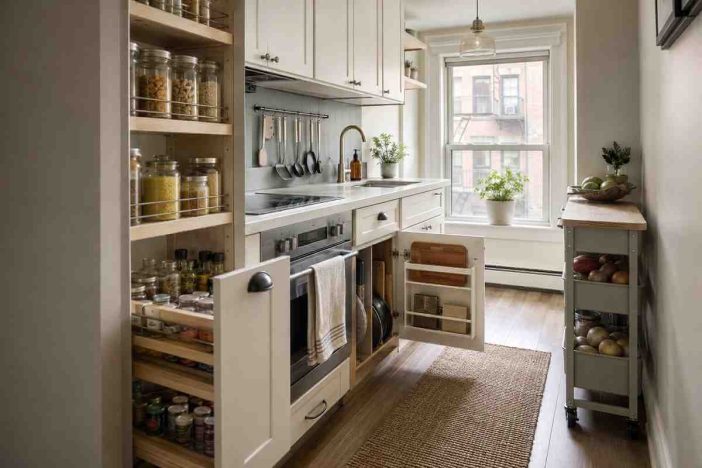
At the start of dinner preparation, a small kitchen can reveal every weak point at once. The cutting board competes with the toaster. The lid you need is trapped behind three pans. An upper cabinet has plenty of height, yet half of that height holds nothing but air.
Nothing is necessarily broken. The storage simply does not match the way the kitchen is used.
That mismatch explains why buying one more basket does not always solve the problem. Effective kitchen storage solutions for small spaces begin with a specific bottleneck: a crowded counter, an inaccessible cabinet, an awkward corner, or everyday tools stored too far from where they are used.
The goal is not to fill every available inch. It is to make the most useful items easier to see, reach, return, and maintain.
Quick Answer: What Works Best in a Small Kitchen?
The best kitchen storage solutions for small spaces reclaim vertical, deep, and awkward areas without reducing the room needed for cooking. Start with low-cost cabinet inserts, drawer dividers, door-mounted racks, and vertical organizers. Add wall storage, a rolling cart, or built-in pullouts only when the simpler fixes cannot address the problem.
Before buying anything, identify the zone that causes the most frustration and measure it carefully. One well-fitted organizer is more useful than several containers that create another layer of clutter.
Why Purpose-Built Kitchen Storage Matters
Storage is not a minor concern in kitchen planning. The 2026 U.S. Houzz Kitchen Trends Study, based on nearly 1,800 U.S. homeowners engaged in kitchen renovation, reported that 76% added specialty built-in features. Among respondents upgrading cabinetry, 94% incorporated specialty storage.
That research concerns renovating homeowners rather than small kitchens specifically. Still, it illustrates a useful principle: dedicated places for trays, spices, cutlery, waste bins, and frequently used equipment can make an existing kitchen easier to operate.
In a compact room, the most effective kitchen storage solutions for small spaces generally accomplish at least one of four things:
- Clear an active preparation surface.
- Make the back of a cabinet accessible.
- Divide tall, unused cabinet space.
- Move frequently used tools closer to the work zone.
How to Choose Kitchen Storage Solutions for Small Spaces
Identify the real bottleneck
Spend a normal day using the kitchen before purchasing organizers. Notice where items accumulate and which cabinet must be emptied to reach something at the back.
A crowded counter may require wall storage. Stacked pans may need vertical dividers. A deep cabinet may benefit more from a pullout than from another bin.
Measure the usable opening
Measure the interior width, depth, and height—not only the outside of the cabinet. Account for hinges, pipes, garbage disposals, shelf lips, door frames, electrical outlets, and appliance ventilation.
For pullouts, measure the cabinet opening through which the organizer must pass.
Match installation to the property
Renters should prioritize freestanding, tension-mounted, or removable products. Permanent shelves, heavy wall racks, and ceiling-mounted systems may require permission, suitable anchors, and professional installation.
Protect access and movement
Storage should not narrow an essential walkway, block a cabinet door, interfere with an appliance, or force someone to reach over an active cooking surface.
15 Kitchen Storage Solutions for Small Spaces at a Glance
| Solution | Best for | Cost level | Renter-friendly |
|---|---|---|---|
| Under-sink pullout | Deep sink cabinets | Low–medium | Yes, if freestanding |
| Shelf risers | Tall cabinet shelves | Low | Yes |
| Cabinet-door rack | Unused door interiors | Low | Depends on mounting |
| Drawer dividers | Cutlery and utensils | Low | Yes |
| Vertical pan organizer | Pans, lids, and boards | Low–medium | Yes |
| Rotating tray | Deep corners | Low | Yes |
| Narrow pullout pantry | Slim gaps | Medium–high | Sometimes |
| Stackable clear bins | Pantry and refrigerator | Low | Yes |
| Wall rail or pegboard | Utensils and tools | Low–medium | Depends on mounting |
| Magnetic knife strip | Knives and metal tools | Low–medium | Depends on mounting |
| Floating shelves | Empty wall space | Medium | Usually no |
| Pot rack | Bulky cookware | Medium | Usually no |
| Over-sink drying rack | Limited counter space | Low–medium | Yes |
| Rolling kitchen cart | Flexible storage and prep space | Medium | Yes |
| Full-height cabinet system | Permanent maximum storage | High | No |
1. Use an Under-Sink Pullout Organizer
The cabinet below the sink is often deep but difficult to use because plumbing interrupts the middle. A pullout tray, two-tier organizer, or removable bin can keep dishwashing supplies visible without forcing you to reach around the pipes.
Measure the plumbing configuration before choosing the organizer. Models with adjustable or offset tiers generally adapt better than one-piece shelves.
Use a washable liner or shallow tray beneath the organizer so a slow leak is easier to notice. If children or pets can access the cabinet, cleaning products should remain in their original containers and be secured appropriately. Poison Control recommends keeping household cleaners securely stored and out of children’s sight and reach.
For a detailed setup, see our guide to organizing under the kitchen sink.
2. Add Shelf Risers and Under-Shelf Baskets
A single tall cabinet shelf often leaves usable space above short cups, bowls, or food packages. Shelf risers create a second level without changing the cabinet, while an under-shelf basket uses the space immediately below an existing shelf.
These are among the easiest kitchen storage solutions for small spaces because they require little or no installation. Use risers for stable items such as plates and mugs, and reserve hanging baskets for lighter supplies.
Measure the distance between shelves and check the cabinet-door clearance. Adding more levels is only helpful when each level remains visible and easy to reach.
3. Use the Inside of Cabinet Doors
Cabinet-door interiors can hold measuring spoons, cutting-board accessories, wraps, small spice packets, or lightweight cleaning tools. Options include adhesive hooks, shallow wire racks, and purpose-built door organizers.
Before mounting anything, close the door with the proposed organizer temporarily held in place. Check whether it strikes a shelf, hinges, or items stored inside.
Keep the load light unless the rack is mechanically fastened and rated for heavier storage. Adhesive products should also be compatible with the cabinet finish so removal does not damage the surface.
4. Divide Drawers by Task
A drawer becomes inefficient when utensils lie in overlapping layers. Adjustable dividers or fitted trays assign a visible place to cutlery, cooking tools, baking accessories, and small gadgets.
Remove everything before measuring. Discard duplicates or move rarely used tools elsewhere, then choose an organizer for the items that genuinely need to remain in the drawer.
For deep drawers, consider a sliding upper tray or modular bins rather than one oversized insert. The best divider is not necessarily the one with the most compartments—it is the one that fits the tools used in that particular work zone.
5. Store Pans, Lids, and Cutting Boards Vertically
Horizontal stacks make the bottom pan or cutting board difficult to retrieve. A vertical divider allows each piece to slide in and out independently.
This is one of the most effective kitchen storage solutions for small spaces when cookware is consuming an entire base cabinet. Adjustable dividers work for pans, baking sheets, serving trays, chopping boards, and pot lids.
Place heavier cookware where the rack and cabinet floor can support it. Check the height of pan handles and lids before fixing the divider position, and avoid packing the slots so tightly that cookware must be forced out.
6. Put a Rotating Tray in a Deep Corner
A rotating tray brings bottles, jars, or small containers from the back of a cabinet to the front. It is especially useful in a corner cabinet where ordinary bins would still require reaching past the first row.
Choose a diameter that allows the tray to rotate without striking the cabinet frame. A raised rim helps prevent tall bottles from slipping off, while divided models keep smaller items upright.
Do not automatically place a turntable in every cabinet. It works best for groups of similarly sized items that are difficult to see—not for large cookware that already fills the available footprint.
7. Install a Narrow Pullout Pantry
A narrow pullout can convert an otherwise unusable vertical gap into storage for spices, cans, bottles, or packaged ingredients. Freestanding rolling versions may work for renters, while built-in models use cabinet-grade slides and require more careful installation.
Measure the opening at several points because walls, cabinets, and floors are not always perfectly square. Check handle clearance and make sure the unit can extend without blocking an appliance or walkway.
A tall pullout must remain stable when loaded. Follow the product’s installation and weight instructions rather than treating it as a casual DIY addition.
For pantry-specific routines, see how to organize your pantry.
8. Use Stackable Clear Bins and Containers
Clear bins make grouped items easier to identify before anything is moved. In a pantry, they can separate snacks, baking supplies, breakfast foods, or unopened refills. In a refrigerator, shallow bins can prevent small packages from disappearing behind larger containers.
Stack only containers designed to remain stable when stacked. Straight-sided containers can use shelf space efficiently, but only when their dimensions suit the cabinet.
Visibility does not replace food-safety practices. The FDA recommends keeping refrigerated foods in covered containers or sealed storage bags and checking leftovers for spoilage.
9. Create a Wall Rail or Pegboard System
A wall rail or pegboard can move utensils, small pans, strainers, and frequently used tools out of drawers. Because hooks can be repositioned, the system can change as cooking habits change.
These kitchen storage solutions for small spaces work best near the zone where the tools are used, but they should not interfere with a stove, sink, outlet, cabinet door, or walking route.
Use wall anchors suitable for the wall material and the expected load. A decorative rail installed only into drywall may not support cookware safely. Renters can look for freestanding pegboards or obtain permission before drilling.
10. Replace a Knife Block With a Magnetic Strip
A magnetic strip can free counter or drawer space while keeping knives visible. Choose a strip long enough to prevent blades and handles from colliding, and test that each knife is held securely.
Installation and placement determine whether this solution is appropriate. Mount the strip on a stable surface, away from a busy passage, and beyond the reach of young children. Leave enough clearance to grasp the handle without touching another blade.
Do not assume every magnetic strip is suitable for every knife. Follow the manufacturer’s mounting, weight, and compatibility guidance.
11. Extend Storage Up the Wall
Floating shelves can use empty wall space above a counter, doorway, or freestanding cabinet. Store frequently used dishes on lower shelves and lighter, less frequently used items higher up.
Open shelves are not automatically better than closed cabinets. They provide quick access but expose items to cooking residue and visual clutter. Limit them to objects that are used and cleaned regularly.
When comparing kitchen storage solutions for small spaces, wall shelves make the most sense when the wall is genuinely unused and the installation will not crowd the preparation area.
12. Hang Cookware on a Wall or Ceiling Rack
A properly mounted pot rack can release a large amount of cabinet space. Wall-mounted versions usually require less overhead clearance, while ceiling-mounted racks can work above an island or another open area.
The rack and its fasteners must be rated for the combined weight of the cookware. Ceiling models should be attached to appropriate structural support, not merely to the visible ceiling surface.
Position hanging pans where they will not obstruct lights, ventilation, sprinklers, cabinet doors, or normal movement. Avoid locations that require reaching across active burners.
13. Choose an Over-Sink Drying Rack
An over-sink rack uses the sink zone instead of occupying a separate section of counter. Freestanding models may hold plates, cups, utensils, or washed produce, while roll-up racks can be stored when not needed.
Measure the sink, faucet height, counter edges, and any window or cabinet above it. A rack that technically spans the sink may still interfere with the faucet or make the basin difficult to use.
Choose a stable, corrosion-resistant design and follow its weight limit. Distribute dishes evenly rather than loading one side with heavy cookware.
14. Add a Rolling Kitchen Cart
A narrow rolling cart can provide shelves, drawers, and a small work surface without committing to a permanent island. It can hold baking supplies, coffee equipment, produce baskets, or frequently used cookware.
Choose lockable wheels so the cart remains stable during use. Its depth should leave adequate room for people to pass and for appliance doors to open.
A cart is one of the most flexible kitchen storage solutions for small spaces, but it should solve a defined problem. If it simply becomes another surface for miscellaneous items, it will reduce rather than improve usable floor space.
15. Build Storage to the Ceiling
When permanent work is appropriate, a full-height cabinet system can use vertical space more efficiently than several unrelated organizers. Adjustable shelves, internal drawers, tray dividers, and pullouts can be configured around the items the household actually owns.
Keep heavy and frequently used items between approximately knee and shoulder level whenever practical. Reserve high compartments for lighter, occasional-use items stored in labeled bins.
This is the most expensive option among these kitchen storage solutions for small spaces, so plan it only after auditing the existing kitchen. A cabinetmaker or kitchen designer can help address uneven walls, ventilation, electrical access, and safe attachment.
Choosing a Solution by Budget
Low-cost improvements
Start with drawer dividers, shelf risers, vertical pan organizers, rotating trays, clear bins, and lightweight cabinet-door storage. These changes can reveal whether a permanent upgrade is really necessary.
Moderate investment
Consider a rolling cart, over-sink rack, wall rail, sturdy open shelving, or a fitted cabinet pullout. These options require more precise measurements and may require drilling.
Permanent upgrade
A built-in narrow pantry, full-extension cabinet system, wall-mounted cookware rack, or floor-to-ceiling cabinet offers greater capacity but should be planned around the kitchen layout.
If storage problems are caused by appliance placement or poor circulation, consult our guide to the best kitchen layout for small spaces before investing in cabinetry.
How to Keep the New Storage System Working
Even well-chosen kitchen storage solutions for small spaces eventually fail if new items enter the kitchen without an assigned place.
Use a simple maintenance system:
- Store items near the zone where they are used.
- Return frequently used tools to the same location.
- Avoid filling every organizer to maximum capacity.
- Review duplicates and unused gadgets periodically.
- Move seasonal equipment away from prime storage areas.
- Adjust dividers and shelf positions when household needs change.
Our guide to small kitchen organization ideas covers the routines that help maintain these physical storage systems.
Frequently Asked Questions
What are the best kitchen storage solutions for small spaces without a pantry?
Use a tall freestanding shelf, narrow pullout, wall-mounted rack, or rolling cart to create a dedicated food-storage zone. Group packages in labeled bins, but avoid spreading pantry items across unrelated cabinets where they become difficult to track.
Which solutions are best for renters?
Shelf risers, drawer dividers, vertical pan racks, clear bins, over-sink racks, and rolling carts usually require no permanent alteration. Adhesive organizers may also work, but the adhesive must be compatible with the surface.
How can I add storage without losing counter space?
Use cabinet interiors, door-mounted racks, wall rails, floating shelves, magnetic strips, and over-sink systems. Prioritize solutions that move existing items away from the preparation surface.
Are open shelves better than closed cabinets?
Neither is universally better. Open shelves provide quick access but require more frequent cleaning and visual order. Closed cabinets conceal clutter but may need pullouts or dividers to make deep areas accessible.
What should I measure before buying a cabinet organizer?
Measure the internal width, depth, height, and door opening. Note hinges, shelf lips, pipes, outlets, and other obstructions. For pullouts, confirm that the entire unit can pass through the cabinet opening.
Which kitchen storage improvement should I make first?
Start with the location that interrupts daily cooking most often. Fixing one congested drawer, inaccessible cabinet, or crowded preparation surface usually produces more value than reorganizing the entire room at once.
The Bottom Line
The best kitchen storage solutions for small spaces are not necessarily the largest, newest, or most expensive. They are the ones that solve a specific access problem without creating a new obstruction.
Begin with a short storage audit. Identify one daily frustration, measure the space around it, and choose the least complicated solution capable of fixing it. Once that improvement works in ordinary use, move to the next bottleneck.
A small kitchen may never hold everything a large kitchen can. It can, however, make every essential item easier to find, use, and return.