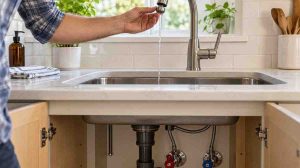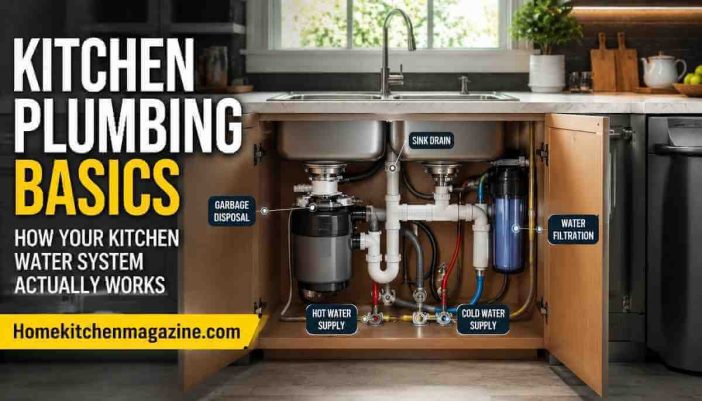
Walk into almost any kitchen and you’ll see only a few visible plumbing fixtures.
A faucet.
A sink.
Perhaps a dishwasher.
Everything else remains hidden behind cabinets, beneath floors, and inside walls.
Yet every time you wash vegetables, run the dishwasher, fill a kettle, or rinse dishes, dozens of plumbing components quietly work together.
Fresh water travels into the kitchen under pressure.
If the kitchen faucet is the only fixture producing a weak stream, use our kitchen faucet low-water-pressure diagnostic guide to isolate the restriction before replacing parts.
Wastewater flows away using gravity.
Air enters the drainage system through vents.
Valves isolate the water supply when maintenance is needed.
None of these systems operates independently.
They function as one coordinated network.
That is why many plumbing problems are rarely caused by a single pipe.
Instead, they develop because one part of the system begins affecting another.
Understanding that relationship makes it easier to recognize problems early, communicate with plumbers more effectively, and make smarter decisions when renovating or upgrading a kitchen.
Editorial note: This guide explains how residential kitchen plumbing systems generally operate. Local plumbing codes, installation methods, and materials may vary by jurisdiction. Repairs and modifications should always comply with applicable plumbing regulations.
A Kitchen Plumbing System Is Really Two Separate Systems
One of the biggest misconceptions among homeowners is that all kitchen plumbing performs the same job.
In reality, the kitchen contains two independent—but closely connected—systems.
The Water Supply System
Its purpose is straightforward:
deliver clean water wherever it is needed.
This includes supplying water to:
- the kitchen faucet;
- dishwasher;
- refrigerator ice maker;
- instant hot water dispenser;
- filtration systems;
- pot fillers where installed.
Because water is supplied under pressure, it can travel upward, around corners, and throughout the home before reaching the kitchen.
The Drainage System
The drainage system performs the opposite task.
Instead of delivering water, it removes wastewater after it has been used.
Unlike supply plumbing, most residential drainage depends primarily on gravity.
Wastewater flows away through:
- sink drains;
- dishwasher discharge connections;
- garbage disposal (where installed);
- branch drain piping;
- larger household drain lines.
Although homeowners usually think about the sink itself, the visible drain represents only a very small portion of the complete drainage system.
Why Understanding The Entire System Matters
Many plumbing articles focus on individual problems:
- slow drains;
- leaking faucets;
- clogged disposals;
- dripping supply lines.
Those problems certainly matter.
But solving them becomes much easier when homeowners understand how every plumbing component interacts with the others.
For example:
A slow sink drain may not originate inside the sink.
A dishwasher drainage issue may actually involve the branch drain.
A leak beneath the cabinet may come from a shut-off valve rather than the faucet.
A garbage disposal problem may be connected to improper drainage rather than the disposal itself.
Understanding the overall system allows homeowners to think beyond the first visible symptom.
Original Editorial Insight: Think Of Kitchen Plumbing As A Circulation System
Many homeowners picture plumbing as a collection of pipes.
A more useful way to understand it is as a continuous circulation process.
The cycle looks like this:
Water Source → Supply Lines → Fixtures & Appliances → Drain System → Household Drainage → Municipal Sewer or Septic System
Every stage depends on the stage before it.
When one section develops a restriction, leak, or improper installation, the effects often appear somewhere else entirely.
That is why plumbing diagnosis is often more complex than locating the nearest puddle.
The Six Major Parts Of A Kitchen Plumbing System
Although plumbing layouts differ between homes, nearly every modern kitchen contains the same core components.
1. Water Supply Lines
These pipes deliver clean water from the home’s plumbing system to individual fixtures and appliances.
They are designed to maintain reliable water pressure while supplying multiple fixtures throughout the house.
Supply lines remain under pressure even when no water is flowing.
As a result, leaks in supply plumbing can release water continuously until the supply is shut off.
2. Fixtures And Appliances
Water is used by several different fixtures, including:
- kitchen faucet;
- dishwasher;
- refrigerator water dispenser;
- ice maker;
- water filtration equipment;
- specialty fixtures installed during remodeling.
Each fixture places different demands on the plumbing system.
Some operate continuously.
Others use water only during specific appliance cycles.
3. The Drainage System
Once clean water has been used, the plumbing system shifts to a completely different job.
Instead of moving pressurized water toward the kitchen, it must safely carry wastewater away.
Unlike supply plumbing, drainage systems generally rely on gravity rather than pressure.
That means proper pipe slope, unobstructed flow, and adequate venting all become essential.
Wastewater leaving the kitchen may include:
- food particles;
- grease residues;
- soap;
- detergents;
- hot water;
- dishwasher discharge.
All of these eventually travel through progressively larger drain pipes before leaving the home.
4. The Trap (P-Trap)
One of the most recognizable plumbing components beneath a kitchen sink is the P-trap.
Many homeowners assume it exists to catch lost jewelry or prevent clogs.
Its primary purpose is actually much more important.
The curved section retains a small amount of water after each use.
This water creates a seal that helps prevent sewer gases from traveling back into the kitchen.
Without that water seal, unpleasant odors—and potentially harmful sewer gases—could enter the living space.
The trap therefore functions continuously, even when no water is actively flowing.
5. The Vent System
Drainage pipes remove wastewater.
Vent pipes manage air.
Without adequate venting, wastewater cannot move efficiently through the drainage system.
Air entering through the vent system helps equalize pressure inside the drain pipes.
This reduces problems such as:
- slow drainage;
- gurgling sounds;
- siphoning of trap water;
- inconsistent draining.
Because vent pipes are hidden inside walls and extend through the roof, many homeowners are unaware they even exist.
Yet they play a critical role in keeping the drainage system functioning properly.
6. Shut-Off Valves
Shut-off valves are among the simplest components in a kitchen plumbing system, but they become extremely valuable whenever maintenance is required.
They allow water to individual fixtures to be isolated without shutting off water to the entire house.
Common locations include:
- beneath the kitchen sink;
- behind refrigerators with water dispensers;
- near specialty plumbing fixtures.
Knowing where these valves are located can significantly reduce water damage if a supply line begins leaking unexpectedly.
How Water Travels Through A Kitchen
Understanding the sequence makes the plumbing system much easier to visualize.
A simplified flow looks like this:
Municipal Water or Well → Main Water Supply → Household Plumbing → Kitchen Supply Lines → Faucet & Appliances → Sink Drain → P-Trap → Branch Drain → Main Drain → Municipal Sewer or Septic System
Although this sequence appears straightforward, every stage depends on the proper operation of the stages before and after it.
A restriction, leak, or improper installation at one point may create symptoms somewhere else in the system.
That is why plumbing diagnosis often requires looking beyond the first visible problem.
Original Editorial Framework: The Kitchen Water Journey
Instead of thinking only about “pipes,” imagine every drop of water completing four distinct stages.
Stage 1 — Delivery
Clean water enters the home under pressure and travels through supply piping toward the kitchen.
Reliability at this stage depends on:
- adequate pressure;
- sound supply piping;
- functional shut-off valves.
Stage 2 — Use
Water reaches fixtures and appliances where it performs useful work.
Examples include:
- cooking;
- cleaning;
- food preparation;
- dishwasher operation;
- ice production.
Each appliance interacts with the plumbing system differently.
Stage 3 — Collection
After use, wastewater immediately enters the drainage system.
Here, gravity—not water pressure—becomes the primary driving force.
The trap protects indoor air quality while the drain begins transporting wastewater away from the kitchen.
Stage 4 — Removal
Wastewater continues through larger drainage pipes before leaving the house through the building drain and eventually entering either:
- the municipal sewer system; or
- a private septic system.
Every successful plumbing system completes this entire journey without interruption.
Why Plumbing Problems Often Appear Far From Their Actual Cause
One of the most confusing aspects of plumbing is that symptoms frequently appear somewhere other than the original problem.
For example:
A puddle beneath the sink may originate from:
- a faucet connection;
- a supply line;
- a shut-off valve;
- the drain assembly;
- the garbage disposal.
Similarly:
A slow-draining sink does not always indicate a clog directly beneath the sink.
Restrictions may exist farther along the branch drain or even deeper within the home’s drainage system.
This is why experienced plumbers evaluate plumbing as a connected network rather than treating each symptom as an isolated event.
Common Misunderstandings About Kitchen Plumbing
Many avoidable plumbing decisions begin with incorrect assumptions.
Some of the most common include:
- believing all plumbing pipes perform the same function;
- assuming every leak comes from the faucet;
- thinking slow drainage always means a clogged sink;
- assuming water pressure and drainage are directly related;
- overlooking shut-off valves until an emergency occurs.
Replacing assumptions with a basic understanding of how the entire plumbing system operates makes future maintenance decisions much more informed.
Practical Kitchen Plumbing Health Checklist
A kitchen plumbing system rarely fails without warning.
Many problems begin with small changes that are easy to overlook during everyday use.
Review your kitchen periodically using the following checklist:
✓ Water pressure remains consistent at the faucet.
✓ Hot and cold water operate normally.
✓ No dripping occurs beneath the sink.
✓ Shut-off valves turn freely and show no signs of corrosion.
✓ The sink drains smoothly without standing water.
✓ No persistent sewer odor is present beneath the sink.
✓ The P-trap remains free of leaks.
✓ Dishwasher drainage completes normally.
✓ Refrigerator water supply connections remain dry.
✓ No unusual gurgling sounds occur after draining water.
✓ Cabinet interiors remain dry with no signs of moisture damage.
✓ Plumbing connections are accessible for future maintenance.
Small observations made during routine inspections often prevent expensive plumbing repairs later.
Original Editorial Framework: The Kitchen Plumbing Reliability Pyramid
Rather than viewing plumbing as individual fixtures, evaluate it as a layered system.
Level 1 — Water Delivery
Everything begins with reliable water supply.
Questions include:
- Is water pressure consistent?
- Are supply lines leak-free?
- Are shut-off valves accessible?
Without dependable water delivery, every downstream component is affected.
Level 2 — Daily Operation
This level focuses on how fixtures and appliances actually perform.
Examples include:
- faucet operation;
- dishwasher cycles;
- refrigerator water dispenser;
- ice maker performance.
The objective is smooth daily operation rather than simply the absence of leaks.
Level 3 — Wastewater Removal
Once water has been used, it must leave the kitchen efficiently.
A healthy drainage system provides:
- smooth flow;
- proper venting;
- functional traps;
- reliable wastewater removal.
Slow drainage or recurring odors often indicate problems at this stage.
Level 4 — Long-Term Reliability
The strongest plumbing systems are not those that never require maintenance.
They are systems that:
- can be inspected easily;
- allow components to be serviced;
- support future remodeling;
- minimize the risk of unexpected water damage.
Long-term reliability comes from planning, not luck.
Frequently Asked Questions
What is the most important part of a kitchen plumbing system?
There is no single most important component.
Water supply lines, drainage pipes, traps, vents, and shut-off valves all depend on one another. A problem affecting any one of these components can influence how the entire system performs.
Why does my sink drain slowly even when the trap is clean?
A slow drain may originate beyond the visible plumbing beneath the sink.
Possible causes include restrictions farther along the branch drain, inadequate venting, grease accumulation, or issues elsewhere in the household drainage system.
Does every kitchen have plumbing vents?
Most residential plumbing systems include venting, although the design varies.
Vent pipes help balance air pressure inside the drainage system, allowing wastewater to flow efficiently while protecting the water seal inside plumbing traps.
Should plumbing be evaluated before remodeling a kitchen?
Yes.
Kitchen remodeling often changes cabinet layouts, appliance locations, and fixture placement.
Reviewing the plumbing system before construction begins can reduce costly modifications after cabinets, countertops, and finishes have already been installed.
Reference
The concepts discussed in this article are consistent with guidance published by:
- International Association of Plumbing and Mechanical Officials (IAPMO)
- International Code Council (ICC) through the International Plumbing Code (IPC) where adopted
- Local plumbing authorities having jurisdiction (AHJ)
- Appliance manufacturers’ installation manuals
Plumbing regulations vary by jurisdiction. Any plumbing installation or modification should comply with the applicable local plumbing code.
Understanding The System Makes Every Plumbing Decision Easier
Most homeowners interact with only a tiny portion of their kitchen plumbing.
They see the faucet.
They empty the sink.
They start the dishwasher.
Hidden behind those routine actions is a carefully coordinated system that delivers clean water, protects indoor air quality, removes wastewater, and supports nearly every activity performed in the kitchen.
Understanding that system changes the way homeowners approach maintenance.
Instead of reacting only after leaks, odors, or drainage problems appear, they can recognize how individual components work together and identify potential issues before they become disruptive.
That systems-based understanding is the foundation for every plumbing article in our Kitchen Systems, Appliances & Efficiency Hub, where we examine kitchens as integrated infrastructure rather than isolated fixtures.