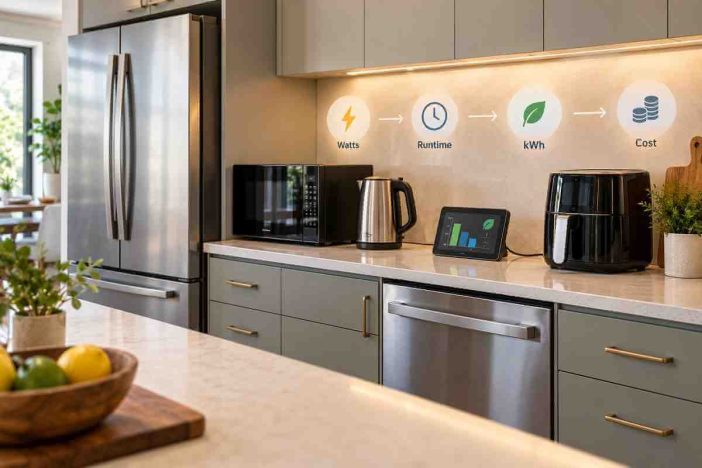
A kettle can look terrifying on a rating plate.
Three thousand watts.
Beside it, a refrigerator may show a much smaller electrical load.
At first glance, the kettle seems like the obvious energy hog.
But the kettle may run for only a few minutes. The refrigerator stays connected all year, repeatedly cooling, stopping, defrosting, and starting again.
The utility meter does not care which appliance has the scarier wattage number.
It records energy consumed over time.
That distinction—between power and energy—is the key to understanding what kitchen appliances actually cost to run.
Quick Answer: Calculate kWh, Not Wattage Alone
Electricity bills are generally based on kilowatt-hours (kWh), not simply on an appliance’s watt rating.
For an appliance that draws roughly constant power while operating:
kWh = watts ÷ 1,000 × hours used
Then:
running cost = kWh × your electricity rate per kWh
For example, if a 1,500-watt appliance actually draws about that level for 30 minutes:
1,500 ÷ 1,000 × 0.5 = 0.75 kWh
If electricity costs $0.20 per kWh:
0.75 × $0.20 = $0.15
That calculation is useful for appliances with fairly predictable operating periods.
It becomes less accurate for equipment that cycles on and off, varies its power continuously, changes output during a programmed cycle, or spends most of the day in standby.
That is why measuring kitchen electricity use requires more than one formula.
The Four-Number Kitchen Energy Test
Before trying to calculate what an appliance costs, identify four numbers.
1. Power
Power describes how quickly an appliance can use electricity.
It is usually expressed in:
- watts (W);
- or kilowatts (kW).
1,000 watts = 1 kilowatt.
A high wattage means a high rate of power draw while that load is operating.
It does not automatically mean high annual energy consumption.
2. Active time or duty cycle
Next ask:
How long is the appliance actually drawing that power?
For a toaster, that may be a few minutes.
For an air fryer, perhaps part of an hour.
For a refrigerator, there is no simple answer because the compressor cycles according to temperature, ambient conditions, door openings, food load, controls, and defrost operation.
That difference determines which calculation method should be used.
3. Frequency
One 20-minute cooking session is not an annual electricity bill.
You also need to know how often the appliance is used:
- times per day;
- times per week;
- cycles per year;
- or continuous year-round operation.
Small differences become important when repeated hundreds of times.
4. Your electricity rate
Use the unit price you actually pay per kWh whenever possible.
Do not automatically copy a national average from an article.
Rates vary by:
- country;
- region;
- supplier;
- tariff;
- billing period;
- time of day;
- and contract type.
For UK households, the daily standing charge should generally not be assigned to one kettle, refrigerator, or dishwasher when estimating the incremental cost of that appliance. The standing charge exists regardless of whether that particular appliance runs.
If you have a time-of-use tariff, use the electricity price that applies when the appliance normally operates.
Calculate Kitchen Appliance Electricity Use From Watts
For an appliance with relatively steady power consumption during a short operating period, start with:
Energy per use = (watts ÷ 1,000) × operating hours
Then:
Annual kWh = energy per use × annual number of uses
And finally:
Annual electricity cost = annual kWh × electricity rate
Suppose an air fryer is rated at 1,500 watts and is used for 25 minutes, four times each week.
Convert 25 minutes to hours:
25 ÷ 60 = 0.417 hours
Energy per session:
1.5 kW × 0.417 hours ≈ 0.625 kWh
At four sessions per week:
0.625 × 4 × 52 ≈ 130 kWh per year
At a hypothetical electricity price of $0.20/kWh:
130 × $0.20 = about $26 per year
That is an illustrative calculation, not a prediction for every air fryer.
The appliance may cycle its heating element rather than drawing its full rated wattage continuously, so measured consumption can be lower.
Estimate kWh and Appliance Running Cost
Enter your appliance’s active power, typical runtime, frequency of use, and electricity rate. Add standby watts only if the appliance normally remains plugged in between uses.
Why Wattage Alone Can Mislead You
Rated wattage is useful.
But it answers a different question:
How much power can this appliance draw under specified operating conditions?
It does not always answer:
How much energy did this appliance consume this month?
Thermostats turn heating loads on and off
An oven may have a powerful heating element.
Once it reaches temperature, however, the element does not necessarily remain continuously energized at full rated output.
It cycles.
A countertop appliance may behave similarly.
Multiplying full rated wattage by the entire cooking period can therefore overestimate actual consumption.
Refrigerators cycle all day
A refrigerator is an even clearer example.
The compressor starts and stops.
Defrost systems operate periodically.
Internal fans may run under different conditions.
Ambient temperature and door opening change the workload.
That is why:
nameplate watts × 24 hours × 365 days
is usually a poor method for estimating refrigerator electricity use.
For refrigeration equipment, model-specific annual kWh data or actual metering is much more useful.
Programmed appliances change load throughout a cycle
Dishwashers do not draw the same amount of electricity every minute.
A cycle can include:
- pumping;
- water heating;
- pauses;
- washing;
- rinsing;
- drying;
- standby.
A two-hour cycle therefore does not mean:
rated watts × two hours = actual cycle consumption.
Use standardized energy-label information, manufacturer data, or measurement instead.
Standby power works in the opposite direction
Some appliances draw very little power while idle, but remain plugged in nearly all year.
A 2-watt continuous standby load consumes approximately:
2 ÷ 1,000 × 8,760 ≈ 17.5 kWh per year
One device may not justify much concern.
Several displays, connected appliances, coffee machines, chargers, and smart devices can add together.
The correct response is measurement—not assuming every standby light is a major part of the bill.
Use the Right Measurement Method for Each Appliance
The best energy estimate depends on how the appliance operates.
| Appliance or behavior | Better starting method | Why |
|---|---|---|
| Refrigerator or freezer | Model-specific annual kWh label or measured consumption | Compressor and defrost loads cycle |
| Dishwasher | Energy label/model annual kWh or cycle data | Heating, pumping and drying vary during a program |
| Electric oven | Model data or appropriate measurement; wattage × time only as a rough estimate | Elements cycle after temperature is reached |
| Electric/induction cooktop | Actual cooking time plus appropriate metering/model data | Power changes with setting and cookware |
| Microwave | Measured input power and actual minutes used | Short, predictable sessions make calculation practical |
| Kettle | Rated/measured power × actual heating time | High power but short runtime |
| Air fryer | Measured use or rated power × time as an initial estimate | Heater cycles depending on temperature and model |
| Toaster | Rated power × actual minutes used | Short operating periods |
| Coffee maker | Separate brewing, warming and standby if relevant | Keep-warm time can matter more than brewing |
| Smart countertop appliance | Active use plus standby where measurable | Connected electronics may remain powered between uses |
This distinction prevents a common mistake:
using the easiest number to find instead of the number that best represents actual energy consumption.
Refrigerators Need Annual kWh, Not a 24-Hour Wattage Calculation
A refrigerator can be plugged in 8,760 hours each year without drawing its maximum rated power for 8,760 hours.
Its actual consumption depends on factors such as:
- model efficiency;
- size;
- ambient room temperature;
- door-opening frequency;
- temperature setting;
- ventilation around the appliance;
- gasket condition;
- frost or condenser condition;
- food load;
- automatic defrost behavior.
For U.S. shoppers, the yellow EnergyGuide label provides a much better comparison starting point than simply reading the electrical rating plate.
The FTC explains that EnergyGuide labels allow shoppers to compare energy use among similar products and provide estimated annual operating cost based on standardized assumptions.
The word estimated matters.
Your kitchen may not match the test assumptions.
Use the annual kWh figure as a standardized comparison tool, then apply your own electricity price when you want a more relevant cost estimate.
Dishwashers Need Cycle Context
Dishwasher electricity use is also easy to miscalculate.
The appliance may have a high heating load but does not operate that load continuously.
Program choice can also matter.
An intensive cycle, heated drying, eco mode, and short program do not necessarily consume the same amount of energy.
Where a product label reports annual consumption or energy per standardized cycle, use that standardized metric when comparing machines.
If a label reports kWh per 100 cycles, a useful comparison calculation is:
label kWh per 100 cycles ÷ 100 = labeled test energy per cycle
Then multiply that result by the approximate number of cycles your household runs annually.
Remember that the labeled cycle is standardized.
Your actual program choices can produce different consumption.
Read an Energy Label as a Comparison Tool, Not a Promise
Energy labels are valuable because they create a common basis for comparing products.
They are less useful when interpreted as a guaranteed utility bill.
For U.S. appliances
FTC EnergyGuide labels on covered products can provide:
- estimated annual energy use or efficiency information;
- estimated annual operating cost;
- comparison information for similar models.
The FTC specifically notes that actual operating cost can differ because household use and local energy prices differ.
So if the label assumes an electricity price different from yours, use its energy-consumption figure and apply your own rate.
For UK appliances
UK energy labels can present consumption differently depending on the product category.
You may encounter:
- annual kWh;
- kWh per 100 cycles;
- cycle-based figures;
- or other standardized metrics.
Read the unit carefully before converting it into household cost.
A figure labeled kWh/100 cycles is not the same as annual kWh.
And an A-to-G efficiency grade alone does not tell you what the appliance will add to your bill.
Capacity and actual use still matter.
Three Simple Examples That Show Why Runtime Matters
These examples deliberately use appliances with short, understandable operating periods.
They assume the stated wattage is maintained throughout the example period. Real measured consumption may differ.
A 3,000-watt kettle used for four minutes
3 kW × 4/60 hours = 0.20 kWh
If used once daily:
0.20 × 365 = 73 kWh per year
The 3,000-watt rating looks large.
The four-minute runtime keeps each use relatively small.
A 1,200-watt microwave used for eight minutes
1.2 kW × 8/60 = 0.16 kWh
Used once per day:
0.16 × 365 = 58.4 kWh per year
Again, annual cost depends on the local unit rate.
A 1,500-watt air fryer used for 25 minutes four times weekly
1.5 × 25/60 ≈ 0.625 kWh per session
0.625 × 4 × 52 ≈ 130 kWh per year
This full-rating calculation is best treated as a planning estimate because thermostatic cycling may reduce actual energy draw.
The important lesson is not which appliance “wins.”
It is that power × time × frequency matters more than wattage by itself.
Which Kitchen Appliance Actually Costs the Most to Run?
There is no universal answer.
It depends on:
- appliance efficiency;
- household size;
- cooking habits;
- cycle selection;
- refrigeration capacity;
- electricity rate;
- frequency of use;
- and whether another fuel such as gas supplies part of the cooking energy.
In many kitchens, refrigeration becomes significant because it operates all year.
High-heat appliances can draw much more power at any one moment but run for shorter periods.
A dishwasher may have moderate annual consumption in one household and substantially more in another because one runs three cycles per week while the other runs two every day.
If your goal is specifically to identify the biggest loads rather than calculate one appliance, see our guide to appliances that use the most electricity in a home.
This article has a different job:
showing you how to verify the number for your own kitchen.
Measure When the Estimate Is Not Good Enough
When an energy decision could affect a major purchase, measurement can be more valuable than another generic online table.
Plug-in electricity meter
For a suitable plug-in appliance, an appropriately rated electricity monitor can measure energy over time.
This is particularly useful when you want to know:
- actual kWh per cooking session;
- standby consumption;
- daily consumption;
- how much different settings change usage.
Always stay within the meter manufacturer’s voltage, current and load ratings.
Do not insert an underrated consumer plug meter into a circuit supplying equipment beyond its design.
Smart plug with energy monitoring
Some smart plugs report energy consumption.
They can be useful for compatible countertop appliances and long-duration monitoring.
Again, compatibility and electrical rating matter more than the fact that the plug has an energy dashboard.
Smart meter or utility data
Whole-home smart-meter data can reveal patterns, especially when a large load is turned on and off in a controlled way.
But whole-home data can be difficult to attribute when refrigerators, HVAC, water heating, electronics, and other loads are operating simultaneously.
Use it as evidence, not automatic proof that one appliance caused a particular spike.
Hard-wired and high-current equipment
Wall ovens, electric ranges, induction cooktops, and other fixed or high-current equipment should not be casually connected through a small consumer plug-in meter.
Use appropriate monitoring equipment, manufacturer data, utility information, or a qualified electrical professional when detailed measurement is needed.
A Five-Minute Running-Cost Check Before Buying an Appliance
When comparing two models, collect:
- purchase price;
- standardized annual kWh or comparable energy metric;
- your local electricity rate;
- expected ownership period;
- any meaningful differences in water use, maintenance, repairability, or installation.
Suppose Appliance A costs $150 more but is expected to use 100 fewer kWh per year.
At $0.20/kWh:
annual electricity difference = 100 × $0.20 = $20
Simple energy-only payback:
$150 ÷ $20 = 7.5 years
That does not automatically make either appliance the better purchase.
You still need to ask:
- Will you own it for 7.5 years?
- Is the more efficient appliance equally reliable?
- Does it require more expensive repair?
- Does installation cost differ?
- Is the capacity actually equivalent?
- Are the energy estimates based on comparable test conditions?
This is where efficiency becomes an ownership decision, not merely an energy-label decision.
Our guide to energy-efficient kitchen appliances goes deeper into selecting efficient models, while the kitchen appliance lifespan guide helps place savings within realistic service life.
If an older appliance is already becoming unreliable, combine energy savings with the broader repair-versus-replace framework rather than replacing equipment solely because its electricity use looks high.
The Most Useful Number Is the Difference, Not the Total
When considering an efficiency upgrade, the important financial number is often not:
“What does the new appliance cost to run?”
It is:
“How much less will it cost to run than the appliance I already own?”
If the existing refrigerator costs approximately $90 per year to operate and a replacement would cost $65, the relevant energy savings are about:
$25 per year
Not $65.
That $25 can then be compared with:
- purchase premium;
- installation;
- disposal;
- expected service life;
- maintenance;
- repair risk;
- other benefits of replacement.
This prevents an efficient appliance from being presented as though its entire operating cost were “savings.”
A 10-Minute Kitchen Electricity Audit
You can build a useful kitchen energy baseline without calculating every wire in the house.
Start with the appliances most likely to matter.
Step 1: Record standardized annual energy data
Check the model documentation or label for:
- refrigerator;
- freezer;
- dishwasher;
- wine cooler;
- other continuously operating appliances.
Record the actual model, not a generic internet estimate.
Step 2: Measure frequent countertop appliances
Choose the devices used most often.
For compatible equipment, measure several normal uses rather than one unusually short or long session.
Average the results.
Step 3: Record frequency
Estimate realistic household use:
- kettle boils per day;
- dishwasher cycles per week;
- microwave minutes per day;
- air-fryer sessions per week;
- coffee-maker warming time.
Avoid using an ideal routine that the household does not actually follow.
Step 4: Use the rate from your bill
Find the electricity unit price.
If your tariff changes by time of day, apply the appropriate rate to appliances whose schedules can realistically shift.
Step 5: Rank by annual kWh and annual cost
This is where priorities become visible.
A device that feels wasteful may turn out to be financially trivial.
Another may deserve attention because it combines:
moderate power × long runtime × frequent use.
Do Not Confuse Electricity Consumption With Appliance Failure
A rising electricity bill can be a clue.
It is not a diagnosis.
Your bill may change because:
- the electricity rate increased;
- household occupancy changed;
- weather changed;
- cooking frequency increased;
- a new appliance was added;
- an existing appliance is operating differently;
- another system elsewhere in the home changed.
If one appliance is suspected, compare kWh, not just the bill total.
A deteriorating refrigerator door seal or refrigeration problem can increase energy consumption, for example, but increased consumption alone does not prove which component is responsible.
Use the energy data to decide what needs inspection.
Do not use it as a substitute for diagnosis.
Trust and Verification
Electricity-cost articles become misleading when estimates are presented as universal facts.
For a reliable calculation:
- use the exact model’s energy data when available;
- use standardized labels for product comparisons;
- use your own tariff for cost estimates;
- distinguish rated watts from measured kWh;
- account for cycling and standby behavior;
- measure appropriate plug-in appliances when higher accuracy is worthwhile;
- do not use consumer monitoring devices outside their electrical ratings;
- do not assume an increase in electricity consumption proves appliance failure.
For U.S. appliance comparisons, the FTC EnergyGuide and ENERGY STAR product information are better starting points than unsourced wattage charts.
For UK readers, use the product’s energy label together with your own electricity tariff. Ofgem’s national price-cap figure can illustrate current market conditions, but it is not a substitute for the unit rate on your own bill.
FAQ
Does a 2,000-watt appliance use 2 kWh every hour?
Only if it actually draws 2,000 watts continuously for the full hour. Appliances with thermostats, variable-speed motors, programmed cycles, or heating elements that switch on and off may consume less. For cycling appliances, measured kWh or standardized annual energy data usually gives a better estimate.
How do I calculate how much an appliance costs per use?
Convert watts to kilowatts, multiply by operating hours, then multiply the resulting kWh by your electricity rate. For example, 1,000 watts used for 30 minutes equals about 0.5 kWh. This method works best when the appliance’s power draw is reasonably steady during that period.
Why can’t I calculate refrigerator cost from its wattage?
A refrigerator does not normally draw its maximum rated power continuously. Its compressor, fans and defrost system operate intermittently according to temperature and conditions. Model-specific annual kWh data or measured consumption therefore provides a more realistic basis than multiplying nameplate watts by 24 hours.
Is replacing an old appliance worth it just to save electricity?
Sometimes, but energy savings should be compared with purchase cost, installation, expected lifespan, repair risk and the existing appliance’s actual consumption. Calculate the annual cost difference first. A modest yearly saving may not financially justify replacing a reliable appliance that still has substantial useful life.
Measure the kWh Before You Chase the Watts
The question “How much electricity do kitchen appliances use?” cannot be answered reliably with one generic wattage table.
A watt tells you the rate at which power can be consumed.
A kilowatt-hour tells you how much electrical energy was actually used over time.
That is the number that makes appliance comparisons useful.
Start with the correct measurement method:
annual energy data for cycling appliances, measured consumption when practical, and wattage × runtime for simple predictable loads.
Then add frequency and your own electricity rate.
Once you do that, kitchen efficiency becomes far less mysterious.
You can see which appliance deserves attention, which apparently powerful device barely affects the annual bill, and whether an expensive efficiency upgrade is likely to recover its premium within the period you realistically expect to own it.
That measurement-first approach is also part of our Kitchen Systems, Appliances & Efficiency Hub, where energy use, appliance reliability, maintenance, electrical capacity, ventilation and ownership cost are treated as connected parts of the kitchen rather than isolated specifications.