The report looked simple.
A few notes.
Some minor concerns.
Nothing catastrophic.
But when the offers came in, they were lower than expected.
Not because the home was damaged—but because it was uncertain.
In real-world inspections, homes don’t lose value because of what’s broken.
They lose value because of what can’t be predicted.
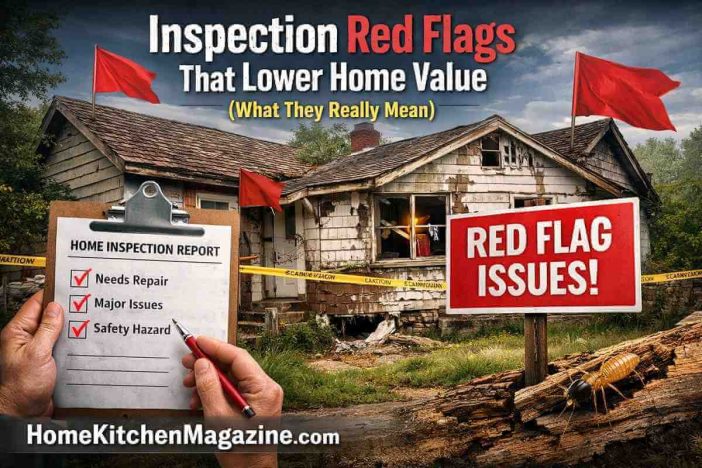
That’s where inspection red flags that lower home value become critical.
Not as problems—but as signals.
Signals that buyers, inspectors, and insurers interpret differently than most homeowners realize.
What Are Inspection Red Flags
Inspection red flags are indicators of potential risk, deferred maintenance, or system instability that can reduce buyer confidence, affect insurance approval, and ultimately lower a home’s perceived value.
Why Inspection Red Flags Matter More Than Visible Damage
Most homeowners assume:
- Damage lowers value
- Repairs fix value
In reality:
- Uncertainty lowers value
- Predictability protects value
Buyers and insurers ask:
- Is this problem isolated?
- Or is it a pattern?
- Will it get worse?
That’s why red flags matter.
They don’t just describe a condition.
They suggest a trajectory.
The Core Inspection Red Flags That Lower Home Value
1. Signs Of Moisture Without Active Leaks
What Inspectors See:
- Stains on ceilings or walls
- Warped cabinetry
- Musty odors
What It Actually Means:
Moisture has been present long enough to affect materials.
Why It Lowers Value:
- Suggests hidden damage
- Raises mold concerns
- Complicates insurance
Many of these cases originate from undetected issues discussed in
How to Prevent Costly Water Damage at Home
2. Aging Plumbing Components Without Replacement Records
What Inspectors See:
- Old supply lines
- Corroded fittings
- Mixed materials
What It Actually Means:
The system is approaching failure—but hasn’t failed yet.
Why It Lowers Value:
- High probability of sudden damage
- Insurance risk increases
- Buyers price in replacement cost
This is especially relevant when evaluating timelines in
How Long Do Braided Stainless Steel Supply Lines Really Last
3. Electrical Load Stress And Outdated Panels
What Inspectors See:
- Frequent breaker trips
- Overloaded circuits
- Outdated panels
What It Actually Means:
The home’s electrical system no longer matches usage demand.
Why It Lowers Value:
- Fire risk perception
- Insurance complications
- Required upgrades before closing
4. Poor Drainage Around Foundation
What Inspectors See:
- Water pooling
- Improper grading
- Overflowing gutters
What It Actually Means:
Water is consistently interacting with structural elements.
Why It Lowers Value:
- Long-term structural risk
- Hidden foundation damage
- Expensive correction
5. Inconsistent Maintenance Patterns
What Inspectors See:
- Some systems updated, others neglected
- No maintenance documentation
- Reactive repairs
What It Actually Means:
The home has no predictable care pattern.
Why It Lowers Value:
- Buyers assume hidden issues
- Inspectors flag uncertainty
- Insurers classify higher risk
This is why structured tracking matters, as explained in
How To Document Home Maintenance For Insurance Claims
6. Aging Safety Systems That “Still Work”
What Inspectors See:
- Old smoke detectors
- Outdated safety devices
- Lack of testing records
What It Actually Means:
The system may fail when needed.
Why It Lowers Value:
- Safety risk perception
- Insurance compliance issues
7. Appliance Connections And Supply Lines Past Their Lifecycle
What Inspectors See:
- Old hoses
- No replacement records
- Minor corrosion
What It Actually Means:
Failure is likely, not hypothetical.
Why It Lowers Value:
- High probability of water damage
- Claim denial risk
Many of these risks are caught early using structured tools like
Kitchen Leak Risk Audit Checklist: 15 Points Homeowners Miss Every Year
How Buyers, Inspectors, And Insurers Interpret Red Flags
| Stakeholder | What They Care About | Interpretation |
|---|---|---|
| Buyer | Future cost | “What will I need to fix?” |
| Inspector | System condition | “Is this predictable?” |
| Insurer | Risk exposure | “Is this preventable?” |
The Real Problem: Red Flags Are Rarely Isolated
Here’s what most homeowners miss:
Red flags don’t exist alone.
They connect.
Example:
- Old supply line
→ moisture signs
→ no documentation
→ insurance concern
Suddenly, a “small issue” becomes a risk profile.
How To Reduce Inspection Red Flags Before They Appear
Step 1 — Shift From Reactive To Preventive
Don’t wait for failure.
Use system-based maintenance strategies like those outlined in
Preventive Maintenance Strategies That Protect Property Value
Step 2 — Document Everything
Track:
- inspections
- replacements
- observations
Step 3 — Replace Before Failure
Especially:
- supply lines
- valves
- detectors
Step 4 — Build Predictability
Predictable homes:
- pass inspections smoother
- get better offers
- face fewer insurance issues
Step 5 — Follow Structured Inspection Cycles
Use frameworks from
Home Safety Inspection: What to Check Before Problems Appear
Expert Insight: What Actually Lowers Value
Across inspections and transactions:
Homes don’t lose value because of age.
They lose value because:
- systems behave unpredictably
- maintenance is unclear
- risk cannot be measured
Predictability—not perfection—is what buyers pay for.
FAQ – People Also Ask
What is the biggest inspection red flag?
Moisture-related issues without clear origin or documentation are among the most serious.
Do inspection red flags always lower home value?
Not always—but they reduce confidence, which often leads to price adjustments.
Can red flags be fixed before selling?
Yes. Many issues can be corrected or documented to improve perception
Do inspectors affect home value directly?
No—but their reports heavily influence buyers and negotiations.
Wrapping Up: Value Is About Confidence, Not Condition
A home doesn’t need to be perfect.
It needs to be understood.
Inspection red flags that lower home value are not just about problems.
They are about how those problems are interpreted.
When a home shows:
- consistent care
- predictable systems
- clear documentation
it doesn’t just pass inspection.
It earns confidence.
And confidence is what protects value.