
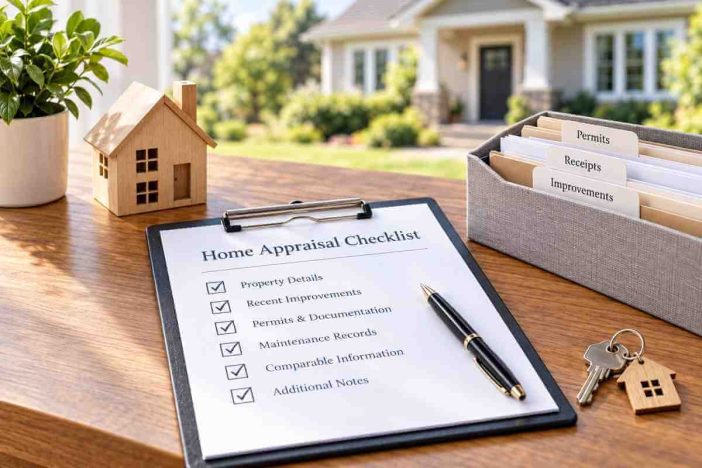
A home appraisal is not the moment to sell your house twice. It is the moment to make sure permanent improvements, major system updates, and important condition facts are easy to verify. This checklist shows sellers how to build a concise appraiser packet without trying to steer the valuation.
The roof was replaced three years ago.
The electrical panel is newer than the kitchen cabinets.
A drainage problem behind the house was corrected, an old plumbing leak was repaired, and the HVAC system has been replaced since the property last changed hands.
The homeowner knows all of this.
The appraiser does not.
At the beginning of an appraisal visit, years of ownership history can be reduced to what is visible, what can be verified, and what is relevant to the assignment. A stack of unlabeled receipts does not solve that problem. Neither does a sales pitch about how much the owner spent.
A useful appraisal packet does something simpler: it turns important property history into organized, verifiable facts.
That distinction is the foundation of this home appraisal checklist for sellers.
The Goal Is Accuracy, Not a Higher Number
Preparing for an appraisal is often described as a way to “increase” or “boost” appraised value.
That is the wrong objective.
An appraiser develops an independent opinion of value using property characteristics, condition, market evidence, comparable sales, and the requirements that apply to the assignment. Seller documentation does not replace that analysis.
What documentation can do is make legitimate information easier to identify and verify.
Fannie Mae’s appraisal guidance requires a clear and accurate description of improvements and calls for relevant commentary on repairs, additional features, modernization, and property condition.
That is why documentation matters.
If you want to understand the valuation side before preparing the paperwork, start with how appraisers evaluate home condition beyond cosmetic upgrades. The distinction is important: that guide explains how condition is interpreted; this one explains how a seller can organize the facts behind that condition.
Think of your packet as an evidence packet, not a persuasion packet.
It should help answer three questions:
- What changed?
- When did it change?
- Is there reliable evidence supporting that information?
If the packet does that quickly, it is useful.
What Should Be in an Appraiser Packet?
The best packet is rarely the thickest one.
It is the one that gives the appraiser useful facts without burying them under years of routine household paperwork.
A practical packet can contain the following.
| Document or record | What it helps explain | What to avoid |
|---|---|---|
| One-page property summary | Major permanent features and relevant property facts | Promotional language and unsupported claims |
| Improvement list | What was replaced, remodeled, added, or materially upgraded | Claiming project cost equals added value |
| Permits and final approvals | Status of permitted additions or major work | Guessing when permit status is unclear |
| Major-system records | Approximate age and replacement history of roof, HVAC, electrical, plumbing, water heater | Every routine service receipt |
| Repair or remediation documents | What caused a material problem and what was done to correct it | Hiding unresolved conditions |
| Warranties and contractor invoices | Dates, scope, equipment, and completed work | Personal payment information |
| Reliable plans or surveys | Property configuration or site information when relevant | Treating owner-created measurements as official |
| Agent-supplied market information | Context for genuinely comparable sales or unusual features | Cherry-picked listings designed to demand a target value |
Start With a One-Page Property Summary
Page one should function as an index, not a brochure.
Include only facts that matter:
- property address;
- major permanent improvements;
- dates of major system replacements;
- additions or conversions;
- permits or final approvals when applicable;
- unusual permanent features that may not be obvious during the visit;
- supporting document references.
For example:
2022 — Roof replacement — invoice and permit attached
is useful.
2022 — Installed an amazing premium roof that should add significant value
is not.
The first statement is verifiable.
The second tries to tell the appraiser what conclusion to reach.
Build a Dated Improvement List
Create a simple chronological list of meaningful projects.
Prioritize changes to the real property rather than movable items or decorating choices.
That may include:
- roof replacement;
- HVAC replacement;
- electrical service or panel work;
- plumbing replacement;
- windows;
- insulation;
- permanent energy-efficiency improvements;
- kitchen or bathroom remodeling;
- additions;
- finished areas;
- drainage improvements;
- foundation or structural work;
- permanent accessibility improvements.
For each project, record what you actually know:
| Year | Improvement | Scope | Verification |
|---|---|---|---|
| 2022 | Roof replacement | Existing roofing replaced | Contractor invoice + permit |
| 2023 | HVAC replacement | Heating and cooling equipment replaced | Invoice + equipment record |
| 2024 | Electrical work | Main panel replacement | Permit + electrician invoice |
| 2025 | Kitchen update | Cabinets, counters, sink and fixed lighting | Contractor invoice |
| 2025 | Leak repair | Failed supply connection repaired and affected materials restored | Plumbing invoice + repair records |
This is only an example. Do not add dates, permits, costs, or scope that you cannot substantiate.
Cost Is Not the Same as Value
A $30,000 project does not automatically contribute $30,000 to an appraisal.
Cost tells the appraiser something about the scope of a project. Market evidence determines whether buyers recognize that improvement and how it contributes to the property’s value.
That is another reason to avoid filling the packet with claims about return on investment.
Report the facts.
Let the valuation process interpret them.
Include Permits When They Matter
Permits become particularly useful when the property has undergone work that changed its physical configuration or major systems.
Examples may include:
- additions;
- converted spaces;
- structural work;
- major electrical changes;
- major plumbing changes;
- HVAC installations where permits are required locally;
- substantial remodeling;
- accessory dwelling units;
- other work subject to local approval.
Do not imply that every improvement everywhere requires the same permits. Building codes, permit requirements, records systems, and enforcement vary by jurisdiction.
If work was permitted, organize the permit and any final inspection or completion documentation with the corresponding improvement.
If permit status is uncertain, do not invent certainty. Identify what you have and let the appropriate local professional or authority clarify the rest.
Make Major System Ages Easy to Understand
Some of the most valuable information in an older house is difficult to see.
An appraiser can observe an HVAC unit, electrical panel, roof surface, or water heater, but the visual inspection may not communicate the complete replacement or service history.
A short system record can help.
For example:
| System | Known installation/replacement year | Documentation |
|---|---|---|
| Roof | 2022 | Invoice, permit |
| HVAC | 2023 | Installation invoice |
| Electrical panel | 2024 | Permit, electrician invoice |
| Water heater | 2021 | Invoice |
| Main plumbing line | 2020 | Contractor invoice |
Do not fill unknown dates with estimates presented as facts.
If the exact year is unknown, write “year not verified” rather than creating false precision.
Organized system history is also useful beyond appraisal. It is one reason maintenance records can increase buyer confidence: documented ownership history makes it easier for another party to distinguish known aging from unexplained risk.
Document Material Repairs, Not Every Small Repair
A packet can become useless when every air filter purchase, paint receipt, faucet washer, and landscaping expense receives equal importance.
Use a higher threshold.
Include documentation when the event materially changes how someone could understand the home’s condition.
Examples include:
- significant water intrusion and remediation;
- structural repair;
- foundation stabilization;
- termite treatment and related repairs;
- roof leak correction;
- electrical hazard correction;
- sewer or main plumbing work;
- major drainage correction.
Water history deserves particular care because a repaired event and an unresolved moisture problem are not the same thing.
If the property has a meaningful leak or water-damage history, use the more specific water damage documentation checklist before selling a home rather than overwhelming the appraisal packet with unexplained photographs and invoices.
A useful repair record answers:
What happened?
What caused it?
What was repaired?
When was the work completed?
Is there professional documentation supporting that history?
Documentation should clarify a past condition, not conceal a current one.
Use the Three-Layer Appraiser Packet
A simple way to prevent information overload is to divide the packet into three layers.
Layer 1: The One-Page Summary
This is the page the appraiser can scan quickly.
It lists only major property facts, improvements, system dates, and the location of supporting records.
Layer 2: Verification
Behind the summary, place the documents that substantiate its key entries:
- permits;
- final approvals;
- invoices;
- warranties;
- contractor records;
- reliable plans;
- relevant inspection or repair documentation.
Keep each group labeled.
If the summary says “Roof — 2022,” the supporting roof record should be easy to find.
Layer 3: Issue-Specific Evidence
Reserve the final section for complicated history that requires context.
For example:
- water remediation;
- structural work;
- major drainage changes;
- an addition;
- an accessory unit;
- significant electrical modernization.
This section may include reports, before-and-after records, plans, or professional documentation.
The purpose is not to make an old problem disappear.
It is to prevent a resolved problem from becoming an unexplained problem.
The 60-Second Appraiser Packet Test
Before handing over the folder, place yourself in the position of someone who has never owned the home.
Open the packet and give yourself roughly a minute.
Can you identify:
- the three to five most important improvements;
- when they occurred;
- which major systems have been replaced;
- whether relevant permits or approvals are available;
- where supporting evidence can be found;
- whether a major past repair appears resolved or still uncertain?
If not, reorganize the packet.
This is the central editorial rule for appraisal documentation:
Reduce evidence-to-noise ratio before adding more evidence.
Ten clearly indexed records can be more useful than one hundred unsorted receipts.
What Not to Give the Appraiser
More information is not automatically better information.
Avoid turning the packet into a negotiation file.
A Target Appraisal Number
Do not write a cover sheet stating what the property “must” appraise for.
The purpose of the appraisal is an independent value opinion.
Online Home-Value Screenshots
Automated estimates can be useful to homeowners as rough reference points, but they are not substitutes for the appraiser’s property observation and market analysis.
Unsupported Square Footage
If you have a reliable survey, plan, builder document, or other credible record, identify the source.
Do not present a homeowner’s rough measurement as an official fact.
A Box of Unsorted Receipts
A receipt for paint brushes from six years ago does not deserve the same prominence as documentation for a roof replacement.
Curate before you hand over.
Private Financial Information
Redact bank account numbers, credit card information, or other unnecessary personal data from invoices and records.
The appraiser needs property information, not access to your financial life.
Claims About What an Improvement “Added”
Avoid statements such as:
“New kitchen added $50,000 in value.”
“New roof guarantees full replacement cost in the appraisal.”
Those claims confuse project cost, seller expectations, and market-supported value.
Prepare the Property as Carefully as the Paperwork
The paperwork cannot compensate for inaccessible or visibly unfinished areas.
Before the appointment, make it easy to observe the home.
Ensure reasonable access to areas such as:
- attic access where applicable;
- basement or crawl-space entry;
- garage;
- utility areas;
- electrical panel;
- HVAC equipment;
- water heater;
- exterior areas;
- permitted additions or accessory spaces.
This is not about staging the property like an open house.
It is about removing preventable obstacles.
Finish straightforward repairs that are already underway. Correct active leaks rather than documenting them as if documentation were a repair. Remove items blocking major systems. Replace missing covers or other basic safety components where appropriate.
Deferred maintenance matters because an accumulation of visible issues can change how property condition is understood. For a deeper look at that pattern, see how deferred maintenance can reduce property value.
For some financing programs, condition issues can also have consequences beyond ordinary market appeal. Current HUD guidance for FHA transactions requires the appraisal process to address property acceptability and certain defective conditions affecting safety, soundness, or security.
That does not mean sellers should try to diagnose FHA compliance themselves. It means obvious safety or structural concerns should not be disguised as cosmetic issues.
Appraisal Preparation Is Different From Inspection Preparation
An appraisal and a home inspection can overlap in what they observe, but they answer different questions.
The appraiser is developing an opinion of value for the assignment.
A home inspector is examining the property’s systems and components to identify conditions and concerns within the scope of the inspection.
That distinction becomes important when a house has aging systems or unresolved defects.
A folder of invoices cannot make an active roof leak disappear.
Likewise, a clean inspection report does not tell the appraiser what value conclusion to reach.
If the property is approaching a sale, sellers should understand both sides. Our guide to home inspection issues that commonly trigger price negotiations explains how condition findings can become repair requests, credits, specialist evaluations, or price discussions after the buyer’s inspection.
A 2026 Note About the New Appraisal Reporting System
The U.S. appraisal reporting system is undergoing a major transition in 2026.
Fannie Mae and Freddie Mac opened broad production of UAD 3.6 on January 26, 2026. Fannie Mae states that all new appraisal reports submitted through the Uniform Collateral Data Portal for applicable Fannie Mae and Freddie Mac loans must use UAD 3.6 beginning November 2, 2026.
Sellers do not need to learn UAD terminology or appraisal software.
The practical lesson is simpler: appraisal reporting is increasingly structured around specific property data, condition, features, and supporting information.
Give the appraiser clean facts.
Do not try to write the appraisal for them.
Special Situations Need More Than a Generic Checklist
Some properties require additional documentation because their history or configuration is not obvious.
An Addition or Converted Space
Gather available permits, plans, approvals, and final inspection records.
Avoid representing a converted garage, basement, attic, or other space as something that has not been officially verified.
A Property With Significant Past Water Damage
Prepare the source-of-loss history, repair records, professional remediation documents where applicable, and evidence showing how the cause was addressed.
Do not rely on new paint as documentation.
A House With Major Hidden Upgrades
Rewiring, repiping, insulation, drainage correction, or structural work may have little visual impact even though the work was substantial.
This is exactly where concise verification records are useful.
A Unique Property
If the home has unusual acreage, outbuildings, accessory units, easements, or other characteristics that are not obvious, organize reliable records and let the appraiser determine their relevance.
Do not convert unusual features into unsupported value claims.
A Final Pre-Appraisal Checklist
Before the appointment, confirm that:
If all ten are true, stop adding paperwork. The packet is ready.
Frequently Asked Questions
Should I give receipts to a home appraiser?
Yes, when they document meaningful permanent improvements, system replacements, or major repairs. Organize them by project rather than handing over every household receipt. A receipt can help verify when and what work occurred, but the amount you spent does not automatically determine how much value the project contributes.
Can an appraisal packet increase my home’s appraised value?
There is no guarantee. Documentation does not control an appraiser’s independent value conclusion. Its practical purpose is to make legitimate property facts, improvements, system updates, and repair history easier to identify and verify so the appraisal is based on complete, understandable information.
Should I give comparable sales to the appraiser?
Relevant market information can be provided, often through the seller’s real estate agent, but it should be accurate and genuinely comparable. The appraiser remains responsible for selecting and analyzing the market evidence used in the appraisal. Avoid cherry-picking listings simply because their prices support a desired number.
Do I need to be present during the appraisal?
Follow the appraiser, lender, and agent’s instructions for access. If you are present, make important records available, answer factual questions, and give the appraiser room to work. A concise packet is usually more useful than following the appraiser from room to room explaining every improvement.
Make the Property Easy to Understand
A seller cannot control the market evidence.
A seller cannot choose the appraiser’s final opinion.
And a seller cannot convert renovation spending into value simply by showing receipts.
What a homeowner can control is whether important property history arrives as evidence or noise.
A useful home appraisal checklist for sellers therefore has a modest goal: make significant improvements, permanent features, major repairs, and system history easy to understand and easy to verify.
Do not build the biggest packet.
Build the clearest one.
When the property can tell its history without exaggeration, missing dates, unsupported claims, or a box of disconnected receipts, the documentation has done its job.