A homeowner replaces an old kitchen outlet with a new one.
A few weeks later, the dishwasher suddenly loses power.
The outlet has tripped.
Someone says,
“That’s the GFCI doing its job.”
A month later another breaker trips inside the electrical panel.
This time the outlet still has power.
Someone else replies,
“That’s probably the AFCI.”
To many homeowners, both situations feel identical.
Electricity stopped working.
Something tripped.
Reset it and move on.
In reality, those two protective devices may be responding to completely different hazards.
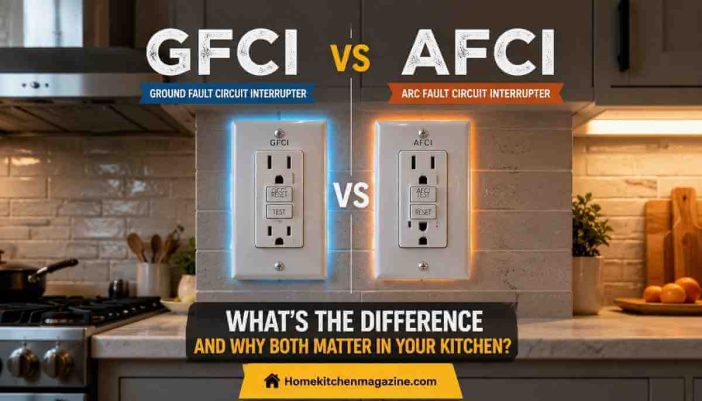
One is primarily intended to reduce the risk of electric shock.
The other is intended to reduce the risk of electrical fires caused by dangerous arcing.
Understanding the difference helps homeowners recognize why modern kitchens often rely on both forms of protection rather than one replacing the other.
Safety note: Electrical protection requirements vary by the edition of the National Electrical Code (NEC) adopted in your jurisdiction and by local amendments. This article explains the underlying concepts rather than providing installation instructions. Any electrical modifications should be evaluated by a licensed electrician and performed in accordance with applicable code and manufacturer requirements.
Why Modern Kitchens Use Multiple Layers Of Electrical Protection
A modern kitchen combines several risk factors in one room.
It contains:
- water;
- grounded metal surfaces;
- high-wattage appliances;
- heating elements;
- motors;
- electronic controls;
- frequent plug-in and unplugging;
- multiple branch circuits operating simultaneously.
No single protective device addresses every electrical hazard.
Instead, kitchen electrical safety relies on layers.
Examples include:
- properly designed branch circuits;
- correctly sized breakers;
- grounding;
- GFCI protection where required;
- AFCI protection where required;
- suitable receptacles and wiring methods;
- appliance-specific installation requirements.
This layered approach explains why simply installing additional outlets or dedicated circuits does not automatically produce a safer kitchen.
Electrical protection must match the type of hazard being reduced.
GFCI And AFCI Solve Different Problems
Although both devices interrupt electrical power when abnormal conditions occur, they monitor very different electrical events.
GFCI
A Ground-Fault Circuit Interrupter (GFCI) is designed to reduce the risk of electric shock by detecting current that leaves the intended circuit path.
Instead of focusing on overload, a GFCI monitors whether electricity flowing out on the ungrounded conductor returns normally on the grounded conductor.
If a small imbalance is detected—such as current leaking through water or a person’s body—the device disconnects power very quickly.
Its primary concern is:
people.
AFCI
An Arc-Fault Circuit Interrupter (AFCI) addresses a different hazard.
It looks for electrical arcing patterns that may occur because of:
- damaged conductors;
- deteriorated insulation;
- loose electrical connections;
- damaged cords;
- failing receptacles;
- wiring defects.
Its primary concern is:
fire prevention.
Although some electrical faults can involve both shock and fire hazards, the detection methods and protective purpose of GFCI and AFCI are fundamentally different.
Original Editorial Insight: Think About The Hazard, Not The Device
Many online articles ask:
“Should I install a GFCI or an AFCI?”
That question is often backwards.
A better question is:
“What hazard am I trying to reduce?”
If the primary concern involves unintended current flowing through a person or water, GFCI protection becomes highly relevant.
If the concern involves damaged wiring or dangerous electrical arcing hidden inside walls or cords, AFCI protection becomes the appropriate layer of protection.
Modern kitchens frequently present both hazards at the same time.
That is why these devices should be viewed as complementary—not competing—technologies.
Comparing GFCI And AFCI
| Feature | GFCI | AFCI |
|---|---|---|
| Primary purpose | Reduce electric shock risk | Reduce fire risk from dangerous arcing |
| Detects | Ground faults | Arc faults |
| Typical concern | Electricity taking an unintended path through water or a person | Electrical arcing caused by damaged or deteriorated wiring |
| Common location | Receptacles or breakers, depending on installation | Usually incorporated into circuit breakers, although other configurations exist |
| Replaces the other? | No | No |
The comparison highlights an important point.
Neither device is “better.”
Each responds to a different electrical hazard.
How GFCI Protection Works In Real Kitchen Situations
Understanding GFCI becomes much easier when viewed through everyday kitchen scenarios instead of electrical theory.
Scenario 1 — Water Reaches A Countertop Appliance
A coffee maker sits beside the sink.
While filling the reservoir, water spills across the countertop and reaches the appliance cord or plug.
If electrical current begins flowing somewhere it should not, a properly functioning GFCI is designed to disconnect power rapidly to reduce the risk of serious electric shock.
The important point is that the appliance itself may not be defective.
The abnormal current path is the problem.
Scenario 2 — Moisture Inside A Dishwasher
Dishwashers operate in an environment containing:
- water;
- heating elements;
- pumps;
- electrical controls.
If moisture reaches electrical components in a way that creates an unintended current path, GFCI protection may interrupt power.
The trip itself is not the problem.
It is an indication that an abnormal condition requires investigation.
Simply resetting the device repeatedly without identifying the cause can allow the underlying issue to continue developing.
Scenario 3 — Damaged Appliance Cord
Suppose the insulation on a blender cord has been cut after years of being pinched inside a drawer.
The appliance may still operate.
However, damaged insulation can expose users to increased electrical risk.
Depending on the nature of the fault, GFCI protection may respond before a more serious incident occurs.
These examples illustrate why kitchens have traditionally received special attention regarding shock protection.
How AFCI Protection Works In Real Kitchen Situations
AFCI protection addresses a different category of electrical hazards.
Instead of monitoring current imbalance, it analyzes electrical waveforms for characteristics associated with dangerous arcing.
Scenario 1 — Loose Receptacle Connections
A countertop outlet has become worn after years of plugging and unplugging appliances.
The plug no longer fits securely.
Small electrical arcs begin forming during appliance operation.
The outlet still works.
Nothing appears visibly wrong.
Over time, however, repeated arcing may generate heat capable of damaging surrounding materials.
An AFCI may recognize these abnormal arcing characteristics and disconnect power before the condition develops into a larger fire hazard.
Scenario 2 — Damaged Wiring Behind Cabinets
Kitchen renovations sometimes involve moving cabinets, installing screws, or modifying wall finishes.
Years later, hidden wiring may become damaged or loosened without obvious external symptoms.
An AFCI is intended to detect certain dangerous arcing conditions that conventional breakers may not identify until much later.
Scenario 3 — Aging Appliance Connections
Repeated heating and cooling cycles gradually affect electrical connections.
Loose terminals.
Fatigued conductors.
Worn receptacles.
These problems may initially produce only:
- intermittent buzzing;
- occasional flickering;
- unexplained breaker trips.
As discussed in Kitchen Circuit Overload Warning Signs: 10 Problems You Should Never Ignore, seemingly minor symptoms sometimes represent developing electrical faults rather than simple overload conditions.
Why Both Devices May Exist On The Same Kitchen Circuit
One of the most common homeowner questions is:
“Why do I have both GFCI and AFCI protection?”
Because they protect against different hazards.
Think of a kitchen in terms of layered risk.
Water creates one category of hazard.
Damaged wiring creates another.
Neither device makes the other unnecessary.
Instead, they work together with:
- correctly sized breakers;
- properly designed branch circuits;
- grounding systems;
- appropriate conductor sizing;
- safe appliance installation.
This layered approach reflects how modern electrical safety has evolved.
Rather than relying on one protective device, electrical systems now address multiple failure modes independently.
Why GFCI And AFCI Sometimes Trip “For No Reason”
Homeowners frequently believe these devices are overly sensitive.
In reality, repeated tripping often means one of three things.
Normal Protective Operation
The device detected a condition it was designed to detect.
This is the desired outcome.
Appliance Problem
An aging appliance may create leakage current, damaged insulation, or abnormal electrical behavior.
Replacing the protective device alone will not solve the appliance problem.
Wiring Or Installation Issue
Loose terminals.
Damaged wiring.
Improper modifications.
Shared neutrals.
Improper grounding.
These conditions can also produce nuisance tripping.
The challenge is that homeowners usually cannot determine the exact cause without proper testing.
For that reason, repeated unexplained trips deserve professional evaluation rather than repeated resets.
Common Homeowner Misunderstandings
“My Breaker Never Trips, So Everything Is Safe.”
Not necessarily.
Different hazards trigger different protective devices.
Some wiring defects may exist long before conventional overload protection responds.
“Replacing The GFCI Will Solve The Problem.”
Sometimes.
Often it will not.
If an appliance or wiring fault exists, installing a new device simply removes one symptom while leaving the original condition unchanged.
“AFCI Means My Wiring Is Bad.”
Not automatically.
An AFCI trip indicates that abnormal arcing characteristics have been detected.
The next step is diagnosis—not assumption.
“If One Device Protects The Kitchen, The Other Is Unnecessary.”
This misunderstanding remains extremely common.
GFCI and AFCI are designed for different electrical hazards.
Choosing between them is usually the wrong question.
The better question is whether the electrical system provides the layers of protection appropriate for the installation.
Original Editorial Framework: The Kitchen Electrical Protection Pyramid
Instead of memorizing device names, think about kitchen electrical safety as four connected layers.
Layer 1 — Safe Electrical Design
Everything begins with:
- properly sized branch circuits;
- appropriate conductor sizing;
- adequate panel capacity;
- dedicated circuits where needed.
These planning decisions are explored in Kitchen Electrical Load Planning for Modern Homes and Dedicated Kitchen Circuits Explained: Which Appliances Need Their Own Circuit?
Layer 2 — Shock Protection
Where water and electricity may interact, GFCI protection helps reduce shock risk.
Layer 3 — Fire Prevention
Where dangerous electrical arcing may develop, AFCI protection adds another layer of defense.
Layer 4 — Ongoing Maintenance
Even the best protection devices cannot compensate for:
- damaged appliance cords;
- loose receptacles;
- neglected maintenance;
- aging electrical equipment.
Routine inspections remain an essential part of long-term kitchen safety.
This layered perspective helps homeowners understand that electrical safety is not created by a single breaker or outlet.
It results from multiple protective systems working together.
Practical Homeowner Electrical Safety Checklist
You do not need to remove outlets or open the electrical panel to improve kitchen electrical safety. Many developing problems can be identified simply by observing how the kitchen behaves during normal daily use.
Review the following checklist regularly:
✓ Test GFCI devices according to the manufacturer’s instructions.
✓ Record any AFCI or breaker trips instead of simply resetting them.
✓ Inspect appliance cords for cuts, crushing, or loose plugs.
✓ Replace receptacles that no longer hold plugs securely.
✓ Avoid using extension cords as permanent kitchen wiring.
✓ Do not ignore flickering lights, buzzing outlets, or warm receptacles.
✓ Review appliance installation manuals before replacing major equipment.
✓ Have electrical modifications evaluated by a licensed electrician.
Small observations made early often prevent much larger electrical problems later.
Original Editorial Insight: Protection Devices Are The Last Line Of Defense
Many homeowners believe adding more protective devices automatically creates a safer kitchen.
In reality, GFCIs and AFCIs are the final layer—not the foundation—of electrical safety.
A dependable kitchen begins with:
- properly planned branch circuits;
- appropriate electrical capacity;
- correctly installed appliances;
- quality workmanship;
- routine inspection and maintenance.
Only after those fundamentals are in place do GFCI and AFCI devices perform the role they were designed for: reducing the consequences of faults that should not occur during normal operation.
Thinking this way changes how homeowners approach electrical safety.
Instead of asking,
“Which device should I install?”
the better question becomes,
“How do I reduce the likelihood that these protective devices ever need to operate?”
That shift—from reacting to faults to preventing them—is the foundation of long-term kitchen reliability.
Frequently Asked Questions
Does every kitchen need both GFCI and AFCI protection?
Requirements depend on the electrical code adopted in your jurisdiction, local amendments, the type of circuit, and the installation itself. Modern residential kitchens commonly incorporate both forms of protection because they address different electrical hazards rather than serving the same purpose.
Why does my GFCI keep tripping even when nothing seems wrong?
Repeated GFCI trips may result from appliance faults, moisture intrusion, wiring problems, or damaged receptacles. Simply resetting the device repeatedly without identifying the cause is not recommended.
Can an AFCI trip because of a faulty appliance?
Yes.
Although AFCIs primarily monitor for hazardous electrical arcing, damaged appliance cords or internal electrical failures may also produce conditions that trigger protective operation. Determining the exact cause often requires qualified troubleshooting.
Should I replace a GFCI or AFCI myself?
Replacing electrical protection devices involves more than matching appearance.
Compatibility with the electrical system, circuit configuration, applicable code, and manufacturer requirements should all be verified. When there is uncertainty, the work should be performed or inspected by a licensed electrician.
Reference
This article is based on electrical safety principles published by authoritative organizations including:
- National Fire Protection Association (NFPA) — National Electrical Code (NEC) guidance.
- Electrical Safety Foundation International (ESFI) — Residential electrical safety education.
- U.S. Consumer Product Safety Commission (CPSC) — Consumer electrical safety recommendations.
- Appliance manufacturer installation manuals.
- Local electrical codes and Authorities Having Jurisdiction (AHJ).
Because electrical regulations change over time and vary by location, always verify the requirements that apply where the installation is being performed.
Wrapping Up: Understanding The Difference Protects More Than Your Kitchen
GFCI and AFCI protection are often discussed as though they compete with each other.
They do not.
Each addresses a different type of electrical hazard.
One helps reduce the risk of electric shock.
The other helps reduce the risk of electrical fires caused by dangerous arcing.
Modern kitchens rely on both because modern kitchens contain both types of risk.
Understanding that distinction allows homeowners to interpret electrical problems more accurately, communicate more effectively with electricians, and make better decisions when upgrading appliances or remodeling a kitchen.
Electrical safety is rarely the result of one breaker, one outlet, or one device.
It is the result of thoughtful planning, appropriate protection, routine maintenance, and early attention to small warning signs before they become larger problems.
This guide is part of our Kitchen Systems, Appliances & Efficiency Hub, where we examine appliance reliability, electrical planning, water-risk management, preventive maintenance, and long-term kitchen performance through one connected system.