The microwave starts.
The lights over the counter dim for half a second.
The homeowner notices, then continues preparing dinner.
A few days later, the breaker trips while the toaster oven and kettle are running together.
The breaker is reset.
Everything appears normal again.
Then one outlet begins feeling warmer than the others.
Electrical problems often develop this way—not as one dramatic event, but as a sequence of small abnormalities that gradually become part of the household routine.
A dimming light becomes “something the kitchen always does.”
A tripping breaker becomes an inconvenience.
A buzzing receptacle becomes background noise.
That normalization is what makes overload warning signs dangerous.
Circuit breakers, fuses, GFCIs, and AFCIs are protective devices. When they interrupt power repeatedly, they are responding to a condition that should be understood rather than bypassed. ESFI notes that frequent breaker trips can indicate an overloaded circuit or another electrical issue requiring diagnosis, while CPSC advises homeowners not to continue using outlets or switches that become unusually warm.
Safety note: Do not remove panel covers, replace breakers with larger ratings, open receptacle boxes, or attempt wiring repairs unless you are qualified and authorized to perform that work. If you smell burning insulation, see smoke or arcing, receive a shock, or find an outlet that is hot or visibly damaged, stop using the circuit and contact a licensed electrician. Call emergency services if there is active smoke or fire.
What A Kitchen Circuit Overload Actually Means
A branch circuit is designed to carry electrical current up to the limits established by its conductors, protective device, installation, and connected loads.
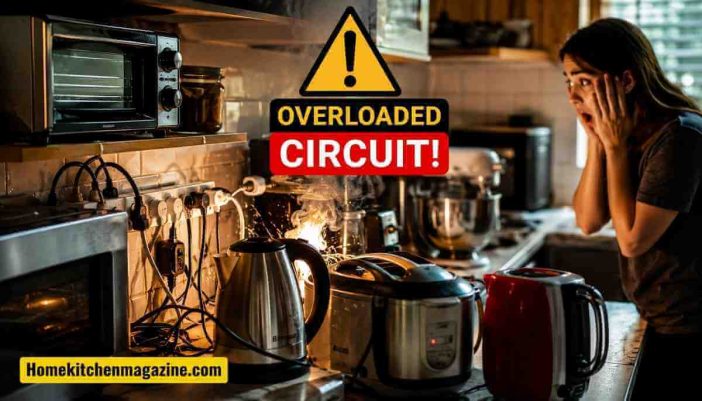
A kitchen circuit becomes overloaded when the simultaneous demand placed on it exceeds what the circuit is intended to supply.
That can happen when several high-wattage appliances operate together, such as:
- microwave oven;
- electric kettle;
- air fryer;
- toaster oven;
- coffee maker;
- portable induction burner.
But not every overload-like symptom comes from too many appliances.
Similar warning signs may result from:
- a failing appliance;
- loose electrical connections;
- worn receptacles;
- damaged wiring;
- a deteriorating breaker;
- incorrect circuit modifications;
- voltage drop;
- arcing;
- shared loads elsewhere in the home.
This distinction matters because unplugging one appliance may temporarily stop the symptom without correcting the underlying defect.
Why Kitchens Are Especially Vulnerable To Overload
Modern kitchens combine high power demand with frequent simultaneous use.
A single countertop appliance may draw a substantial portion of a branch circuit’s available capacity. When several appliances start heating at once, total demand can rise rapidly.
Kitchen electrical demand also changes over time.
A home originally designed for a refrigerator, toaster, and basic coffee maker may later add:
- over-the-range microwave;
- large espresso machine;
- air fryer;
- countertop convection oven;
- beverage refrigerator;
- warming appliance;
- multiple charging devices.
The cabinets may not change.
The circuits behind them may still be serving a much more demanding kitchen than the one they were originally designed for.
This is why electrical capacity should be reviewed as part of a complete kitchen system. Our guide Kitchen Electrical Load Planning for Modern Homes explains how appliance demand, circuit allocation, panel capacity, and future upgrades should be considered together.
Overload, Short Circuit, Ground Fault, And Arc Fault Are Not The Same
Homeowners often describe every electrical interruption as an overload.
That is not always accurate.
Overload
An overload generally occurs when too much current is demanded by connected loads.
Typical pattern:
- several appliances operate together;
- breaker trips after demand rises;
- reducing simultaneous use may stop the immediate trip.
Short Circuit
A short circuit involves an unintended low-resistance connection between conductors.
It may cause:
- immediate breaker operation;
- sparks;
- sharp popping sounds;
- visible damage;
- repeated instantaneous tripping.
Ground Fault
A ground fault occurs when current follows an unintended path toward ground.
Because kitchens contain sinks, appliances, water connections, and conductive surfaces, GFCI protection plays an important role in reducing shock risk where required.
Arc Fault
Arcing can occur through damaged, loose, or deteriorated electrical connections.
Warning signs may include:
- crackling;
- sizzling;
- intermittent buzzing;
- overheating;
- burning odor;
- discoloration.
A homeowner generally cannot determine the precise cause from symptoms alone. The purpose of recognizing warning signs is not to diagnose wiring from the countertop—it is to know when normal use should stop and qualified evaluation should begin.
10 Kitchen Circuit Overload Warning Signs
1. The Breaker Trips Repeatedly
A breaker that trips once during an unusual combination of appliances may be responding to a temporary excessive load.
A breaker that trips repeatedly is delivering a pattern.
Common examples include:
- breaker trips whenever the microwave and kettle run together;
- dishwasher trips the circuit during heated drying;
- toaster oven causes power loss after several minutes;
- refrigerator and countertop appliance cannot operate simultaneously;
- breaker trips even when appliance use appears normal.
Frequent tripping can indicate overload, but it can also point to appliance defects, wiring problems, or a failing breaker. NFPA lists recurring tripped breakers or blown fuses among the warning signs of home electrical problems.
Do not respond by installing a larger breaker.
Breaker rating must match the circuit design and conductor capacity. Increasing protection size without verifying the wiring can remove an important safety limit while allowing excessive heat to build inside walls.
If one appliance consistently triggers the problem, unplug it and stop using it until the appliance and circuit have been evaluated.
If multiple appliances trigger the same circuit, the kitchen may have a load-allocation problem.
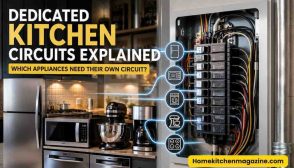
Our guide Dedicated Kitchen Circuits Explained: Which Appliances Need Their Own Circuit? helps homeowners understand when fixed or high-demand appliances should be separated from shared countertop loads.
2. Lights Dim Or Flicker When Appliances Start
A brief change in lighting when a large appliance starts may indicate voltage drop or a heavily loaded circuit.
Watch for patterns such as:
- lights dim every time the microwave starts;
- pendant lights flicker while the refrigerator compressor runs;
- lighting brightness changes when a kettle or toaster oven heats;
- lights pulse during dishwasher operation;
- flickering affects more than one room.
ESFI includes flickering, blinking, or dimming lights among common signs of an overloaded electrical system.
The significance depends on:
- how often it occurs;
- how severe it is;
- whether lights share the same branch circuit;
- whether the issue affects multiple circuits;
- whether other warning signs are present.
Dimming should not automatically be blamed on the appliance.
It may indicate:
- excessive shared load;
- loose neutral connection;
- poor wiring connection;
- voltage drop;
- panel or service issues.
If flickering becomes frequent, pronounced, or widespread, qualified evaluation is warranted.
3. Outlets Or Wall Plates Feel Warm
An outlet serving a high-demand appliance may become slightly warm under some conditions, but noticeable, persistent, or increasing heat should not be treated as normal.
Warning signs include:
- receptacle face warmer than nearby outlets;
- wall plate heating during appliance use;
- plug blades hot after removal;
- outlet remains warm after the appliance is turned off;
- warmth accompanied by odor, buzzing, or discoloration.
Heat can result from:
- loose terminal connections;
- worn receptacle contacts;
- excessive load;
- damaged plug blades;
- undersized or deteriorated components;
- arcing.
CPSC advises that an unusually warm or hot outlet or switch may indicate an unsafe wiring condition and should not be used until checked by a qualified electrician.
Stop using an outlet that is hot, discolored, cracked, melted, or producing odor.
Do not attempt to “cool it down” and resume use.
Heat is evidence that electrical energy may be dissipating where it should not.
4. Receptacles Become Discolored
Discoloration is rarely a cleaning problem when it appears around plug openings or outlet edges.
Look for:
- brown marks;
- darkened plastic;
- yellowing concentrated around one receptacle;
- melted areas;
- scorched plug blades;
- heat-damaged wall plates.
Discoloration may indicate repeated overheating, loose connections, poor contact between the plug and receptacle, or arcing.
NFPA and ESFI both identify warm or discolored outlets as electrical warning signs.
Do not continue testing the outlet with different appliances.
Remove power only if it can be done safely, avoid further use, and have the circuit evaluated.
5. Buzzing, Sizzling, Or Crackling Comes From An Outlet
Healthy receptacles and switches should not produce persistent electrical noise.
Buzzing or crackling may point to:
- arcing;
- loose connections;
- damaged receptacle contacts;
- failing switches;
- appliance plug problems;
- deteriorating wiring.
ESFI identifies cracking, sizzling, and buzzing from receptacles as overloaded-circuit or electrical-hazard warning signs.
A faint appliance motor hum is different from sound originating inside the wall, outlet, switch, or panel.
If the sound comes from fixed electrical equipment, stop using the connected appliance and arrange professional inspection.
Do not remove the receptacle faceplate to investigate.
6. A Burning Smell Appears During Appliance Use
A burning odor is one of the most serious electrical warning signs.
Even if the smell disappears after unplugging an appliance, it should never be dismissed as “normal.”
Possible causes include:
- overheating wiring;
- damaged insulation;
- loose electrical terminals;
- overloaded receptacles;
- failing appliance components;
- electrical arcing.
Try to identify where the odor originates.
Is it coming from:
- the appliance?
- the outlet?
- behind the wall?
- the electrical panel?
If smoke, visible charring, or a strong burning smell is present:
- stop using the appliance immediately;
- switch off power if it can be done safely;
- contact a licensed electrician;
- call emergency services if fire is suspected.
Do not continue testing the appliance “just one more time.”
Electrical odors often appear before visible damage becomes obvious.
7. Appliances Suddenly Perform Worse Than Before
Electrical overload does not always announce itself with a breaker trip.
Sometimes appliance performance changes first.
Watch for appliances that begin to:
- heat more slowly;
- run longer than usual;
- restart unexpectedly;
- display intermittent electronic errors;
- behave inconsistently.
For example:
- a microwave takes noticeably longer to heat food;
- a dishwasher repeatedly pauses or resets;
- a refrigerator compressor cycles irregularly;
- an induction cooktop reports power-related errors.
These symptoms do not automatically mean the circuit is overloaded.
They may also indicate:
- appliance failure;
- voltage instability;
- internal electronic faults;
- deteriorating electrical connections.
The important point is to recognize that changing appliance behavior deserves investigation rather than being accepted as normal aging.
8. You Feel A Mild Shock Or Tingling Sensation
Electricity should never be felt.
A tingling sensation while touching:
- a refrigerator door;
- dishwasher;
- oven;
- sink near an appliance;
- metal countertop equipment;
may indicate an electrical fault requiring immediate attention.
Potential causes include:
- grounding problems;
- damaged wiring;
- appliance insulation failure;
- defective electrical components.
Do not continue using an appliance that produces even a slight electrical shock.
Disconnect power safely if possible and arrange professional inspection.
This is a personal safety issue—not simply an appliance problem.
9. Extension Cords Become Permanent Kitchen Equipment
Extension cords solve temporary problems.
They should not become permanent kitchen wiring.
Warning signs include:
- refrigerator connected through an extension cord;
- microwave sharing a power strip;
- multiple countertop appliances using adapters;
- daisy-chained power strips;
- cords routed beneath rugs or cabinets.
Permanent reliance on extension cords often indicates the kitchen no longer has sufficient receptacle placement or branch-circuit capacity for modern appliance usage.
Rather than adding more adapters, homeowners should evaluate whether additional properly installed receptacles or dedicated circuits are needed.
Our guide Dedicated Kitchen Circuits Explained: Which Appliances Need Their Own Circuit? explains when permanent appliances deserve their own branch circuit instead of competing for shared receptacles.
10. Electrical Problems Begin After Installing New Appliances
Many overload problems appear shortly after a kitchen upgrade.
Examples include:
- installing an induction range;
- replacing a basic refrigerator with a larger smart model;
- adding a second wall oven;
- purchasing a high-powered espresso machine;
- introducing multiple countertop cooking appliances.
Homeowners often assume the appliance caused the problem.
In reality, the appliance may simply reveal that the existing electrical system was already operating near its practical limit.
A kitchen designed twenty years ago may not have anticipated today’s electrical demand.
This is why appliance replacement should always include an evaluation of:
- circuit capacity;
- panel capacity;
- branch-circuit allocation;
- future appliance plans.
Our Kitchen Appliance Replacement Timeline: Which Appliances Should You Replace First? explains why appliance upgrades should be planned as part of a broader kitchen system rather than as isolated purchases.
Original Value Framework: The Kitchen Electrical Risk Escalation Model
Not every warning sign represents the same level of urgency.
The following framework helps homeowners prioritize their response.
| Risk Level | Typical Symptoms | Recommended Response |
|---|---|---|
| Level 1 — Monitor | Occasional nuisance trip after unusually heavy simultaneous appliance use | Reduce simultaneous load and observe whether the issue repeats. |
| Level 2 — Investigate | Repeated breaker trips, frequent light dimming, changing appliance performance | Review appliance usage, verify circuit loading, and schedule electrical evaluation if the pattern continues. |
| Level 3 — Stop Using The Circuit | Warm outlets, buzzing receptacles, discoloration, persistent breaker trips | Discontinue use of the affected outlet or circuit until inspected by a licensed electrician. |
| Level 4 — Immediate Safety Concern | Burning odor, smoke, visible arcing, melted receptacles, electrical shock | Stop using the circuit immediately, disconnect power if safe, and contact emergency services or a licensed electrician without delay. |
The value of this framework is that it separates inconvenience from genuine danger.
Not every electrical symptom requires emergency response.
Some absolutely do.
Recognizing that difference helps homeowners respond appropriately without either ignoring serious hazards or overreacting to routine nuisance trips.
Why Small Electrical Symptoms Become Expensive Problems
Electrical systems rarely deteriorate overnight.
More often, homeowners become accustomed to gradually changing conditions.
A breaker that trips every few months becomes accepted.
A slightly warm outlet becomes “the outlet that always feels like that.”
Lights dim briefly every evening.
Nothing dramatic happens.
Until one day it does.
Early investigation is almost always less disruptive—and often less expensive—than waiting until visible damage or appliance failure occurs.
Practical Kitchen Electrical Inspection Checklist
Homeowners should never diagnose internal wiring by opening electrical equipment. However, they can safely observe patterns that may indicate developing electrical problems.
During routine kitchen inspections, check for the following:
✓ Breakers that trip repeatedly under normal appliance use.
✓ Outlets or wall plates that feel noticeably warm.
✓ Burn marks, discoloration, or melting around receptacles.
✓ Buzzing, crackling, or sizzling sounds from outlets or switches.
✓ Appliances that frequently reset, lose power, or perform inconsistently.
✓ Lights that dim whenever major appliances start.
✓ Extension cords or power strips being used as permanent kitchen wiring.
✓ Loose plugs that no longer fit securely into receptacles.
✓ Visible damage to appliance power cords or plugs.
✓ New electrical problems appearing after appliance upgrades.
Documenting these observations helps electricians identify patterns that may not be obvious during a single service visit.
What To Do When You Notice A Warning Sign
Many homeowners immediately ask:
“Should I keep using the appliance until someone can look at it?”
The safest answer depends on the symptom.
Continue Monitoring
Suitable only for isolated situations such as:
- one nuisance breaker trip after unusually heavy simultaneous appliance use;
- a single event that cannot be reproduced.
If the problem repeats, move to the next step.
Reduce Electrical Load
If several high-demand appliances are operating together:
- unplug unnecessary appliances;
- avoid simultaneous heating loads;
- observe whether the symptoms disappear.
If reducing demand consistently prevents the issue, the kitchen’s electrical capacity may need professional evaluation.
Stop Using The Appliance Or Circuit
Immediately discontinue use if you observe:
- warm or hot receptacles;
- burning odors;
- buzzing outlets;
- visible discoloration;
- repeated breaker trips;
- electrical shock or tingling.
These conditions indicate that continued operation may increase the risk of equipment damage or fire.
Arrange Professional Evaluation
A licensed electrician can determine whether the problem involves:
- appliance failure;
- branch-circuit overload;
- loose electrical connections;
- deteriorated receptacles;
- wiring defects;
- panel capacity limitations;
- grounding or protection issues.
Replacing appliances without identifying the underlying electrical cause may simply transfer the problem to new equipment.
Why Overload Symptoms Should Never Be Ignored
Electrical overload rarely damages only one component.
Continued overheating can gradually affect:
- receptacles;
- switches;
- conductor insulation;
- breaker performance;
- appliance electronics;
- plug connections.
Even if no fire occurs, repeated overheating accelerates wear throughout the electrical system.
This is one reason preventive electrical planning is generally less expensive than repeated reactive repairs.
Our Kitchen Electrical Load Planning for Modern Homes explains how proper branch-circuit design reduces these long-term reliability problems before they appear.
Frequently Asked Questions
Is it normal for a kitchen breaker to trip occasionally?
A single trip during unusually heavy simultaneous appliance use may simply indicate that the circuit exceeded its intended load.
Repeated trips under normal daily use should be investigated.
Can one bad appliance overload an entire circuit?
Yes.
An appliance with an internal electrical fault may repeatedly trip breakers or create abnormal electrical demand.
However, similar symptoms can also result from wiring problems or excessive combined appliance loads.
Should an outlet ever feel warm?
A slight temperature increase under heavy use may occur.
Noticeably warm, hot, discolored, or damaged outlets should never be considered normal and should be evaluated before further use.
Why do my kitchen lights dim when the microwave starts?
Momentary dimming can indicate voltage drop associated with a large starting load.
If dimming becomes frequent, severe, or affects multiple circuits, the electrical system should be inspected.
Can extension cords solve kitchen electrical problems?
Extension cords are intended for temporary use.
Permanent reliance on extension cords often indicates that receptacle placement or branch-circuit capacity no longer matches the kitchen’s electrical demand.
No.
Reference
Reference
For additional guidance on residential electrical safety, kitchen branch circuits, and overload prevention, consult resources published by:
- National Fire Protection Association (NFPA)
- Electrical Safety Foundation International (ESFI)
- U.S. Consumer Product Safety Commission (CPSC)
- Appliance manufacturer installation manuals
- Your local electrical authority having jurisdiction (AHJ)
Wrapping Up: Electrical Systems Usually Warn You First
Kitchen electrical failures rarely happen without warning.
The warning signs are often subtle:
a breaker that trips a little more often…
lights that dim slightly…
an outlet that feels just a bit warmer…
a faint buzzing sound that wasn’t there before.
Individually, these changes may seem insignificant.
Together, they tell a story.
The safest kitchens are not those that never experience electrical issues.
They are the ones where small abnormalities are recognized, investigated, and corrected before they become expensive repairs—or serious safety hazards.
Understanding these warning signs allows homeowners to respond early, protect valuable appliances, reduce fire risk, and maintain a kitchen electrical system that remains dependable for years to come.
This guide is part of our Kitchen Systems, Appliances & Efficiency Hub, where we explore appliance reliability, electrical planning, water-risk management, preventive maintenance, and long-term kitchen performance through a connected, system-based approach.