The new dishwasher is installed.
The supply connection is dry.
The appliance fills, washes, and appears to drain normally.
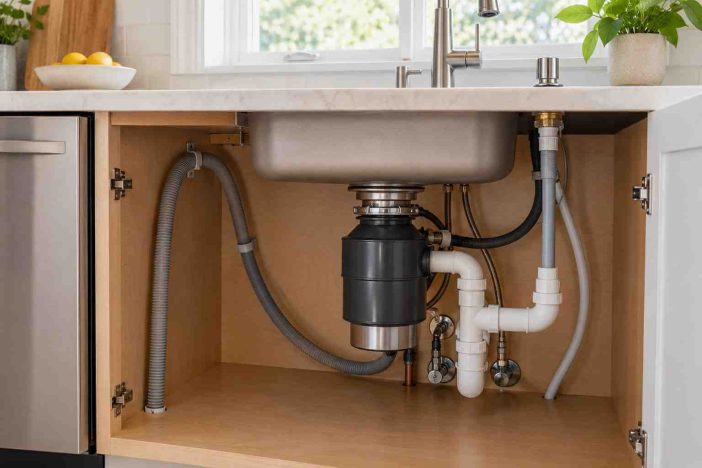
Then you look beneath the kitchen sink.
The dishwasher drain hose rises toward the underside of the countertop before dropping into the garbage disposal.
That looks like a high loop.
But beside the faucet is a small chrome fitting that looks like a second miniature faucet.
That is an air gap.
Now the obvious question appears:
Does the dishwasher need both?
The answer cannot reliably be reduced to “always” or “never.”
A dishwasher high loop and an air gap are both used in dishwasher drain systems, but they solve the backflow and drainage problem differently. More importantly, manufacturer instructions and local plumbing requirements can determine which configuration is acceptable for a particular installation.
The right decision therefore begins with the installation documents—not with removing whichever component looks unnecessary.
Quick Answer
A dishwasher high loop routes the drain hose upward beneath the countertop before the hose connects to the sink drain or garbage disposal. The elevated routing helps reduce wastewater flowing or siphoning back toward the dishwasher.
A dishwasher air gap creates a physical atmospheric separation in the drain path, usually through a fitting mounted at the sink deck or countertop.
They are not automatically interchangeable.
Use this order:
- Find the installation instructions for the exact dishwasher model.
- Determine whether your local plumbing requirements specify an air gap.
- If an air gap is required, a high loop does not replace that requirement.
- If an air gap is not required, verify whether the manufacturer permits a high-loop configuration.
- Confirm that the drain hose, garbage disposal or waste-tee connection, and downstream drain are installed correctly.
- Test for drainage, leaks, and wastewater returning to the dishwasher.
Do not use a generic internet measurement as a substitute for the exact installation instructions. Manufacturers specify different drain-loop heights for different products and configurations.
Dishwasher High Loop vs Air Gap at a Glance
| Feature | High Loop | Air Gap |
|---|---|---|
| Basic design | Dishwasher hose is routed high beneath counter | Drain passes through an atmospheric-break fitting |
| Usually visible above counter | No | Yes |
| Helps reduce reverse wastewater movement | Yes | Yes |
| Creates a physical air break | No | Yes |
| May satisfy every local requirement | No | Depends on applicable requirement |
| May be permitted by manufacturer | Model-specific | Model-specific |
| Works with garbage disposal | Commonly | Commonly |
| Works with sink waste connection | Commonly | Commonly |
| Common problem | Hose falls, sags, kinks, or is routed incorrectly | Air-gap outlet or downstream hose becomes restricted |
| Correct height/routing | Follow exact appliance instructions | Follow appliance, air-gap, and local requirements |
The most important row is not the first one.
It is:
May satisfy every local requirement: No.
The existence of a high loop does not prove that an installation complies with rules that specifically require an air gap.
Likewise, seeing an air gap does not prove that the entire drain assembly is installed correctly.
Use this checklist before changing a high loop, removing an air gap, or buying drain parts.
1. Dishwasher information
2. Local requirement
3. Current configuration
4. High-loop condition
5. Drain destination
6. Garbage disposal check
7. Air-gap behavior
8. Drainage symptoms
9. Leak check
10. Next action
What a Dishwasher High Loop Actually Does
A dishwasher drain pump pushes used water through a drain hose toward the kitchen drainage system.
Without correct routing, wastewater from the sink or disposal can potentially move in the wrong direction, and drainage behavior can become unpredictable.
A high loop raises a section of the dishwasher drain hose near the underside of the countertop before the hose drops toward its final connection.
Conceptually, the route looks like this:
Dishwasher → hose rises high → hose descends → disposal or waste connection
The elevated section helps discourage dirty water from moving backward toward the dishwasher and helps control siphoning.
But a high loop remains a continuous hose connection.
There is no open atmospheric break between the dishwasher hose and downstream drain system.
That distinction is why a high loop should not automatically be treated as equivalent to an air gap where an air gap is specifically required.
For context on how dishwasher discharge fits into the larger drain network, our Kitchen Plumbing Basics guide explains how dishwasher discharge, sink drains, garbage disposals, branch drains, and household drainage interact.
What a Dishwasher Air Gap Actually Does
A dishwasher air gap uses a different approach.
Instead of relying only on hose elevation, an air-gap assembly creates physical atmospheric separation between the dishwasher discharge side and the downstream drainage side.
A typical countertop air gap has:
- an inlet connected to the dishwasher drain hose;
- an outlet connected toward the garbage disposal or waste connection;
- an internal opening exposed to atmosphere;
- a visible cap mounted above the sink or countertop.
This physical break is why an air gap is treated differently from a high loop.
If wastewater backs up downstream, the separation is intended to reduce the chance that contaminated drain water can be siphoned directly back through a continuous drain-hose path into the dishwasher.
Where local requirements specifically mandate a countertop air gap, a hidden hose loop is not a substitute merely because both are intended to address backflow concerns.
Why You Should Not Memorize One “Correct” High-Loop Height
One of the biggest problems with online dishwasher advice is the presentation of one number as universal.
It is not.
Manufacturer guidance varies.
For example, manufacturer support and installation documents can specify different minimum or target drain-loop heights depending on the dishwasher and installation.
That leads to a much safer rule:
Do not design the drain hose from a generic measurement. Design it from the exact dishwasher installation instructions.
Your correct specification may depend on:
- dishwasher model;
- drain-hose design;
- connection method;
- garbage disposal versus waste tee;
- cabinet configuration;
- manufacturer requirements;
- local plumbing rules.
If you inherit an existing installation and do not know whether the loop is correct, find the model number before moving the hose.
The Correct Decision Order
When comparing a dishwasher high loop vs air gap, use a hierarchy.
Step 1: Read the Exact Dishwasher Installation Manual
Start here.
Not with a forum.
Not with a generic diagram.
Not with the old dishwasher that was installed before it.
The installation manual may specify:
- whether a high loop is required;
- minimum or maximum drain connection height;
- whether an air gap is permitted or required under certain conditions;
- acceptable hose routing;
- garbage disposal connection instructions;
- clamp requirements;
- maximum drain-hose length.
A replacement dishwasher can have different installation requirements from the appliance it replaces.
Never assume the previous hose route is automatically correct for the new model.
Step 2: Check the Plumbing Requirements Where the Home Is Located
Plumbing rules vary by jurisdiction.
An installation that is commonly accepted in one location may not satisfy another jurisdiction’s adopted code or amendment.
This matters especially for air gaps.
Some locations require a physical air-gap device for dishwasher drainage.
If the applicable requirement says an air gap is mandatory, then:
high loop ≠ air-gap replacement.
Do not remove the countertop air gap simply because your dishwasher appears to have another anti-backflow feature or because the drain hose is already routed high.
Step 3: Identify Where the Dishwasher Drains
Most kitchen installations route dishwasher discharge toward one of two general destinations:
- a garbage disposal dishwasher inlet; or
- a sink waste/drain connection.
The final destination changes the physical installation details, but not the decision hierarchy.
You still need:
manufacturer instructions → local requirement → correct routing → unobstructed downstream drain
High Loop With a Garbage Disposal
A common installation looks like:
Dishwasher → high loop → garbage disposal inlet
One small detail can stop the entire system from working:
the garbage disposal knockout plug.
New garbage disposals often have a factory plug blocking the dishwasher inlet.
If a dishwasher is connected without removing that plug, the drain pump has nowhere to send the wastewater.
The result may look like a dishwasher malfunction even though the appliance itself is operating normally.
This is especially worth checking after:
- installing a new garbage disposal;
- remodeling the sink cabinet;
- reconnecting an existing dishwasher;
- moving the dishwasher drain hose.
Do not insert tools into the disposal or modify the connection while the appliance is energized. Follow the disposal and dishwasher instructions.
Air Gap With a Garbage Disposal
With an air gap, the path generally becomes:
Dishwasher → air gap → larger downstream hose → garbage disposal inlet
The two sections perform different jobs.
The hose from the dishwasher sends wastewater toward the air gap.
The downstream hose carries it from the air gap toward the disposal.
If the downstream section becomes restricted, dishwasher discharge can reach the air gap but struggle to continue toward the drain.
That creates one of the easiest diagnostic clues in the entire system.
Why Is Water Coming Out of the Dishwasher Air Gap?
Water appearing at the air-gap fitting does not automatically mean the air gap itself is defective.
Often it means water has reached the air gap but cannot move freely through the downstream path.
Possible causes include:
- debris inside the air-gap fitting;
- restricted hose from air gap to disposal;
- kinked downstream hose;
- blocked garbage disposal inlet;
- garbage disposal knockout plug not removed;
- downstream drainage restriction.
Think about direction of flow.
If the dishwasher pump successfully pushes water all the way to the air gap but the water then spills toward the sink, the restriction may be after the air gap.
That is more useful diagnostically than simply replacing the visible fitting.
A High Loop Must Stay High
A drain hose loosely pushed toward the top of a cabinet is not necessarily a dependable high loop.
Routing needs to remain secured as intended.
Under-sink storage can gradually interfere with plumbing.
A large trash bin, cleaning-products basket, or stored appliance can pull or push against a hose.
After plumbing work, installers can also leave a previously secured hose lower than before.
Inspect whether the hose:
- remains secured in the correct position;
- has developed a sag;
- is kinked;
- is crushed;
- is under tension;
- contacts sharp cabinet hardware;
- interferes with disposal or sink plumbing.
Our broader water leak prevention guide for sinks, dishwashers, and supply lines identifies dishwasher drain routing as one of the under-sink areas worth inspecting because hidden appliance connections can remain unnoticed until moisture or drainage symptoms appear.
Built-In Dishwasher Features Do Not Automatically Replace Local Requirements
Another source of confusion is the phrase:
“My dishwasher already has backflow protection.”
Some dishwasher designs incorporate internal drain features intended to help manage wastewater movement.
That can be relevant to appliance design.
It does not automatically mean that a jurisdiction requiring an external air-gap arrangement considers that internal feature equivalent.
Whirlpool, for example, explicitly notes that some dishwasher designs may contain built-in air-gap-related features while still stating that such internal devices do not replace a through-counter device where one is required.
The decision remains:
exact model instructions + applicable local requirements
not:
the appliance has something similar, so the countertop device must be unnecessary.
High Loop vs Air Gap: Which Is Better?
There is no useful universal “winner.”
The correct question is:
Which system is required and appropriate for this installation?
A high loop may be appropriate when
- the dishwasher manufacturer permits it;
- local requirements permit it;
- the hose can be secured at the specified height;
- the drain route remains accessible;
- the downstream drain is correctly configured.
An air gap may be required or preferable when
- local requirements mandate it;
- manufacturer instructions specify it for the installation;
- a physical atmospheric separation is required;
- the plumbing configuration has been designed around the air-gap fitting.
Do not choose solely based on appearance.
Yes, many homeowners prefer the cleaner countertop appearance of a hidden high loop.
That aesthetic preference does not override installation requirements.
What About the Dishwasher Drain Connection Height?
This is where precise-looking internet advice can become misleading.
Different manufacturers and models specify different geometry.
Manufacturer documentation may state:
- minimum elevation;
- maximum elevation;
- connection-height range;
- securing location beneath the countertop;
- conditions under which an air gap is necessary.
So instead of asking:
“Is my hose 20, 30, or 32 inches high?”
start with:
“What height does the installation manual for this model specify?”
Only then measure the actual installation.
The number is evidence after you know the specification, not before.
High Loop vs Air Gap Failure Patterns
The two configurations tend to fail differently.
Common high-loop problems
- loop never installed;
- loop installed too low for the specific appliance requirement;
- hose not secured;
- hose falls after cabinet work;
- hose becomes kinked;
- hose is crushed behind stored items;
- downstream disposal or drain is blocked;
- wrong drain connection height.
Common air-gap problems
- air gap becomes obstructed;
- downstream hose becomes restricted;
- hose between air gap and disposal kinks;
- garbage disposal inlet remains plugged;
- discharge spills through the countertop fitting;
- fitting is removed even though still required.
This difference makes the configuration itself useful diagnostic information.
Why a Dishwasher May Smell Like Dirty Water
Dirty water or persistent wastewater odor inside the dishwasher can point toward a drainage or installation problem.
It does not automatically prove the dishwasher needs replacement.
Potential areas include:
- incorrectly routed drain hose;
- missing required high loop;
- air-gap problem;
- downstream backup;
- clogged filters;
- food residue;
- drain-hose restriction.
GE specifically notes that dirty water returning to the tub can be associated with improper drain-hose installation and instructs users to verify a high drain loop or air gap according to the model instructions.
If the sink itself drains slowly, however, investigate that system too.
A dishwasher cannot discharge efficiently into a drainage path that is already struggling to accept water.
Do Not Blame the Dishwasher for a Slow Kitchen Drain
The dishwasher drain ultimately joins the larger kitchen drainage system.
If the branch drain is restricted, dishwasher discharge can expose the problem quickly because the appliance releases water in a concentrated drainage event.
Symptoms may include:
- sink gurgling while dishwasher drains;
- water appearing in the sink;
- slow disposal drainage;
- wastewater at the air gap;
- dishwasher draining incompletely.
That does not automatically mean the high loop or air gap is wrong.
It may mean the downstream drainage system is restricted.
The distinction is important because rearranging the dishwasher hose will not clear a blocked branch drain.
For system-level context, Kitchen Plumbing Basics explains that dishwasher discharge ultimately becomes part of the same household drainage network serving the kitchen.
Dishwasher Drain Hose and Garbage Disposal Troubleshooting Sequence
If the dishwasher does not drain normally after installation, use this sequence before replacing parts:
- Confirm the dishwasher filter is not obstructed.
- Verify that the drain hose is not kinked or crushed.
- Confirm high-loop or air-gap configuration against the model instructions.
- Verify the garbage disposal knockout plug has been removed when applicable.
- Check whether the air gap is obstructed.
- Check the downstream hose from the air gap.
- Confirm that the sink or disposal itself drains normally.
- Escalate to appliance service if the installation path is correct but the dishwasher still fails to pump out water.
This sequence separates:
appliance problem → hose-routing problem → connection problem → household drain problem
rather than assuming every standing-water complaint is caused by the dishwasher pump.
What to Check After Replacing a Garbage Disposal
Garbage disposal replacement is one of the best times to inspect the dishwasher drain configuration.
Verify:
- dishwasher inlet plug was removed if required;
- drain hose is connected to the correct inlet;
- clamp is secure;
- hose routing remains compliant with the dishwasher instructions;
- existing high loop has not fallen;
- air-gap hose is not kinked;
- disposal drains correctly;
- no leakage occurs during dishwasher discharge.
Do not treat the dishwasher drain connection as an unrelated accessory.
It is part of the disposal installation whenever the dishwasher discharges through the disposal inlet.
What to Check After Replacing a Dishwasher
The reverse also applies.
A new dishwasher should not automatically inherit every detail of the old dishwasher’s drain setup.
Before reconnecting:
- identify the new model;
- read its drain instructions;
- confirm local air-gap requirements;
- inspect existing hoses and fittings;
- verify disposal/waste connection;
- confirm the allowed drain height;
- replace damaged or incompatible components.
This is particularly important in older homes where several appliance replacements may have occurred without the under-sink plumbing ever being reassessed.
When an Air Gap Is Already Installed
Do not remove it merely because:
- you dislike how it looks;
- the new dishwasher has a high-loop hose;
- someone online says high loops are better;
- the previous dishwasher worked without one elsewhere.
First determine why it exists.
Possibilities include:
- local requirement;
- manufacturer requirement;
- previous permitted installation;
- original plumbing design.
Removing it without verifying those factors can turn a compliant installation into a questionable one.
When There Is No Air Gap
Likewise, the absence of an air gap does not automatically prove the installation is wrong.
Instead verify:
- exact dishwasher instructions;
- local requirement;
- high-loop configuration;
- connection height;
- disposal/waste connection;
- drain performance.
Avoid diagnosing plumbing purely from whether a chrome air-gap cap is visible beside the faucet.
How to Inspect the Dishwasher Drain Setup Without Taking It Apart
A useful first inspection can often be visual.
Open the sink cabinet and identify:
- dishwasher drain hose;
- high point in the hose;
- air-gap hoses if present;
- garbage disposal dishwasher inlet;
- hose clamps;
- visible kinks;
- cabinet interference;
- signs of leaking;
- staining;
- moisture.
Do not start disconnecting hoses just to understand the route.
Trace them first.
If access requires pulling out a hardwired appliance, disconnecting plumbing, modifying electrical wiring, or opening inaccessible drain connections, professional installation review becomes more appropriate.
After Installation, Test the System Under Real Conditions
A dry cabinet before the dishwasher runs does not prove that the drain side is leak-free.
Test during discharge.
After installation or modification:
- Keep the sink cabinet clear.
- Dry all visible connections.
- Run the dishwasher through a short cycle or manufacturer-approved test.
- Observe the drain period.
- Watch the air gap if installed.
- Inspect the disposal or waste connection.
- Check clamps and hose joints for moisture.
- Confirm that dirty water does not remain or return to the dishwasher.
- Recheck the cabinet after the cycle.
A paper towel pressed beneath a connection can reveal a small seep earlier than visual inspection alone.
For a broader preventive routine, the Kitchen Leak Risk Audit Checklist provides a structured way to inspect dishwasher hoses and other hidden kitchen water-risk points.
When to Call a Plumber or Installer
Professional review is appropriate when:
- local air-gap requirements are unclear;
- the dishwasher manual conflicts with the existing installation;
- drain plumbing must be modified;
- the waste connection is improperly positioned;
- water repeatedly spills from the air gap;
- wastewater returns to the dishwasher;
- the branch drain is backing up;
- hose routing cannot meet the manufacturer’s requirements;
- under-sink piping is corroded or leaking;
- there is uncertainty about a permitted installation.
The objective is not simply to make the dishwasher empty.
It is to create a drainage path that is correct, stable, serviceable, and appropriate for the installation.
Frequently Asked Questions
Is a dishwasher high loop the same as an air gap?
No. A high loop elevates the dishwasher drain hose beneath the counter. An air gap creates a physical atmospheric separation in the drain path. Both can address wastewater backflow concerns, but they do so differently and are not automatically interchangeable.
Do I need an air gap if my dishwasher has a high loop?
Possibly. It depends on the dishwasher installation instructions and the plumbing requirements adopted where the home is located. If an external air gap is required, a high loop does not automatically replace it.
Can I remove my dishwasher air gap?
Do not remove it until you know why it was installed. Check local requirements and the exact dishwasher installation instructions first. A through-counter air gap may have been required for the installation.
Why does water come out of my dishwasher air gap?
The downstream path may be restricted. Check for an obstructed air gap, kinked downstream hose, blocked garbage disposal inlet, disposal knockout plug, or a drainage restriction. Water reaching the air gap but not continuing downstream is an important diagnostic clue.
How high should a dishwasher high loop be?
There is no single internet measurement that should replace the manufacturer’s installation instructions. Manufacturers and models specify different requirements. Use the documentation for your exact dishwasher.
Does a dishwasher need a high loop when connected to a garbage disposal?
Many dishwasher installations require correct elevated drain-hose routing or an air gap, but the exact configuration should follow the dishwasher instructions and local requirements. The garbage disposal connection does not eliminate those requirements.
What happens if the garbage disposal knockout plug is not removed?
The dishwasher may be unable to discharge through the disposal inlet. This is a common problem after installing a new garbage disposal and can look like a dishwasher drain failure.
Can a clogged sink make the dishwasher drain poorly?
conYes. The dishwasher ultimately discharges into the household drainage system. A downstream restriction can interfere with drainage even when the dishwasher pump and hose routing are correct.
Final Takeaway
The dishwasher high loop vs air gap question should not be decided by appearance or one universal plumbing rule copied from the internet.
Start with:
exact dishwasher manual → local plumbing requirement → drain configuration → physical installation → drainage test
A high loop uses hose elevation.
An air gap uses physical atmospheric separation.
Sometimes the installation instructions permit a high loop.
Sometimes an air gap is required.
And sometimes the visible high loop or air gap is not the real problem at all—the failure is farther downstream at the garbage disposal or branch drain.
Understanding that distinction turns a confusing collection of hoses beneath the sink into a diagnosable system.
For broader planning around water supply, appliance drainage, shutoff valves, and household waste piping, return to the Kitchen Systems, Appliances & Efficiency Hub.