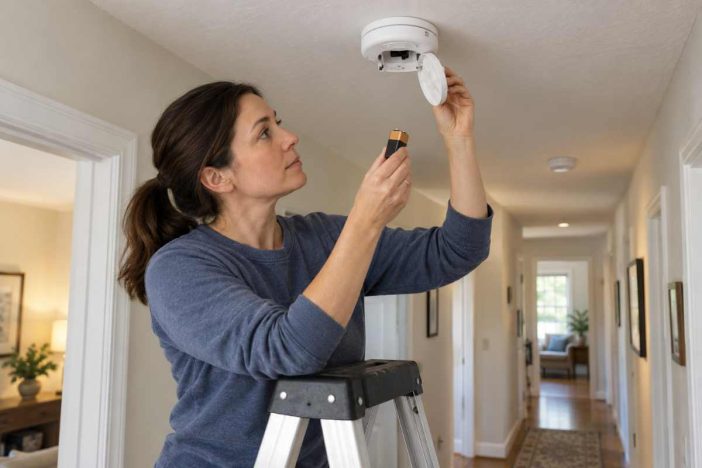
You change the battery, snap the compartment closed, step down from the ladder, and wait.
Silence.
Then—chirp.
A minute later, it happens again.
The frustrating part is not the sound itself. It is that the obvious repair has already been done, which makes the problem feel less predictable.
But a new battery only eliminates one possible cause.
The remaining possibilities fall into a much smaller set: the battery may not be making proper contact, the alarm may need the manufacturer-prescribed reset procedure, a hardwired unit may have lost AC power, the unit may have reached the end of its service life, or the sound may not be the kind of warning you think it is.
The safest troubleshooting order is therefore not “keep replacing things.”
It is:
identify the signal → verify power → verify age → follow the model instructions → decide whether the alarm should stay in service.
Quick Answer: Why Is a Smoke Detector Still Chirping After a Battery Change?
If a smoke detector continues chirping after you install a fresh battery, first confirm that the battery is the correct type, correctly oriented, fully seated, and that the compartment is completely closed.
Then check whether:
- the alarm requires a reset after battery replacement;
- the sound is coming from another alarm;
- a hardwired unit has lost AC power;
- the alarm has reached the end of its rated service life;
- the unit is reporting a fault rather than low battery;
- you are hearing a full alarm rather than a maintenance chirp.
Do not assume every repeating sound means “low battery.” Audible patterns differ by manufacturer and model, so the device manual should control the final interpretation.
The U.S. Fire Administration also advises replacing smoke alarms 10 years from the manufacture date and testing them regularly.
Check 1: Make Sure It Is Really a Chirp, Not an Emergency Alarm
This is the safety gate.
Do not begin battery troubleshooting simply because you cannot see smoke.
First determine whether the device is producing:
- a short periodic chirp;
- a repeating full-volume smoke alarm;
- a voice alert;
- a combination smoke/CO warning;
- a fault or end-of-life pattern.
Manufacturers use different patterns.
For example, some First Alert models use a repeating three-beep smoke-alarm pattern, while Kidde documents different chirp intervals for battery, fault, hush, and end-of-life conditions. The exact pattern on your unit must be checked against its label or manual rather than generalized from another model.
If there is smoke, heat, a burning smell, visible electrical damage, or an unexplained full alarm, treat the situation as potentially real.
Leave the home and contact emergency services from a safe location when appropriate.
Do not dismantle a detector while trying to prove that an emergency warning is false.
If you use a combination device, remember that smoke and carbon monoxide are separate hazards. Homekitchenmagazine’s carbon monoxide detector placement guide explains why CO protection should not be interpreted using smoke-alarm assumptions.
Check 2: Verify the New Battery Instead of Assuming It Is Correct
“New” does not automatically mean “correctly installed.”
Check four things.
Battery type
Use the battery type specified on the alarm label or in its manual.
Do not substitute another chemistry or battery configuration simply because it physically fits.
First Alert notes that models can specify particular replacement batteries, while Kidde likewise recommends using the type specified for the unit.
Polarity
Confirm positive and negative contacts are aligned as shown on the alarm.
Do not force a compartment closed around a battery that does not sit correctly.
Seating
Make sure the terminals are making firm contact.
A battery that appears installed but is not fully seated can leave the alarm behaving as if power is still inadequate.
Battery compartment
If the model has a drawer or door, close it completely.
Kidde specifically identifies improperly installed batteries and incompletely closed front-load battery compartments as causes of chirping.
After reinstalling the battery, use the alarm’s test function according to the manufacturer instructions.
Check 3: Confirm You Changed the Alarm That Is Actually Chirping
This sounds almost too simple.
In a hallway with several detectors, however, a brief high-pitched chirp can bounce off hard walls and ceilings. The alarm directly above you may not be the source.
Before taking the same detector apart for the third time:
- wait for the next chirp;
- move closer to each nearby alarm;
- check interconnected smoke/CO units;
- consider other battery devices in the same area.
First Alert even includes “Are you sure it’s the smoke alarm?” among its troubleshooting checks for a unit that seems to keep chirping after a new battery.
This matters because repeatedly removing the wrong alarm creates a new safety problem without solving the original one.
Check 4: Follow the Exact Reset Procedure for Your Model
Some alarms retain a previous low-battery or error condition after the battery has been replaced.
That does not mean every detector should be reset with the same internet recipe.
Kidde documents reset procedures for certain battery-only and AC-powered models, but the steps—including how power is disconnected and how long the test button is held—can differ by product.
The safer sequence is:
- find the model number;
- locate the manufacturer instructions;
- follow the reset procedure for that exact model;
- restore the alarm to normal installed operation;
- run the prescribed test.
Do not turn a model-specific reset into a universal “hold this button for 15 seconds” rule.
That shortcut is especially risky with:
- sealed 10-year alarms;
- interconnected systems;
- combination smoke/CO units;
- smart alarms;
- hardwired devices.
If the manufacturer says the sealed unit has reached end of life, replace it. Do not attempt to open the housing or replace a battery that was not designed to be serviced.
Check 5: For a Hardwired Alarm, Separate Battery Power From AC Power
A hardwired smoke alarm can still chirp even after its backup battery is replaced.
That is because two power paths are involved:
household AC power + backup power.
A power interruption, tripped breaker, loose connection, or electrical problem can leave the alarm depending on backup power or reporting a fault.
Start with observations that do not require opening energized wiring:
- Did the chirping begin after a power outage?
- Did electrical work recently occur?
- Is the alarm’s normal AC-power indicator behaving as its manual describes?
- Is the smoke-alarm circuit breaker tripped?
- Does the breaker trip again after being reset?
Kidde specifically notes that power interruptions and electrical conditions can contribute to chirping in hardwired systems.
If a breaker repeatedly trips, the alarm loses AC power again, you see damaged wiring, or diagnosis would require working inside the electrical box, stop DIY troubleshooting and use a qualified electrician.
Do not leave the alarm disconnected while waiting to solve a wiring problem.
Check 6: Read the Manufacture Date, Not Just the Battery Date
A smoke alarm is not a permanent fixture.
The U.S. Fire Administration says smoke alarms should be replaced 10 years from their manufacture date, including hardwired units. It also recommends monthly testing.
That creates a useful decision point.
Remove the alarm only as permitted by its instructions and look for:
- manufacture date;
- replace-by date;
- model number;
- alarm type;
- battery specification.
If the smoke alarm is already around its replacement age, a fresh battery is not a reason to keep troubleshooting indefinitely.
The battery can be new while the sensing device itself is old.
This is also why the essential home maintenance checklist treats aging detection equipment as a maintenance issue rather than waiting for total failure.
What if there is no readable date?
An unreadable or missing date removes your ability to verify service age.
For safety equipment, uncertainty should not automatically be interpreted as “probably fine.”
Check the manufacturer documentation and replacement guidance. If the age cannot be established and the alarm continues to malfunction, replacement may be the more defensible choice.
Check 7: Decide Whether the Alarm Has Earned Replacement
There is a point where more troubleshooting becomes false economy.
Consider replacing the alarm when:
- it has reached the manufacturer’s end-of-life date;
- it is approximately 10 years old as a smoke alarm;
- the unit fails its prescribed test;
- the sound is weak or abnormal;
- chirping continues after the correct battery and model-specific reset;
- the alarm reports a fault or end-of-life condition;
- its casing or contacts are visibly damaged;
- its age cannot be verified;
- manufacturer support tells you the unit should be replaced.
Kidde states that sealed models can chirp to indicate end of unit life and advises replacement when the unit reaches that condition.
A battery replacement restores a consumable power source.
It does not rejuvenate an aging sensor.
The HomeKitchenMagazine Signal-First Decision Matrix
The table below is designed to prevent the most common troubleshooting mistake: treating every noise as the same problem.
| What you observe | First question | Safest next move |
|---|---|---|
| Short periodic chirp after battery replacement | Is battery type, polarity, seating, and compartment closure correct? | Correct installation, test, then follow the model-specific reset instructions |
| Chirping began after an outage | Is the hardwired alarm receiving normal AC power? | Check normal power indicators and breaker; use an electrician for recurring electrical faults |
| Sealed alarm is chirping | Is this an end-of-life or fault pattern for this model? | Check the manual; replace the entire unit when required |
| Alarm is around 10 years old | Is the manufacture date at or beyond replacement age? | Replace the smoke alarm |
| Full-volume repeating alarm | Is there any smoke, heat, burning odor, or unexplained hazard? | Treat it as an emergency until danger has been ruled out |
| Chirp continues but you cannot identify the source | Are you working on the correct detector? | Locate the actual sound source before removing another alarm |
| Alarm fails its test after basic checks | Is the device still dependable? | Replace it or contact manufacturer support rather than leaving it disabled |
This framework is deliberately conservative.
It does not attempt to decode every manufacturer’s LED and beep combination from memory. The model’s manual remains the controlling source.
Chirping Is Not the Same Problem as a Nuisance Alarm
A maintenance chirp and a smoke alarm that suddenly sounds during cooking are different troubleshooting branches.
Cooking particles, steam, airflow, dust, and poor placement can contribute to nuisance alarms.
The U.S. Fire Administration specifically warns against removing a smoke-alarm battery because cooking triggered the alarm. Instead, its guidance includes using the hush function where provided, ventilating the area, and correcting problematic placement.
If full alarms repeatedly happen during cooking or showering, review your smoke detector placement rather than assuming the battery is responsible.
Placement, airflow, and distance from nuisance sources are separate from a periodic low-power chirp.
Do not solve the wrong problem.
Why Smoke Alarms Often Seem to Chirp at Night
There is a physical reason some low-battery warnings first become noticeable overnight.
Kidde explains that a battery already near the end of its useful charge can be more likely to trigger a low-battery warning as room temperature falls. Homes are often coolest during the early-morning hours.
That does not mean cold temperatures should be used as an excuse to ignore the signal.
The important clue is that nighttime chirping may expose a battery or alarm that was already close to a threshold.
Replace or service the device according to its instructions instead of waiting for warmer daytime temperatures to make the symptom disappear.
Do Not Silence the Problem by Removing Protection
The worst fix is the one that creates silence by eliminating the alarm.
Do not:
- leave the battery removed;
- leave a hardwired unit disconnected;
- tape over the detector;
- permanently deactivate a sealed unit that is still supposed to be in service;
- ignore a recurring fault because the test button sounded once.
USFA states plainly that a smoke alarm with a dead or missing battery provides no effective protection and warns against removing the battery to stop nuisance alarms.
Silence is not the objective.
A working, correctly powered, correctly placed alarm is.
For a wider schedule covering detection systems and other equipment, use HKM’s guide to how often home safety systems should be checked.
When to Call an Electrician or the Manufacturer
Manufacturer support is usually the better next step when:
- the beep pattern does not match the manual;
- a sealed unit reports a fault before its expected replacement date;
- a smart or wireless alarm reports a network-related condition;
- the unit remains under warranty;
- you cannot determine whether the signal means malfunction or end of life.
A qualified electrician is more appropriate when:
- a hardwired alarm does not appear to receive AC power;
- the circuit breaker repeatedly trips;
- wiring appears damaged;
- several interconnected alarms behave unpredictably after electrical work;
- testing requires access to wiring beyond normal homeowner maintenance.
Do not treat an electrical fault as a battery-maintenance problem.
Frequently Asked Questions
Why is my smoke detector still chirping with a brand-new battery?
A fresh battery rules out only one cause. Check the specified battery type, polarity, terminal contact, battery compartment, alarm age, and manufacturer reset procedure. Hardwired alarms can also chirp after AC-power problems. If the unit reports a fault or has reached end of life, replacement may be necessary.
Can I reset a smoke detector after changing the battery?
Many models provide a reset procedure, but the steps are not universal. Some require power removal and a test-button sequence, while sealed alarms may work differently. Find the model number and use its manufacturer instructions rather than following a generic reset duration from another alarm.
Why is my hardwired smoke detector chirping with a new backup battery?
The backup battery may be fine while the AC side has a problem. Check whether normal power indicators match the manual and whether the circuit breaker is tripped. If power repeatedly fails or wiring must be inspected, use a qualified electrician rather than repeatedly replacing batteries.
Should I replace a smoke detector that keeps chirping?
Replace it when the manufacturer identifies the signal as end of life or malfunction, when it fails its test, or when it reaches its replacement age. USFA recommends replacing smoke alarms 10 years from the manufacture date. Persistent unexplained faults should not be solved by permanently silencing the device.
Sources and Verification
This guide was cross-checked against current homeowner guidance from the U.S. Fire Administration, Kidde, and First Alert.
USFA provides the general U.S. safety baseline: test alarms regularly, keep them operational, and replace smoke alarms 10 years from the manufacture date.
Kidde’s current troubleshooting guidance documents multiple chirping causes—including battery installation, retained error state, power conditions, malfunction, environmental conditions, and end-of-life warnings—while emphasizing that specific models should be checked against their manuals.
First Alert likewise notes that a detector can continue chirping with a new battery and recommends model-specific troubleshooting rather than assuming every chirp has the same cause.
This article supports routine homeowner troubleshooting. It does not replace manufacturer instructions, local fire-safety requirements, emergency response guidance, or professional electrical diagnosis.
Fix the Cause, Not Just the Noise
A smoke detector chirping after a battery change is useful information.
The new battery tells you what the problem probably is not.
Now work in order:
identify the signal, verify the battery, confirm the source, check power, read the manufacture date, use the exact manufacturer procedure, and replace an alarm that can no longer be trusted.
Most importantly, do not trade a frustrating chirp for an unprotected home.
Continue through the Home Safety, Maintenance & Prevention hub for the broader prevention system.