The rain has been falling for hours.
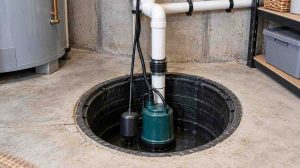
Downstairs, the primary sump pump cycles every few minutes. Water rises, the float lifts, the pump starts, and the pit empties again.
Everything appears to be working exactly as it should.
Then the lights go out.
Within seconds, the most important question is no longer whether the primary pump is reliable. It is whether anything can keep removing water while that pump has no power.
That is the problem a sump pump backup is supposed to solve.
But buying a battery, secondary pump, or expensive backup package simply because a basement contains a sump pit is not a sound decision. Some homes depend heavily on continuous pumping during storms. Others have pits that rarely collect meaningful water. Some need protection mainly from electrical outages. Others are more vulnerable to primary-pump failure, rapid groundwater inflow, a blocked discharge, or several failures occurring together.
The useful question is therefore not:
“Does every sump pump need a battery backup?”
It is:
What happens to this house if the primary sump system stops working when water is still entering the pit?
Quick Answer: Is a Sump Pump Battery Backup Worth It?
A sump pump battery backup is usually worth serious consideration when the home depends on active pumping to keep the basement dry and a loss of pumping during a power outage could allow water to rise into the building.
The case becomes stronger when:
- the primary pump cycles frequently during heavy rain or snowmelt;
- water rises quickly in the pit;
- storms in your area can also interrupt electrical service;
- the basement is finished or contains valuable equipment;
- previous sump or drainage failures have caused water intrusion;
- nobody is likely to be home to respond quickly;
- there is no reliable alternative drainage path.
Federal flood-loss guidance supports the basic concept. FloodSmart recommends a working sump pump, water alarm, and a battery-operated backup pump in case power goes out.
But a battery backup is not automatically adequate just because one is installed.
Before buying, verify:
- how dependent the home is on the sump;
- which failure you want the backup to cover;
- the consequences if pumping stops;
- whether the backup pump can handle the actual water load;
- whether the battery can support the expected duty cycle;
- whether another backup architecture fits better;
- whether the entire system can be maintained and tested reliably.
A backup system is valuable only if it can actually move enough water when the primary system cannot.
Why a Working Primary Sump Pump Is Not Enough
A healthy primary sump pump solves one problem:
it removes water while the pump, controls, discharge path, and electrical supply are available.
That leaves several other failure paths.
The primary pump can stop because of:
- a utility outage;
- a failed pump motor;
- a failed or obstructed float switch;
- an electrical problem;
- a control failure;
- a blocked or frozen discharge;
- a check-valve problem;
- water entering faster than the installed system can remove it.
This is why a sump pump should be viewed as a system, not as one motor sitting in a basin.
Before thinking about backup equipment, verify that the existing primary system actually works through a full operating cycle. Our guide to testing a sump pump explains how to check activation, pumping, automatic shutoff, exterior discharge, and backup layers without treating motor noise as proof that the system is healthy.
A backup does not make a defective primary system acceptable.
It adds another layer after the primary system has been made reliable.
The 7 Checks Before You Buy a Sump Pump Battery Backup
1. Determine How Much Your Home Actually Depends on the Sump
Start with the house, not the product.
Some pits remain dry through most weather events. Others receive groundwater every time rainfall becomes sustained.
Observe the existing system during normal conditions and wet weather.
Useful questions include:
- How frequently does the primary pump cycle during heavy rain?
- Does the water level rise rapidly between cycles?
- Has water ever reached the basement floor?
- Does groundwater continue entering after rainfall stops?
- Does the sump protect a finished basement or only a low-risk utility area?
- Is the home located where storms and power interruptions commonly occur together?
Do not intentionally disable a working primary pump during a storm simply to answer these questions.
Use normal observations, maintenance records, safe functional testing, and professional evaluation where necessary.
A basement that depends on frequent pumping has a very different risk profile from one whose sump rarely activates.
2. Identify the Failure You Are Trying to Cover
“Backup” is too broad a word.
Different backup systems cover different failures.
A typical battery-operated secondary sump pump can provide protection when:
- utility power fails;
- the primary pump cannot run;
- a separate backup float activates because water rises above the normal primary-pump level.
But the exact protection depends on system design.
For example, a separate DC secondary pump with its own float may still operate when the AC primary pump fails mechanically.
An inverter or backup-power system that only supplies electricity to the existing primary pump may help during a grid outage—but cannot make a mechanically failed primary pump start working again.
Neither arrangement automatically solves:
- a frozen discharge;
- a completely blocked shared discharge pipe;
- a pit receiving water faster than both pumps can remove it;
- a badly designed drainage system.
Before buying anything, write down the failure you expect the backup to handle.
3. Measure the Consequence of Pump Failure
Backup systems should be evaluated partly by the damage they are preventing.
Consider what is below grade.
A short period without pumping may be especially consequential when the basement contains:
- finished drywall or flooring;
- furnaces, boilers, water heaters, electrical equipment, or HVAC components;
- home-office equipment;
- stored documents;
- furniture;
- appliances;
- irreplaceable personal property.
The broader principle is the same one used in our water-damage prevention framework: controlling water early is usually easier than dealing with it after it spreads into building materials.
Risk is not determined only by how likely failure is.
It is also determined by what happens when failure occurs.
4. Compare Backup Capacity at the Actual Pumping Head
One of the easiest mistakes is comparing sump pumps using the largest gallons-per-hour number printed on a product page.
Pump output changes with pumping conditions.
Water must often travel:
- vertically from the sump;
- through discharge pipe;
- through valves and fittings;
- horizontally toward the exterior;
- to a termination point outside the building.
The vertical elevation the pump must overcome is part of the system’s head.
FEMA guidance for sump systems specifically recognizes pump capacity, pumping head, water inflow, and power availability as design considerations.
Therefore, compare the manufacturer’s performance curve at the approximate head of your installation, not just the maximum flow figure measured under easier conditions.
Do not assume:
higher horsepower = automatically adequate backup
or:
same discharge-pipe size = same pumping performance.
Instead compare:
expected inflow → pumping head → backup pump flow at that head
If the existing pit fills rapidly during storms or the required pumping capacity is unclear, professional sizing is more reliable than guessing from a product label.
5. Treat Battery Runtime as a Variable, Not a Promise
A battery-backup product may advertise long operation, many pump cycles, or a projected runtime.
Those figures require context.
Actual backup duration can depend on:
- battery chemistry and capacity;
- battery age and condition;
- state of charge when the outage begins;
- charger performance;
- backup-pump electrical demand;
- pumping head;
- how frequently the pump must cycle;
- how long each cycle runs;
- the amount of water entering the pit.
A lightly loaded backup that runs briefly every twenty minutes faces a different demand from a pump cycling almost continuously.
That is why a statement such as:
“This battery gives X hours of protection”
is incomplete without knowing the pumping duty cycle.
Many purpose-built systems specify compatible 12-volt deep-cycle or manufacturer-approved batteries. Use the battery type, size, terminals, charger, and installation method required by the exact backup-system manufacturer.
Do not substitute a random automotive battery simply because the voltage appears similar.
6. Compare Battery Backup With the Other Backup Architectures
Battery backup is not the only way to add sump redundancy.
The correct option depends on what utilities and systems the house can reliably support.
Battery-powered secondary sump pump
This is one of the most common residential arrangements.
A separate DC pump, controller, battery, charger, and float can operate when normal AC power disappears.
Advantages can include:
- automatic response;
- no fuel handling during an outage;
- operation even when nobody is home;
- separate pumping hardware from the primary pump.
Limitations include:
- finite stored energy;
- battery aging;
- charger or controller dependence;
- potentially lower output than the primary system;
- periodic testing and battery maintenance.
Water-powered backup sump pump
A water-powered backup can use pressure from the municipal water supply to remove sump water without household electricity.
This can be attractive for a prolonged outage because there is no storage battery to deplete.
But it is not appropriate everywhere.
A water-powered unit may require:
- a reliable municipal water supply;
- adequate water pressure;
- permanent plumbing;
- required backflow protection;
- compliance with local plumbing rules;
- sufficient pit and discharge space.
A manufacturer of water-powered backup equipment specifically notes that a unit relying on municipal pressure will not function during a power outage in a home whose water supply depends on an electric well pump.
Water-powered systems also consume potable water while operating.
Generator or standby power
A properly designed generator strategy can potentially keep the primary sump pump—and possibly other critical household loads—operating during an extended outage.
However, generator sizing, electrical connection, transfer equipment, startup load, fuel availability, and installation must all be considered.
Portable generators also introduce a serious carbon-monoxide hazard if they are misused.
Never operate a portable generator inside a home, garage, basement, crawlspace, shed, porch, or carport. Follow current CPSC guidance and the generator manufacturer’s installation and operating instructions.
High-water alarm only
An alarm can be useful.
It can tell you that water has reached an abnormal level.
But an alarm does not remove water.
Think of it as:
detection, not pumping capacity.
The strongest systems often combine pumping redundancy with warning and notification rather than asking one device to perform every role.
Battery Backup vs Water-Powered Backup vs Generator
| Backup strategy | Can work during grid outage? | Separate pump possible? | Main dependency | Key limitation |
|---|---|---|---|---|
| Battery backup pump | Yes | Yes | Charged compatible battery and functioning controller | Stored energy is finite |
| Water-powered backup | Yes | Yes | Reliable municipal water pressure | Not suitable for every water supply; uses potable water |
| Standby generator | Yes | Usually powers AC equipment | Fuel, generator capacity, transfer system | Cost and system complexity |
| Portable generator | Yes, when connected appropriately | Usually powers AC equipment | Fuel and safe operation | CO, electrical and weather hazards |
| High-water alarm only | Alarm may be battery-backed | No | Sensor/alarm reliability | Does not pump water |
The comparison is not meant to identify one universal winner.
It is meant to identify the dependency that remains when the primary pump stops.
7. Decide Whether You Can Maintain the Backup Long Term
Backup protection deteriorates if it is installed and forgotten.
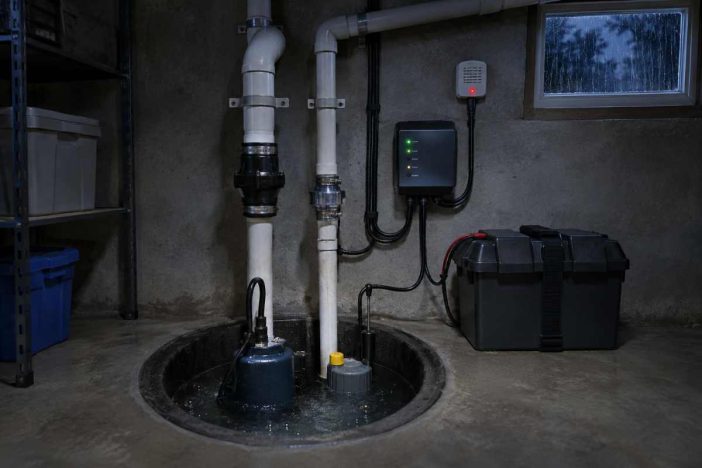
A battery backup may include:
- backup pump;
- battery;
- charger;
- controller;
- separate float switch;
- audible alarm;
- remote notification;
- check valve or discharge components.
Each component can have its own inspection or test procedure.
The existing HKM sump pump testing guide treats the backup as a separate system for exactly this reason: a successful primary-pump test does not prove the battery, secondary pump, controller, high-water alarm, or notification system works.
Follow the manufacturer schedule for your exact equipment rather than inventing one universal battery-replacement interval.
Useful maintenance records can include:
- date of backup-system test;
- battery installation date;
- battery or controller warnings;
- charger status;
- secondary-float operation;
- alarm test result;
- observed backup discharge;
- repairs or component replacements.
Add these records to your essential home maintenance checklist so the backup remains part of a routine rather than something remembered only when a storm is approaching.
Sump Pump Backup Decision Checklist
Check the statements that apply to your home. This is a decision record, not a safety score. Multiple risk factors generally strengthen the case for evaluating a properly sized backup system.
What a Battery Backup Will Not Fix
A backup pump can reduce one important risk, but it is not flood insurance for every failure mode.
A blocked or frozen discharge
If the backup and primary pump share a discharge path that cannot move water outside, adding a second pump may not solve the restriction.
Water inflow greater than the available pumping capacity
FEMA notes that seepage rates can exceed the capacity of standard sump pumps under some flood conditions.
When water enters faster than the combined system can remove it, more stored battery energy alone will not solve the hydraulic problem.
Exterior drainage returning water toward the foundation
Water should not simply be pumped outside and allowed to flow back toward the same foundation.
Foundation or groundwater problems beyond the sump design
A sump is one component of basement water management.
It does not replace grading, foundation drainage, appropriate waterproofing, or correction of other water-entry pathways.
A dead or neglected backup battery
A backup system that has not been maintained can create false confidence.
Electrical or mechanical faults outside the backup’s design
A battery cannot clear a blocked pipe, repair a broken discharge, or restore a failed check valve.
The correct mindset is:
backup pump = one layer of redundancy
not:
backup pump = complete flood protection.
A Better Way to Judge Whether a Battery Backup Is Worth It
Instead of asking whether a backup is “cheap” or “expensive,” compare two sides of the decision.
Stronger case for a battery backup
The case becomes stronger when several of these conditions are present:
- the sump routinely handles groundwater during storms;
- the pit rises quickly when pumping pauses;
- the home experiences weather-related power outages;
- the basement is finished;
- critical equipment is located below grade;
- prior sump failures or water intrusion have occurred;
- the household may be away during storms;
- there is no practical gravity-drainage alternative;
- a short interruption could allow water onto the basement floor.
Weaker immediate case
A battery backup may be a lower priority when:
- the sump rarely receives water even during major rainfall;
- drainage around the foundation is already highly effective;
- the basement has little damage exposure;
- historical observation shows very slow pit rise;
- another properly engineered backup-power strategy already protects the pump.
That does not mean “no backup is needed.”
It means the decision should be based on actual dependency and consequences rather than buying equipment by default.
Before You Buy: Specifications That Matter More Than Marketing
When comparing systems, collect the specifications that affect actual operation.
Pump performance curve
Look for backup-pump output at the expected pumping head.
Compatible battery specification
Confirm the exact battery type, capacity range, terminal arrangement, charger compatibility, and enclosure requirements specified by the manufacturer.
Independent backup float
Understand how and when the secondary pump activates.
Alarm functions
Determine whether the controller reports:
- backup activation;
- low battery;
- charger failure;
- high water;
- system fault.
Pit dimensions
A secondary pump and float need sufficient physical space to operate without interfering with the primary float or pump.
Discharge configuration
Determine whether the system uses:
- a separate discharge;
- a shared discharge;
- additional check valves;
- manufacturer-specific fittings.
Do not redesign the discharge based solely on a generic internet diagram.
Electrical requirements
The charger, controller, pump, receptacle, and any transfer or backup-power equipment must follow manufacturer instructions and applicable electrical requirements.
Plumbing requirements
Water-powered systems can introduce additional requirements such as municipal-water connections and backflow protection.
Local plumbing rules can vary.
Serviceability
Ask a practical question before buying:
If this controller, battery, float, or pump fails five years from now, can compatible replacement parts and service still be obtained?
Reliability includes maintainability.
Do Not Size a Backup From Horsepower Alone
Horsepower is easy to compare.
It is not sufficient.
Two pumps with similar horsepower can have different performance curves.
Likewise, a lower-power DC backup may perform adequately for one basement but be insufficient for another with:
- high groundwater inflow;
- long discharge runs;
- greater vertical lift;
- restrictive fittings;
- high stormwater demand.
For an important basement where the sump cycles frequently, sizing should begin with the water problem, not the motor label.
What About an Inverter That Runs the Existing Sump Pump?
Some backup-power arrangements use stored battery energy and an inverter to operate an AC primary pump.
This can have an advantage:
the same primary pump may continue operating during a grid outage.
But it creates a different redundancy structure.
If the primary pump itself fails mechanically, supplying it with backup electricity does not create a second functioning pump.
By contrast, a secondary battery-operated pump gives the system a separate pump and usually a separate activation control.
Neither architecture is automatically superior.
Ask:
Am I primarily protecting against loss of electricity, or against loss of the primary pumping path itself?
That distinction matters.
Battery Backup Does Not Eliminate the Need for a High-Water Alarm
A backup pump should not fail silently.
A high-water alarm can provide another layer of protection by indicating that water has risen beyond the expected normal operating range.
That matters because backup activation itself may indicate that:
- utility power failed;
- the primary pump failed;
- the primary float did not activate;
- inflow exceeded normal primary-pump capacity.
An alarm or remote notification can tell you that the system has entered an abnormal state.
But remember:
notification is not pumping capacity.
Use alarms as an additional layer, not as a substitute for a functioning primary and backup system.
Think About Outage Duration Before You Buy
A short power interruption and a multi-day outage are different design problems.
Battery storage can be an effective response to intermittent outages, especially when the sump operates only periodically.
But where flood-related seepage is sustained for long periods, the amount of stored energy becomes increasingly important.
FEMA guidance makes the same distinction at the system level: batteries may be sufficient where seepage is controlled and outage duration is limited, while longer-duration conditions can require a more substantial standby-power strategy.
This does not mean every homeowner needs a generator.
It means the backup should be selected for the duration and pumping demand you actually need it to survive.
Generator Safety Is Part of the Sump-Pump Decision
A portable generator may appear to solve the runtime problem because fuel can be replenished.
But using one incorrectly can create a much more serious hazard than a wet basement.
Current U.S. Consumer Product Safety Commission guidance says portable generators must be operated outdoors, at least 20 feet from the home, with exhaust directed away from windows, doors, and vents.
Never run one:
- in a basement;
- in a garage;
- in a crawlspace;
- in a shed;
- on a porch;
- in a carport.
If a backup-power installation requires permanent wiring, transfer equipment, new circuits, or other electrical modifications, use appropriately qualified professionals and follow applicable local requirements.
When a Water-Powered Backup May Make Sense
A water-powered backup can be attractive where:
- the house has reliable municipal water during electrical outages;
- sufficient water pressure is available;
- local plumbing requirements permit the installation;
- potable-water consumption during emergency operation is acceptable;
- the system can be installed with required backflow protection.
It can be especially useful when avoiding battery-runtime limits is a priority.
But it is not a universal solution.
A home supplied by a well pump that loses electrical power may also lose the pressure required to operate a municipal-pressure-style water-powered backup.
Manufacturer specifications and local plumbing requirements should therefore be reviewed before selecting this route.
When to Stop DIY and Call a Professional
Homeowners can safely make many observations without modifying the system.
You can usually document:
- how often the primary sump cycles;
- whether water rises rapidly;
- whether alarms are working according to their test function;
- battery or controller status indicators;
- visible condition of accessible components;
- manufacturer model numbers and specifications.
Professional evaluation is appropriate when the decision requires:
- determining actual required pumping capacity;
- modifying sump discharge piping;
- installing or changing check valves;
- adding permanent electrical equipment;
- modifying circuits or receptacles;
- installing generator transfer equipment;
- connecting a water-powered backup to domestic plumbing;
- installing required backflow protection;
- working in a sealed radon sump;
- resolving repeated breaker or GFCI trips;
- diagnosing a system that cannot keep up with incoming water.
Do not work around energized electrical equipment while standing in water.
If flooding and electricity are interacting, personal safety takes priority over saving belongings or completing a pump repair.
Sump Pump Backup Decision Matrix
| Home condition | Backup priority |
|---|---|
| Pump runs frequently during storms + finished basement + outage exposure | Strong reason to evaluate backup |
| Pump runs frequently + unfinished basement + critical mechanical equipment below grade | Strong reason to evaluate backup |
| Pump rarely cycles + water rises very slowly + minimal damage exposure | Lower urgency, but maintain testing and alarm strategy |
| Existing backup has unknown battery age or has never been tested | Treat backup reliability as unverified |
| Well-water home considering water-powered backup | Verify compatibility carefully; loss of power may also remove water pressure |
| High inflow that challenges primary pump | Get system capacity evaluated; backup alone may be inadequate |
| Shared discharge is restricted or freezes | Correct discharge problem; second pump does not solve a blocked exit |
This matrix is an editorial decision framework, not a substitute for site-specific engineering, plumbing, electrical, or waterproofing advice.
Frequently Asked Questions
Is a battery backup sump pump really necessary?
Not in every home. It becomes more valuable when the house depends heavily on active sump pumping and a power outage could allow water to reach the basement before anyone can respond.
Will a battery backup work if the main sump pump fails?
A separate backup pump with its own float and controller may still operate if the primary pump fails, depending on the cause of failure and the system design. A backup-power system that only supplies electricity to the failed primary pump cannot correct a mechanical pump failure.
How long will a battery backup sump pump run?
There is no universal runtime. Actual duration depends on battery capacity and condition, pump load, pumping head, water inflow, cycle frequency, charger condition, and the design of the backup system. Compare manufacturer specifications under conditions that resemble your installation rather than relying on one headline runtime figure.
Can I use a car battery for a backup sump pump?
Use only a battery type permitted by the backup-system manufacturer. Many systems specify deep-cycle or specific manufacturer-compatible batteries. Similar voltage alone does not establish compatibility.
Is a water-powered sump backup better than a battery backup?
Neither is universally better. Battery systems store energy locally and can work without municipal water pressure. Water-powered systems avoid stored-battery runtime limits but depend on a suitable municipal water supply, plumbing installation, water pressure, and applicable backflow requirements.
Is a generator better than a sump-pump battery backup?
A generator can provide longer-duration electrical power and may serve several household loads, but it adds fuel, sizing, installation, maintenance, and safety considerations. A separate battery backup can respond automatically and can provide a second pump as well as a second energy source. The best architecture depends on the failure modes you want to cover.
Is a high-water alarm enough without a backup pump?
An alarm can warn you that water is rising, but it cannot remove the water. In a house that depends on active sump pumping, an alarm should be considered a warning layer rather than a replacement for pumping redundancy.
Sources and Verification
This guide was cross-checked against current guidance and technical information from:
- FEMA, for sump capacity, pumping-head, seepage, and emergency-power considerations;
- National Flood Insurance Program / FloodSmart, for basement flood-loss mitigation and battery-operated backup pump recommendations;
- U.S. Consumer Product Safety Commission, for portable-generator carbon-monoxide safety;
- current manufacturer documentation for battery-powered and water-powered backup sump systems, including backup-power dependencies and installation limitations.
Always use the installation manual for the exact pump, controller, battery, generator, alarm, or water-powered backup installed in the home. Manufacturer requirements and applicable local plumbing and electrical rules take precedence over generalized guidance.
Final Takeaway: Buy Redundancy for the Failure You Actually Have
A sump pump battery backup is not valuable because a product label calls it “emergency protection.”
It is valuable when it closes a real failure path in a home that depends on pumping.
Start with seven questions:
Does the basement depend on the sump?
What happens if pumping stops?
Which failure needs to be covered?
Can the backup move enough water at the actual pumping head?
Can its energy source survive the expected outage?
Is another backup architecture more appropriate?
Will the system actually be tested and maintained?
When those answers point toward significant water exposure during a power outage or primary-pump failure, a properly selected backup becomes a rational layer of water-damage prevention rather than an impulse purchase.
Then keep the hierarchy clear:
good drainage → reliable primary sump → appropriate backup → high-water detection → regular testing → documented response plan.
That same prevention-first approach connects this guide with the broader Home Safety, Maintenance & Prevention Hub, where water, electrical, maintenance, and inspection risks are treated as connected home systems rather than isolated emergencies.