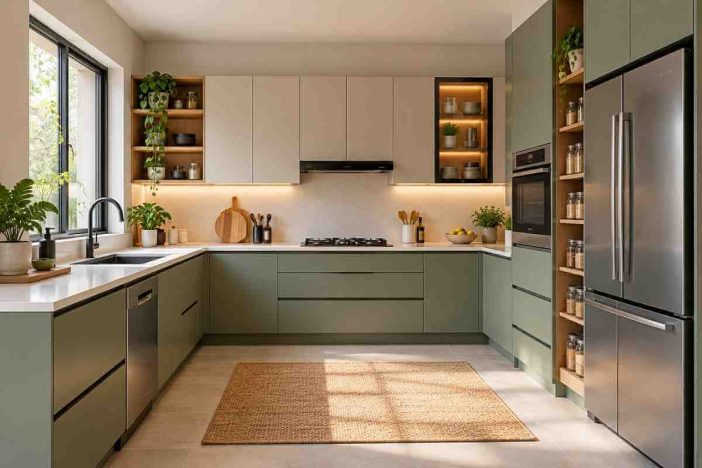
A modular kitchen design uses standardized cabinet units that can be combined around the available room dimensions, storage needs, appliances, and daily workflow. Unlike a kitchen planned mainly around appearance, a good modular layout starts with practical decisions: where the sink, cooktop, refrigerator, drawers, tall units, and work surfaces need to be placed.
The right configuration depends on more than whether an L-shaped, U-shaped, galley, or island kitchen looks attractive. You also need to consider aisle clearance, cabinet depth, appliance dimensions, corner access, countertop workspace, storage volume, materials, hardware, and how the modules will be installed. The seven layouts below explain where each configuration works best and what to check before committing to it.
For those seeking minimalist perfection, our in-depth Invisible Kitchen Design guide shows how to make a modular kitchen vanish into your living space.
If you’re dreaming of a kitchen that’s as efficient as it is elegant, these 7 stunning modular kitchen design ideas will not only inspire you—they might just transform the way you cook, live, and connect.
Quick Answer: A modular kitchen is planned from standardized cabinet units that are combined around the room dimensions, storage needs, appliances, and workflow. Before installation, choose the layout first, confirm exact measurements and appliance sizes, then finalize cabinet modules, internal storage, materials, hardware, plumbing, electrical points, ventilation, and door or drawer clearances.
What Is a Modular Kitchen Design?
A modular kitchen is built from separate cabinet units—such as base cabinets, wall cabinets, tall units, drawer modules, corner units, and appliance housings—that are planned to work together within a specific room.
Because the kitchen is assembled from defined modules, the layout can be adapted to different room sizes and storage requirements more easily than a one-off built-in arrangement. The practical advantage is not simply that modules can be rearranged. It is that cabinet sizes, internal storage, appliance spaces, work zones, hardware, and finishes can be planned as one coordinated system.
A modular kitchen still requires accurate measurements and installation planning. Standardized components do not guarantee a good result if doors collide, corner cabinets are difficult to access, appliances lack ventilation clearance, or frequently used items are placed far from the main prep area.
7 Modular Kitchen Layouts: Which One Fits Your Space?
| Configuration | Best For | Main Advantage | Main Planning Issue |
|---|---|---|---|
| L-Shaped | Small to medium kitchens | Flexible circulation and two working walls | Inside-corner access |
| U-Shaped | Medium to large kitchens | High storage and countertop capacity | Maintaining enough central aisle space |
| Island | Larger and open-plan kitchens | Extra prep, storage, or seating space | Clearance around the island |
| Straight / Single-Wall | Studios and compact homes | Uses minimal floor space | Limited continuous countertop space |
| Parallel / Galley | Long, narrow kitchens | Efficient two-sided work zone | Appliance and drawer conflicts across the aisle |
| Built-In Appliance Configuration | New kitchens and major renovations | Integrated appliance and cabinet planning | Exact dimensions, ventilation, and service access |
| Custom Modular Storage | Storage-focused households | Cabinet interiors tailored to actual items | Cost and complexity of specialty hardware |
1. L-Shaped Modular Kitchen: Flexible for Small and Medium Spaces
An L-shaped modular kitchen uses two adjoining walls, leaving the remaining side open for circulation, dining, or connection to another room. It works especially well when you want a compact work zone without enclosing the kitchen.
Why It Works
- Uses two walls without creating a narrow enclosed aisle.
- Can separate the sink, cooktop, and refrigerator across two runs.
- Leaves room for a dining table, movable cart, or small island when floor space allows.
- Provides both base and wall-cabinet storage without requiring cabinetry on every wall.
Check Before Choosing It
Pay particular attention to the inside corner. A poorly planned corner can create deep, difficult-to-reach storage, so decide early whether you will use a corner drawer, carousel, pull-out mechanism, or simpler shelving.
Also check where the refrigerator and tall cabinets will sit. Placing a tall unit too close to the corner can restrict access to nearby drawers or countertop space.
Best for: small to medium kitchens, open-plan rooms, and households that want flexible circulation.
Installation note: confirm cabinet-door, appliance-door, and drawer clearances at the inside corner before ordering modules.
2. U-Shaped Modular Kitchen: Maximum Work Surface and Storage
A U-shaped modular kitchen places cabinets and work surfaces along three sides of the room. This creates substantial storage and countertop capacity, but it works best when the center aisle remains wide enough for comfortable movement.
Why It Works
- Provides three continuous cabinet and countertop runs.
- Makes it easier to separate preparation, cooking, and cleaning zones.
- Offers more opportunities for drawers, wall cabinets, pantry units, and small-appliance storage.
- Can keep most kitchen tasks within a relatively compact working area.
Check Before Choosing It
Do not maximize cabinet depth at the expense of circulation. Measure the clear aisle after cabinet doors, drawers, dishwasher doors, and appliance handles are taken into account.
The two inside corners also need deliberate planning. Corner units can provide useful capacity, but complicated hardware is not always the best choice. Compare usable access, cost, and maintenance before specifying carousel or pull-out systems.
Best for: medium to larger kitchens, frequent cooking, households that need substantial storage, and kitchens used by more than one person.
Installation note: mark appliance-door swings and drawer extensions on the floor plan before finalizing cabinet widths.
3. Island Modular Kitchen: Extra Prep, Storage, and Seating
A modular kitchen island adds a freestanding or fixed work zone between the main cabinet runs and the surrounding room. Depending on its size and services, it can provide extra countertop space, drawers, cabinets, seating, a sink, or cooking equipment.
Why It Works
- Adds usable preparation space without extending the perimeter cabinets.
- Can provide deep drawers or cabinets for cookware and frequently used tools.
- Creates a natural boundary between the kitchen and an open living or dining area.
- Can combine food preparation, serving, and casual seating in one unit.
Check Before Choosing It
An island only improves the kitchen if there is enough clearance around it. Measure the distance between the island and surrounding cabinets after allowing for drawer extensions, dishwasher doors, refrigerator doors, oven doors, and people working on opposite sides.
If the island will include a sink, cooktop, outlets, or other powered equipment, plan plumbing, electrical, ventilation, and installation requirements before cabinet production begins. Retrofitting these services later can make the project substantially more complicated.
Best for: open-plan kitchens, larger rooms, households that need additional prep space, and layouts where an island can improve rather than restrict circulation.
Installation note: mark the full island footprint and appliance-door swings on the floor before finalizing the module size.
If you are planning a separate prep kitchen, scullery, or secondary cooking zone rather than a single modular kitchen, see our guide to second kitchen design for layout and zoning ideas.
4. Straight Modular Kitchen: Efficient for a Single Wall
A straight, or single-wall, modular kitchen places the main cabinets, appliances, sink, and work surfaces along one wall. It is often a practical choice where the kitchen needs to occupy a compact footprint without creating a separate enclosed room.
Why It Works
- Keeps the cabinet system within one continuous run.
- Preserves more open floor area in studios and compact homes.
- Can simplify cabinet planning because there are no internal cabinet corners.
- Works well when the kitchen shares space with a dining or living area.
Check Before Choosing It
The main limitation is countertop continuity. A refrigerator, sink, cooktop, and tall cabinet can quickly divide a short wall into several small work surfaces.
Plan the sequence around how food moves through the kitchen. Keep useful preparation space between the sink and cooktop where possible, and avoid placing a tall refrigerator or pantry unit where it interrupts the main working surface unnecessarily.
Vertical storage becomes especially important in this layout, so wall cabinets and tall units should be planned around accessibility rather than simply extending cabinetry to every available height.
Best for: studios, narrow homes, compact apartments, secondary kitchens, and rooms where maintaining open floor space is a priority.
Installation note: confirm the exact positions of plumbing, electrical outlets, ventilation, and appliance widths before determining the cabinet-module sequence.
5. Parallel Modular Kitchen: Efficient for Narrow Rooms
A parallel, or galley-style, modular kitchen uses two facing cabinet runs with a working aisle between them. This layout can create an efficient workflow in a long, narrow room because storage, appliances, and work surfaces are distributed across both sides.
Why It Works
- Provides more cabinet and countertop capacity than a single-wall kitchen of similar length.
- Makes it possible to place preparation and cooking functions on one side and cleaning or storage functions on the other.
- Keeps frequently used items within a compact working zone.
- Can work well for serious home cooking when the aisle is planned carefully.
Check Before Choosing It
The aisle width is the critical measurement. A layout that looks efficient on paper can become frustrating if open drawers, an oven door, dishwasher door, or refrigerator block movement through the kitchen.
Also avoid placing two major appliances directly opposite each other if their doors cannot open comfortably at the same time. Where two people regularly cook together, test whether one person can pass safely while the other is working at an open appliance or drawer.
Best for: long narrow kitchens, enclosed kitchens, frequent cooking, and households that want substantial storage without adding an island.
Installation note: draw the full open position of major appliance doors and deep drawers before finalizing the width of the two cabinet runs.
6. Modular Kitchen With Built-In Appliances
Built-in appliances can make a modular kitchen more integrated, but they should be planned before cabinet sizes are finalized. Ovens, microwaves, dishwashers, refrigerators, and other integrated appliances each require specific cabinet dimensions, ventilation clearances, electrical connections, and access for future servicing.
Why It Works
- Keeps appliance positions coordinated with the cabinet system.
- Can free countertop space by housing selected appliances inside tall or base units.
- Creates cleaner visual lines when appliance dimensions match the surrounding modules.
- Makes it easier to plan dedicated storage around cooking, refrigeration, and cleaning zones.
Check Before Choosing It
Do not design the cabinet opening from a generic appliance size. Use the installation specifications for the exact appliance model whenever possible.
Check ventilation requirements, electrical load, outlet location, plumbing connections, door clearances, and whether the appliance can be removed later without dismantling surrounding cabinetry.
Also consider replacement flexibility. An opening designed too tightly around one appliance can make future replacement difficult if a newer model has different dimensions.
Best for: kitchens being planned from scratch, major renovations, and homeowners who want appliances integrated into a coordinated cabinet system.
Installation note: finalize major appliance models or verified installation dimensions before cabinet production begins.
7. Custom Modular Storage: Plan the Inside of the Cabinets
A modular kitchen is not fully planned when the cabinet boxes are chosen. The internal storage system determines how easily cookware, food, utensils, trays, small appliances, and cleaning supplies can actually be reached and returned.
Storage Options to Consider
- Deep drawers for pots, pans, and heavy cookware.
- Vertical dividers for baking sheets, trays, and cutting boards.
- Tall pantry units with adjustable shelves or pull-out storage.
- Drawer inserts for cutlery, knives, utensils, and small tools.
- Corner solutions such as shelves, carousels, or pull-out mechanisms where they genuinely improve access.
- Narrow pull-outs for bottles, oils, or other items that fit a small remaining gap.
Check Before Choosing It
Choose internal fittings around the items you already own rather than filling every cabinet with specialized hardware.
Complex pull-out mechanisms can improve access, but they also add cost, reduce some usable cabinet volume, and introduce moving parts that may eventually need adjustment or replacement. In some locations, a simple drawer or adjustable shelf is the better long-term choice.
Measure the height, width, and depth of the items that need to be stored before specifying drawer heights, shelf spacing, or pull-out accessories.
Best for: households that want storage tailored to cooking habits rather than generic cabinet interiors.
Installation note: confirm that internal organizers do not interfere with hinges, plumbing, appliance connections, or adjacent drawer and door openings.
If you already have usable cabinets and only need smaller storage improvements, these DIY kitchen storage ideas cover simpler retrofits that do not require redesigning the entire modular kitchen.
What Determines the Cost of a Modular Kitchen?
There is no reliable universal price for a modular kitchen because the final cost depends on the room, cabinet specification, materials, hardware, countertop, appliances, labor rates, and installation conditions.
The most important cost drivers usually include:
- Number and size of modules: More cabinets, drawers, tall units, and specialty corner units increase material and hardware requirements.
- Cabinet construction: Plywood, engineered boards, solid wood components, and other cabinet materials vary substantially in price and durability.
- Door and finish selection: Laminate, acrylic, painted finishes, veneers, and specialty surfaces can change the budget significantly.
- Drawer slides and hinges: Standard hardware costs less than premium soft-close or heavy-duty systems.
- Internal organizers: Pull-out pantries, corner mechanisms, drawer inserts, and other specialty fittings can add considerable cost.
- Countertops and backsplashes: These may represent a significant part of the project but are often priced separately from the cabinet modules.
- Appliances: Built-in appliances can require specific housings, electrical work, ventilation, plumbing, or other installation changes.
- Installation conditions: Uneven walls, relocated utilities, structural work, permits, demolition, and site-specific adjustments can increase labor costs.
Before comparing quotes, ask each supplier or contractor to separate cabinetry, hardware, countertops, appliances, delivery, installation, electrical work, plumbing, demolition, and other site work. Comparing itemized scopes is more useful than comparing one headline price.
If the modular kitchen is part of a larger renovation, see our guide on how to save on a kitchen remodel for practical ways to control layout, cabinet, material, and contractor costs.
Maintenance and Durability of a Modular Kitchen
How long a modular kitchen performs well depends on cabinet materials, hardware quality, moisture exposure, installation accuracy, and daily use. A well-planned system is easier to maintain because damaged hardware or individual components can often be serviced without replacing the entire kitchen.
Use these maintenance practices:
- Keep moisture under control: Wipe spills promptly, especially around the sink, dishwasher, and cabinet edges.
- Check hinges and drawer slides: Tighten or adjust hardware if doors begin to sag, rub, or stop closing evenly.
- Avoid overloading drawers and pull-outs: Follow the hardware manufacturer’s load limits, particularly for wide drawers and pantry mechanisms.
- Use surface-appropriate cleaners: Avoid abrasive products or harsh chemicals that may damage laminate, acrylic, painted, or other cabinet finishes.
- Protect cabinet interiors from leaks: Inspect plumbing under the sink and around appliances so slow leaks do not damage cabinet panels unnoticed.
- Keep ventilation paths clear: Built-in appliances should retain the clearances and airflow specified by their manufacturers.
- Replace worn hardware when needed: Hinges, drawer slides, handles, and internal organizers are serviceable components and can often be replaced independently of the cabinet boxes.
When choosing materials and hardware, consider not only how they look when new but also how easily they can be cleaned, adjusted, repaired, or replaced after years of regular use.
Frequently Asked Questions About Modular Kitchen Design
What is the difference between a modular kitchen and a custom kitchen?
A modular kitchen is assembled from defined cabinet units that are planned to work together within the available space. A fully custom kitchen may use more one-off cabinet dimensions, construction details, and built-in elements designed specifically for the room. In practice, many projects combine modular components with some custom adjustments.
Which modular kitchen layout is best for a small space?
A single-wall or L-shaped layout is often easier to fit into a small kitchen because it uses fewer cabinet runs and can preserve more circulation space. A galley layout can also work well in a narrow room if the aisle remains comfortable when appliance and cabinet doors are open.
What should be finalized before modular kitchen installation?
Confirm the room measurements, cabinet layout, major appliance dimensions, plumbing points, electrical requirements, ventilation, countertop details, hardware, and door or drawer clearances before cabinet production begins. Changes made after manufacturing starts can be more difficult and expensive to correct.
Can built-in appliances be replaced later in a modular kitchen?
Usually yes, but replacement is easier when the appliance opening, ventilation, connections, and access were planned with future servicing in mind. Before replacing a built-in appliance, check whether the new model matches the available cabinet dimensions and installation requirements.
Is a Modular Kitchen Right for You?
A modular kitchen is a strong option when you want cabinetry, storage, appliances, and work zones planned as one coordinated system. Its main advantage is flexibility: modules can be selected and arranged around the room rather than treating every cabinet as an isolated decision.
The best result depends on accurate measurements, realistic circulation space, suitable materials, appropriate hardware, and early coordination with plumbing, electrical, ventilation, and appliance requirements.
Before ordering cabinets, compare the layouts above against how your household actually cooks. Choose the configuration that gives you enough preparation space, accessible storage, comfortable movement, and practical appliance placement—not simply the layout with the most cabinets.
If a supplier or contractor is involved, confirm the final dimensions, materials, hardware specifications, appliance openings, installation scope, and exclusions in writing before production begins.