
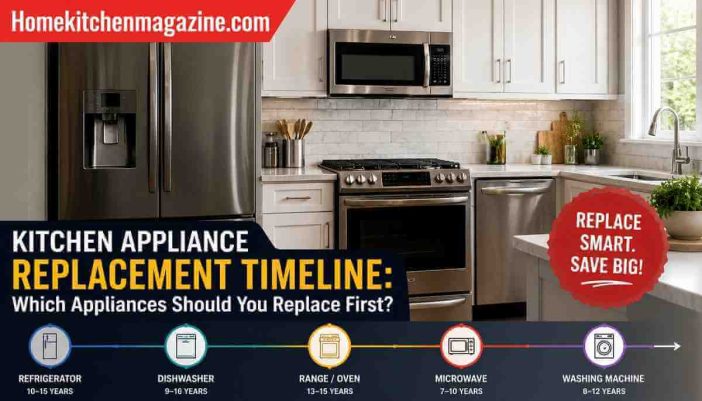
A refrigerator rarely announces the exact day it will stop cooling.
A dishwasher doesn’t schedule its own breakdown.
An oven won’t warn you that next month’s family dinner will be the moment its control board finally gives up.
Yet many homeowners manage appliance replacement as though failures happen randomly.
They don’t.
Most major kitchen appliances follow remarkably predictable aging patterns.
Those patterns become easier to understand when homeowners know how appliances age across their normal service life. Our Kitchen Appliance Lifespan: What Really Lasts And Why explains why lifespan is not just an age number, but a reliability pattern shaped by maintenance, usage, and operating conditions.
Performance slowly declines.
Repair frequency increases.
Energy consumption rises.
Replacement parts become harder to find.
Eventually, a decision that could have been planned calmly becomes an emergency purchase made under pressure.
The question is no longer whether an appliance should be replaced.
The question becomes which appliance deserves attention first—and why.
That distinction can save thousands of dollars over the lifetime of a home.
Why Appliance Replacement Should Be Planned—Not Reactive
Many homeowners assume replacing appliances only after they break is the most economical strategy.
In reality, waiting for complete failure often creates additional costs that aren’t included on the repair invoice.
Unexpected appliance failures may result in:
- emergency repair charges
- food spoilage
- temporary kitchen disruption
- water damage
- higher energy bills before failure
- rushed purchasing decisions
- limited product selection
A planned replacement timeline shifts control back to the homeowner.
Instead of reacting to failures, you’re managing predictable equipment lifecycles.
This approach aligns closely with the preventive philosophy discussed in Kitchen Appliance Maintenance Checklist: A Year-Round Preventive Guide, where routine maintenance extends useful life while helping identify the right replacement window before failures become expensive.
Age Alone Should Never Determine Replacement
One of the biggest misconceptions in home maintenance is assuming every appliance should be replaced after reaching a certain age.
Age matters.
But age is only one variable.
A better replacement decision considers five factors simultaneously.
Lifespan still matters, but only as a starting point. A replacement timeline becomes useful when age is combined with repair history, performance decline, energy use, and failure consequences.
Remaining Mechanical Reliability
Two refrigerators built in the same year may have completely different futures.
One may have received annual condenser coil cleaning, proper ventilation, and regular maintenance.
The other may have operated continuously with clogged coils and elevated compressor temperatures.
Their chronological age is identical.
Their remaining lifespan is not.
Repair History
An appliance requiring its first repair after ten years tells a very different story from one that has required three service calls within eighteen months.
Repeated repairs often indicate that multiple components are approaching the end of their useful lives.
Rather than evaluating each repair independently, homeowners should consider the appliance’s overall reliability trend.
Our guide Repair vs Replace Kitchen Appliances: A Practical Decision Framework explains how recurring repair patterns often provide stronger replacement signals than age alone.
Operating Efficiency
Older appliances frequently continue working long after their peak efficiency has passed.
Signs include:
- longer operating cycles
- increasing electricity consumption
- declining performance
- inconsistent temperatures
- reduced cleaning effectiveness
Although these changes may seem gradual, they quietly increase ownership costs year after year.
Failure Consequences
Not every appliance deserves the same replacement priority.
A failed toaster causes inconvenience.
A failed refrigerator may destroy hundreds of dollars in food.
A leaking dishwasher may damage cabinets, flooring, and subfloors.
The consequences of failure should influence replacement timing as much as the probability of failure itself.
Parts Availability
As appliances age, manufacturers eventually discontinue replacement components.
An otherwise repairable appliance can become economically obsolete simply because critical parts are no longer available.
Planning replacement before this stage provides more options and avoids emergency decisions.
The Appliance Replacement Priority Model
Instead of replacing appliances strictly by age, homeowners should evaluate them according to replacement priority.
This framework considers three variables simultaneously:
- likelihood of failure
- financial consequences of failure
- impact on everyday household function
Together, these factors create a much more practical replacement schedule than manufacturer lifespan estimates alone.
In the following sections, we’ll examine which kitchen appliances typically deserve the highest replacement priority—and why some older appliances can safely remain in service while others should be replaced well before they completely fail.
The Kitchen Appliance Replacement Priority Matrix
Not every appliance should be replaced according to the same schedule.
A refrigerator that operates continuously deserves far more attention than a microwave used only a few minutes each day.
Likewise, a dishwasher connected to your home’s plumbing carries very different financial risks than a countertop coffee maker.
To simplify long-term planning, homeowners can categorize appliances into four replacement priorities.
| Priority | Appliance Condition | Recommended Action |
|---|---|---|
| Priority 1 | High failure risk with expensive consequences | Plan replacement soon |
| Priority 2 | Aging but still reliable | Increase inspections and budget for replacement |
| Priority 3 | Stable performance with moderate age | Continue maintenance |
| Priority 4 | Low-risk appliance | Replace only when reliability declines |
This system helps homeowners avoid replacing functioning appliances unnecessarily while reducing the likelihood of expensive emergency failures.
If a homeowner is still unsure whether an aging appliance should be repaired one more time or replaced, the next step is to compare repair cost, remaining useful life, and reliability outlook through the Repair vs Replace Kitchen Appliances: A Practical Decision Framework.
Priority 1 — Replace These Appliances First
These appliances combine three characteristics:
- expensive repair costs
- high daily usage
- significant consequences if they fail unexpectedly
They deserve the highest replacement priority.
Refrigerator
The refrigerator operates 24 hours a day, every day.
No other kitchen appliance experiences the same continuous workload.
As refrigerators age, homeowners may notice:
- compressor running almost constantly
- inconsistent temperatures
- freezer frost buildup
- higher electricity consumption
- louder operating noise
Unlike many other appliances, refrigerator failure often produces immediate financial losses through spoiled food and emergency replacement.
If repeated repairs begin appearing after years of reliable service, replacement often becomes the more economical long-term decision.
Readers comparing repair costs should also review The Most Expensive Kitchen Appliance Repairs (And How To Avoid Them), where compressor failures frequently become one of the most expensive appliance repairs in the kitchen.
Dishwasher
Dishwashers deserve surprisingly high replacement priority—not because they fail more frequently, but because they combine electrical systems, plumbing, and cabinetry in one location.
An aging dishwasher may continue operating while quietly developing:
- worn door seals
- circulation pump wear
- deteriorating inlet hoses
- slow internal leaks
These seemingly minor issues can eventually damage:
- cabinet bases
- finished flooring
- subfloors
- adjacent walls
The appliance itself may only represent part of the financial loss.
Secondary water damage often costs considerably more than replacing the dishwasher proactively.
This is why dishwasher replacement planning should overlap with leak prevention. Our Kitchen Leak Risk Audit Checklist: 15 Points Homeowners Miss Every Year helps identify hidden water-risk points around dishwashers, sinks, supply lines, and nearby cabinetry.
Built-In Garbage Disposal (Where Installed)
Garbage disposals typically receive little attention until they stop working.
However, advanced age often brings:
- internal corrosion
- bearing wear
- recurring leaks
- motor overheating
If multiple plumbing repairs are already planned beneath the sink, replacing an aging disposal at the same time frequently reduces future labor costs.
Priority 2 — Begin Budgeting For Replacement
These appliances often continue functioning well beyond their expected lifespan.
However, reliability becomes increasingly unpredictable.
Rather than replacing them immediately, homeowners should begin planning financially for replacement within the next few years.
Built-In Oven Or Range
Cooking appliances generally age more gracefully than refrigeration equipment.
Nevertheless, several components gradually become more failure-prone:
- electronic control boards
- temperature sensors
- igniters
- heating elements
- convection fans
If repairs begin involving multiple systems rather than isolated components, replacement often becomes the more practical investment.
Over-The-Range Microwave
Microwaves often appear reliable until performance declines rapidly.
Warning signs include:
- uneven heating
- increasing operating noise
- delayed startup
- intermittent keypad response
- longer cooking times
Because replacement costs have become relatively affordable compared to major repairs, older microwaves frequently fall into the “plan ahead” category rather than “repair indefinitely.”
Priority 3 — Continue Maintaining, Not Replacing
Some appliances often outlive their published lifespan because they experience relatively low mechanical stress.
Replacing these appliances simply because they reach a certain age rarely provides strong financial value.
Instead, focus on maintenance and performance monitoring.
Range Hood
A range hood has comparatively few moving parts.
Most failures involve:
- fan motors
- switches
- lighting
- grease accumulation
Regular cleaning often extends service life significantly.
Replacement usually becomes appropriate only when:
- airflow has noticeably declined,
- motors become excessively noisy,
- replacement parts are unavailable,
- or newer ventilation standards justify an upgrade.
Because proper ventilation also affects indoor air quality and moisture control, homeowners should evaluate overall kitchen airflow rather than the hood alone.
Built-In Coffee Machines Or Specialty Appliances
Premium coffee systems, warming drawers, beverage centers, and similar appliances generally receive less daily stress than refrigerators or dishwashers.
Replacement decisions should focus on:
- repair availability,
- maintenance costs,
- daily usefulness,
- energy efficiency.
If repairs remain inexpensive and reliability stays high, continued ownership is often the better financial decision.
Priority 4 — Replace Only When Necessary
Some kitchen appliances have relatively low replacement urgency because failure carries limited financial consequences.
Examples include:
- countertop microwaves
- toasters
- blenders
- mixers
- electric kettles
- air fryers
- countertop coffee makers
Although these products eventually wear out, unexpected failure rarely creates:
- secondary property damage,
- expensive repair bills,
- insurance concerns,
- or major household disruption.
For these appliances, replacement should be driven primarily by:
- declining performance,
- unavailable replacement parts,
- safety concerns,
- or changing household needs.
Why Failure Risk Matters More Than Manufacturer Lifespan
Manufacturer lifespan estimates provide useful benchmarks.
They do not predict failure dates.
Two identical appliances can age very differently depending on:
- household size
- daily usage
- water quality
- electrical stability
- ventilation
- maintenance consistency
For example:
A refrigerator serving a family of six experiences far more compressor cycles than the same model in a vacation home.
Likewise, a dishwasher running twice daily accumulates years of wear much faster than one operating only on weekends.
This is why actual operating conditions should always influence replacement planning more than published lifespan averages.
Original Value Framework: The Reliability Curve
Most homeowners imagine appliance failure as a straight line.
In reality, reliability follows a curve.
Stage One — Stable Operation
The appliance performs normally.
Maintenance requirements remain low.
Unexpected failures are uncommon.
Stage Two — Early Aging
Performance remains acceptable.
Small repairs begin appearing.
Efficiency gradually declines.
Routine inspections become increasingly valuable.
Many homeowners first recognize this stage through the subtle warning signs explained in Signs Your Kitchen Appliances Are About To Fail, where small changes often precede major failures by months.
Stage Three — Escalating Ownership Cost
Repairs become more frequent.
Operating costs increase.
Replacement parts become harder to obtain.
Confidence declines.
Planning replacement now usually prevents emergency purchasing later.
This is also the point where warranty decisions become more relevant. If an appliance is expensive, still within a serviceable window, or likely to require costly electronic repairs, compare the replacement plan with Should You Buy Appliance Extended Warranties? A Cost vs Risk Analysis.
Stage Four — Reactive Ownership
Failures become unpredictable.
Repair costs rise sharply.
Household disruption increases.
Replacement decisions are made under time pressure.
Financially, this is the most expensive stage to reach.
Smart homeowners aim to replace appliances near the end of Stage Three, before entering Stage Four altogether.
Original Value Framework: The Kitchen Replacement Timeline Matrix
Instead of asking:
“Which appliance is oldest?”
Ask:
“Which appliance creates the greatest financial risk if it fails tomorrow?”
The following matrix provides a practical planning framework.
| Appliance | Typical Replacement Priority | Primary Reason |
|---|---|---|
| Refrigerator | Very High | Continuous operation and expensive failures |
| Dishwasher | Very High | Water damage risk |
| Garbage Disposal | High | Plumbing and leak potential |
| Built-In Oven / Range | Moderate | Repair cost increases with age |
| Over-the-Range Microwave | Moderate | Electronic reliability declines |
| Range Hood | Low | Maintenance extends lifespan |
| Countertop Appliances | Low | Limited financial consequence |
Notice that replacement priority depends more on risk exposure than chronological age.
Original Value Framework: The Kitchen Reliability Score
One practical way to prioritize replacement decisions is by assigning every major appliance a simple reliability score.
Evaluate each appliance using five questions.
| Question | Yes | No |
|---|---|---|
| More than 75% through expected lifespan? | 1 | 0 |
| Two or more repairs in the last three years? | 1 | 0 |
| Performance noticeably declining? | 1 | 0 |
| Failure could damage the home? | 1 | 0 |
| Replacement parts becoming difficult to obtain? | 1 | 0 |
Interpretation:
0–1 points
Continue routine maintenance.
2–3 points
Increase inspections and begin budgeting for replacement.
4–5 points
Develop a replacement plan before an unexpected failure forces an emergency decision.
Unlike age alone, this framework reflects the appliance’s actual condition and financial risk.
Planning Appliance Replacement Over Ten Years
Replacing multiple appliances simultaneously creates unnecessary financial pressure.
A structured timeline spreads costs more evenly.
For example:
Years 1–2
Evaluate:
- refrigerator
- dishwasher
- garbage disposal
These appliances deserve the closest monitoring because failures often generate the highest indirect costs.
Years 3–5
Review:
- built-in oven
- microwave
- ventilation equipment
At this stage, replacement decisions should depend on repair history rather than age alone.
Years 6–10
Continue evaluating:
- specialty appliances
- countertop equipment
- optional upgrades
Technology improvements may justify replacement even when reliability remains acceptable.
This long-term planning approach complements the preventive strategy discussed in Kitchen Appliance Maintenance Checklist: A Year-Round Preventive Guide, where consistent inspections help homeowners forecast replacement years in advance instead of reacting after unexpected breakdowns.
Common Mistakes Homeowners Make
Replacing Everything During A Kitchen Remodel
Many homeowners assume every appliance should be replaced simply because cabinets or countertops are being updated.
That isn’t always financially wise.
If a relatively new refrigerator still has years of dependable service remaining, replacing it solely for appearance may reduce overall renovation value.
Functional reliability should remain the primary decision factor.
Waiting Until Complete Failure
The opposite mistake is waiting until an appliance becomes completely unusable.
This often results in:
- emergency purchases,
- limited product availability,
- rushed installation,
- paying premium prices,
- and accepting models that weren’t carefully researched.
Planning replacements before catastrophic failure creates far better purchasing conditions.
Waiting also increases the likelihood that replacement happens under pressure, when product selection is limited and homeowners may overpay simply to restore normal kitchen function quickly.
Ignoring Repair Frequency
One expensive repair rarely justifies replacement.
Several significant repairs within a short period often indicate the appliance is entering the final stage of its economic life.
Patterns matter more than isolated events.
This principle is explored further in Repair vs Replace Kitchen Appliances: A Practical Decision Framework, where repair history becomes one of the strongest indicators that replacement will soon become the lower-cost option.
Practical Replacement Planning Checklist
Before replacing any major kitchen appliance, review the following questions:
✓ Is the appliance approaching or exceeding its expected service life?
✓ Has repair frequency increased during the past two years?
✓ Have operating costs noticeably increased?
✓ Are replacement parts becoming difficult to obtain?
✓ Could failure damage surrounding cabinets, flooring, or plumbing?
✓ Would a modern replacement significantly improve efficiency or reliability?
✓ Does keeping the appliance create more financial risk than replacing it?
If rising operating cost is part of the replacement case, calculate it before treating efficiency as a reason to buy. Our appliance kWh and running-cost guide shows how to estimate annual electricity cost from real usage and compare it with a prospective replacement.
This checklist becomes more accurate when paired with a basic maintenance record. Cleaning dates, repair notes, inspection results, and recurring symptoms help reveal whether an appliance is aging normally or becoming unreliable.
When several answers point toward increasing risk, proactive replacement often becomes the financially stronger decision rather than waiting for complete failure.
Why A Replacement Timeline Protects More Than Your Budget
A structured replacement timeline does more than reduce repair expenses.
It also improves:
- household reliability
- energy efficiency
- kitchen safety
- maintenance planning
- resale confidence
- inspection outcomes
For example, replacing an aging dishwasher before internal seals fail may prevent cabinet replacement.
Replacing an older refrigerator before compressor failure may avoid food loss, emergency purchases, and expensive weekend repair calls.
Small decisions made proactively often eliminate much larger costs later.
This is why experienced homeowners think in terms of planned ownership, not emergency ownership.
Why Homeowners Often Replace The Wrong Appliance First
Many replacement decisions are driven by appearance.
A stainless-steel refrigerator may be replaced because it no longer matches new cabinetry.
Meanwhile, the twelve-year-old dishwasher quietly develops a leaking door seal.
The visible appliance gets replaced.
The risky appliance stays.
Months later, the dishwasher leaks overnight and damages the surrounding cabinetry.
The lesson is simple:
Appearance influences remodeling.
Risk should influence replacement planning.
Building A Five-Year Appliance Replacement Plan
Rather than viewing appliance replacement as isolated purchases, consider your kitchen as one integrated system.
A practical planning approach looks like this:
Year One
Perform a complete appliance assessment.
Record:
- installation dates
- repair history
- maintenance records
- warranty status
Warranty expiration dates should be recorded alongside installation dates and repair history, because coverage status can influence whether repair, replacement, or self-insurance is the better financial decision.
Read More: Should You Buy Appliance Extended Warranties? - operating condition
Year Two
Prioritize preventive maintenance.
Address:
- refrigerator coil cleaning
- dishwasher inspections
- water filter replacement
- ventilation cleaning
Years Three And Four
Begin replacing high-risk appliances approaching the end of their economic life.
Focus first on appliances whose failures can cause secondary property damage.
Year Five
Review the remaining appliance portfolio.
Update replacement priorities based on:
- actual performance
- repair frequency
- household needs
- new efficiency standards
Instead of reacting to failures, homeowners gradually modernize the kitchen while avoiding major financial spikes.
Frequently Asked Questions
Should I Replace Kitchen Appliances Before They Break?
Often, yes. If an appliance is approaching the end of its useful life, has required repeated repairs, or presents a significant water or electrical risk, planned replacement is usually less expensive than waiting for complete failure.
Which Kitchen Appliance Should Be Replaced First?
For most homes, refrigerators and dishwashers deserve the highest priority because they operate frequently and their failures can result in costly secondary damage, especially water damage.
Is It Better To Replace All Appliances At Once?
Not necessarily. Unless you’re completing a full renovation or several appliances are reaching the end of their lifespan simultaneously, phased replacement generally provides better financial flexibility and allows each appliance to deliver its full service life.
How Often Should I Review My Appliance Replacement Plan?
An annual review is usually sufficient. Update appliance ages, maintenance records, repair history, and any changes in performance to keep the replacement timeline accurate.
What Smart Homeowners Replace First
The oldest appliance isn’t always the one that should leave the kitchen first.
The appliance that creates the greatest financial, operational, or property risk usually deserves priority.
A refrigerator running around the clock.
A dishwasher connected to your home’s plumbing.
An oven requiring increasingly expensive electronic repairs.
These decisions should be based on reliability, not convenience.
A structured kitchen appliance replacement timeline transforms ownership from reactive to proactive.
Instead of waiting for expensive failures, homeowners make informed decisions based on condition, maintenance history, repair trends, and long-term operating costs.
This replacement planning guide is part of our Kitchen Systems, Appliances & Efficiency Hub, where appliance lifespan, repair decisions, maintenance schedules, warranty planning, and long-term kitchen reliability are treated as one connected system.
Over the life of a home, this approach reduces emergency spending, extends appliance reliability, protects surrounding property, and supports a kitchen that remains dependable year after year.