
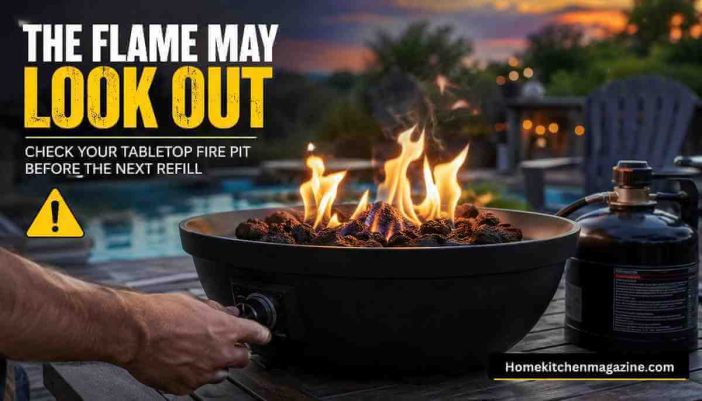
The flame has faded to almost nothing.
Dinner is finished. The marshmallows are gone. Someone decides to add a little more fuel before the evening ends.
The bottle tilts toward the fire pit.
What happens next may depend on something the person holding it cannot easily see.
A small alcohol flame can remain difficult to detect, particularly in a bright environment. If that flame reaches the vapors inside a fuel container while liquid is being poured, ignition can travel back toward the container and propel flame and burning fuel toward the person refilling the appliance—or anyone standing nearby.
The U.S. Consumer Product Safety Commission calls this hazard flame jetting. It is not limited to careless use of one unusual product. Regulators in the United States, Canada, and Australia have addressed hazards involving portable decorative devices that burn pourable alcohol-based fuels.
The first step is not learning how to refill one more carefully.
It is determining whether the product should be used at all.
Why Tabletop Fire Pit Safety Is Under Renewed Scrutiny
On July 16, 2026, the CPSC warned consumers to stop using at least 53,500 Houswise tabletop fire pits sold online since March 2023. The agency said it knew of more than two dozen reports involving flame jetting, leaking fuel, or unexpectedly high flames, resulting in seven injuries that included third-degree burns.
That warning follows a broader CPSC alert concerning fire pits that require users to pour alcohol or another liquid fuel into an open bowl and ignite the pooled liquid in that same location.
The broader alert says products with that design have been associated with two deaths and at least 60 injuries since 2019. The agency advises consumers not to buy or use pooled-alcohol fire pits that violate the applicable voluntary safety standard.
This does not mean every product marketed as a tabletop fire pit has the same design or is covered by the same warning.
It does mean that labels such as “tabletop fireplace,” “portable fire,” “smokeless fire pit,” “bioethanol burner,” or “indoor fire bowl” are not enough to establish that a product has an appropriate fuel system.
Current U.S. safety alert
Status reviewed: July 26, 2026
The latest CPSC warning covers certain Houswise products identified as:
- Vesper
- Altair
- Quad
- Astra
The products have rectangular, round, or square forms and were sold through Houswise, Amazon, Walmart, and other websites. The CPSC says the manufacturer has not agreed to a recall or consumer remedy and instructs owners to stop using and dispose of the identified products without selling or giving them away.
Editorial disclosure: Home Kitchen Magazine has not independently tested these products. Product names, incident figures, and consumer instructions in this section come from the current CPSC publication.
What Flame Jetting Actually Means
Flame jetting can occur when vapors around a stream of liquid fuel ignite as someone refills a fire pit that is still burning or hot.
The flame may travel toward the opening of the fuel container. Ignited vapor can then create pressure that expels flames and burning liquid outward.
The event can develop too quickly for the person pouring the fuel—or nearby guests—to move away.
Health Canada describes flame jetting as a rapid burst of flaming fuel that can travel a dangerous distance toward users and bystanders. It can occur while a flame remains difficult to see or after the visible flame has gone out but the device is still hot.
The danger is not limited to the burner itself.
The fuel container can become part of the event.
Flame jetting and pool fires are different hazards
Two related failures can occur around open-reservoir alcohol fire pits.
Flame jetting begins during refilling when flame or sufficient heat ignites vapor associated with the poured fuel and its container.
An uncontrolled pool fire occurs when alcohol burns across pooled or spilled liquid. The fire can spread beyond the intended burn area, particularly if fuel has leaked, splashed, or overflowed.
The CPSC states that isopropyl alcohol, ethanol, bioethanol, and similar liquid fuels can produce flame temperatures above 1,600°F and can cause third-degree burns in less than one second.
A compact appliance does not produce a compact injury.
Why the Flame Can Be Easy to Miss
Alcohol flames can be difficult to see under some lighting conditions.
The risk increases when the fire pit is used:
- during daylight;
- beneath strong patio lighting;
- near reflective surfaces;
- in a crowded social setting;
- after the main flame has become small;
- when someone other than the original user takes over refilling;
- after the appliance has been moved while warm.
A person may also mistake an empty-looking fuel chamber for a cool chamber.
Visible flame is only one warning signal. Residual heat and fuel vapor also matter.
This is why “I cannot see a flame” is not a reliable refilling test.
The Design Question That Matters Most
Ignore the color, concrete finish, roasting accessories, and words such as “eco,” “clean,” or “smokeless” for a moment.
Examine how fuel enters the appliance.
The concerning category identified by the CPSC involves products that require a user to:
- pour alcohol or another liquid fuel directly into an open bowl or reservoir; and
- ignite the pooled liquid in the same place where it was poured.
CPSC states that this design conflicts with the requirements of ASTM F3363-19, a voluntary U.S. safety standard intended to reduce pool-fire and flame-jetting hazards in unvented liquid- or gel-fuel portable devices.
Health Canada similarly explains that products meeting the relevant performance criteria are designed so fuel cannot be poured into the fire pot in the same location where it burns and so the device cannot hold an open pool of alcohol.
A visual inspection cannot certify a product
A separate fuel chamber, cartridge, pump, or flame arrester may reduce particular refilling risks, but appearance alone does not confirm compliance.
Do not label a product safe based on:
- a metal cup;
- a cotton or ceramic insert;
- a removable reservoir;
- a snuffer;
- a certification logo in a marketplace photograph;
- a seller’s “indoor safe” statement;
- customer reviews;
- the absence of previous problems.
Product safety depends on the full design, stability, fuel system, instructions, labeling, testing, and applicable national requirements.
The No-Ignition Identification Check
Do not light an uncertain product to see how it works.
Instead, inspect it while it is completely cold, empty, and disconnected from any accessories.
Check the fuel instructions
Look for language such as:
- pour rubbing alcohol directly into the bowl;
- fill the burn chamber with isopropyl alcohol;
- add bioethanol to the open reservoir;
- refill when the flame becomes low;
- pour fuel onto an absorbent insert;
- light the fuel where it was poured.
Instructions that require pooled liquid to be poured and ignited in the same open location match the design characteristics identified in the CPSC category alert.
Find the manufacturer and model
Record:
- brand;
- model or item number;
- manufacturer;
- importer or distributor;
- seller;
- order date;
- marketplace order number;
- country of intended sale;
- fuel type.
A seller username is not the same as a traceable manufacturer.
Locate the complete manual
A credible manual should explain:
- permitted fuel;
- filling method;
- maximum fill level;
- lighting method;
- extinguishing method;
- cooling requirements;
- refilling restrictions;
- indoor or outdoor limitations;
- clearances;
- storage;
- spill response;
- maintenance;
- disposal.
Do not invent missing instructions through trial and error.
Examine the labels
Check whether warnings are permanently attached to the appliance rather than present only on disposable packaging.
Photograph the labels before contacting a retailer or regulator.
Do not assume that a printed compliance mark is authentic. Certification information should be verified through the relevant organization or national regulator where possible.
Search Old Orders Before the Next Gathering
A seasonal fire pit may spend most of the year in storage.
By the time it is used again:
- its original box may be gone;
- the marketplace listing may have disappeared;
- the product name may have changed;
- the owner may remember only that it used rubbing alcohol;
- another household member may refill it without having seen the instructions.
Search your marketplace and email history using several terms:
- tabletop fire pit;
- tabletop fireplace;
- fire bowl;
- alcohol burner;
- bioethanol fire;
- rubbing alcohol fireplace;
- smokeless fire pit;
- portable fireplace;
- miniature fireplace;
- indoor fire pit;
- marshmallow fire pit.
Also search for the name printed on the product, not only the brand remembered from the listing.
Make this review part of your essential home maintenance checklist, particularly before outdoor-entertaining season or after unpacking stored heating and fire products.
What to Do When the Product Matches a Warning
Follow the remedy stated by the regulator for the exact brand and model.
When an official warning instructs owners to stop using and dispose of a product:
- Do not light it again.
- Do not perform a refill test.
- Do not sell, donate, or give it away.
- Photograph its labels and retain the purchase record.
- Prevent another household member from using it.
- Check local disposal requirements.
- Report relevant incidents or defects to the appropriate regulator.
Disposal instructions differ among products and locations. A completed recall may offer a refund, repair, or return procedure, while a unilateral safety warning may direct consumers to destroy or discard the product without an established refund program.
Use the instruction attached to the exact alert—not a remedy described for another model.
Check the Official Database for Your Country
A product sold internationally may not have the same alert status, remedy, or legal classification in every market.
| Country | Official place to check | Search terms |
|---|---|---|
| United States | CPSC Recalls and Product Safety Warnings | Brand, model, tabletop fire pit, alcohol fire pit |
| Canada | Health Canada Recalls and Safety Alerts | Brand, model, flame jetting, tabletop fire pit |
| United Kingdom | OPSS Product Safety Alerts, Reports and Recalls | Brand, model, ethanol burner, tabletop fireplace |
| Australia | ACCC Product Safety recalls and mandatory standards | Brand, model, decorative alcohol fuelled device |
The United Kingdom’s OPSS database distinguishes among recalls, product safety reports, and broader safety alerts, so readers should verify the specific action rather than treating every listing as a recall.
Canada maintains a national recalls and safety-alert database and has issued multiple warnings involving tabletop alcohol fire pits sold online.
Australia has a mandatory safety standard for decorative alcohol-fueled devices. The standard includes design, stability, refilling, fuel-container, and warning requirements. Australia’s regulator specifically advises owners of smaller tabletop-style decorative alcohol devices to stop using them.
An alert issued in one country is a reason to investigate. It is not evidence that the identical legal action automatically applies everywhere.
The Open-Reservoir Fire Pit Check
This framework does not certify a product as safe. It identifies conditions that require closer verification or immediate comparison with official warnings.
| Check | Lower concern, pending verification | Strong warning sign |
|---|---|---|
| Fuel location | Fuel enters a separate system designed to prevent direct pouring into the burn area | Liquid alcohol is poured into the same open bowl where it burns |
| Refilling system | Purpose-built cartridge, flame-arresting container, or automatic pump required by the design | Fuel is poured directly from an ordinary bottle |
| Fuel containment | Design prevents an open pool of liquid fuel | Alcohol remains pooled or can spill from an open reservoir |
| Instructions | Detailed filling, cooling, extinguishing, and spill procedures | Vague, missing, translated poorly, or contradictory instructions |
| Traceability | Manufacturer, model, manual, and responsible seller can be verified | Generic product with no durable model or manufacturer identity |
| Warnings | Permanent, market-appropriate warnings on the product | Safety language appears only in the online listing |
| Current status | Product and model have been checked against official databases | Listing has disappeared, identity is uncertain, or a regulator warning matches it |
A product does not become safe because it scores well in the left column.
The next step is still verification against the manual, applicable standard, certification records, and current regulator alerts.
Never Refill a Burner That Is Lit or Hot
For devices not subject to a stop-use warning, follow the exact manufacturer instructions and national fire-safety guidance.
Do not:
- add fuel while any flame is present;
- rely on flame visibility alone;
- refill a hot fuel chamber;
- pour from a large bulk container;
- overfill the chamber;
- move a burning device;
- leave it unattended;
- use a fuel not specified by the manufacturer;
- improvise a homemade burner;
- light pooled fuel after a spill;
- use the appliance when instructions or product identity are missing.
Australian safety guidance warns that many ethanol-burner injuries occur during refilling because the flame may not be visible or the fuel chamber may still be hot. Tabletop versions can require more frequent refilling and may be easier to knock over than larger fixed devices.
UK fire services similarly warn against adding fuel to a burning fire or filling a firebox that is still hot.
These precautions do not override an official stop-use warning. A warned or recalled product should not be made acceptable through more careful operation.
Keep the Fire Pit Out of Indoor Traffic Patterns
A flame device should not sit where someone can bump it while reaching for food, passing a drink, moving a chair, or supervising children.
Evaluate:
- table stability;
- appliance stability;
- distance from edges;
- overhead decorations;
- curtains and fabric;
- dry vegetation;
- paper plates and napkins;
- loose clothing;
- pets;
- children;
- prevailing wind;
- escape routes;
- fuel-storage location.
Do not place the fuel bottle on the same table as the active fire pit.
The fact that a product is marketed for indoor use does not replace the need to verify ventilation, clearances, fire-code restrictions, lease terms, building rules, and the manufacturer’s current instructions.
Review the device as part of a broader home safety inspection, especially when it is used near exterior walls, covered patios, balconies, or doors that serve as escape routes.
Prepare for Fire Without Planning to Fight Every Fire
Fire extinguishers, fire blankets, smoke alarms, and escape plans are readiness systems—not permission to continue using a questionable product.
Before using any permitted flame-producing device:
- keep exits clear;
- ensure everyone knows how to leave;
- verify that smoke alarms are functional;
- keep fuel outside the immediate flame area;
- know the local emergency number;
- understand the limitations of available fire equipment.
Our smoke detector placement guide explains how detection coverage should relate to the home’s layout rather than convenience alone.
For broader habits around open heat, combustibles, clothing, and emergency preparation, review the site’s kitchen safety guide.
If fire spreads
Move people away and contact emergency services.
Do not remain in a deteriorating situation to protect the appliance, fuel, furniture, or property.
Do not pour water onto an alcohol-fuel fire. Australian regulator guidance warns that water may spread the flames.
Fire-extinguisher selection and use depend on the fuel, local classification system, equipment available, and whether a safe exit remains accessible. Obtain country-specific instruction from the local fire authority rather than relying on a product seller’s social-media demonstration.
If Someone Is Burned
Stop the burning process and move the person away from the hazard when it is safe to do so.
For a thermal burn, the American Red Cross recommends cooling the affected area promptly with clean, cool running water. Do not use ice, butter, oil, or another greasy substance. Remove jewelry or clothing near the burn unless it is stuck to the skin.
Contact emergency medical services for serious burns, including burns that:
- appear deep;
- involve a large area;
- affect the face, hands, feet, major joints, neck, or groin;
- result from an explosion;
- are accompanied by breathing difficulty or suspected smoke inhalation;
- affect a young child, older adult, or medically vulnerable person.
The American Burn Association advises seeking prompt professional care for large, deep, or functionally significant burns and cooling burns with clean, cool—not icy—running water.
This section is general first-aid information, not a substitute for emergency evaluation or individualized medical advice.
Common Mistakes That Increase the Risk
Assuming “smokeless” means low-risk
Reduced visible smoke does not remove the hazards created by liquid fuel, hot surfaces, open flame, or fuel vapor.
Adding a small amount of fuel to extend the evening
The remaining flame may be difficult to see. Refilling is the moment in which the fuel container itself can become involved in flame jetting.
Trusting previous successful use
A product may have operated before without establishing that its design is compliant or that the next refill will occur under the same conditions.
Using rubbing alcohol because the listing recommends it
A listing instruction does not override a regulator warning. CPSC specifically identifies open products that pool and burn isopropyl alcohol or similar fuels as a serious concern.
Assuming the snuffer makes refilling safe
A snuffer may reduce or extinguish visible flame. It does not prove that the chamber is cool, that vapor is absent, or that the appliance design meets relevant requirements.
Passing the product to someone else
Selling or donating a product covered by a stop-use and disposal warning transfers the hazard rather than removing it.
Replacing it with the nearest marketplace lookalike
Similar concrete shells and accessories may conceal very different—or equally questionable—fuel systems.
Frequently Asked Questions
Are all tabletop fire pits unsafe?
No. Products use different fuels and fuel-delivery systems, and national requirements vary. The CPSC warning focuses on products that require users to pour liquid alcohol into an open container and ignite the pooled fuel in the same location. Verify the exact design, model, manual, and regulator status.
What is flame jetting?
Flame jetting occurs when a remaining flame or hot condition ignites vapors associated with liquid fuel during refilling. Ignition can travel toward the fuel container and expel flame and burning liquid at the user or nearby people, leaving little time to move away.
Can I refill a tabletop fire pit when no flame is visible?
Do not use flame visibility as proof that refilling is safe. A small alcohol flame can be difficult to see, and the chamber may remain hot after the visible flame disappears. Follow the exact manual, and do not use a product covered by a regulator’s stop-use warning.
What should I do if the brand label is missing?
Do not light the product to identify it. Search order histories, email receipts, packaging photographs, manuals, and model markings. Compare the physical design with official safety warnings. When identity and instructions cannot be established, continued use creates uncertainty that careful operation cannot reliably correct.
Check Before the Bottle Tilts
The most dangerous assumption around a liquid-fuel tabletop fire pit may be the quietest one:
The flame looks gone, so it must be safe to refill.
That assumption ignores residual heat, difficult-to-see flame, fuel vapor, and the possibility that the product’s open-reservoir design is itself the subject of a safety warning.
Before the next dinner, patio evening, camping trip, or marshmallow roast:
- find the product;
- identify the fuel system;
- search the order history;
- check the official database;
- read the current remedy;
- do not conduct a live test.
A few minutes spent checking a stored appliance can prevent the moment when someone reaches for the fuel bottle without realizing the fire has not truly ended.
Reference
- U.S. Consumer Product Safety Commission category alert: Primary source for the pooled-alcohol design concern, flame-jetting mechanism, incident totals, ASTM F3363-19 context, and category-level stop-use guidance.
- CPSC Houswise warning dated July 16, 2026: Source for the timely news hook, product models, estimated unit count, reported incidents and injuries, seller channels, and current consumer action.
- Health Canada: Supports the explanation of flame jetting, residual heat, difficult-to-see flames, product-disposal guidance, and the design principles used to reduce open-pool refilling hazards.
- Australian Competition and Consumer Commission: Supports the mandatory-standard discussion, advice concerning small tabletop devices, refilling risks, fuel-container requirements, and warning not to use water on an alcohol-fuel fire.
- UK Office for Product Safety and Standards: Used only for the official UK product-alert verification path. Do not imply that the current U.S. warning automatically applies in the UK.
- American Red Cross and American Burn Association: Support the cautious burn first-aid section and the criteria for seeking urgent medical attention.