
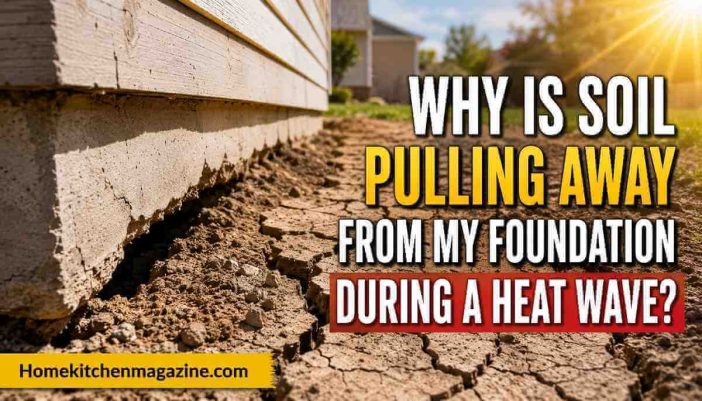
During a heat wave, soil—especially clay-rich soil—can lose moisture, contract, and leave a visible gap beside a foundation. The gap is a reason to inspect and stabilize conditions carefully, but it does not by itself prove that the foundation has failed.
The first sign is often quiet. A homeowner walks around the house after days of punishing heat and notices that the lawn no longer meets the concrete. There is a narrow dark channel where firm soil used to press against the foundation.
That opening may be only a fraction of an inch, or it may be wide enough to catch the edge of a shoe. Nearby, the yard has split into irregular cracks. Inside, every door suddenly feels suspicious.
Extreme heat and a lack of rainfall can reduce soil moisture quickly. In rapidly developing dry conditions, sometimes described as flash drought, intense heat can accelerate the loss of moisture from the upper soil profile.
The visible gap deserves attention, but the correct response is not panic, immediate excavation, or pouring a garden hose into the opening. The first task is to determine whether you are seeing seasonal soil contraction, uneven moisture around the house, or signs that the structure itself has begun to move.
Why Soil Pulls Away From a Foundation During Extreme Heat
The foundation has not necessarily moved away from the yard. In many cases, the surrounding soil has become smaller.
Soils described as expansive change volume as their moisture content changes. They swell when they absorb water and shrink as they dry. Structures built on these soils may experience shifting or cracking when that movement becomes uneven or severe.
Clay-rich soil is particularly susceptible because its fine mineral particles interact strongly with water. During an extended hot, dry period, moisture is lost through surface evaporation and plant uptake. The soil contracts, ground cracks develop, and a gap can appear along the foundation edge.
Texas A&M AgriLife Extension has documented this pattern in heavy clay soils: drought-related contraction can create both large lawn cracks and visible separations between soil and a concrete slab. The same guidance notes that repeated expansion and contraction—not simply the appearance of one gap—is what can place a foundation under stress over time.
Heat alone is rarely the entire explanation
A heat wave may reveal a moisture imbalance that was already developing. Contributing conditions can include:
- Clay-rich or expansive soil
- Weeks of low rainfall before the heat arrived
- One side of the house receiving more irrigation than another
- Large trees or dense vegetation drawing moisture from a localized area
- A leaking irrigation line keeping one section unusually wet
- Downspouts or grading that concentrate water beside one corner
- Exposed soil losing moisture faster than shaded or mulched beds
Trees, altered drainage, leaking pipes, and downspout discharge can all create localized moisture differences around expansive soil. Those differences matter because one section of a foundation may remain supported by moist, expanded soil while another section sits above soil that has contracted.
Does a Soil Gap Mean the Foundation Is Damaged?
Not automatically.
A gap can form because the soil beside the foundation has contracted without producing meaningful structural movement. Texas A&M guidance notes that seasonal expansion and contraction may occur without major foundation effects, although extended drought increases vulnerability.
The gap becomes more concerning when it appears alongside new, related changes in the structure.
Walk around the outside and then through the interior of the house. Look for changes rather than isolated imperfections that may have existed for years.
Exterior warning signs include:
- New stair-step cracks through brick mortar
- Brick veneer pulling away from windows or trim
- A chimney separating from the main structure
- Cracks with visible displacement on either side
- One section of the foundation appearing lower than another
- Fresh gaps at exterior doors, garage openings, or utility penetrations
Interior warning signs include:
- Doors or windows that recently began sticking
- Several doors becoming misaligned at the same time
- New diagonal drywall cracks near door or window corners
- Flooring that feels newly sloped or uneven
- Tile cracks extending across multiple rooms
- Baseboards or cabinets separating from walls
- Evidence of a plumbing leak after movement occurred
Difficulty operating doors and new cracks in walls, brick veneer, or tile can accompany differential foundation movement in dry clay conditions. They are not a diagnosis by themselves, but multiple symptoms appearing together justify closer evaluation.
For a broader review of structural, drainage, electrical, and moisture indicators, use this home safety inspection framework alongside the heat-wave check.
Use This Three-Level Foundation Response Framework
A visible gap is easier to manage when you classify what you are seeing instead of treating every case as an emergency.
| Response level | What you observe | Appropriate next step |
|---|---|---|
| Monitor | Soil gap only, no new structural symptoms, no active leak, and no obvious change in floor or door alignment | Photograph and measure the gap, inspect the full perimeter, verify soil type, and recheck at consistent intervals |
| Stabilize and assess | The gap is increasing, moisture differs sharply around the house, or one or two new minor interior symptoms have appeared | Correct obvious irrigation or drainage imbalances and arrange an inspection if changes continue |
| Escalate | Displaced foundation cracks, several sticking doors, brick separation, sloping floors, chimney movement, or a suspected broken pipe | Stop relying on DIY moisture adjustments and contact a licensed structural or geotechnical engineer |
This framework is not a substitute for an onsite assessment. Its purpose is to separate a soil observation from a pattern of possible structural movement.
What Homeowners Should Do First
1. Inspect the entire perimeter
Do not make a decision based on the first gap you find.
Walk around all four sides of the home and note:
- Where the gap begins and ends
- Whether it is wider on one side
- Which areas receive sun or shade
- Where irrigation reaches the soil
- Whether downspouts discharge nearby
- Whether trees are concentrated on one side
- Whether water has previously pooled in the area
Uneven conditions are often more informative than the maximum width of one opening.
2. Create a visual record
Place a ruler beside the gap and take a photograph from the same position. Record the date, recent weather, and approximate location, such as “southwest corner near dining room.”
Repeat the photograph every few days during the heat wave and again after weather conditions change. Do not rely on memory; small changes are difficult to judge without matching images.
Add the observation to your essential home maintenance checklist so the issue remains part of a repeatable inspection routine rather than a one-time reaction.
3. Check for a plumbing or irrigation leak
Dry weather does not mean every moisture difference is drought-related.
Look for:
- An unusually green patch near the foundation
- Soft soil surrounded by hard, cracked ground
- A sprinkler head that runs longer than others
- An unexplained increase in water use
- Dampness near an exterior faucet
- Water appearing where a supply or sewer line enters the building
A leak can keep one part of expansive soil swollen while the rest of the perimeter contracts. Correcting the leak may be more important than adding water elsewhere.
4. Identify the likely soil type
Do not assume every dark or hard soil is expansive clay.
The USDA Natural Resources Conservation Service provides the Web Soil Survey, which allows users to review current soil data for a selected area. Local Cooperative Extension offices can also help interpret regional soil conditions. A survey is useful for screening, but conditions on a developed lot may differ because of imported fill, grading, or construction disturbance.
A geotechnical soil test provides a more reliable property-specific answer when significant movement or an expensive repair decision is involved.
Should You Water Around the Foundation?
In some clay-soil regions, maintaining relatively consistent moisture around a slab foundation may reduce extreme shrinkage. That does not mean every foundation should be watered or that more water is always safer.
Texas A&M materials recommend slow, even moisture around the perimeter during extended dry periods and specifically warn against directing a heavy stream into the gap. A concentrated flow can travel through deep cracks, move soil particles, or produce rapid, uneven swelling.
Safer principles for moisture management
When local extension guidance or a qualified professional recommends foundation-area irrigation:
- Apply water slowly, allowing it to soak in without runoff or puddling.
- Treat the whole relevant perimeter, not only the most visible crack.
- Keep the hose near the foundation zone but not against the wall or inside the gap.
- Use low-pressure drip irrigation or a soaker hose rather than a forceful open hose.
- Check the soil between cycles instead of running water continuously.
- Stop if water begins ponding, flowing toward the house, or entering a basement or crawlspace.
- Follow all local drought and outdoor-watering restrictions.
Texas A&M publications illustrate low-flow hoses positioned roughly 6 to 18 inches from a slab edge, depending on the system and local guidance. That range should not be treated as a universal construction standard.
The EPA advises homeowners to follow state and local drought restrictions and to use efficient irrigation methods rather than allowing water to pool or run off.
Why there is no universal watering schedule
The correct frequency depends on:
- Soil mineral composition
- Depth of dry soil
- Recent rainfall
- Temperature and wind
- Shade and vegetation
- Irrigation output
- Foundation design
- Local water rules
A schedule copied from another climate may keep your soil too dry, saturate it unnecessarily, or create a new moisture imbalance. The objective is consistency, not permanently wet soil.
When Generic Foundation Watering Advice Can Be Wrong
Foundation watering is discussed most often in connection with slab-on-grade homes built on expansive clay. It should not be applied blindly to every property.
Seek local professional guidance before adding perimeter irrigation when:
- The home has a basement with a history of water intrusion
- The property sits on a slope
- Retaining walls are nearby
- Soil already drains poorly
- Water collects beside the foundation
- The home has a pier-and-beam or specialized engineered foundation
- You do not know where underground utility lines run
- Structural movement is already visible
- A geotechnical report specifies a moisture-control plan
A basement wall affected by hydrostatic pressure presents a different problem from a slab perimeter drying in clay soil. Similarly, a hillside property may require drainage and slope analysis rather than additional irrigation.
What Not to Do When the Soil Pulls Away
Do not pour water directly into the gap
This can create rapid local swelling and may carry loose soil deeper into existing cracks. Use low-flow, distributed moisture only when it is appropriate for the property.
Do not water only the visible side
Keeping the front landscaping green while allowing the rear perimeter to become extremely dry can produce uneven soil conditions. Texas A&M specifically warns that this wet-versus-dry imbalance can contribute to misalignment and cracking.
Do not assume filling the opening fixes the cause
Packing the surface gap with loose soil or covering it with caulk does not restore support below the foundation. It can also hide whether the opening is changing.
Do not remove a mature tree impulsively
Trees can contribute to localized moisture loss, but removing a large tree changes soil moisture and root conditions again. Obtain advice from an arborist and an engineer before treating tree removal as a foundation repair.
Do not hire a repair crew before establishing the diagnosis
A foundation-repair company may be qualified to install a repair, but the company also sells repair services. For significant or disputed movement, an independent licensed structural engineer or geotechnical engineer can evaluate the cause and define whether repair is necessary.
Prepare for the Rain That Follows the Heat
Drought cracks do not disappear as a risk the moment rain returns.
Deep openings can give stormwater a fast path into the soil. Expansive soil may then rehydrate unevenly, particularly where gutters, downspouts, low grading, or landscape beds concentrate water. Prolonged drought followed by soil-saturating rainfall can intensify shrink-swell hazards.
Before the next storm:
- Clear gutters and downspouts.
- Confirm that discharge moves away from the structure.
- Correct low spots where water collects beside the house.
- Repair broken irrigation components.
- Keep mulch below siding, brick weep areas, and termite inspection clearances.
- Reinspect the gap and interior symptoms after rainfall.
These checks fit naturally within broader preventive maintenance strategies that protect property value, because drainage and structural predictability matter beyond a single heat wave.
When to Call a Structural or Geotechnical Engineer
Arrange a professional evaluation when several related symptoms appear, when changes are progressing, or when the condition could affect an expensive repair or real estate decision.
Call sooner when you observe:
- A foundation crack with visible offset
- A stair-step brick crack that is growing
- Several doors or windows changing alignment
- New floor slope or separation from walls
- Chimney movement
- Recurring plumbing failures
- A gap concentrated at one corner with matching interior damage
- Previous foundation repairs followed by new movement
- Symptoms that continue after weather conditions normalize
Bring dated photographs, past inspection reports, plumbing records, and any geotechnical documents to the appointment. A clear timeline helps the professional distinguish a recent event from an older condition.
Keep those materials with your system for documenting home maintenance for insurance claims. Documentation does not guarantee insurance coverage, but it establishes what you observed, when you observed it, and how you responded.
If shifting is accompanied by a suspected broken gas line, leave the area and contact the gas utility or emergency services. Do not attempt to locate or repair a gas leak yourself.
Frequently Asked Questions
Will the soil gap close after it rains?
It may narrow as clay soil absorbs moisture and expands, but closure does not prove that the foundation remained stable. Photograph the area before and after rainfall, check for structural symptoms, and avoid allowing stormwater to collect beside the foundation.
Does watering around a foundation prevent foundation damage?
Consistent moisture may help manage shrinkage around some slab foundations built on expansive clay. It cannot correct an existing structural defect, poor drainage, leaking plumbing, unsuitable fill, or advanced differential movement. Regional extension or engineering guidance should determine whether watering is appropriate.
How wide can the gap become before it is serious?
Gap width alone is not a reliable measure of structural damage. Location, rate of change, soil type, foundation design, and related symptoms matter more. A smaller gap with growing brick cracks and sticking doors may deserve more attention than a wider, stable surface opening.
Treat the Gap as a Signal, Not a Verdict
Soil pulling away from a foundation during a heat wave is commonly associated with moisture loss and clay-soil contraction. The gap tells you that conditions around the home have changed; it does not tell you, by itself, whether the structure has been damaged.
Inspect the full perimeter, document what changes, check for leaks and drainage imbalances, and verify the soil and foundation conditions before adopting a watering routine. When structural symptoms accompany the gap, an independent professional assessment is more valuable than guesswork or a rushed repair proposal.
A calm response protects the house better than either neglect or overcorrection. That prevention-first approach is also the foundation of the broader Home Safety, Maintenance & Prevention hub.