The door rises in the morning, closes behind the car, and gives no obvious reason for concern.
Its motor sounds familiar. The remote works. The door reaches the floor.
From the driveway, that looks like a functioning garage-door system.
But smooth movement answers only one question: can the opener move the door?
It does not answer another, more important safety question:
Will the system stop or reverse when something is where the closing door expects empty space?
Modern automatic garage-door openers use entrapment-protection systems designed around that problem. Yet homeowners often test only the photo-eye sensors—or assume that because the sensor lights are glowing, the entire reversal system is working.
Those are not equivalent checks.
A useful garage door auto-reverse test separates non-contact protection from contact reversal, tests each within the boundaries of the owner’s manual, and treats a failed result as a safety problem rather than an inconvenience.
Quick Answer: What Should a Garage Door Auto-Reverse Test Include?
For many modern residential garage-door openers, two different safety responses need to be verified:
- Non-contact reversal or photo-eye response — the door should respond appropriately when the sensor beam is obstructed.
- Contact reversal — the door should reverse when it meets the specified test obstruction described by the manufacturer.
The exact procedure depends on the opener.
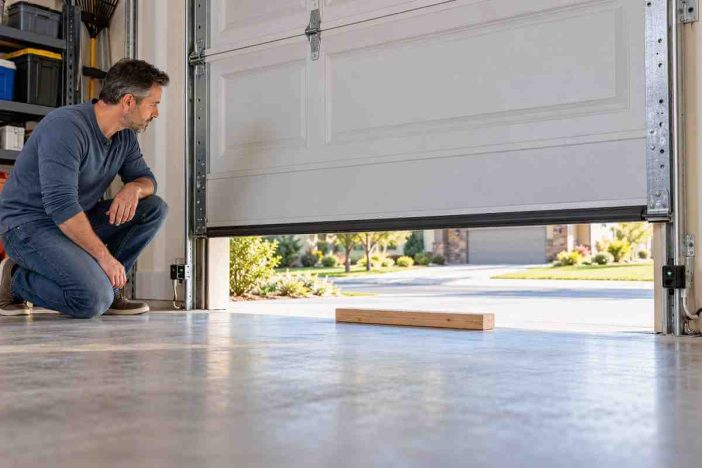
For many U.S. systems, manufacturer instructions use a 2×4 board laid flat for the contact-reversal test. Always confirm the procedure in your own opener manual before performing it.
Do not substitute a person, pet, hand, foot, bicycle, or vehicle for a test object.
And do not assume one successful test proves the other safety system works.
For the larger system-based approach, our home safety inspection guide explains why protective systems should be checked for function rather than merely assumed reliable because they are installed.
Why Two Safety Tests Matter
Automatic garage doors create an unusual household safety problem.
They combine:
- a heavy moving door;
- an electric operator;
- mechanical springs, cables, rollers, and tracks;
- electronic controls;
- protective sensors;
- programmed travel and force limits.
One component can operate normally while another does not.
For U.S. readers, automatic residential garage-door operators are covered by the federal Safety Standard for Automatic Residential Garage Door Operators, 16 CFR Part 1211.
The rule reflects a long history of entrapment concerns.
That does not mean every modern opener uses identical electronics or diagnostic lights. It means reversal protection should be treated as a real safety system rather than an optional convenience.
That distinction fits the broader principle in our guide to long-term home safety systems: protective equipment has value only when it remains functional and is tested rather than simply installed and forgotten.
Before Testing: Know What You Are Not Testing
A homeowner-level reversal test is not a full garage-door inspection.
It does not establish that:
- springs are correctly tensioned;
- cables are structurally sound;
- tracks are properly aligned;
- rollers are within wear limits;
- opener force settings are correctly programmed;
- mounting hardware is structurally secure;
- the door is correctly balanced.
Those systems interact with the opener, but several involve stored mechanical energy and should not be adjusted casually.
Do not loosen, wind, unwind, remove, reposition, or experiment with torsion springs, extension springs, cables, bottom brackets, drums, or other high-tension hardware.
If the door is visibly crooked, a spring appears broken, a cable is loose, hardware is pulling away from the structure, or movement is violent or unstable, skip the routine auto-reverse test and have the door evaluated.
The objective here is to verify safety response—not perform mechanical repair.
Test 1: Check the Photo-Eye Safety Response
The small sensors mounted near the bottom of many residential garage-door openings create the non-contact protection layer.
They are often called:
- photo eyes;
- safety eyes;
- photoelectric sensors;
- reversing sensors;
- safety beams.
Names vary by manufacturer.
Start with a visual check
Before moving the door, inspect what you can see safely.
Look for:
- an object already blocking the beam;
- dirt or cobwebs covering the lens;
- a sensor bracket that has been bumped;
- visible wire damage;
- a sensor hanging loose;
- obvious misalignment.
Do not assume LED colour has a universal meaning.
Different manufacturers use different indicator patterns, colours, and diagnostic codes. Consult the opener manual before interpreting a blinking or unlit sensor.
Perform the non-contact test
Use the specific test procedure in the owner’s manual.
A common method is to begin closing the door and interrupt the sensor beam with an appropriate object while staying completely clear of the moving door.
A properly functioning system should respond according to its manufacturer design—typically by stopping downward movement and reversing.
Another manufacturer-specified method may involve placing an object in the beam before commanding the door to close; the opener may then refuse to begin normal downward movement.
The important result is not which demonstration looks more dramatic.
The important result is whether your opener responds exactly as its manufacturer says it should when the non-contact protection system is interrupted.
What a successful photo-eye test proves
It supports one narrow conclusion:
The non-contact protection responded during that test.
It does not prove:
- the contact-reversal system is working;
- spring tension is correct;
- the door is properly balanced;
- force settings are correct;
- every mechanical component is safe.
That distinction prevents false confidence.
Test 2: Check the Contact-Reversal System
The contact test asks a different question:
What happens if the descending door physically encounters the specified test obstruction?
Many garage-door opener manufacturers instruct owners to use a 1½-inch-high object or a standard 2×4 laid flat in the centre of the door opening.
Check your owner’s manual first.
Prepare the test area
Before beginning:
- remove vehicles;
- keep children and pets away;
- clear unrelated objects from the opening;
- stand away from the door’s travel path;
- confirm that the door is not already showing abnormal mechanical behaviour.
Place only the manufacturer-specified test object in the prescribed location.
Never use your hand, foot, shoulder, or body to test reversal force.
Close the door using the normal control
Operate the opener as directed by the manufacturer.
When the door reaches the test object, observe the result.
The door should respond according to the manufacturer’s contact-reversal requirement.
For example, Genie instructs that its system should begin reversing after contacting the specified 2×4 test board.
If the door simply stops on the object, continues pressing against it, behaves unpredictably, or otherwise fails the prescribed test, do not treat the result as “close enough.”
The contact-reversal system has failed its functional check.
One Passing Test Cannot Cancel One Failed Test
This is the most important distinction in the entire guide.
Imagine this result:
Photo-eye test: PASS
Contact-reversal test: FAIL
It may be tempting to think the door is still reasonably safe because the sensors worked.
That is the wrong interpretation.
You have verified one protection layer and identified a problem with another.
Now reverse the scenario:
Photo-eye test: FAIL
Contact-reversal test: PASS
Again, the system has not earned an overall pass.
A properly functioning contact response does not repair or substitute for non-contact protection.
This gives us a more useful decision framework.
The HKM Two-Channel Garage Door Safety Matrix
This framework is designed to prevent a common homeowner mistake: collapsing two different safety functions into a single “garage door works” judgment.
| Photo-eye response | Contact reversal | Interpretation | Next step |
|---|---|---|---|
| Pass | Pass | Both tested protection layers responded during the check | Record the date and continue manufacturer-specified maintenance |
| Fail | Pass | Non-contact protection has not passed | Stop relying on automatic operation until the cause is resolved and the system passes retesting |
| Pass | Fail | Contact reversal has not passed | Do not assume working photo eyes make the opener safe; follow manufacturer guidance and arrange service if necessary |
| Fail | Fail | Neither tested protection layer passed | Keep the opener out of normal automatic service and obtain qualified inspection/service |
This is an editorial decision framework, not a replacement for the opener manual, UL requirements, local codes, or professional diagnosis.
Its purpose is simple:
one failed safety channel means the overall safety check has not passed.
What If the Garage Door Will Only Close When You Hold the Wall Button?
This symptom deserves attention because homeowners sometimes discover it while troubleshooting a sensor problem.
On some opener designs, constant pressure on the wall control can allow a specific form of closing operation when the non-contact sensor system has a fault or obstruction.
That behaviour is not permission to use the wall button as the permanent solution.
If the door suddenly refuses to close normally from the remote or keypad but moves only while the interior button is continuously held, investigate the opener’s diagnostic guidance.
Possible causes can include:
- obstructed photo eyes;
- dirty sensor lenses;
- misalignment;
- damaged or disconnected sensor wiring;
- failed sensors;
- other opener-specific faults.
Avoid replacing parts by guesswork.
A useful diagnosis begins by identifying the model, reading its LED or display code correctly, and following the manufacturer’s troubleshooting sequence.
Four False Passes That Fool Homeowners
1. “Both sensor lights are on, so the system is safe”
Indicator lights provide information.
They are not a substitute for a functional obstruction test.
A sensor can appear powered without proving that the complete system responds correctly during door movement.
2. “The remote works, so the opener is fine”
Remote communication only proves that a command reached the opener.
It does not prove either reversal system will respond properly.
3. “The door reversed when I blocked the beam, so the 2×4 test is unnecessary”
That result verifies the non-contact channel.
It does not independently verify contact reversal.
4. “It failed once but passed the second time”
Intermittent behaviour should not automatically be dismissed.
A protective system expected to operate reliably should not depend on repeated attempts to obtain a favourable result.
If the result is inconsistent, stop treating it as a routine pass and investigate why.
Do Not Adjust Closing Force by Trial and Error
A failed contact-reversal test can tempt homeowners to reach immediately for travel or force adjustments.
That is where generic internet instructions become risky.
Adjustment methods vary significantly across opener generations and manufacturers.
On some units, settings are programmed electronically. Older systems may use different controls. Incorrect adjustments can change how the door behaves.
Use the exact manual for the model.
If manufacturer instructions explicitly provide a homeowner adjustment procedure, follow those instructions and repeat every required safety test afterward.
If the required adjustment is unclear, the system continues failing, or mechanical problems are present, use a trained door-systems technician.
Manufacturer documentation from Genie specifically directs owners toward professional assistance when the opener does not pass its required reversal testing after appropriate troubleshooting.
When the Problem May Be the Door, Not the Opener
A garage-door operator is attached to a mechanical door system.
The opener cannot compensate safely for every door problem.
Stop focusing on sensor troubleshooting alone if you observe:
- a visibly broken spring;
- a loose or damaged cable;
- one side of the door lower than the other;
- jerky or binding movement;
- rollers leaving the track;
- unusual grinding or violent movement;
- damaged hinges;
- structural attachment points pulling loose.
A door that is difficult to move mechanically can affect how the opener behaves.
This is one reason a home safety inspection works best when systems are reviewed as connected components rather than isolated gadgets.
How Often Should You Run a Garage Door Auto-Reverse Test?
For systems whose manufacturer calls for monthly reversal testing, put the test on a monthly schedule rather than waiting for symptoms.
Genie publishes monthly maintenance guidance for its safety systems, and numerous opener manuals use a similar cadence.
Your own manual remains the controlling reference for your particular model.
Testing is also sensible after relevant work on:
- opener travel settings;
- force settings where applicable;
- the garage door;
- springs or hardware;
- the floor beneath the closing path;
- opener installation or repair.
That timing principle fits HKM’s broader guide to how often home safety systems should be checked: safety equipment should be reviewed before visible failure becomes the reminder.
Create a 60-Second Garage Door Safety Record
A maintenance test becomes much more useful when you can compare this month with the previous one.
Record only what matters:
| Field | Record |
|---|---|
| Date | Test date |
| Opener model | Manufacturer and model if known |
| Photo-eye test | Pass / Fail / Not tested |
| Contact-reversal test | Pass / Fail / Not tested |
| Door movement | Smooth / abnormal / not evaluated |
| Warning lights or codes | Exact observation |
| Action taken | None / cleaned / retested / service requested |
| Final status | Passed / unresolved |
Do not record a safety check as “passed” when only one test was performed.
And do not erase a failed result merely because a later test passed after adjustment. Record what changed.
That creates maintenance history rather than memory.
If you use a broader household schedule, add this check to your essential home maintenance checklist so the garage door does not become the heavy moving system everyone uses but nobody tests.
When to Stop DIY Troubleshooting
Routine observation is reasonable.
High-tension mechanical repair is not.
Stop troubleshooting and seek qualified assistance when:
- either reversal test continues to fail;
- a spring is broken;
- a cable is loose, frayed, or displaced;
- the door is crooked;
- the door binds or drops unexpectedly;
- opener mounting appears loose;
- wiring damage is beyond simple visual inspection;
- the required adjustment procedure is unclear;
- the opener is old enough that its safety configuration is uncertain;
- the system behaves inconsistently after retesting.
A professional garage-door technician can assess both the operator and the mechanical door system.
That distinction matters because replacing a sensor will not correct a broken spring, and adjusting an opener will not make damaged door hardware safe.
What About Garage Door Openers Made Before 1993?
Older automatic residential garage-door openers deserve special caution in the United States.
Federal entrapment-protection requirements changed significantly in the early 1990s, including additional requirements applying to residential automatic garage-door openers manufactured for U.S. sale from 1993.
Do not assume an older opener provides the same protective architecture as a modern unit.
If the manufacture date is unclear, inspect the opener’s identification label or documentation.
For a very old system, especially one lacking modern non-contact protection, professional evaluation and replacement may be more sensible than trying to retrofit a safety strategy around obsolete equipment.
This is a decision about the complete system—not simply whether the motor still runs.
Frequently Asked Questions
How often should I test my garage door auto-reverse?
Follow the opener manufacturer’s instructions. Major manufacturer guidance commonly calls for monthly safety-reversal testing. Retest after relevant opener adjustments or garage-door repairs as directed. A functioning door should not be assumed safe indefinitely simply because it passed the previous test.
Is the garage-door sensor test the same as the 2×4 test?
No. The sensor test evaluates the non-contact protection system, typically using photo eyes. The 2×4 test evaluates contact reversal when the door physically encounters the manufacturer-specified obstruction. A system can pass one and fail the other, so both checks matter when required by the opener instructions.
Why does my garage door close only when I hold the wall button?
On some systems, that behaviour can occur when the photo-eye protection is obstructed, misaligned, disconnected, or reporting a fault. Do not use constant-pressure closing as a permanent workaround. Check the exact opener manual and diagnostic indicators, then correct and retest the safety system.
Should I adjust the garage-door opener force myself if the test fails?
Only follow adjustments explicitly documented for your exact opener model. Force and travel controls differ between systems, and incorrect changes can affect safety behaviour. If the procedure is unclear or the opener still fails after manufacturer-authorised adjustment and retesting, use a trained door-systems technician.
A Working Door Is Not the Same as a Tested Door
The everyday test—pressing the remote and watching the door close—is not enough.
It proves motion.
A garage door auto-reverse test asks a different question: whether the protection designed to interrupt that motion still responds when something goes wrong.
Check the non-contact system.
Check the contact-reversal system.
Treat them as separate channels.
Record the result.
And if either required test fails, do not let the success of the other one create false reassurance.
That prevention-first approach is exactly why the Home Safety, Maintenance & Prevention hub treats inspections, maintenance schedules, and safety devices as one connected system.
The safest garage door is not the one that opens fastest or closes most quietly.
It is the one whose protective systems are still being verified after years of ordinary use.
Sources and Verification
This article was developed against authoritative and manufacturer guidance including:
- U.S. Consumer Product Safety Commission — Safety Standard for Automatic Residential Garage Door Operators, 16 CFR Part 1211.
- The Genie Company — Garage Door Opener Safety and safety reversing system testing guidance.
- Manufacturer owner manuals should remain the primary procedural reference for a specific opener model.
This article supports routine homeowner observation and functional safety checking. It does not replace manufacturer instructions, applicable codes, or professional diagnosis of springs, cables, structural hardware, opener electronics, or other high-risk components.