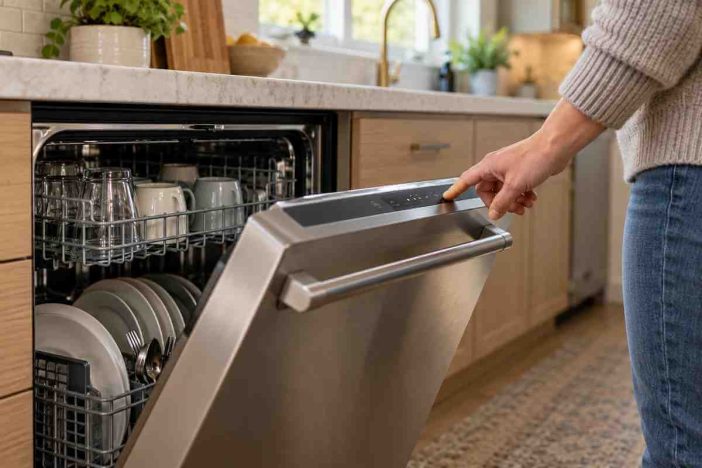
The dishwasher has been running for nearly four hours. A small light is still glowing on the control panel, and the plates from dinner are somewhere inside, being washed by a machine that claims to be saving energy.
Beside the long Eco cycle sits another option: Quick Wash. It promises clean dishes in a fraction of the time.
That shorter program feels like the obvious money-saver. Less running time should mean less electricity, shouldn’t it?
Not necessarily.
A dishwasher’s energy use depends less on how long its display counts down and more on how much water it heats, which temperatures it reaches, how it dries the dishes, and what the selected program is designed to accomplish.
There is another complication: a dedicated Quick Wash cycle and a Speed Boost button are not the same thing.
Understanding that distinction makes the choice between Eco, Quick, and Normal considerably more useful than simply selecting the shortest available program.
Dishwasher Eco vs Quick Wash: The Practical Answer
For a typical load of normally soiled dishes, Eco mode is often the more energy-efficient choice, even though it runs longer.
Eco programs commonly reduce energy demand by using lower water temperatures and extending the cleaning process. Quick Wash prioritizes time, and certain rapid programs use hotter water or additional resources to finish sooner.
However, this is not a universal rule for every model or every load.
A dedicated low-temperature Quick Wash can consume relatively little electricity when cleaning lightly soiled dishes, especially if it omits a substantial drying stage. Meanwhile, activating a Speed Boost option on an otherwise efficient cycle may increase electricity or water use to reduce the duration.
Use this starting rule:
- Eco: Normally soiled dishes when you can wait for the cycle to finish.
- Quick Wash: Lightly soiled dishes when the manufacturer recommends that program for the load.
- Normal or Auto: Everyday loads with varying soil levels, particularly when the dishwasher has effective soil-sensing controls.
- Heavy or Intensive: Stubborn, baked-on food when an ordinary cycle is insufficient and the cookware is dishwasher-safe.
Your dishwasher’s model-specific manual should determine the final choice.
Why a Four-Hour Eco Cycle Can Use Less Electricity
The longest cycle is not necessarily the one that draws the most energy.
Dishwashers consume electricity through several activities, including operating pumps and electronics, heating wash and rinse water, and, on some machines, heating air or surfaces during drying.
These activities have different power demands.
Water heating is often a substantial component of dishwasher electricity consumption. Running a pump for longer at modest power may require less energy than heating water to a higher temperature in a shorter period.
Lower-temperature washing changes the calculation
Eco programs typically spread cleaning across a longer period with lower wash temperatures and carefully managed water use.
The additional time allows soaking, detergent chemistry, spray action, and repeated circulation to help remove ordinary food residue.
Bosch’s explanation of dishwasher Eco mode identifies lower water-heating requirements as an important reason its Eco programs can consume less energy despite longer operation.
The result is a useful distinction:
Cycle duration measures elapsed time. Electricity consumption measures energy. They are not interchangeable.
A dishwasher taking four hours to finish is not necessarily drawing its maximum rated wattage for four continuous hours.
Why Quick Wash may consume more
Some fast cycles compensate for less cleaning time through different wash temperatures, spray patterns, water changes, or heating strategies.
Whirlpool’s guide to dishwasher cycles describes its Quick Wash options as prioritizing faster cleaning and potentially using more water, energy, and heat.
But the exact comparison still depends on the machine.
A 30-minute light-soil program without heated drying is not equivalent to an accelerated full wash intended for a heavily soiled dinner load.
This distinction is where many simple Eco-versus-Quick comparisons become misleading.
Quick Wash and Speed Boost Are Different Settings
A dishwasher may offer one or both of the following.
A dedicated Quick Wash program
This is a separate cleaning program designed around a shorter cycle.
Depending on the model, it may be intended for lightly soiled plates, glasses, or recently used dishes.
It may use a different temperature, fewer wash stages, or reduced drying.
Some dedicated low-temperature quick programs can use less energy than Eco for suitable light-soil loads. That does not mean they provide equivalent cleaning or drying for every type of dish.
A Speed Boost or Express option
This option modifies another program to finish more quickly.
For example, a dishwasher might offer Normal Wash, then allow the user to activate an additional speed setting.
The machine may respond by changing its temperature, water use, or other operating conditions.
A study published in the journal Energy Efficiency examined dishwasher program selection and found that speeding up an existing program could carry a meaningful energy and water penalty. The researchers distinguished this from selecting an appropriate low-temperature quick program for lightly soiled dishes.
Read the peer-reviewed research on dishwasher program selection for the underlying methods and findings.
The critical question is whether you’re choosing a shorter program designed for a different cleaning task or asking the same cleaning program to work faster.
Those decisions should not be treated as identical.
Eco, Quick, Normal, and Speed Boost Compared
The following table describes typical operating goals, not guaranteed consumption figures.
| Program | Primary purpose | Energy implication | Most suitable use |
|---|---|---|---|
| Eco | Reduce resource use for normal soil | Often lower energy and water use | Everyday loads when time is flexible |
| Quick Wash | Finish a lighter cleaning task rapidly | Highly model-dependent | Lightly soiled dishes needed sooner |
| Normal / Auto | Balance cleaning and everyday convenience | Depends on soil sensors and settings | Mixed everyday dishes |
| Speed Boost / Express option | Shorten an existing program | May raise energy or water use | When finishing sooner is worth the trade-off |
| Heavy / Intensive | Remove difficult, baked-on residue | Often more resource-intensive | Heavily soiled dishwasher-safe cookware |
The best program is not necessarily the one with the lowest electricity consumption in isolation.
A cycle that leaves food residue behind and requires a second wash may be less efficient for that particular load than a somewhat more intensive cycle that finishes the job properly.
Cleaning performance therefore belongs in the decision, alongside energy, water, and time.
How to Find Which Dishwasher Cycle Actually Uses Less Energy
Generic online comparisons are useful for understanding the technology, but they cannot tell you the exact cost of operating your particular dishwasher.
For that, begin with the manufacturer’s documentation.
Step 1: Identify the exact model
Look for the model-number label in a manufacturer-designated accessible location, often around the inner door edge or door frame.
Record the full model number, including suffixes where applicable.
Two dishwashers from the same brand or product family may have different programs.
Step 2: Find the program consumption table
Search the official manual for headings such as:
- Program Consumption
- Cycle Information
- Energy and Water Consumption
- Wash Programs
- Technical Specifications
Some manufacturers publish approximate kWh, water consumption, and duration for individual programs.
Others provide only general program descriptions or annual efficiency figures.
If detailed figures are unavailable, do not invent them from cycle duration.
Step 3: Check what the figures actually represent
A published energy figure might assume a particular inlet-water temperature, selected drying option, test load, or laboratory procedure.
Likewise, a stated water-consumption range may depend on how a soil sensor evaluates the load.
The manufacturer’s notes and test conditions are part of the number.
Do not compare a European-market Eco program tested under one method directly with a U.S.-market model’s annual EnergyGuide estimate as though the figures describe identical conditions.
Step 4: Compare the same cleaning task
If you want to identify the most efficient program for everyday dishes, compare programs capable of cleaning the same type and amount of soil satisfactorily.
A light-duty express program may report lower energy use because it performs a less demanding cleaning task.
That does not establish that it can replace Eco or Normal for a full load of normally soiled dishes.
What the ENERGY STAR Label Does—and Doesn’t—Tell You
ENERGY STAR certification helps U.S. shoppers compare overall appliance efficiency.
Under the ENERGY STAR dishwasher criteria effective July 19, 2023, qualifying standard-size residential dishwashers are limited to 240 kWh of estimated annual energy use and 3.2 gallons per cycle under the program’s specified test conditions.
These are certification criteria, not a claim that every Eco or Quick cycle consumes the same amount.
The program’s annual energy calculation uses a standardized test methodology and assumed use pattern. It is not a complete table of the electricity consumption of every program on every machine.
For further detail, see ENERGY STAR’s dishwasher efficiency criteria.
Don’t divide annual kWh and call it the Eco-cycle number
You may be tempted to divide the annual energy figure by the assumed number of cycles per year.
That can give a rough standardized average under the test assumptions, but it does not reveal actual Eco, Quick, or Heavy cycle consumption.
Standby energy, test conditions, and cycle-selection assumptions complicate the interpretation.
If you’re considering replacing the entire appliance, our guide to choosing energy-efficient kitchen appliances explains how to compare annual consumption, capacity, purchase price, and total ownership cost.
For a dishwasher you already own, the more useful first step is choosing an appropriate wash program—not purchasing another machine merely because it advertises a more efficient cycle.
Calculate the Real Electricity Cost of Each Cycle
Once you have credible model-specific energy figures, comparing costs is straightforward.
Electricity cost per cycle = kWh per cycle × electricity price per kWh.
Consider this hypothetical example:
| Item | Eco | Accelerated wash |
|---|---|---|
| Electricity use | 0.80 kWh | 1.05 kWh |
| Illustrative electricity rate | $0.18/kWh | $0.18/kWh |
| Electricity cost | $0.144 | $0.189 |
The difference is approximately 4.5 cents per cycle.
If a household used that cycle four times a week for 52 weeks, the illustrative annual electricity difference would be:
$0.045 × 4 × 52 = $9.36.
These numbers are hypothetical, not test results for a particular dishwasher.
They demonstrate something frequently missing from appliance-efficiency advice: even a meaningful percentage change in per-cycle energy can amount to a relatively modest annual dollar difference for one household.
The result depends on the appliance, frequency of use, and utility rate.
What about water and sewer charges?
Dishwasher operating costs can also include water and wastewater charges.
Where charges are based on usage, estimate the additional variable cost using the volume of water consumed and the applicable rates.
Avoid adding fixed utility service fees to each cycle as though running the dishwasher creates those fees.
Also consider whether hot-water supply affects the appliance’s actual energy use. Water-heating costs and test assumptions differ by model and installation; do not blindly add a second water-heating estimate to an energy figure that already accounts for the relevant heating energy.
Time-of-use pricing changes dollars, not physical energy consumption
Some U.S. utilities charge different electricity rates at different hours.
On these plans, running the same cycle during a lower-priced period may reduce cost without reducing the number of kWh consumed.
A shorter, higher-energy program can sometimes have a lower electricity charge than an efficient program run during an expensive peak period, depending on the actual prices and quantities involved.
That is a billing comparison, not evidence that the shorter program is more energy efficient.
Check your utility tariff and any restrictions on delayed operation rather than assuming nighttime electricity is always cheaper.
For other practical operating habits, see our guide to saving electricity in the kitchen.
When Eco Mode Is the Better Everyday Choice
Eco is generally a sensible starting point when dishes are normally soiled, the machine is appropriately loaded, and there is no urgency.
Consider an ordinary family dinner: plates with sauce residue, drinking glasses, utensils, and dishwasher-safe bowls.
The dishes need a thorough everyday wash, but there is no reason they must be ready in the next 45 minutes.
If the manufacturer recommends Eco for that load, using a compatible Eco program is usually reasonable.
You may notice:
- a longer displayed cycle time;
- a different drying result than Normal;
- changes in how the machine pauses or operates;
- a lower published energy or water figure; or
- program-specific detergent recommendations.
None of these characteristics alone indicates malfunction.
The important test is whether the selected cycle delivers acceptable cleaning while staying within the manufacturer’s operating guidance.
When Eco mode is not the right answer
Some loads require more intensive treatment.
Examples include heavily baked-on cookware, unusual residue, and dishes for which the manufacturer specifies a different program.
Do not claim that an Eco program provides a sanitizing function merely because it runs for several hours.
Where sanitization is required, consult the appliance’s certified sanitizing feature and manufacturer instructions. Avoid substituting a general Eco program for a specified hygiene or care procedure.
When Quick Wash Makes More Sense
Quick Wash can be reasonable when you need lightly soiled dishes sooner.
A few recently used glasses, lightly soiled plates, and suitable utensils present a different cleaning task from pans covered in cooked-on oil.
The first load may be adequately handled by a short program designed for light soil.
The second may need a longer or more intensive cycle.
Check whether the Quick program:
- is intended for light or normal soil;
- has a drying phase;
- allows the desired detergent;
- supports the load size;
- excludes any particular dishware; and
- requires another option for more intensive cleaning.
A low-energy Quick program should not be praised as efficient if it regularly causes rewashing.
Similarly, a longer Eco cycle is not automatically the responsible choice when the manufacturer specifically recommends a simpler program for a light load.
Choose the least resource-intensive program that reliably completes the actual cleaning task.
The Three-Load Decision Rule
Rather than using one favorite button for everything, sort the load into one of three practical scenarios.
Scenario A: Normal dinner dishes
The load contains ordinary plates, bowls, cups, and utensils with routine food residue.
First choice: Eco when recommended by the manufacturer and time permits. Normal or Auto is an alternative when it better matches the load or provides more reliable cleaning.
Scenario B: Lightly soiled dishes needed soon
The load contains recently used glasses and lightly soiled dishes, without stubborn residue.
First choice: A dedicated low-temperature Quick or Light program if the manual indicates that it suits the load.
Avoid assuming a Speed Boost modifier provides the same resource savings.
Scenario C: Baked-on or difficult residue
The load contains dishwasher-safe cookware with dried, cooked-on material.
First choice: Follow the model’s guidance for Normal, Auto, or Heavy/Intensive.
Do not use Quick solely to achieve the lowest displayed time, especially if inadequate cleaning will require another run.
This framework does not require buying an accessory or replacing the dishwasher. It begins with matching the program to the job.
The Five-Run Cycle Comparison Record
If your dishwasher provides trustworthy per-cycle consumption data, you can build a simple household record.
Use five ordinary dishwasher loads as an observational log, rather than treating one unusual cycle as representative.
| Run | Program | Load / soil level | Heated dry? | kWh if available | Cleaned satisfactorily? |
|---|---|---|---|---|---|
| 1 | |||||
| 2 | |||||
| 3 | |||||
| 4 | |||||
| 5 |
Include the cycle’s reported water use if that information is available.
Try to record the type of load consistently.
Do not deliberately run extra cycles merely to collect data if doing so would waste water and energy. Use normal household washing opportunities.
What this record can establish
The record can help reveal which settings work for your typical dishes and whether the machine reports meaningful consumption differences.
It cannot provide a controlled laboratory comparison unless the relevant test variables are actually controlled.
Different amounts of food residue, varying inlet-water temperatures, drying settings, and soil-sensing behavior can influence the results.
Also, appliance-app energy figures are not necessarily independently calibrated measurements.
Be cautious with electricity monitors
Many dishwashers are hardwired or use electrical configurations that make an ordinary plug-in energy monitor unsuitable.
Do not disconnect a hardwired dishwasher, use an incompatible smart plug, overload an adapter, or modify the electrical supply to test consumption.
If direct electrical measurement is necessary, consult a qualified electrician about a compatible method.
For broader appliance-usage decisions that do not require electrical modifications, our kitchen power-consumption guide explains how to prioritize operational changes before spending on equipment.
Three Habits That Can Matter More Than the Program Button
Scrape food instead of pre-rinsing under a running tap
Modern dishwasher manufacturers generally design everyday wash programs to handle scraped dishes without extensive manual pre-rinsing.
ENERGY STAR recommends scraping dishes rather than pre-rinsing them because unnecessary pre-rinsing increases water use.
Follow your dishwasher’s loading and soil-removal instructions, and clear large scraps that could obstruct the filter.
Run appropriately loaded cycles
A half-empty dishwasher may still use a substantial portion of the resources required for a fuller load.
However, overcrowding can prevent spray water from reaching dish surfaces.
The objective is not to pack the machine until nothing can move. It is to use the designed rack capacity without obstructing spray arms, detergent release, or water circulation.
Treat drying as a separate choice
Heated drying may increase electricity consumption, depending on the machine.
If the model offers air drying or an option to disable additional heated drying, consider that setting when appropriate.
Do not assume a Quick cycle and an Eco cycle include equivalent drying functions. A lower energy figure for a program that omits drying describes a different service level from a program that washes and fully dries dishes.
A Final Check Before Buying a New Dishwasher
A dishwasher’s cycle name is not enough to justify replacing a working appliance.
First determine whether normal use is inefficient because of inappropriate program selection, excessive pre-rinsing, habitual partial loads, or unnecessary heated drying.
Then consider the appliance’s age, reliability, cleaning performance, repair history, and model-specific consumption.
A replacement may make sense when equipment is failing or its overall ownership cost supports the purchase.
But saving a few cents per cycle will not necessarily recover a substantial replacement cost quickly.
An efficiency decision should be made with annual consumption and real household needs in view, rather than from a single marketing claim about Eco mode.
Common Questions About Dishwasher Eco and Quick Cycles
Does a four-hour Eco dishwasher cycle use more electricity?
Not necessarily. Eco programs often reduce water-heating demand by operating at lower temperatures over a longer period. The pump and electronics do not draw maximum power continuously throughout the cycle. The actual energy comparison depends on your dishwasher model, wash settings, load, and drying options.
Is Quick Wash cheaper if I only wash a few dishes?
It can be, particularly when a dedicated light-soil program is designed to use little water or energy. But some rapid cycles use additional heat or water, and partial loads are not inherently efficient. Compare model-specific data and cleaning results rather than judging by the timer.
Can I use Eco mode every day?
Usually, when your manufacturer recommends it for the types of dishes and soil levels you normally wash. Follow the appliance’s guidance for machine cleaning, difficult residues, and any specialized sanitizing needs. Eco should not replace programs required for a different cleaning or maintenance purpose.
Choose the Program, Not Just the Shortest Time
The dishwasher eco vs quick wash decision comes down to what the dishes need and how the machine achieves its result.
Eco is often an efficient default for normally soiled everyday loads. A dedicated low-temperature Quick Wash may be suitable for lightly soiled dishes. A Speed Boost option can have a different energy cost because it accelerates an existing program rather than selecting a lighter cleaning task.
Compare model-specific information, consider water and drying, and pay attention to whether the dishes are actually clean.
An efficient kitchen does not require treating one setting as universally superior. It requires choosing the right amount of work—and the right resources—for the job.
Explore our Sustainable & Efficient Living hub for further guidance on measurable household efficiency and practical ways to reduce avoidable resource use.