Small houses rarely feel cramped because they are small. They feel cramped because shoes pile up near the door, kitchen counters become storage zones, beds swallow half the bedroom, and furniture is chosen before the room’s movement pattern is understood. Learning how to maximize space in a small house starts with one simple shift: every item, wall, corner, and surface must earn its place.
Learning how to maximize space in a small house starts with one important shift: stop thinking only about decoration and start thinking about daily function. A compact home can feel open, stylish, and comfortable when storage is planned vertically, furniture fits the room’s scale, natural light is protected, and unused areas are turned into practical zones.
The goal is not to make a small house look like a large one. The goal is to make every square foot work harder without making the home feel crowded.
Quick Answer: How To Maximize Space In A Small House
The best way to maximize space in a small house is to reduce visual clutter, use vertical storage, choose multifunctional furniture, keep walkways clear, use light colors, and turn unused spaces such as corners, walls, stairs, and under-bed areas into practical storage or work zones.
Why Small Houses Feel Smaller Than They Really Are
Before buying new shelves, storage boxes, or furniture, it helps to understand why a small house feels crowded in the first place. In many cases, the problem is not the size of the home but the way space is used.
A small house usually feels tighter when:
- The floor is filled with too many loose items.
- Furniture is too large for the room.
- Natural light is blocked by curtains, cabinets, or bulky décor.
- Storage is spread randomly instead of being planned by zone.
- Every surface becomes a temporary storage area.
- Rooms have no clear purpose.
- Entryways, kitchens, and bedrooms collect daily clutter.
Once these problems are fixed, even a compact home can feel more comfortable and visually open.
20 Smart Ideas on How To Maximize Space In A Small House
1. Start With a Room-by-Room Space Audit
Before changing anything, walk through your home and look at each room honestly. Ask yourself: What items do I use every day? What items are rarely touched? Which corners are wasted? Which furniture blocks movement?
This simple audit helps you avoid buying storage products that only add more clutter. The first step in learning how to maximize space in a small house is knowing exactly where space is being wasted.
Focus on three things in every room:
- Items that can be removed.
- Items that need better storage.
- Areas that can serve more than one function.
Sometimes, removing one oversized item creates more improvement than adding five new organizers.
2. Keep Main Walkways Clear
A small house feels uncomfortable when people cannot move easily from one area to another. Clear walkways make the home feel larger because the eye can travel through the room without interruption.
Avoid placing chairs, baskets, side tables, or shoe racks in narrow paths. In living rooms, leave enough space between the sofa and coffee table. In bedrooms, make sure you can walk comfortably around the bed. In kitchens, keep the cooking path free from unnecessary furniture.
Good space planning is not only about storage. It is also about movement.
3. Use Vertical Storage to Your Advantage
When floor space is limited, walls become valuable storage zones. Tall shelves, ceiling-high cabinets, wall hooks, and over-the-door organizers can hold many items without consuming precious floor area.
Vertical storage works well in:
- Kitchens
- Bathrooms
- Bedrooms
- Laundry areas
- Entryways
- Hallways
- Children’s rooms
Use upper shelves for items you do not need every day, such as seasonal décor, extra bedding, luggage, or rarely used kitchen tools. Keep daily essentials at eye level or within easy reach.
This is one of the most effective methods for how to maximize space in a small house because it uses areas that are often ignored.
4. Choose Multifunctional Furniture
Multifunctional furniture is a game-changer in small homes. Instead of filling the room with separate pieces, choose furniture that can do more than one job.
Good examples include:
- Sofa beds
- Ottomans with storage
- Coffee tables with drawers
- Beds with built-in storage
- Foldable dining tables
- Benches with hidden compartments
- Nesting tables
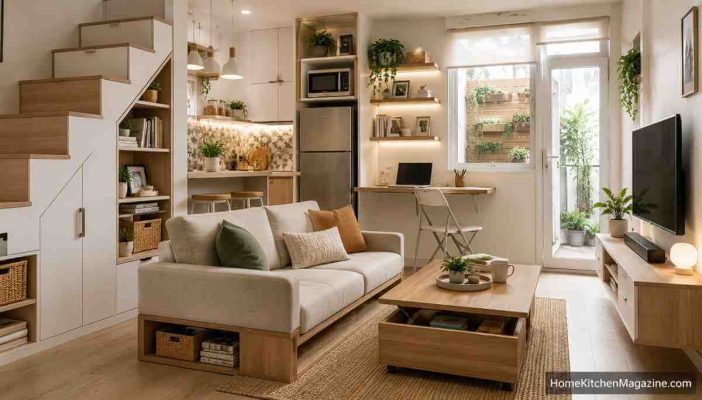
- Wall-mounted desks
The key is to choose furniture based on your daily routine. If you often host guests, a sofa bed may be useful. If your bedroom lacks a wardrobe, a storage bed can solve a real problem. If your dining area is limited, a foldable table can make the room more flexible.
5. Create a Multifunctional Kitchen Bar
A kitchen bar can work as a dining table, food preparation area, work desk, and room divider. In an open-plan small house, it can separate the kitchen from the living area without building a wall.
Choose slim stools that slide under the counter when not in use. This keeps the floor clear and prevents the kitchen from feeling crowded.
A kitchen bar is especially useful for small homes that do not have a separate dining room. It gives the space a clear function while keeping the design compact and stylish.
6. Install Floating Shelves in Strategic Areas
Floating shelves are useful because they provide storage without the visual heaviness of bulky cabinets. They make a room feel more open while still giving you space for books, plants, kitchen items, or decorative objects.
Good places for floating shelves include:
- Above the toilet
- Beside the bed
- Above a work desk
- Around door frames
- In narrow hallways
- Above kitchen counters
- In unused corners
However, avoid overloading floating shelves. Too many items on open shelves can create visual clutter. Use baskets, matching containers, and simple arrangements to keep the look clean.
7. Use Light Colors and Layered Lighting
Light colors help a small house feel brighter and more open. White, soft beige, pale gray, cream, and warm neutral tones reflect light better than dark colors.
But paint alone is not enough. Lighting also matters. A small house needs layered lighting:
- Ambient lighting for general brightness.
- Task lighting for work areas.
- Accent lighting for corners, shelves, or wall features.
Dark corners can make a room feel smaller. Add wall lamps, under-cabinet lights, or floor lamps where natural light does not reach.
If you want to understand how to maximize space in a small house without renovation, improving light is one of the simplest upgrades.
8. Add Mirrors to Reflect Light and Depth
Mirrors can visually expand a small room by reflecting light and creating a sense of depth. A large mirror opposite a window can make the room feel brighter and more open.
Use mirrors in:
- Entryways
- Living rooms
- Bedrooms
- Dining corners
- Narrow hallways
For best results, choose a mirror size that fits the wall properly. A tiny mirror on a large wall may look awkward, while an oversized mirror in a narrow space may feel overwhelming.
9. Design a Small Office in an Unused Corner
You do not need a separate room to work from home. A quiet corner in the bedroom, living room, hallway, or under the staircase can become a compact workstation.
Use a wall-mounted desk, floating shelf, or narrow writing table. Pair it with a foldable chair or slim chair that can be tucked away easily.
Even a small office beside the bed or near a window can become functional if it has good lighting, a clear surface, and simple wall storage.
To avoid clutter, keep only essential items on the desk. Store documents, chargers, and stationery in a drawer, wall pocket, or small storage box.
10. Use Staircases for Hidden Storage
If your small house has stairs, do not waste the space underneath. Staircases can become one of the most valuable storage areas in the home.
You can use the space under the stairs for:
- Drawers
- Bookshelves
- Shoe storage
- A small pantry
- Cleaning supplies
- A coat rack area
- A reading nook
- A compact work desk
Your staircase can be more than just a path between floors. With smart planning, it can become a practical storage zone and a design feature at the same time.
Discover creative stair designs for small houses that maximize function and style.
11. Mount the TV and Media Console on the Wall
A bulky entertainment unit can make a small living room feel crowded. Mounting the TV on the wall frees up floor space and creates a cleaner look.
Instead of using a large cabinet, choose a floating media console or a narrow shelf below the TV. Keep cables hidden with cord covers or wall channels.
This simple change makes the living room feel more modern and spacious. It also reduces the number of furniture pieces touching the floor, which helps the room look lighter.
12. Choose Round Tables Over Square Ones
Round tables are often better for small homes because they are easier to move around. They have no sharp corners, which makes traffic flow smoother in tight dining areas or compact kitchens.
A round dining table can also make conversations feel more natural and flexible. For very small spaces, choose a pedestal base instead of four legs. This gives more legroom and allows chairs to tuck in more easily.
Round side tables and coffee tables can also soften the look of a small room.
13. Maximize Under-the-Bed Storage
Beds take up a large amount of floor space, so the area underneath should not be wasted. Use under-bed drawers, rolling bins, vacuum bags, or built-in storage to keep items organized.
Under-bed storage works well for:
- Seasonal clothes
- Extra blankets
- Shoes
- Bedsheets
- Towels
- Bags
- Children’s toys
Choose containers that are easy to pull out. Label them if needed, especially if you store many different items.
Want to make the most of your bedroom too? Check out these easy tips to maximize space in the bedroom so your sleeping area stays calm, organized, and clutter-free.
Want to make the most of your bedroom too? Check out these easy tips to maximize space in the bedroom that will help you stay organized without cluttering your sleeping area.
14. Use Floor-to-Ceiling Curtains
Curtains can change how tall a room feels. Hang curtains close to the ceiling and let them fall to the floor. This draws the eye upward and creates the illusion of height.
Choose lightweight fabrics if the room is small. Heavy curtains can block light and make the space feel darker.
This idea works especially well in bedrooms and living rooms with small windows. Even if the window itself is not large, tall curtains can make the wall look more elegant and spacious.
15. Use Transparent or Glass Partitions
If you want to divide rooms without making them feel closed off, use glass partitions, open shelving, or see-through curtains. These options help define zones while allowing light to move through the space.
Transparent partitions are useful for:
- Separating a bedroom from a living area in a studio
- Dividing a kitchen and dining space
- Creating a small home office corner
- Separating a reading nook
- Making a compact bathroom feel more open
Solid walls can make a small house feel boxed in. Transparent dividers give structure without sacrificing openness.
16. Install Sliding Doors
Traditional swinging doors require clearance space. Sliding doors are more efficient because they move sideways instead of opening into the room.
Use sliding doors for:
- Bathrooms
- Closets
- Pantries
- Laundry areas
- Bedrooms
- Storage rooms
Pocket doors are even better if your layout allows them because they disappear into the wall. Barn-style sliding doors can also work, but make sure they do not block switches, shelves, or wall storage.
Sliding doors are a practical upgrade when thinking about how to maximize space in a small house because they reduce wasted movement space.
17. Revamp Your Entryway With Hooks and Storage
The entryway is one of the easiest places for clutter to build up. Shoes, bags, umbrellas, keys, jackets, and packages often collect near the door.
Create a simple drop zone with:
- Wall hooks
- A narrow shoe rack
- A small bench with storage
- A tray for keys
- A wall-mounted mail organizer
- A small plant for warmth
A tidy entryway makes the whole house feel more organized. It also prevents clutter from spreading into the living room or kitchen.
18. Use Open Shelving Carefully in the Kitchen
Open shelving can make a small kitchen feel lighter than closed cabinets. It works best for items you use often, such as plates, bowls, glasses, spices, or mugs.
However, open shelves need discipline. If they are crowded with mismatched containers and random items, they can make the kitchen look messy.
Use open shelving for daily essentials and keep less attractive items inside cabinets or baskets.
Looking for more kitchen inspiration? Explore our small kitchen ideas for modern homes to find clever layouts, smart storage, and minimalist design tips.
Looking for more kitchen inspiration? Explore our small kitchen ideas for modern homes to find clever layouts, smart storage, and minimalist style tips.
19. Add Greenery With Vertical Gardens
Plants make a small house feel fresh and alive, but large pots can take up too much space. Vertical gardens solve this problem by using walls, railings, shelves, and hanging planters.
Try:
- Wall-mounted planters
- Hanging pots
- Herb gardens in the kitchen
- Balcony plant racks
- Small indoor plant shelves
- Vertical garden panels
This is especially useful for small homes with limited outdoor areas. You can bring nature indoors without sacrificing floor space.
20. Extend Living Space to the Patio or Balcony
Even a tiny balcony, patio, or porch can become an extension of your home. Add a foldable chair, compact bistro table, vertical plant rack, or outdoor storage bench.
A small outdoor space can serve as:
- A morning coffee area
- A reading corner
- A mini garden
- A drying area
- A relaxing evening spot
When indoor space is limited, outdoor areas become valuable. Keep the design simple and avoid oversized furniture.
Practical Space-Saving Solutions by Problem
| Small House Problem | Best Solution | Why It Works |
|---|---|---|
| Too much floor clutter | Use vertical storage | Frees up walking space |
| No dining room | Add a kitchen bar | Combines dining and food prep |
| Small bedroom | Use under-bed storage | Uses hidden space efficiently |
| Dark room | Add light colors and layered lighting | Makes the room feel more open |
| No home office | Use a wall-mounted desk | Creates function without taking much floor space |
| Narrow entryway | Add hooks and slim shoe storage | Stops clutter near the door |
| Bulky living room | Mount the TV and use floating furniture | Reduces visual weight |
| Limited outdoor area | Use vertical gardens and foldable seating | Extends usable living space |
Common Mistakes That Make a Small House Feel Even Smaller
Knowing how to maximize space in a small house also means knowing what to avoid. Some design choices may look attractive online but create problems in real homes.
Buying Furniture Before Measuring
Never buy furniture based only on appearance. Measure the room, doorways, walking paths, and furniture depth first. A beautiful sofa can become a daily problem if it blocks movement.
Using Too Many Small Storage Boxes
Storage boxes can help, but too many small containers can create visual chaos. Use fewer, better-labeled containers that fit shelves or cabinets properly.
Blocking Natural Light
Avoid placing tall cabinets, thick curtains, or large furniture in front of windows. Natural light is one of the most powerful tools for making a small house feel larger.
Filling Every Wall With Shelves
Vertical storage is helpful, but not every wall needs shelves. Leave some blank space so the room can breathe visually.
Choosing Oversized Décor
Large décor pieces can dominate a small room. Choose a few meaningful items instead of filling every surface.
Ignoring the Entryway
A messy entryway can make the whole home feel disorganized. Since it is the first area you see, it should be functional and simple.
How To Decide Which Space-Saving Idea to Try First
If your home feels crowded, do not try to change everything at once. Start with the area that creates the most daily frustration.
Use this order:
- Fix the entryway if clutter starts at the door.
- Fix the kitchen if counters are always full.
- Fix the bedroom if storage is the main problem.
- Fix the living room if furniture blocks movement.
- Fix lighting if the home feels dark or heavy.
- Fix outdoor areas if you need extra breathing space.
This approach helps you make progress without feeling overwhelmed.
Frequently Asked Questions
What is the best way to maximize space in a small house?
The best way to maximize space in a small house is to combine vertical storage, multifunctional furniture, clear walkways, light colors, and smart room zoning. Start by removing unnecessary items, then use walls, corners, stairs, and under-bed areas for practical storage.
How can I make a small room look bigger?
Use light wall colors, add mirrors, hang curtains close to the ceiling, keep furniture proportional, reduce visual clutter, and let natural light enter the room. A small room looks bigger when the floor is clear and the eye can move easily through the space.
Can a small house have a home office?
Yes, a small house can have a home office. You can use a corner of the bedroom, living room, hallway, or area under the stairs. A wall-mounted desk, slim chair, task lamp, and floating shelf are usually enough for a compact but functional workspace.
What Furniture Is Best for a Small House?
The best furniture for a small house is multifunctional, lightweight, and properly scaled. Choose storage beds, foldable tables, nesting tables, wall-mounted desks, slim chairs, and ottomans with hidden storage.
How Do I Reduce Clutter in a Small House?
Reduce clutter by giving every item a fixed home. Use closed storage for items that look messy, vertical storage for daily essentials, and hidden storage for seasonal items. Avoid keeping things on countertops, floors, and chairs.
Final Thoughts
A small house does not have to feel limited. With the right layout, smart storage, multifunctional furniture, and better lighting, even a compact home can feel calm, stylish, and practical.
The most important lesson in how to maximize space in a small house is this: every item must earn its place. When each corner has a purpose, each surface stays clear, and each room supports daily life, a small house can become more comfortable than a larger home filled with wasted space.
Start with one room, solve the biggest problem first, and build from there. Small changes can make a big difference when they are planned with intention.